#70 Avoiding Burnout: Balancing Work, Family and Faith
Introduction: Understanding Burnout Biblically
Let me introduce you to Sally, John, and Annie.
Sally is a top-tier doctor who thrives on work. Leading a team of junior doctors, she’s spent two decades climbing the ladder and shows no signs of slowing. But work never really stops. Texts about patients ping her during family time, and she finds herself thinking about tomorrow’s schedule while playing with her kids. Bedtime is just a warm-up for planning the first two hours of her day. Burnout? Sally scoffs. “Rest? Ha! I can rest when I’m dead!” Meanwhile, her husband Greg notices the toll: snapping at their kids, defensiveness about vacations or weekend plans, and frequent Sunday morning absences from church. These are early burnout symptoms that often go unnoticed because overachievement and overwork are socially rewarded.
John runs a busy IT department for a university. He loves it-until a new, tyrannical boss turns his workload into a crushing mess. At home, he juggles care for his disabled son, and each day is more stressful than the next. John prays for patience, but months of pressure leave him sobbing in his office, wondering how he’ll survive. This reminds us that burnout causes are not just internal weaknesses but often external pressures, unhealthy work systems, and relentless emotional strain.
Annie, a young journalist, is always on call. Between a new marriage, a new house, and constant reporting demands, she rarely says “no.” Even at birthday parties, Bible studies, or quiet nights at home, she’s ready to drop everything to report on a story. On top of all this, she plays a key role in two midweek sports teams, pushing herself because her teammates rely on her. “If I say no, they’ll forget me!” she thinks, though everyone around her knows she’s unsustainably overcommitted. Her story shows that a lack of boundaries is one of the most common burnout causes among young professionals and ministry workers.
Each of these three characters, in their own unique ways, is on the path to burnout. For some people, signs of burnout may be subtle and build up over time, while for others, burnout seems to emerge suddenly. Understanding burnout symptoms early is essential for avoiding deep emotional or spiritual collapse.
So, what is burnout?
Burnout is when you’ve reached the end of your capacity-emotionally, mentally, physically, and even spiritually-leading to a state of exhaustion. It may be caused by prolonged stress, overwork, or an imbalance of lifestyle habits. Burnout often comes with prolonged fatigue, a need to “escape,” cynicism toward the world, mental or emotional “giving up,” and even depression and feelings of hopelessness and nihilism (WHO 2019). Christians and non-Christians alike can, and do, experience burnout, and it’s a topic that is increasingly discussed in relation to pastoral ministry and church work.
When we read Scripture and study burnout through a biblical and theological lens, we can diagnose burnout using deeper categories. Burnout is what happens when…
- We try to live and work outside of God’s design for human limits and dependence on Him,
- We carry burdens we weren’t made to carry,
- We ignore God’s given rhythms of work and rest,
- We prioritise the creation over the Creator,
- We trust in our own strength instead of God’s, and
- We become spiritually dry because we prioritise our busyness over time with Him.
Scripture helps us see that burnout causes are rarely one-dimensional-they are physical, emotional, relational, and deeply spiritual. When we reach that point, the question becomes how to recover from burnout in a way that restores both body and soul. Biblical wisdom teaches that recovery involves rest, prayer, relinquishing control, returning to spiritual disciplines, and inviting others into our burdens.
As someone who has experienced burnout myself, I pray that as you work through this life skill guide, you will be equipped with a biblical vision and practical resources for identifying burnout and stress, understanding burnout symptoms clearly, and learning how to recover from burnout in a Christ-centered way that honors both human limitation and God’s design for flourishing.
Reflection Questions:
- What has been your own personal experience with burnout, stress, or work-based anxiety?
- What makes you stressed? How do you know when you’re reaching your full capacity?
- Sally thinks burnout isn’t real. How do ideas about ‘working hard’ or ‘pushing through’ make it harder for people to take care of themselves?
- What stands out to you from the biblical or theological understanding of burnout? Why?


音频指南
音频
#70 Avoiding Burnout: Balancing Work, Family and Faith
Part 1: You are not alone
One of the reasons why burnout is so prevalent today is because of the social stigma attached to it. Especially in the modern West, we live in a world driven by profits, productivity, and results. We don’t want to appear weak to our friends, colleagues, or family, so we keep going with an unbalanced and unhealthy lifestyle before finally cracking under the pressure. You’d be surprised at the number of people-especially those deemed “high functioning” or “exceptional,” even among church workers-who have experienced mental burnout but who never share their experiences. People often suffer silently because they don’t know how to recover from burnout in a way that addresses both the emotional and spiritual dimensions.
Scripture, however, commands Christians to be vulnerable with other Christians in the church: “Bear one another’s burdens, and so fulfil the law of Christ.” (Gal. 6:2 ESV) When you walk into church, you’re not walking into a gym where spiritual elites flex their muscles for all to see and compare. No, you’re walking into a spiritual hospital where weak and broken sinners come to find restoration, encouragement, and healing. In other words, learning how to recover from burnout is not meant to be a private struggle-it is something we carry together, as part of the body of Christ.
We don’t just have to open our church door to find people who’ve experienced stress and burnout; we can also open our Bibles. Did you know that burnout isn’t a modern phenomenon? When we read our Bibles, we won’t find the word “burnout,” but we certainly see examples of those who endured or cracked under intense emotional, mental, physical, or spiritual exhaustion. These biblical figures often faced mental burnout and overwhelming discouragement before God restored them and taught them how to recover from burnout through rest, dependence on Him, and renewed calling.
Moses
Moses was God’s chosen servant to lead the Israelites out of slavery in Egypt and through the wilderness. During this time, the people constantly complained about food, water, and Moses’ leadership (Exod. 16–17; Num. 11). Moses’ stress had been piling up, caused by the heavy responsibilities of leading a large group of people with little human support, the continual complaints and grumblings from those supposed to honour him, and the pressure of mediating between a holy God and sinful people. In biblical terms, Moses shows us how to recover from burnout by not carrying every burden alone.
Moses needed someone from outside-his father-in-law, Jethro-to notice just how much pressure Moses was under and offer a solution. Jethro advised Moses to delegate responsibilities to capable leaders to alleviate his workload (Exod. 18:13–27). Moses also continually drew strength and guidance from spending time alone with God (Exod. 33:12–23), reminding us that one of the clearest ways to learn how to recover from burnout is to combine practical help with spiritual dependence.
Elijah
After God’s dramatic victory over the prophets of Baal on Mount Carmel, the prophet Elijah fled from Queen Jezebel, fearing for his life (1 Kgs. 19:1–3). Imagine that-this spiritual “high” and public victory is quickly followed by a retreat away from the crowd in a state of helplessness and fear. Elijah was exhausted and at the end of his capacity, even wishing his own death to escape the stress and pressure of his situation. Elijah’s experience teaches us that emotional collapse can happen even after significant spiritual victory, and he needed God to show him how to recover from burnout in the middle of deep fatigue.
Alongside his emotional burden for God’s people and his own life, Elijah felt isolated and overwhelmed by the enormity of his task. God took care of Elijah, providing him with rest and food (1 Kgs. 19:4–8). God also spoke gently to him, reminding him that He cared for Elijah in compassionate love (1 Kgs. 19:9–18). Here we learn another biblical principle for how to recover from burnout: rest, nourishment, honest lament, and divine reassurance matter as much as continued action.
Jonah
The reluctant prophet Jonah preached to the people of Nineveh, warning them of God’s coming judgment. When God spared the city after the people repented, Jonah became angry and frustrated at God, walking away from the city, sitting down in the heat, and wishing to die (Jonah 4). Jonah’s burnout stemmed from the conflict between his own expectations and what God was choosing to do. Jonah shows us how to recover from burnout when disappointment and confusion feel unbearable: God invited Jonah into a renewed perspective rather than abandoning him to despair.
Jonah was spiritually exhausted because he could not understand why God would show mercy to such a sinful city. But God spoke to Jonah, reminding him of His compassion for the lost and sinful, and invited Jonah to realign his perspective with God’s own, higher viewpoint (Jonah 4:6–11). Realignment-and understanding God’s heart-is a crucial step in how to recover from burnout, especially when emotional exhaustion comes from unmet expectations.
Jeremiah
God called Jeremiah to be a prophet to the chosen but rebellious nation of Israel. Still, Jeremiah often lamented the heavy burden of his calling and the rejection he constantly faced when he preached (Jer. 20:7–18). Jeremiah often faced burnout because it seemed that his perpetual hard work wasn’t paying off. He bore the emotional weight of warning a people who constantly ignored him, alongside the personal suffering and persecution he endured (Jer. 20). Like Jeremiah, many Christian workers today need guidance on how to recover from burnout when obedience does not immediately produce visible fruit.
When Jeremiah made his agony and complaints known to God, God gave him rest by reminding him of His promises and purposes (Jer. 1:4–10; chapter 20). Jeremiah learned that how to recover from burnout involves emotional honesty, lament, theological clarity, and renewed confidence in God’s long-term plan.
John the Baptist
John the Baptist’s whole life was devoted to one calling: preparing the way for the Messiah. He lived a difficult and demanding life in the wilderness (Mark 1:4–6) and preached boldly to crowds in a powerful ministry that came at a cost. After years of sacrifice, John was suddenly imprisoned for speaking the truth to King Herod. Sitting in prison with the excitement of his ministry behind him, John wrestled with questions, confusion, and disappointment: “Was it worth it? Did I make a mistake? Is Jesus really the One?” (see Matt. 11:2–3). These moments reveal how to recover from burnout spiritually: by bringing our confusion to Jesus rather than pretending we are fine.
John the Baptist was burnt out and questioning his life and calling. When his disciples told Jesus this, His response was one of gentle reassurance and confirmation: John’s work was not in vain. Even in a dark cell, John could trust in the knowledge that God’s plan was unfolding exactly as planned. In the process, Jesus shows John-and us-how to recover from burnout not by changing circumstances, but by receiving renewed identity, perspective, and peace.
Jesus Christ
And of course, there’s Jesus himself. Jesus was (and is) truly God-yes, but He was (and is) also truly man. Jesus’ divinity never takes away from his humanity, so we must avoid the satanic danger of treating Jesus like Superman and assuming that He never truly suffered. Jesus’ tears were real tears, and his blood was shed through real, raw, and agonising pain.
After long days of ministry, Jesus would often withdraw to lonely places to pray (Mark 6:30–32). This pattern offers a profoundly biblical picture of how to recover from burnout: stepping away from constant demands, resting, and communing with the Father. Jesus’ entire ministry was marked by difficulty and constraint, even grieving over cities that rejected Him (Matt. 11:20–24) and disciples who misunderstood Him (Matt. 16:5–12). On the night before his crucifixion, Jesus told his disciples in the Garden of Gethsemane, “My soul is overwhelmed with sorrow to the point of death” (Matthew 26:38). Imagine that-the Son of God made flesh feeling burnt out, emotionally crushed and spiritually burdened, experiencing exhaustion so deep that His soul felt near the grave even before His body approached the cross.
Friend, God knows how you feel. He knows how you feel when you’ve reached the end of your capacity-when you are feeling burnt out, constricted, pressed down, or under a dark cloud. You are not alone. When you tread these dark paths, you are treading a path which He Himself has trodden. And in His life we see more than identification-we see a model for how to recover from burnout, not by escape or denial, but by rest, lament, dependence, and communion with the Father.
A Word of Comfort
What does Jesus do with a soul that cries out to him? I’m drawn to the dark yet powerful scene in Luke 23. As Jesus is dying on the cross, one of the robbers condemned to die next to him calls out in a state of desperation and faith, “Jesus, remember me when you come into your kingdom.” (Luke 23:42). I’m amazed at Jesus’ response to this dying man. Jesus is also dying-more than that, he’s bearing the sin of the world on his shoulders! He’s under the just wrath and condemnation of God Almighty against countless sinners. Satan’s forces have surrounded him, and the Son of God is made a spectacle before the watching universe-seen and unseen.
Yet in this chaos and tragedy, where is Jesus’ attention? With the dying man next to Him who calls out in distress and faith. Jesus says to him, “Truly, I say to you, today you will be with me in paradise.” (Luke 23:43). Jesus speaks a word to comfort this dying man. Even though in just a few hours he would be with Jesus in heaven, the man was suffering, distressed, and crushed. Jesus cared for him while he himself was dying.
Burnout occurs because of overwork, and our overwork is often caused by the voices within us or outside us, telling us, “Do more”, “That’s not enough”, “Not quite there yet”, “Another “one”, “Keep going”, “Don’t fail”, “Stay tough”, “Hold it together”, “Don’t show weakness”, “… Do more!”. On and on it goes until we collapse. Before we proceed with this life skill guide, it’s essential to recognize that God’s own voice is not like that. It’s so easy to turn to prayer or Bible reading and expect God’s voice to sound the same, but it’s not. God’s voice to his broken and weary children is gentle, calm, and comforting.
When you feel that you’re at the end of your rope, when that last straw finally breaks the camel’s back, when you find yourself burnt out and questioning how you can go forward, take courage. Jesus speaks a word of comfort to you:
“Come to me, all who labor and are heavy laden, and I will give you rest. Take my yoke upon you, and learn from me, for I am gentle and lowly of heart, and you will find rest for your souls. For my yoke is easy, and my burden is light.” – Matthew 11:28-30
—
Reflection Questions:
- Which of the biblical examples of burnout (Moses, Elijah, Jonah, Jeremiah, John the Baptist, or even Jesus) do you most relate to right now, and why? How does their story encourage you in your own struggles?
- Galatians 6:2 calls us to bear one another’s burdens. What holds you back from sharing your struggles with others, and what steps could you take to be more open about your weariness with trusted believers?
- Each burnt-out servant of God received reassurance – whether through human advice, God’s gentle whisper, or words of comfort or encouragement. What do these responses teach us about how God cares for us in our weakness?
- When you read how Jesus comforted the dying thief on the cross (Luke 23:39-43), what does this show you about His heart toward those who are weary, broken, or at their limit? How might remembering His compassion change the way you view your own burnout?
We’ve seen the God who understands and hears the cries of his burnt-out people. Now, let’s examine how we can prevent burnout in the future by paying attention to how God intends for us to live.
—
Part 2: The God of Order, Priorities, and Discipline
The God of the Bible is a God who cares deeply about order, priorities, and discipline. Each one of these aspects stems from His own holy and perfect character. God is a God of order, creating an intricately beautiful world that functions with meticulous design (Gen. 1–2). He is a God of priorities, creating humanity with higher status than animals and preferring His own glory over anything else (Gen. 1:27; Isa. 42:8). He is a God of discipline, continually sustaining the universe by His Word (Heb. 1:3) while calling His children to develop discipline as well (Gal. 5:22–23; Titus 2:11–12).
God wants human beings to flourish, and throughout Scripture we see moments where He gives His people order, priorities, and discipline so they can grow. When we pay attention to these God-given rhythms, boundaries, and principles for work and life, we receive practical wisdom for how to avoid burnout and for preventing burnout before stress accumulates. Burnout causes are often rooted in disorder, constant pressure, or the absence of intentional rhythms, which is why Scripture gives us patterns that support burnout prevention.
The God of Order
God has built order and routine into our world. Consider the role of the four seasons, influencing daily life, work rhythms, and even emotional states. Ecclesiastes 3:11 says, “He [God] has made everything beautiful in its time.” Ecclesiastes 3 paints a structured model for human life: there is a time to plant and pluck (v. 2), a time to build and break (v. 3), a time to collect and scatter (v. 5), and more. God has appointed distinct times for different activities so that life is not constant pressure.
We also see this principle in Israel’s feast days, given to commemorate God’s work in their lives (Lev. 23). Israel’s calendar was designed with rhythms of work and rest, dedication and celebration, strenuous labor and joyful community. Even the weekly pattern teaches burnout prevention because life was never meant to be nonstop motion.
The Sabbath command underscores this:
“Remember the Sabbath day, to keep it holy… On it you shall not do any work… For in six days the LORD made the heavens and the earth… and rested on the seventh day.” -Exodus 20:8–11
Whatever one’s theology on Sabbath application today, we must acknowledge the principle: God built how to prevent burnout into Israel’s lifestyle by commanding rest. God expected His people to put down tools, pause business, let work remain unfinished, and simply rest in Him. Ignoring this principle is one of the major burnout causes, because when life has no rhythm, stress becomes chronic and rest becomes optional rather than essential.
To avoid burnout, we can follow God’s example: build intentional routines into our days and weeks that balance work, family, worship, rest, and recovery. Consider using Sundays as a Sabbath-style rest day or creating small daily pauses to recharge. These rhythms are at the heart of burnout prevention. When we intentionally plan times of recovery, prayer, worship, and rest, we guard our health and honor God’s design for humanity.
Playing the Long Game
Now consider how the following passages align:
- “Be steadfast, immovable, always abounding in the work of the Lord, knowing that in the Lord your labor is not in vain.” -1 Corinthians 15:58
- “And let us not grow weary of doing good, for in due season we will reap, if we do not give up.” -Galatians 6:9
- “…let us run with endurance the race that is set before us…” -Hebrews 12:1
We see words like steadfast, not growing weary, and endurance. The apostle Paul is a model of long-term perseverance rather than short bursts of unsustainable energy.
The Christian life is not about working frantically until we crash. Instead, Scripture models habits that strengthen us over the long haul. Sustainable routines, rest, and endurance are God’s answer to how to avoid burnout in both spiritual and practical life. A personal trainer once told me that real fitness isn’t defined by intensity alone but by whether you can keep showing up five, ten, or twenty years into the future. The same principle applies spiritually, emotionally, relationally, and professionally.
Life will always have unusually busy seasons-major projects, medical crises, newborn babies, caring for aging parents, and more. But long-term sustainability comes from consistent habits, intentional rhythms, and wise limits. These habits protect emotional capacity and address burnout causes before they grow into serious exhaustion.
While annual Christian holidays are beautiful, the New Testament emphasizes a weekly rhythm: gathering for worship every Lord’s Day (Acts 20:7; 1 Cor. 16:2). Weekly worship, weekly rest, and weekly refocusing are a biblical model for preventing burnout, especially when life feels heavy or overwhelming. This pattern gives us space to recover and process how to prevent burnout in both physical and spiritual ways, ensuring that our lives do not become dominated by unrelenting pressure.
The God of Priorities
God is a prioritising God, and he calls his people to prioritise their lives. Consider how the following Scriptures show evidence of priorities:
- “But seek first the kingdom of God and his righteousness, and all these things will be added to you.” – Matthew 6:33
- “If then you have been raised with Christ, seek the things that are above, where Christ is, seated at the right hand of God. Set your minds on things that are above, not on things that are on earth.” – Colossians 3:1-2
- “…Behold, now is the favorable time; behold, now is the day of salvation.” – 2 Corinthians 6:2
- “But if anyone does not provide for his relatives, and especially for members of his household, he has denied the faith and is worse than an unbeliever.” – 1 Timothy 5:8
Prioritising requires recognising that some things are more important than other things, and ‘importance’ can be defined by status, inherent value, time pressure, or impact. The importance of things fluctuates over time and varies according to different factors, and wisdom is necessary to identify and respond to every aspect of our lives with the correct appreciation of its importance.
Just as God calls us to seek his kingdom first (Matt. 6:33) and to set our minds on things above (Col. 3:1-2), so we must intentionally evaluate our daily tasks, responsibilities, and commitments to avoid burnout. I encourage you to determine what is truly urgent and important and to give those areas your primary attention. This might mean saying ‘No’ to lesser demands, delegating tasks, and scheduling regular times for rest, prayer, and family.
Now let’s zoom out for a moment and look at the big picture of priorities. As we’ve already seen, God has designed a world in which some things are more important than other things:
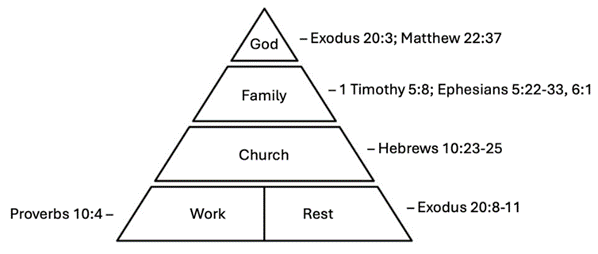
The roles, duties, and responsibilities God has given to humanity (which includes you) are good yet unequal; some are greater than others. Part of living a life of wisdom and godliness is living with this order of priorities intact.
There may be some days when you’ll need to work late because of a special deadline or project, and this will mean you’re unable to eat with your family or put your kids to bed. God understands that. You might also have a job (for example, in the emergency services) where you’re unable to attend church every Sunday morning because of a special calling you possess to preserve life and good order in society. God understands that, too. Except for maintaining God at the top, momentary occasions for re-ordering priorities are part of living in a busy world and balancing God’s many blessings, and that’s a good thing! However, they are exceptions that prove the rule, and brief interruptions to the superseding hierarchy.
To avoid burnout, it’s important to maintain consistency in our lives while allowing for occasional flexibility for things that have God-given or God-driven reasons. Consider planning your days and weeks to protect what is most important and to return to your routine after any temporary disruptions. By doing this, you prevent short-term pressures from becoming long-term patterns of overwork.
At the heart of the matter, considering our priorities will inevitably involve us saying ‘No’ to things. This can be difficult for people who are often tempted to overwork and stress, but it’s important. Avoiding burnout often means ‘taking your foot off the gas pedal’ in different areas of life. Allow slowness and rest into your schedule. We might need to step back from different responsibilities to allow ourselves to prioritise the most important things. After all, every ‘Yes’ is a ‘No’ to something else, and every ‘No’ is a ‘Yes’ to something else.
The God of Discipline
God is a God of discipline, desiring his people to exercise discipline in their lives. Not only is wisdom the task of recognising our priorities (as we’ve seen), it’s also the task of disciplining ourselves to ensure these priorities remain secure. We need to be disciplined with our priorities and habits to strike a balance between life’s blessings and pressures. The book of Proverbs is an excellent resource for understanding discipline.
Proverbs tells us that discipline is about training consistency, cultivating godly habits, and having the self-control to keep oneself from danger or sin. Proverbs 12:1 says, “Whoever loves discipline loves knowledge, but he who hates reproof is stupid.” Discipline is the backbone of a balanced life, which, by the indwelling power of the Holy Spirit, equips us to order our days, manage responsibilities, and maintain our spiritual, mental, and physical health. Without it, even the most well-intentioned efforts can become chaotic or unsustainable.
Proverbs also teaches us that discipline is crucial for managing time, energy, and priorities, allowing us to pace ourselves, plan effectively, and avoid the extremes of overwork on one hand, or neglect on the other. Proverbs 6:6 says, “Go to the ant, O sluggard; consider her ways, and be wise. Without having any chief, officer, or ruler, she prepares her bread in summer and gathers her food in harvest.”
Just as the ant prepares in advance, disciplined people plan their work and activities ahead of time, anticipating challenges and making sustainable choices to avoid burnout. While our culture tells us that we’re being ‘tough’, ‘successful’, or ‘strong’ for our overwork (which leads to burnout), we see that true strength and wisdom involve carving out time for rest or other activities to help sustain our work and life.
—
Reflection Questions:
- Order: What changes to your rhythms and routines could you make to compartmentalise your life and avoid burnout?
- Priorities: Looking back over the past few weeks, how has your time reflected your priorities? What priorities need to shift up or down to ensure you’re not overworking?
- Discipline: What does godly discipline look like in your current season of life? How might practising consistency and self-control protect you from burnout?
- Looking at your overall lifestyle, where do you see an imbalance (too much work, too little rest, or neglected spiritual habits)? What one intentional step can you take this week to realign your order, priorities, and discipline with God’s design and wisdom?
—
Part 3: Work, Family, and Rest
In Part One, we reminded ourselves of the good and gentle character of God who calls us to find refreshment in him. In Part Two, we considered how God has established (1) order, (2) priorities, and (3) discipline for a sustainable life and to avoid overwork. Now, in Part Three, we look at the two most significant facets of our lives that need the most attention and therefore require balancing correctly for a healthy lifestyle: work and family.
Work
Avoiding burnout doesn’t just mean preventing work hours from overspilling into other areas of our lives; it also means working well, in the first instance, according to how God commands us to work. When we work with a biblical perspective and according to biblical principles, we’ll find that our work life can become far more sustainable and enjoyable.
There are so many good Christian books on the topic of work, so we’re not going to study the topic in-depth. Here are just a few biblical principles to remember in our work:
1. Work with Purpose
“And whatever you do, do it heartily, as for the Lord and not for men.” – Colossians 3:23
We need purpose in our work, and work without purpose will quickly become draining and monotonous, ultimately leading to burnout. When we understand the motivations for our efforts-whether it’s providing for our family, serving others, or advancing the Kingdom of God-we transform our work from being a mere obligation into becoming a meaningful contribution in God’s good world.
Ultimately, Paul tells us in Colossians 3:23 that our work is for Christ himself, not for any human master. We work because Christ tells us to work and thereby to worship him. Paul also writes in 1 Corinthians 10:31, “So, whether you eat or drink, or whatever you do, do all to the glory of God.” Our purpose in work gives our work direction, fuels our perseverance, and helps us endure seasons of difficulty with hope.
Work becomes dangerous when it turns into an idol-something we put before God in our hearts or lives. Success, status, recognition, or money can quickly become our primary or ultimate purpose in our work. When this happens, it’s a perfect recipe for burnout. How amazing it is that God’s design for work-working for him and not for ourselves or others-leads us to a healthier mindset and spirit.
We can avoid overwork, stress, and burnout when we remember we’re working for our sovereign and good God. Make every effort to replace the fear of man or the fear of failure with the fear of God. Make serving him your primary motivation, thereby infusing all you do with significance and satisfaction. Serve the Creator rather than being enslaved to the created.
2. Work with Joy
“Serve the LORD with gladness!…” – Psalm 100:2
As pastor and author John Piper teaches, God is most glorified in us when we are most satisfied in Him (2012). Indeed, bringing true glory to God will inevitably entail bringing true and lasting joy to us, since God is Joy. God desires that our work be joyful (Neh. 8:10). Working with joy doesn’t mean our work is always easy or effortless, but it does mean that we can experience satisfaction, peace, and strength as we serve Christ in our work.
When we work with a daily reminder of the gospel of Jesus Christ-our forgiveness of sins through Christ’s death, resurrection, and ascension-we can remember who we are in Christ and approach each day with a refreshed heart. Lasting, deep joy (not transient and surface-level happiness) counteracts stress, fatigue, and cynicism and gives us endurance to continue faithfully and even inspire those around us with the gospel. When we work with joy in Christ, we can find daily strength to work well from a place of refreshment and peace.
3. Make Work Worshipful
Serving Christ in our work makes our work worship. Furthermore, having joy in Christ and the gospel in our work also transforms it into worship. However, it is easy for the day’s stresses and busyness to overpower our joy. When stress accumulates without relief, it becomes one of the most common burnout causes, especially in seasons where responsibilities feel unending or emotionally heavy.
One key part of burnout treatment involves learning how to treat work not merely as a demand but as an act of worship. When we remember that our work is service to Christ, we engage with it differently: instead of striving for perfection or approval, we seek faithfulness and grace.
What practical steps can we take to ensure we’re not drifting from worship during our work? Consider these:
– Begin and end each workday with prayer, asking God to guide your decisions and attitudes. You can also pray before and after key work tasks or meetings.
– Build godliness into your daily routines: review emails and reports carefully before sending, speak truthfully in meetings, and gently correct any mistakes instead of covering them up. You can keep a small note or phone reminder that says, “Work with integrity,” “Work with joy,” or “Work with patience.”
– Take moments during the day to notice and celebrate progress, however small, and write down things you’re grateful for in a journal or planner.
– Schedule regular breaks and protect these times from distractions. Healthy boundaries are one of the simplest and most biblical ways of how to treat burnout, especially when you’re experiencing emotional fog, irritability, or slowed productivity-very common physical symptoms of burnout.
– Recognise when you’re entering stress and then: (1) delegate work to others, (2) ask for help, (3) pay attention to how stress manifests physically or emotionally. Physical symptoms of burnout might show up as headaches, tension, disrupted sleep, low appetite, chronic fatigue, or irritability. Learning to identify early warning signs is a powerful tool in burnout treatment.
– Reflect weekly (perhaps with your spouse) on how your work aligns with God’s purposes.
Ask how your work honoured God and served others. You can journal or discuss with a trusted mentor to keep an eternal perspective on your work.
Creating worshipful routines does not remove all stress, but it gives you a way to work with God’s presence, not apart from it, which is one of the strongest protections against emotional and spiritual exhaustion.
4. Work with Rhythms of Rest
Even the most meaningful and joyful work can become draining when our days lack boundaries and rhythm. God never designed us to work endlessly at full capacity. A great deal of burnout treatment in Christian wisdom begins with learning how to treat burnout not only emotionally but physically and practically. When we add intentional rhythms of rest into our weeks and our work structure, we actively prevent the slow accumulation of stress that leads to both emotional exhaustion and physical symptoms of burnout.
God built rhythm into creation itself: six days of labor and one day of rest. Rest is not downtime from “real” work-it is part of God’s design to make productivity sustainable. Without healthy rhythms of sleep, meaningful breaks, worship, and Sabbath-style reflection, even enjoyable work becomes heavy, overwhelming, and spiritually dull.
Rest also trains us to trust God. When we stop striving, we declare that we are not God-we are finite, limited, embodied creatures who need restoration. Preventing burnout begins with humility: recognizing that our bodies, minds, and emotions require rest and that refusing to rest is not a sign of strength but a sign of spiritual imbalance.
To make rhythms of rest part of your routine, consider:
– Protecting Sunday as a true Sabbath day rather than a “catch up” day.
– Scheduling weekly or daily breaks that are non-negotiable.
– Practicing sleep hygiene, physical movement, quiet mornings, slow evenings, or moments of solitude.
– Limiting work hours for seasons of recovery if you are already experiencing physical symptoms of burnout – headaches, muscle tension, chronic fatigue, irritability, or disrupted sleep are your body’s early warning signs that internal pressure has reached unhealthy levels.
For many Christians, learning how to treat burnout does not begin with quitting a job or abandoning responsibilities. Instead, it usually starts with restoring rhythms of rest, addressing emotional exhaustion, and paying attention to the early physical symptoms of burnout.
When we recover through rest, we return to work with clarity, spiritual vitality, renewed joy, and deeper worship. Rest does not weaken productivity – it strengthens endurance.
Family
Balancing family with your other commitments might not be a problem for you. Conversely, it might be your biggest stressor and burden. Often, when we’re working at full capacity for protracted periods, it can become easy to neglect our families, even if we think we’re spending a lot of time with them. This is one of the most common causes of relationship burnout, especially when emotional presence is missing even though physical presence is there. Something my wife and I have found helpful in our marriage is identifying each other’s ‘love languages’. Everyone has a love language (how they show love to others and/or how they feel loved by others), and understanding love languages in others-such as our spouse or children-helps us to ensure they don’t feel neglected by us.
Pastor Gary Chapman (1992) identifies five love languages. He argues that God, in His infinite beauty and creativity, has caused each of us to be different in how we give and receive love and affection. Because of sin, however, it’s all too easy to misjudge one another’s love languages and so to hurt or neglect them when we’re really trying to show love. Neglecting this emotional awareness can lead to stress and misunderstanding in families, a subtle form of relationship burnout that often goes unnoticed until someone finally expresses how overwhelmed or unseen they feel.
Chapman’s love languages are:
- Words of Affirmation—Expressing love through spoken or written encouragement, compliments, and kind words. For example, saying, “I really appreciate how hard you worked today,” or leaving an encouraging note.
- Acts of Service—Showing love by doing practical things that help or serve others. For example, washing the dishes, cooking a meal, or helping with errands can be actions that communicate care and affection.
- Gifts—Expressing love through thoughtful (not necessarily costly!) gifts, even on ordinary days.
- Quality Time—Showing love by giving someone your full, undivided attention. For example, having an unhurried conversation, sharing a meal without distractions, taking a walk together, or watching a movie.
- Physical Touch—Communicating love through physical closeness and (appropriate!) touch. For example, a hug, holding hands, or a reassuring pat on the back.
Busy individuals are often so task-oriented that they can find themselves rushing from one thing to the next, seeing family love as another box to check. (It’s sad and it’s sinful, but it’s true.) People on the verge of burnout often think they’re loving their family well when, in reality, they’re neglecting them. As a result, the emotional struggles at home compound with the work pressures beyond the home, and stress levels escalate. Suddenly, the home no longer becomes a safe and restful space but a place where, once again, we can feel that we’re managing impossible expectations. When this cycle continues for a long period of time, it can lead to emotional burnout, where the home feels heavy and draining rather than life-giving.
Prioritising family and loving them well will help us avoid burnout and strengthen our marriages and relationships. Take the time to understand both your own and your family’s love languages to ensure love is being communicated aptly. This will not only refresh you but also refresh those around you, creating an emotionally healthy home and lifestyle. It’ll require humility and patience to understand others’ needs, but the Holy Spirit equips us for this task (Gal. 5:22-23).
—
Reflection Questions:
- How can Colossians 3:23 (“And whatever you do, do it heartily, as for the Lord and not for men”) and 1 Corinthians 10:31 (“So, whether you eat or drink, or whatever you do, do all to the glory of God”) help you to find purpose in your work and avoid burnout?
- How does the fear of man or the fear of failure influence your stress levels? How can remembering the gospel day by day help avoid idolising work and prevent it from leading to burnout?
- What practical steps can you implement in your daily work routine to maintain joy and worship in your tasks?
- How well do you understand the love languages of your spouse, children, or close family members, and how might applying this understanding improve your relationships and reduce stress at home?
—
Part 4: The Church and Healthy Living
Our secular Western societies tell us that for a happy lifestyle, we need healthy bodies and minds. We can read numerous books and articles on the importance of eating well, exercising, and even entertainment in maintaining a happy and sustainable life, as well as avoiding overwork and stress. These are wonderful things, and ensuring our bodies and minds are healthy is a cornerstone for avoiding stress and burnout. But we mustn’t forget the spiritual dimension, too. After all, we’re embodied spirits.
Did you know that the local church is integral to your growth as a person? That’s because the local church is integral to your growth as a Christian-as an embodied soul, a person made in the image of God and saved by the amazing work of Jesus Christ. As Christians, we’re commanded to grow in our spiritual maturity and holiness (Col. 1:28), and this often occurs in the context of the gathered church. The New Testament letters themselves, which command and encourage our spiritual health and discipline, were primarily written to gathered churches. Spiritual health is a group project!
There are many helpful Christian tools, resources, and programmes out there. You can enjoy spiritual growth and nourishment by reading good Christian books with a Christian friend, or you can participate in accountability groups with close believers, where you share your burdens and struggles. These are all great things which I encourage us all to do, but did you know that the gathered, corporate church is the only discipleship tool commanded in the New Testament?
So, how does the church help us to stay spiritually healthy in a way that flows out into other aspects of ourselves? How does the church help us to avoid burnout?
Feeding on God’s Word
“Man shall not live by bread alone, but by every word that comes from the mouth of God.” – Matthew 4:4
Coming to church each week, we are (hopefully!) sitting under good, soul-nourishing preaching. The best preaching is expositional preaching—the ‘exposing’ of God’s Word where a passage of Scripture (not merely a topic or an idea) is closely, carefully, and faithfully brought out, taught, and applied. The regular, Spirit-empowered preaching of God’s Word has God’s power to grow us by re-centering us on God’s truth. This helps to counteract the lies told to us by our world or our bosses about the necessity of overwork and how our value is tied to our productivity. This rhythm pulls us back from the edge of burnout by restoring our perspective and identity in Christ.
Make Church Restful
“Not neglecting to meet together, as is the habit of some, but encouraging one another, and all the more as you see the Day drawing near.” – Hebrews 10:25
Church attendance and involvement are a priority, regardless of your convictions on Sabbath rest and its relevance today. For most Christians, regular church attendance naturally complements their day of rest. It provides a healthy, God-given rhythm for spiritual, emotional, and relational renewal. Hebrews 10:25 reminds us that meeting together as a church should encourage us. It should be a moment in our week that energises us and spurs us on to love and good works, not one that drains us.
When church is approached rightly as a place of rest and renewal, it becomes a safeguard against burnout and a haven for us to renew our strength, preparing us to face the week ahead with clarity, peace, and joy. Those of us who are prone to burnout likely are those who find it difficult to say ‘No’, and this includes our response to church activities, too. Identify periods when you’re prone to stress and overwork, and be willing to reduce your involvement in the serving rota as needed. This doesn’t mean pulling back from your involvement in church. In fact, a good way we can avoid burnout and free up our schedules is by utilising our natural involvement and discipleship of other believers instead of focusing on programmes.
Paul writes in Galatians 6:10, “So then, as we have opportunity, let us do good to everyone, and especially to those who are of the household of faith.” Our spiritual investment in others within our churches should be done “as we have opportunity”, and this will ebb and flow with the rhythms of our life. Consider involving others in what you’re doing, or phone calling those who need encouragement while commuting, and model what it looks like to be a follower of Christ in different (even stressful) areas of your life—helping others to follow Christ better. Biblical, life-on-life discipleship will be organic, not programmatic and rigid.
Commitment
“Bear one another’s burdens, and so fulfill the law of Christ.” – Galatians 6:2
Biblical church membership means being part of the local Body of Christ—not merely ‘going to’ church but being ‘part of’ the church as a present and committed member. Joining a church, and not merely attending one, is part of what it means to live as a Christian. When believers are deeply connected to their local church, they gain a network of people to share burdens, pray for them, and offer practical help. Sadly, I’ve seen far too many people neglect membership in their local church and suffer as a result. When times of difficulty, suffering, or ill health come, they’re unable to access help from a web of support, rooted in covenant love, which was persistently offered to them and which they persistently rejected.
It’s important that we share our burdens with one another in our church. If you’re struggling with stress at work, family challenges, or emotional exhaustion, confide in a trusted church member. The Bible says that’s what they’re there for (Gal. 6:2)! Not only can a fellow church member pray with you and regularly check up on you, but they might offer to help you practically. Members might offer practical help, such as babysitting for an overwhelmed parent, running errands for someone out of town, or helping with household chores during a busy season.
It’s also important (and godly) to have the humility to be helped. Many people hesitate to let others in, fearing they’ll be a burden. But God calls us to humility and interdependence. Accepting help, and even showing signs of weakness, isn’t sinful; it’s obedience to Jesus Christ and part of ‘doing church’ together (Phil. 2:4; 1 Thes. 5:11; Heb. 10:24-2). Examples include allowing a friend to help with meal prep during a stressful week, coming over to play with your kids while you’re on a work call, or even sharing financial or logistical needs with a trusted church member. If burnout is going to lead to spiritual dryness, wavering faith, diminished prayer life, cynicism, and neglect of God’s Word and God’s people, then avoiding it is a spiritual priority the church can help you with.
—
Reflection Questions:
- How can regular involvement in the local church help you maintain spiritual, emotional, and relational health, and in what ways could neglecting church attendance contribute to burnout?
- In what practical ways can you make your church experience a time of rest and renewal rather than an added source of stress? Consider both your participation and your mindset.
- How can life-on-life discipleship and sharing burdens with other believers (Gal. 6:2; Phi. 2:4) protect you from burnout? Can you think of specific examples in your life where this has happened or could happen?
- Do you have supportive relationships in your church? Think about whether you have people who notice when you’re struggling, who can pray for you, and offer encouragement or practical help.
—
Conclusion: Rest, Recovery, and a Call to Humility
Think back to Sally, John, and Annie from the start of this field guide. We may not lead a team of doctors, run a busy IT department, or chase breaking news, but we can all relate to feeling stretched, persistently stressed, weary, and spiritually drained amidst life’s busyness. I’m sure many of us can see aspects of ourselves in them.
Burnout can manifest differently for each of us, and the warning signs vary according to individual personality type and circumstances. It’s so important for our own health (mental, emotional, physical, and spiritual) and the health of those around us that we identify when we’re on the path to burnout and take active steps to avoid it. When workplace burnout becomes chronic, we need to pursue intentional burnout recovery, exploring rhythms of rest, support, spiritual renewal, and healthier boundaries.
Sally, John, and Annie remind us that burnout isn’t just a workplace problem, or a family problem, or a life-balancing problem; it’s a spiritual problem, and that means the solution will be deeper than a vacation or even a healthier routine. Whether you are experiencing burnout in work, or carrying emotional burdens from home, learning how to deal with burnout must include humility before God, repentance from self-reliance, and a rediscovery of God’s rhythms of work and rest.
To avoid burnout, we must follow Scripture’s teaching and return to God’s design for our lives-his order, priorities, and discipline. Particularly, making deliberate and intentional steps to integrate wholly and biblically into our church family, in covenant love and relationship, provides us with a spiritually healthy foundation for work and rest. In many cases, recovery from burnout is not merely physical; it is relational, emotional, and deeply spiritual, and the local church becomes a vital place of healing.
God is omnipotent; we are not. God is omnipresent; we are not. God is unbound by time; we are bound by time. God is infinite; we are finite. God’s work is indispensable and eternal; ours is dispensable and limited. Let’s wisely apply the soul-refreshing and soul-nourishing instruction of God’s Word not only to avoid burnout but to thrive at work, home, and church.
References
- Chapman, G. (1992). The 5 Love Languages: The Secret to Love that Lasts. New York City, NY: Northfield Publishing.
- Piper, J. (2012). ‘God is Most Glorified in Us When We are Most Satisfied in Him’. Desiring God. Available at https://www.desiringgod.org/messages/god-is-most-glorified-in-us-when-we-are-most-satisfied-in-him [accessed on October 23rd 2025].
- World Health Organization. (2019). ‘Burn-out an “occupational phenomenon”: International Classification of Diseases’. Available at https://www.who.int/news/item/28-05-2019-burn-out-an-occupational-phenomenon-international-classification-of-diseases [accessed on 24th October 2025].
About the Author
JOSHUA LUDLOW is an assistant minister in Cardiff, Whales, where he, his wife, and daughter live.
目录
- Part 1: You are not alone
- Moses
- Elijah
- Jonah
- Jeremiah
- John the Baptist
- Jesus Christ
- A Word of Comfort
- Reflection Questions:
- Part 2: The God of Order, Priorities, and Discipline
- The God of Order
- Playing the Long Game
- The God of Priorities
- The God of Discipline
- Reflection Questions:
- Part 3: Work, Family, and Rest
- Work
- Family
- Reflection Questions:
- Part 4: The Church and Healthy Living
- Feeding on God’s Word
- Make Church Restful
- Commitment
- Reflection Questions:
- Conclusion: Rest, Recovery, and a Call to Humility
- References
- About the Author