#103 By His Stripes We Are Healed – Trusting God Through Illness and Pain
Part 1: Why Do We Get Sick?
We get sick because of death. And we die because of sin.
Sickness is a bit like the grave extending its grimy hands into the land of the living to alert us to what’s coming and then drag us down.
If we weren’t destined for death (i.e., if we weren’t dying), we wouldn’t get sick. And if it weren’t for sin, we wouldn’t die.
So why do we get sick? Because of sin.
God created us to live. His intention for our first parents was the multiplication of life, not the dispersion of death. The first command, the one preceding the prohibition, in fact, was to “be fruitful and multiply” (Gen. 1:28). That immortality was held out to Adam and Eve is clear from the fact that death is only introduced as a consequence for sin: “But you must not eat from the tree of the knowledge of good and evil, for on the day you eat from it, you will certainly die” (Gen. 3:17).
God made Adam and Eve so that they would live. They were warned that sin is the consequence of death (Rom. 6:23). But sin they did. And so, God punished the man and the woman following their disobedience:
You will eat bread by the sweat of your brow
until you return to the ground,
since you were taken from it.
For you are dust,
and you will return to dust. (Genesis 3:19).
We die because of sin.
The irony is that Adam and Eve, being made in the image of God, sat somewhere between heaven and earth, so to speak. But they were discontent with their lot, they strove to be more like God than they should, and so now we’re destined to return to the dust. Death humbles us as low as the serpent who fed that first lie.
Yet, even as we face the reality of sickness and death, there is hope for healing. The Bible offers profound Bible verses for healing and strength, reminding us that God’s purpose is not just to let us suffer but to heal us through His grace. A beautiful Bible verse for the sick is Psalm 6:2, which says, “Have mercy on me, Lord, for I am faint; heal me, Lord, for my bones are in agony.” This verse gives us a clear invitation to seek healing from God, knowing He listens to our cries for mercy.
The author of Ecclesiastes picks up this tragic irony:
For the fate of the children of Adam and the fate of animals is the same. As one dies, so dies the other; they all have the same breath. People have no advantage over animals since everything is futile. 20 All are going to the same place; all come from dust, and all return to dust. (Ecclesiastes 3:19-20).
Death is humiliating. It’s God’s ultimate limitation on those who thought they could vie with God for power, rule, and autonomy. We thought we could be like God, and now we die like the dogs. We have no advantage over animals in terms of death.
Yet, even in the face of death, the Bible reminds us that healing is possible through God. In Isaiah 53:5, we read, “But he was pierced for our transgressions, he was crushed for our iniquities; the punishment that brought us peace was on him, and by his stripes we are healed.” This verse is a powerful Bible reference on healing that shows God’s willingness to restore us, not just spiritually but also physically.
Because of sin, we die.
Paul too recognizes this connection and writes, “Therefore, just as sin entered the world through one man, and death through sin, in this way death spread to all people, because all sinned” (Rom. 5:12).
Death is about separation. Physical death is the separation of soul and body (Jas. 2:26). Spiritual death is the separation of the sinner from God (2 Thess. 1:9). Death is the unmaking or the undoing of man. This is why sickness is a symptom or precursor to death. It is the slow unraveling or unmaking of us before we meet our final fate in the grave, where we return to dust.
That’s what Ecclesiastes shows us:
So remember your Creator in the days of your youth:
Before the days of adversity come,
and the years approach when you will say,
“I have no delight in them”;
before the sun and the light are darkened,
and the moon and the stars,
and the clouds return after the rain;
on the day when the guardians of the house tremble,
and the strong men stoop,
the women who grind grain cease because they are few,
and the ones who watch through the windows see dimly,
the doors at the street are shut
while the sound of the mill fades;
when one rises at the sound of a bird,
and all the daughters of song grow faint.
Also, they are afraid of heights and dangers on the road;
the almond tree blossoms,
the grasshopper loses its spring,
and the caper berry has no effect;
for the mere mortal is headed to his eternal home,
and mourners will walk around in the street;
before the silver cord is snapped,
and the gold bowl is broken,
and the jar is shattered at the spring,
and the wheel is broken into the well;
and the dust returns to the earth as it once was,
and the spirit returns to God who gave it. (Ecclesiastes 12:1-7).
We don’t need to worry ourselves with all the details. The picture the author is giving, I think, is that of the human body breaking down in old age. If you live long enough, your hands (guardians) will tremble at the smallest tasks. Your teeth (women who grind grain) will be few in number. Your eyes (the ones who watch) won’t see as clearly. What you used to conquer with ease, like walking up a curb, will become a point of fear. You’ll lose all kinds of desires. Until finally your life is shattered like a glass on the kitchen floor. Life will be frustrating in these days of adversity, as he calls them.
Because of sin, you die. And because of death, your body will break down until it breaks. Sickness is an early warning sign from the grave. No death; no sickness.
This is where Bible quotes about healing bring comfort. While sickness is part of the human condition due to sin, God offers healing. Bible verses about healing sickness such as Psalm 107:20, “He sent out his word and healed them; he rescued them from the grave,” remind us of God’s power to restore. Even in our brokenness, there is hope for healing.
I wonder, how often do you connect your sickness to death and sin? If you don’t, sickness will likely take you by surprise.
There are two kinds of people reading this life skill guide: those who are dying and know it, and those who are dying and don’t. I assume the majority of people in the Western world fall into the latter category. There are exceptions, of course-those who have brushed against death-their own or others-or those who can see it on the horizon. For the rest of us, however, we know we’re dying, but not really.
Sickness is inexplicable to those who are immortal.
One of the reasons we deny death, I suspect, is that we’ve minimized our exposure to it. It’s not as easy to have its mark left on our hands. We put the elderly in homes. Those who are seriously ill or injured, we leave in hospitals. Those with little hope enter hospice care. Out of sight, out of mind, as they say. This is not to suggest, of course, that assisted living facilities, hospitals, and hospice care are without merit. They are of obvious value. It’s only to say that it comes at a cost: a diminished awareness of our own mortality. The less we see people seriously sick and dying, the less likely we are to understand that we’re dying. But who wants to think about death? It’s that-which-must-not-be-named
Another reason we deny death, I think, is due to modern advances in various technologies. As I’m writing this, I can hear the rain pounding against the window. Its sound is rivaled only by the heater, which keeps the room comfortable. Protection from the elements outside. Conformity of the elements inside to my liking. We assume our “mastery” over nature extends as far as our bodies. The advances made in medicine perpetuate the myth. There is, it would seem, a treatment for nearly any diagnosis a doctor may deliver. It breeds confidence. All of science’s merits aside, the cost has been significant: we assume a higher degree of control over life and death than we actually possess. And so, we deny death and we deny our lack of control.
What does this have to do with sickness? Well, if you’ve come to believe you’re not going to die on the one hand and that you should be able to control nature-both life and health on the other-you’re going to be very frustrated when your body tells you otherwise. Sickness can be frustrating, much like a faulty engine in a brand-new car. It shouldn’t be there!
And in one sense, it shouldn’t. Sickness and death are unnatural to what we were destined for. But because of sin, as we’ve seen, they have become our new normal. So, in another sense, they should be in our world. Sickness and death that follow are God’s limits on creatures who thought they should be more. The wages of sin is death. We die because of sin. And we get sick because of death. It’s death reaching into our lives to warn us of what’s coming. It’s the engine light flashing on the dashboard. It is God’s sign to you that your body is not right because of sin. Soon, you will meet the full extent of its force, and after that, you will meet him who put these limits on you: God. Sickness, like death, should always lead our gaze Godward. It’s a reminder of death, sin, and him who is sovereign as judge and merciful as savior.
When you feel the weight of sickness, it’s important to turn to biblical quotes for healing. A prayer for sickness and healing, like the one found in James 5:15, can be a powerful response: “And the prayer offered in faith will make the sick person well; the Lord will raise them up.” These verses help us to remember that God’s healing power is greater than our suffering.
Once we come to grips with the root of sin and its inevitability, we are well-positioned to experience growth through it and hope beyond it. But first, we should press more deeply on the question of the root of sickness.
So, we (humanity) get sick because of sin. Got it. But am I sick because of my sin?
—
Reflection Questions:
- What is the closest you have ever come to death (either yourself or a loved one)? How did it make you feel?
- When you think of death, do you fear? Do you try to ignore it? Does it change your perspective? How and why?
- What is the relationship between sin, sickness, and death?
—
Part 2: Am I Sick Because of My Sin?
Yes. No. Maybe.
Am I sick because of my sin? I want to give a qualified yes to this question. If you weren’t a sinner now and in Adam, you wouldn’t die, and so, you wouldn’t get sick.
If you are in Christ Jesus, however, then you need to know that you are not being punished for your sin when you’re sick. On this point, Scripture is clear:
“Therefore, there is now no condemnation for those in Christ Jesus” Romans 8:1.
If you are in Christ, then every sin you have committed was dealt with on the cross. Your record of debt was canceled in full, and you are forgiven (Col. 2:14-15). It is finished, as Christ promises (John 19:30).
So, your sickness is not God punishing you because of your sin. But, again, if you weren’t a sinner, you wouldn’t ever get sick. Sickness is a consequence of life in a fallen world and is a precursor to death. Though Christ has suffered in our stead, we still die, though not as a punishment of sin but as its putting off.
Sickness, though not a direct punishment for specific sins, serves as a reminder of the brokenness of our world. As we face sickness, it is essential to remember the promises of God’s healing. One Bible verse about healing of the sick is found in James 5:15, where it says, “And the prayer offered in faith will make the sick person well; the Lord will raise them up.” This speaks to God’s grace and healing power, even when sickness is not directly linked to our personal sin.
Heidelberg 42 asks: Since Christ has died for us, why do we still have to die?
And it answers: “Our death is not payment for our sins, but it puts an end to sin and is an entrance into eternal life.”1
In a similar fashion, sickness is not payment for our sins, but it is a reminder that we must still put off this body of flesh so that we can be clothed in incorruptibility (1 Cor. 15:53). Sin must be put to death even as we are reminded that death is coming. Until the flesh is put off at death, we will get sick.
Despite the reality of sickness, we hold onto the truth of biblical verses on healing. Isaiah 53:5 powerfully declares, “But he was pierced for our transgressions, he was crushed for our iniquities; the punishment that brought us peace was on him, and by His stripes we are healed.” This verse reminds us that God’s healing is available to us, even as we live in a world cursed by sin.
So, am I sick because of my sin? In the most general sense, as a human living in a world that is cursed because of sin, the answer is yes. However, we are not being punished.
We need to press further, though. Am I sick because of my sin? That is, am I sick because of my specific sin? Is this cancer, this Parkinson’s, this Cystic fibrosis, this ALS, this fill-in-the-blank, because of my sin?
Is this specific sickness because of a specific sin? The answer is probably not. It’s because of sin in general, yes, but not your sin specifically.
In John chapter 9, Jesus and his disciples passed by a man who was born blind. “His disciples asked him, ‘Rabbi, who sinned, this man or his parents, that he was born blind?’” (John 9:2). It was commonly thought that serious sickness was due to specific sin, hence the disciples’ question. In fact, as the chapter unfolds, this man, who was soon to be healed, would be questioned by the Pharisees because Christ healed him on the Sabbath. They dismiss his testimony (Jesus healed him, and God doesn’t listen to sinners, so God must be at work through him) by calling him a sinner: “You were born entirely in sin,” they replied, “and are you trying to teach us?” Then they threw him out (John 9:34).
This healing is one of many examples of the healings of Jesus, and it is a powerful reminder that by His stripes we are healed.
So, in keeping with their religious culture, the disciples ask Jesus, not just if this man is blind because of sin. They’re sure that’s the case. The question is whose sin, though. Christ responds:
“Neither this man nor his parents sinned,” Jesus answered. “This came about so that God’s works might be displayed in him.” (John 9:3). Healing with God always has a greater purpose, one that displays His glory. As it’s written in Isaiah 53:5, “by His stripes we are healed,” showing that God’s plan for healing is part of a greater redemption process for humanity.
After he said these things he spit on the ground, made some mud from the saliva, and spread the mud on his eyes. “Go,” he told him, “wash in the pool of Siloam” (which means “Sent”). So he left, washed, and came back seeing (John 9:6-7).
This man’s entire life was marked by blindness. Blindness was not, however, because of his sin in some kind of tit-for-tat manner. And at the same time, his blindness was not meaningless. It was so that God’s works might be displayed in him-namely, the revelation of God in Christ, which we would believe is God the Son and Messiah (John 20:31). The healing of Jesus is always intentional and reflects God’s mercy and power to heal. We’ll come back to God’s purpose in our suffering soon enough. The point here is that your sickness is not primarily because of your sin in a punitive manner.
So, is my specific sickness because of my specific sin? Almost certainly not. But we should have a category for sickness as a discipline for specific sin.
So, once again, is my specific sickness because of my specific sin? Probably not, but maybe.
In John 5, Jesus, on the Sabbath, notices a man who had been disabled for 38 years (note the similarities to the blind man in John 9). Jesus asks him if he wants to be made well. The man doesn’t even answer his question, likely not thinking healing is within reach. Jesus then, by speaking a word, makes his body whole.
“Get up,” Jesus told him, “pick up your mat and walk.” Instantly the man got well, picked up his mat, and started to walk. (John 5:8).
The Jewish leaders also question this man. Christ finds him after and said to him:
“See, you are well. Do not sin anymore, so that something worse doesn’t happen to you” (John 5:14).
The man is well, but he has been given a warning. Do not sin anymore lest something worse happens. The man in John 9 was given no such warning. Note also how Christ did not have to give him any specifics. The man knows the sin Christ is referencing. This is a reminder that God heals not only the body but also calls us to repentance. Christ’s gracious healing of him demands his repentance. It’s as though Christ is telling him, “I have saved your body from that sin that caused its ruin, don’t return to it, and so bring back that ruin.”
So is my specific sickness because of sin? Maybe. It could be. We at least need to have a category for it. We see something similar in James.
He gives specific advice to Christians in various situations.
“Is anyone among you suffering?” James 5:13a.
What should he do?
“He should pray. Is anyone cheerful?” James 5:13b.
What should he do?
“He should sing praises.” James 5:13c.
“Is anyone among you sick?” James 5:14a.
Ah, what should he do?
He should call for the elders of the church, and they are to pray over him, anointing him with oil in the name of the Lord. The prayer of faith will save the sick person, and the Lord will raise him up; if he has committed sins, he will be forgiven. 16 Therefore, confess your sins to one another and pray for one another, so that you may be healed (Jas. 5:14-16).
Healing with God involves both physical and spiritual restoration. Note the close connection between confessing sin and receiving healing. The sick person is healed, and in the cases where there is sin, they are forgiven. And, so, what should we do: “Confess [our] sins to one another and pray for one another, so that [we] may be healed.” The confession of sin leads to healing. Sometimes we are lovingly disciplined by God for sin through sickness. As the Bible quotes about healing suggest, healing often involves turning our hearts back to God and seeking His grace.
This means in addition to the kinds of questions doctors may ask you about your diet, movement, history, exposure, and so on, one of the diagnostic questions we should be asking ourselves is, “Am I in unrepentant sin?” One of the questions the elders should ask with great care is, “Are you in unrepentant sin?”
Our God is a healer (Exodus 15:26), and He can bring healing, whether it’s through prayer or the hands of doctors, or both.
God can and will discipline you because He loves you (Heb. 12:6). And the way He may see fit to rouse you from your hard-heartedness is through sickness. Such questions should be undertaken with prudence and with the help of others, as James suggests.
Depending on your personality, your proclivities, and your background, you may be more inclined to assume any suffering in your life is a result of your specific sin. I would caution against this. We live in a deeply broken world because of sin (in general). God is gracious and gentle with His children, always remembering our frame (Ps. 103:14) and working all things together for our good (Rom. 8:28).
Conversely, you may be the type never to think to ask whether your suffering, in this case your sickness, may be because of your sin. It might be, and it’s always worth asking God to search our hearts to uncover sin. It’s always worth asking trusted family members, members of our church, and our pastors if they are aware of any blind spots. At a minimum, we learn in what ways we might mortify the flesh and so please God. In doing so, we may experience the healing power of God.
So why do we get sick? In the most general sense, because we live in a world stained by sin. And in some exceptional cases, it’s because of our specific sin. In either case, we are forced to seek God.
As has been intimated, God heals and is neither uninvolved nor indifferent to our sickness or suffering. He is not taken aback by it. He sends it.
—
Reflection Questions:
- Are you more prone to connect sickness with your sin or less? What does this say about your sensitivity to spiritual matters?
- What should you do when you’re sick from a spiritual perspective?
- Who in your life can you ask good questions about yourself to?
—
Part 3: Where Is God in My Sickness?
It is worth noting at the outset that God hates our suffering. He really does. He sent his Son to become man, to bear the punishment due our sin, to rip the gates off of Hell, and to ascend to the throne of heaven that he might save us from all kinds of suffering.
Christ spent much of his time preaching and healing those who were afflicted (Luke 4:40).
God is moving all of human history along toward its appointed end, where he recreates the cosmos and dwells with man. Having seen this vision, John tells us what God will do:
“He will wipe away every tear from their eyes. Death will be no more; grief, crying, and pain will be no more, because the previous things have passed away” (Rev. 21:3-4).
God will not only wipe away our tears, but he will also wipe away the things that cause us to cry. The new creation will not be a place of suffering, of hatred, of enemies, or heartache. It will not be a place of death. That means it won’t be a place for sickness. We will find ourselves in the presence of God and the tree of life once again, and “The leaves of the tree” will be “for healing the nations” (Rev. 22:2).
I want you to see that God cares. He cares about you, your tears, your body, your future, and especially your soul. He is good. He is loving. He is powerful. And, yes, he is sovereign over your suffering.
We do well to begin with the goodness of God’s character and his plan to remove all suffering. That serves as a comfort as we consider God’s sovereignty over sickness.
He is sovereign over all things-the cosmic and the microscopic.
Consider these texts:
See now that I alone am he;
there is no God but me.
I bring death and I give life;
I wound and I heal.
No one can rescue anyone from my power. — Deuteronomy 32:39.
Note that basic to being God is complete sovereignty over the full spectrum of human life from its beginning to its ending. God gives life and death. He not only heals, but he wounds.
We see something similar in Isaiah:
I form light and create darkness,
I make success and create disaster;
I am the Lord, who does all these things. — Isaiah 45:7
Again, the Lord speaks about his sovereignty over mankind:
The Lord said to him, “Who placed a mouth on humans? Who makes a person mute or deaf, seeing or blind? Is it not I, the Lord. — Exodus 4:11
Christ himself speaks similarly:
Aren’t two sparrows sold for a penny? Yet not one of them falls to the ground without your Father’s consent. But even the hairs of your head have all been counted. – Matthew 10:29-30
Again, we are given a picture of God’s meticulous sovereignty. A bird may fall in the forest apart from your knowledge (and they do), but it doesn’t happen apart from the Father’s consent. In modern and biological terms, we might say that cells don’t grow and multiply in your body (cancer) apart from the will of the Father.
Where is God in my sickness? He sends it.
It is easy enough to confess that God is sovereign in the most general sense-directing human history, causing the rising and fall of nations, swaying kings, and working all things together to bring us good. It’s hard to stomach that the good he brings us might be through suffering.
Where is God in my sickness? He is sovereign over it as the one who sends it. He is also present with us in it as the God who sustains us, holds us, guides us, and leads us to greener pastures (Ps. 23).
—
Reflection Questions:
- What do you think when you hear that God sends sickness? Is this a surprise to you? If so, why?
- How might knowing that God is sovereign over sickness be a spiritual comfort?
—
Part 4: What Is God Doing in My Sickness?
He’s doing something.
Twelve years and four kids ago, after struggling with infertility for an extended period of time, and after so many tests, an infertility doctor told my wife it was unlikely she’d get pregnant and less likely she’d be able to carry a child to term.
I wept when I relayed the news to a good friend and mentor of mine. The very first words out of his mouth were, “God is not trying to teach you anything. God is not doing anything. You didn’t do anything wrong.”
He kept repeating the first refrain, trying to comfort me, “God is not trying to teach you anything.”
His attempt to comfort me, if I had listened to him, would have robbed me of the grounds of my hope. Namely, that God is not impotent and my suffering wasn’t pointless.
No. God is the king and he works all things, yes all things, together for the good of his people, and so we can say and we can sing “What’er my God Ordains is Right.”
God is doing something in your sickness, and he is trying to teach you something. No doubt he is doing more. He is doing a million things-much of it beyond our understanding in this life and perhaps the life to come. But what we can know is what Scripture for healing tells us: God sends the trial not to leave us in a lesser situation but to improve our station altogether. He strips what we think we need (riches, reputation, health) to show us what we really need: him.
Consider the consistent testimony of Scripture:
The healing that comes from God is not just a quick fix for our suffering; it is a restoration of all things. By His stripes we are healed (Isaiah 53:5), a profound truth that speaks to the total healing of our souls and bodies through Christ’s sacrifice. This healing is part of God’s eternal plan, where He uses suffering to mold us into His image, and through it, He draws us closer to Him.
My son, do not take the Lord’s discipline lightly
or lose heart when you are reproved by him,
for the Lord disciplines the one he loves
and punishes every son he receives.
Endure suffering as discipline: God is dealing with you as sons. For what son is there that a father does not discipline? But if you are without discipline — which all receive — then you are illegitimate children and not sons. Furthermore, we had human fathers discipline us, and we respected them. Shouldn’t we submit even more to the Father of spirits and live? For they disciplined us for a short time based on what seemed good to them, but he does it for our benefit, so that we can share his holiness. No discipline seems enjoyable at the time, but painful. Later on, however, it yields the peaceful fruit of righteousness to those who have been trained by it.
Therefore, strengthen your tired hands and weakened knees, and make straight paths for your feet, so that what is lame may not be dislocated but healed instead.
— Hebrews 12:5-13
Healing with God is both a physical and spiritual process. When we endure suffering, we are not just receiving physical restoration, but we are being trained to experience greater spiritual health and wholeness. The healing of Jesuswas not merely to restore the body but to restore the entire person-body, soul, and spirit.
What do you see in the text regarding your suffering and God’s purposes?
The author of Hebrews grasps how discouraging our suffering is, and he calls us to take heart by pointing us to the purpose of the pain and the heart behind its sender: God is applying pressure in your life that you might experience greater degrees of righteousness and, verse 13, spiritual healing with God. He does this because he loves you. In fact, if God didn’t love you, he’d let you be.
Consider Romans 5:
And not only that, but we also boast in our afflictions, because we know that affliction produces endurance, 4 endurance produces proven character, and proven character produces hope. 5 This hope will not disappoint us, because God’s love has been poured out in our hearts through the Holy Spirit who was given to us — Romans 5:3-5
If we never suffered, if life always went as we planned, we’d have no need for hope. Why hope for a future if your present is perfect? God, in his kindness, unsettles us, in order that we might be reminded of our need for heaven’s glories and so take courage. Sickness may weigh down our physical bodies, but it propels our spiritual running. We need more Jesus. We need more heaven.
Sickness uniquely reminds us of the sting of death that we might long to be free from sin in resurrection glory.
Peter speaks in similar terms:
Blessed be the God and Father of our Lord Jesus Christ. Because of his great mercy he has given us new birth into a living hope through the resurrection of Jesus Christ from the dead and into an inheritance that is imperishable, undefiled, and unfading, kept in heaven for you. You are being guarded by God’s power through faith for a salvation that is ready to be revealed in the last time. You rejoice in this, even though now for a short time, if necessary, you suffer grief in various trials so that the proven character of your faith — more valuable than gold which, though perishable, is refined by fire — may result in praise, glory, and honor at the revelation of Jesus Christ. Though you have not seen him, you love him; though not seeing him now, you believe in him, and you rejoice with inexpressible and glorious joy, because you are receiving the goal of your faith, the salvation of your souls. — 1 Peter 1:3-9
Healing with God means enduring through trials that refine our faith. By His stripes we are healed, not just from sickness but from the root cause of our suffering: sin. This healing is transformative, drawing us nearer to God.
Suffering refines our faith, which is worth more than gold, and certainly, then, worth more than physical wellness. Further, the character of our faith, and especially the worthiness of its object, results in praise, glory, and honor at the coming of Christ. Your suffering is an opportunity to grow in trust and glory.
What would you rather have, though? Physical wellness now? Or Spiritual maturity that comes on the other side of testing and trial? Physical glory here or when Christ returns?
You can be physically well and not happy. If you suffer well, though, you will have inexpressible and glorious joy even in the midst of your suffering because your trial gives you the opportunity to see the power and nearness of God in your sickness. As he sustains us, we see him not as far off but near and able.
Is God’s outcome for your suffering worth more to you than the alternative?
At the end of the day, we are called to trust God. If he thought it would be better for us not to be sick, we wouldn’t be sick.
I struggle with chronic, in some seasons, daily migraines. I have to regularly remind myself that if God knew it was better for me to be whole, I would be. He has and is teaching me that he is all I need. Not less pain. Not clear thinking. Not less sensitivity to light and sounds. What I need is Christ’s grace.
Sickness is an opportunity to learn this. Listen to what Paul says:
For if I want to boast, I wouldn’t be a fool, because I would be telling the truth. But I will spare you, so that no one can credit me with something beyond what he sees in me or hears from me, especially because of the extraordinary revelations. Therefore, so that I would not exalt myself, a thorn in the flesh was given to me, a messenger of Satan to torment me so that I would not exalt myself. Concerning this, I pleaded with the Lord three times that it would leave me. But he said to me, “My grace is sufficient for you, for my power is perfected in weakness.” — 2 Corinthians 12:6-9
To keep Paul from boasting, God imposed some kind of limit on him. Some sort of painful reminder of his weakness (and the infinite power of God). He was given a thorn in the flesh, and though he asked for it to be removed, God did not take it away. Paul learned God’s grace was sufficient for him. His power is made perfect in weakness.
God often does more for us and through us and to us when we’re weak than when we’re strong. When we’re weak, we are put in a position to look to him for aid, for help, for strength, for hope. That’s what sickness in general, and especially chronic sickness, gives us an opportunity to cast ourselves onto the mercies of Christ, abiding in him lest we do nothing (John 15:5).
Is God’s grace sufficient for you? Are you content for his power to be displayed in your weakness? Or would you rather display your power in your health?
The desire to be healthy is good and natural. But is it your greatest desire? Do you trust God and desire his grace more?
God sends us sickness for his glory (John 9:3) and for our good (Rom. 8:28; Gen. 50:20).
So we’ve considered why we get sick. We’ve considered God’s place in our sickness. In this section, we’ve considered why he sends it: to conform us to his character, to increase our trust in him, to whet our appetite for heaven, to give us endurance as we run, and to show us he is enough.
But how do we suffer well in our sickness?
—
Reflection Questions:
- In what ways is sickness an opportunity to grow spiritually?
- How have you seen God work in you through sickness? How have you been encouraged by his work in others during times of sickness?
- How is God’s sovereignty over sickness different from the perspective of the world?
—
Part 5: What Should I Do in My Sickness?
This should go without saying, but if you’re sick, you should consult a doctor, multiple doctors perhaps, and consider their counsel. You may experience improvement by modifying your diet, adjusting your lifestyle, getting better sleep, considering surgery, or taking medication. I don’t know your condition, and I’m not a doctor. Pursue legitimate solutions to your physical problems insofar as you’re able.
What I want to do is to focus on your spiritual practices during your sickness.
What should you do when you are sick?
First, pray.
As we saw in 2 Corinthians 12, when Paul was afflicted (perhaps with a physical ailment), his instinct was to pray. He prayed because he knew both that God is powerful and willing to bring healing prayer for a friend if it were for his best.
Have you been praying for healing? In times of sickness, we are reminded that our God is healer, and we can bring our pain to Him, knowing that He cares for us deeply and is capable of bringing both biblical healing and miraculous healing in His perfect timing.
Consider Luke 11:
So I say to you, ask, and it will be given to you. Seek, and you will find. Knock, and the door will be opened to you. For everyone who asks receives, and the one who seeks finds, and to the one who knocks, the door will be opened. What father among you, if his son asks for a fish, will give him a snake instead of a fish? Or if he asks for an egg, will give him a scorpion? If you then, who are evil, know how to give good gifts to your children, how much more will the heavenly Father give the Holy Spirit to those who ask him? —Luke 11:5-14.
Along similar lines, Christ contrasts a wicked judge with the good Father in Luke 18:1-8.
There is a widow who persists in her demands for justice and prevails upon him. Christ then teaches:
Then the Lord said, “Listen to what the unjust judge says. Will not God grant justice to his elect who cry out to him day and night? Will he delay helping them? — Luke 18:6-7
Christ told us this so that we would grasp our need for prayer and never give up.
Have you given up praying to God for healing? If earthly fathers give good gifts and bad judges even administer justice, how much more desirous is your good and perfectly heavenly Father to bring you what is good? If that’s healing, He will. Ask Him for it.
To be clear, simply asking for healing does not guarantee that you will receive it. Part of what we do in prayer is to submit our desires to God. We don’t just ask of Him because He has the power to supply, but because He has the wisdom and righteousness to do what is right.
When we ask, “Father, will you remove this disease from me,” we are implicitly saying, “but your will be done.” In the act of prayer, we not only ask, but we also acknowledge that He knows best and that we will trust His answer.
When we ask for healing, the answer is always “yes, now” or “yes, in glory.” Keep praying until you’re healed-here or in heaven.
The first thing you should do is pray.
The second thing you should do is pray with others. Have you called the elders of your church together to pray for you, as we saw in James 5? If you have good pastors, they will love to come and lay hands on you in prayer.
The third thing you should do, in keeping with James 5, is consider if you have unrepentant sin. Again, your specific sickness could be a result of your specific sin. It probably isn’t, but we should have a category for it. Ask God to search you out. Ask your pastors and friends to speak the truth to you. At a minimum, you may learn of some sin to be mortified and so walk closer to Christ.
Fourth, hold fast to Christ. If the reason God providentially sends you suffering is so that your faith will be refined, what a shame it would be to waste it.
The author of Ecclesiastes tells us:
“The heart of the wise is in a house of mourning, but the heart of fools is in a house of pleasure.” — Ecclesiastes 7:4
The wise person sees the advantage of looking death and tragedy in the face, because by it they grow. The fool only seeks escape.
Don’t waste your suffering. View your physical weakness as a means of clinging to the power of Christ.
Joni Eareckson Tada developed quadriplegia after a diving accident when she was 17. She’s in her late 70s now. She’s spent her life in a wheelchair, and rather than despising her pain, she speaks of it as God’s instrument for her greater joy:
…I always say that in a way, I hope I can take my wheelchair to heaven with me—I know that‘s not biblically correct, but if I were able, I would have my wheelchair up in heaven right next to me when God gives me my brand new, glorified body. And I will then turn to Jesus and say, ‘Lord, do you see that wheelchair right there? Well, you were right when you said that in this world we would have trouble, because that wheelchair was a lot of trouble! But Jesus, the weaker I was in that thing, the harder I leaned on you. And the harder I leaned on you, the stronger I discovered you to be. So thank you for what you did in my life through that wheelchair.’
If all you do is seek escape in the midst of your trial by means of a screen, a bottle, a book, or a friend, you will miss out on the point of the suffering and the more valuable product it yields. Here’s the point: You’ll never feel the strength of Christ if you never lean on Him in pain.
Is that enough for you?
In your sickness and suffering, cling to Christ. Search his Word for sweet promises. Pray to him on your knees. Sing to him with your friends. Talk about him as you lie down and wake up. Let the pains of sickness cause you to cling to the strength of his promises and the sufficiency of his goodness.
If you rely on him, you will find that though sickness has poked holes in your life, your cup still overflows. That is how satisfying Christ is.
And lastly, long for heaven.
We get sick because we die, and we die because of sin. It should cause us to long to be free of sin, to long for death to be put away once and for all, and for us to reign in resurrection power.
Sickness is the flashing sign on your dashboard telling you-this body isn’t it. This place isn’t home. As such, it’s a kind of gift from a very kind God.
But one day we will lay aside what is corruptible and decaying and put on what will not. Paul writes of our hope:
Listen, I am telling you a mystery: We will not all fall asleep, but we will all be changed, in a moment, in the twinkling of an eye, at the last trumpet. For the trumpet will sound, and the dead will be raised incorruptible, and we will be changed. For this corruptible body must be clothed with incorruptibility, and this mortal body must be clothed with immortality. When this corruptible body is clothed with incorruptibility, and this mortal body is clothed with immortality, then the saying that is written will take place:
Death has been swallowed up in victory.
Where, death, is your victory?
Where, death, is your sting?
The sting of death is sin, and the power of sin is the law. 57 But thanks be to God, who gives us the victory through our Lord Jesus Christ! — 1 Corinthians 15:51-57
Sickness, especially chronic or fatal sickness, should increase our longing to be free from it and its root: sin and death. It should cause us to long for the resurrection of Christ, where the curse will be removed as far as it is found. If you never suffered in the flesh, you wouldn’t want to put it off. If Earth were perfect, you’d not need heaven.
Sickness teaches you to cling to Christ. It causes us to look to him.
In John 11, Martha, Mary, and Lazarus rightly looked to Christ when Lazarus was ill. Christ gave the sisters a promise that I think we can take as our own: “This sickness will not end in death but is for the glory of God.”
It doesn’t always come, however, according to our timing. And so Martha and Mary both lamented to Christ, “Lord, if you had been here, my brother wouldn’t have died.”
Christ assured them that he is the resurrection and the life and that those who believe in him, though they die, will live, and they will live and never die.
—
Reflection Questions:
- How does thinking about heaven bring you hope in your suffering?
- In your sickness, what kinds of things do you pray for? Who do you pray with?
—
Conclusion
No sickness can bring us to death in an absolute sense because Christ has risen from the grave. By His stripes we are healed, and one day, when He returns, we will be raised with Him, clothed in new bodies that will never decay. The healing we truly need is not found in this world, but in the world to come. By His stripes we are healed, and that healing encompasses so much more than physical restoration-it’s the complete redemption of all things.
While we pray for healing now, by His stripes we are healed, and we continue to hope for the day when every sickness, every pain, and every ailment will be wiped away. Sickness, especially when faced with chronic or life-threatening conditions, gives us a unique opportunity to look forward to that day with an anticipation that others may not fully understand. It’s a gift from God, one that points us to something greater.
By His stripes we are healed, and as we walk through our own struggles, we can offer healing prayers for friends, knowing that the same promise of healing extends to them. Christ’s sacrifice on the cross means that His healing power is available, not just in the future but in the present as well. By His stripes we are healed, and that promise allows us to support each other with unwavering hope, even in the midst of illness.
And so we sing:
1 On Jordan’s stormy banks I stand,
and cast a wishful eye
to Canaan’s fair and happy land,
where my possessions lie.
I am bound for the promised land,
I am bound for the promised land;
oh, who will come and go with me?
I am bound for the promised land.
2 O’er all those wide extended plains
shines one eternal day;
there God the Son forever reigns,
and scatters night away.
3 No chilling winds or poisonous breath
can reach that healthful shore;
sickness and sorrow, pain and death,
are felt and feared no more.
4 When I shall reach that happy place,
I’ll be forever blest,
for I shall see my Father’s face,
and in his bosom rest.
When will we reach that place where sickness, pain, and death no longer haunt us? By His stripes we are healed, and that day is on the horizon. As we wait, we live in the hope that one day, Christ will fully restore us, and everything broken will be made whole.
We get sick because of death, and we die because of sin. But one day, by His stripes we are healed, and Christ will put an end to both. That is our hope: a complete healing, a complete restoration, for all who believe.
End Notes
- Heidelberg Catechism. Heidelberg Catechism. Revised Edition. Cleveland, OH: Central Publishing House, 1907.
About the Author
JOHN SARVER is a pastor at Midtown Baptist Church in Memphis, TN. He earned his Ph.D. from Southern Seminary. He and his wife have four children.
#102 Digitalisation: Breaking Free from Screen Addiction
Part 1: Designed to Addict—Why We Can’t Look Away
The engineering of captivity
Your phone buzzes. Before you even think about it, your hand reaches for your phone to check a notification, a like, a message, or a headline. Within seconds, you’re scrolling, and five minutes later, you wonder how you got here. You weren’t planning on checking Instagram. You didn’t mean to fall down a YouTube rabbit hole. This reflex is the seed of phone addiction.
Here’s the thing: it didn’t just happen. It was designed to happen.
The apps you use, the platforms you visit, and even the videos that autoplay are all carefully engineered to create digital addiction. Every feature has been designed by some of the brightest minds in digital technology, armed with billions of dollars in research, for one singular purpose: to capture and keep your attention as long as possible. The longer you stay, the more ads you see. The more you engage, the more data they collect. Your attention has become the most valuable commodity in the modern economy, and these companies have built empires by taking it from you.
Philosopher Matthew Crawford describes our modern world as an “ecology of attention,” an environment deliberately designed to hijack every perceptual trigger we have.3 We’re not simply choosing to spend time on our devices but walking into carefully constructed traps, baited with digital dopamine hits and engineered to keep us coming back.
Consider the mechanics of digital addiction. Infinite scroll means there’s never a natural stopping point. Autoplay ensures the next video starts before you can decide whether you want to watch it. Notifications are timed to interrupt you at optimal moments, creating endless digital distractions. Even the colors on your app icons, those bright reds and oranges, trigger urgency and excitement in your brain.
This isn’t a fair fight. You’re up against a system built to exploit the way God designed your brain to work.
The dopamine economy
At the heart of screen time struggles and digital addiction is a simple neurological reality. Your brain craves dopamine. Dopamine is the neurotransmitter associated with reward, pleasure, and motivation. God designed our brains to experience pleasure and reward because He created us to find our deepest satisfaction in Him. This dopamine system should draw us toward what truly delights God and fulfills us, knowing Him, loving others in community, and experiencing the joy of meaningful work done for His glory.
Tech companies have learned to weaponize this, creating a cycle of digital dopamine. Every time you get a like on social media, your brain releases a small hit of dopamine. Every time you see a new notification, open a fresh app, or discover something surprising in your feed, dopamine is released. The problem is that these rewards come at unpredictable intervals, which is precisely the pattern that creates the strongest digital dependence.
Psychologists call it “intermittent reinforcement,” and it’s the same mechanism that makes slot machines so addictive. You never know when the next reward is coming, so you keep pulling the lever. Or in this case, keep swiping, scrolling, and refreshing. Your phone has become a pocket casino. The stakes aren’t money but your time, your digital attention, your peace of mind, and ultimately, your walk with God.
I have an addictive personality. Most of my life, I’ve been an athlete, head coach, and very competitive. This competitive side led to a terrible gambling addiction (see Field Guide #45 Gambling: The Hidden Costs for more information). Social media addiction is similar in many ways. Much of the content is funny, making you laugh, cry, and want more. There’s the draw to watch one more reel, one more short, complete one more task, and our phones are always just inches away. I had become a digital addict. The way my brain works is I think something like, this video is less than 20 seconds, so I won’t waste too much time, and before I know it, two hours have gone by. I convince myself I can multitask and get things done while scrolling and watching videos, but the truth is, I’m not nearly as good at multitasking as I think I am.
But behind every hit of dopamine lies a deeper hunger—not just for pleasure, but for meaning.
What are we really seeking?
Here’s the uncomfortable truth. We don’t reach for our phones primarily because we need information. We reach for them because we need something deeper. We reach to satisfy a digital dependence we often refuse to acknowledge.
Maybe it’s validation. Social media addiction thrives on a steady stream of affirmation through likes, comments, and shares. Every notification whispers, “You matter.” “People see you.” “You’re important.”
The comparison trap intensifies this. You scroll through feeds filled with perfect families, flawless bodies, and highlight reels that make everyone else’s life look effortlessly amazing. You start believing you need to measure up to impossible standards. This is the heavy burden carried by digital natives and the wider digital generation alike. If you gain followers, you’re trapped maintaining a facade you can never sustain. You’re chasing validation through a fantasy no one can live up to.
Maybe it’s an escape. We use our devices to drown out the silence, creating layers of digital noise to avoid sitting with our own thoughts.
Maybe it’s control.
Maybe it’s a connection.
Or maybe it’s simply the promise of something. The next video might make you laugh. The next article might answer your question. The next notification might be important. We stay because we’re always chasing that elusive “something better” just one scroll away, hooked on digital dopamine.
Where your treasure is
Track your screen time for a week. Don’t change your behavior but observe it honestly. How many hours a day? What apps consume the most time? Look at your digital habits. Then ask yourself, if this is where I’m spending my life, is this what I treasure?
This is why phone addiction is fundamentally a spiritual issue. It’s not just about time management or self-discipline. It’s about worship. Whatever captures your attention, whatever you give your best hours to, whatever shapes your desires and emotions, becomes what you’re worshiping, whether you realize it or not. In this era of rapid digitalisation, we must be careful not to fall into digital worship, where the created device takes precedence over the Creator.
God created you for Himself. He designed your heart to find its deepest satisfaction in knowing Him, loving Him, and living for His glory. His purpose for you is clear: to be conformed to the image of His Son (Romans 8:29). You were made to grow in Christlikeness, to reflect His character, priorities, and love more each day. But digital distraction hinders this growth. Sin has twisted our desires, leading us to chase substitutes—things that promise to fulfill us but ultimately leave us empty.
Screens and digital technology are just the latest version of an ancient problem of seeking joy and life apart from God. We open a digital Bible app, but get sidetracked by a text. We try to engage in digital prayer, but our minds wander to the news. We watch digital church, but treat it like entertainment. True digital discipleship requires us to fight for our focus.
The good news is that recognizing this pattern is the first step toward freedom. You don’t have to remain a digital addict. The same God who created you with the capacity for deep attention, meaningful work, and rich relationships is ready to restore what’s been fractured. He doesn’t just want to modify your behavior but to redirect your heart toward what will truly satisfy and conform you to the image of Christ.
The question isn’t just how to avoid digital addiction or whether you can stop scrolling. The question is, what will you treasure instead? Perhaps it is time for a season of digital fasting to reset your soul. Until your heart finds something better than the cheap thrills of your phone, you’ll keep going back. Freedom comes when you discover that God offers something infinitely better than anything a screen can provide, leading you to true digital rest and a renewed digital faith.
—
Reflection Questions:
- When you reach for your phone, what are you typically seeking? Validation? Escape from digital distractions elsewhere? Entertainment? Connection?
- Look at your screen time data. What does it reveal about where your treasure really is?
- How has constant digital stimulation affected your ability to be still, to pray, or to be present with God and others?
—
Part 2: The Hidden Costs—Time, Relationships, and Purpose
What you don’t see at first
No one picks up their phone thinking, I’m about to waste the next three hours of my life.
Digital addiction doesn’t announce itself. It creeps in quietly, masked by convenience and entertainment. The first things you notice are the wins, the funny video that made you laugh, the article that taught you something, and the message from a friend. The last things you notice are the things you’re losing because of these subtle digital distractions. By the time you realize what it’s really costing you, the pattern is already deeply rooted in your digital habits.
The losses aren’t just about hours scrolling but about how those hours could have been otherwise spent. They’re about relationships eroding in real time while you’re staring at a screen. They’re about skills you never develop, books you never read, conversations you never have, and moments with your children that slip away forever.
Paul warns us to walk wisely, “making the best use of the time, because the days are evil” (Ephesians 5:15-16). When Paul uses the word “walk” here, he’s not talking about physical steps but describing your entire way of life, the pattern and direction of how you live each day. Every hour given to mindless scrolling and yielding to digital temptations is an hour you’ll never get back. This section is about seeing those costs clearly, the ones that don’t show up in your screen time report but show up in your life.
The time you’ll never recover
Recently, I asked my high school students—true digital natives—to check their average daily digital screen time from the past week. Many reported spending between eight and twelve hours a day on their phones. I was stunned. Much of it was Netflix or other streaming content, but even so, that’s an enormous portion of every single day—especially during the school year.
Let’s do the math together.
Eight hours a day adds up to fifty-six hours a week, nearly three thousand hours a year. Over a decade, that’s 29,000 hours—more than three years of your life consumed by screens.
Think about that. What could you do with three extra years? You could learn multiple languages, master an instrument, read hundreds of books, or invest deeply in your relationships. You could pursue meaningful work, grow in your walk with Christ, or build something that lasts through faithful digital stewardship.
Instead, most of that time vanishes into an endless stream of content you won’t remember a week later, a symptom of severe digital overuse. The tragedy isn’t just the hours themselves but what those hours could have been—the conversations never had, the skills never developed, the memories never made. Every hour on a screen is an hour not spent on something that actually matters.
The relational damage
Phone addiction doesn’t just steal time but steals presence. You can be physically in the room with someone while being mentally and emotionally absent. Your spouse talks to you, but you’re half-listening, eyes glued to your phone. Your kids ask you to play, but you tell them “Just a minute” for the tenth time. You’re at dinner with friends, but everyone’s scrolling, lost in social media addiction, instead of talking.
Researchers have coined the term “phubbing,” phone snubbing, to describe the act of ignoring someone in favor of your device, prioritizing digital attention over human connection. Studies show that phubbing increases conflict in relationships and decreases satisfaction.4 When you choose your phone over the person in front of you, you’re sending a clear message. This screen is more important than you.
Over time, trust erodes. Your family stops asking you to engage because they know you’re distracted. Your friends stop confiding in you because you’re not really listening. The people closest to you begin to feel like they’re competing with your phone for your attention and losing.
The academic and professional toll
The research is sobering. Studies show that each additional hour of phone use per day lowers a student’s GPA by an average of 0.152 points.5 Adolescents who spend more than seven hours daily on screens are 40% less likely to achieve high academic performance.6 Even two hours of television per day at ages 8-9 correlates with losing four months of learning per year.7
As a teacher for over 15 years, I’ve witnessed these changes firsthand. Students today have a significantly harder time with basic social skills compared to a decade ago. They struggle to articulate their words clearly. They can’t maintain eye contact when speaking or being spoken to. They have difficulty relating to one another without their phones as a crutch. Social skills have decreased dramatically. What used to be natural, having a face-to-face conversation, reading social cues, and expressing thoughts verbally, now feels awkward and uncomfortable for many young people. They’ve grown up in a world where communication happens through screens, and they simply haven’t developed the skills needed for real human interaction.
Finland offers a sobering case study. Once the world’s education leader, Finland embraced technology heavily in schools over the past decade. Between 2012 and 2022, students’ performance declined by more than 20 points on average across all subjects.8 Of Finnish students, 41% reported that digital resources distracted them in every or most math lessons, significantly higher than the OECD average of 31%.9 The decline was so severe that in April 2025, Finland’s Parliament passed legislation banning personal device use in classrooms for students aged 7-16, which took effect in August 2025.10 The lesson is clear: unlimited screen access doesn’t enhance learning but undermines it. Whether you’re a student, a professional, or simply someone trying to grow and develop, screens fragment your focus and diminish your capacity for deep work.
The physical and spiritual costs
The physical toll of screen addiction is real. “Text neck,” forward head posture from looking down at devices, causes chronic pain for millions. Digital eye strain affects 50-90% of computer users.11 Blue light exposure disrupts sleep patterns, leaving you exhausted and irritable. Hours of sitting while scrolling contribute to sedentary lifestyles and declining health.
The spiritual cost may be even greater. When your mind is constantly occupied by digital noise, there’s no space left for God. Prayer becomes rushed or forgotten, often confusing true communion with a quick notification from a digital prayer app. Reading your digital Bible feels boring compared to the stimulation of your feed. Digital worship experiences feel flat because your heart has been trained to crave novelty, not depth. You lose the ability to sit in silence, to embrace digital rest, to meditate on Scripture, to hear God’s still, small voice.
Our crisis of attention is really a crisis of the self. When we can’t focus our digital attention, we can’t fully engage with reality, including spiritual reality. Screens don’t just create a digital distraction from God but reshape us into people who are incapable of sustained attention to anything, including the One who made us. This undermines true digital discipleship.
The path forward
These costs are real, but the good news is that recognizing the cost is the first step toward change and learning how to beat digital addiction.
God calls us to walk wisely, to make the best use of our time through digital discipline. That doesn’t mean perfection. It means intentionality. It means looking honestly at what you’re losing and deciding it’s not worth it anymore. The days are evil, Paul reminds us. We don’t have time to waste. Every moment matters.
What you’ve lost can’t be recovered, but what lies ahead can still be redeemed, rebuilding a resilient digital faith.
—
Reflection Questions:
- What has excessive screen time cost you in terms of relationships, sleep, work, or spiritual growth?
- If you could reclaim the hours you’ve spent on screens this past year, what would you do with that time?
- Who in your life have you “phubbed” or neglected because of your phone? How might you begin to restore those relationships and reduce your digital dependence?
—
Part 3: Digital Idolatry—When Screens Become a God
How screens function as idols
An idol isn’t just a golden statue in an ancient temple. An idol is anything that demands the allegiance that belongs to God alone. It’s whatever we run to for comfort, identity, validation, or escape. It’s what captures our hearts, shapes our desires, and consumes our attention. By that definition, for many of us, our phones have become idols, fueling a subtle but powerful digital addiction.
Think about it honestly. What’s the first thing you reach for in the morning? What’s the last thing you check at night? When you’re anxious, bored, lonely, or stressed, where do you turn? If your phone is lost or dies, how do you feel? For most of us, the answer reveals an uncomfortable truth. We’ve become dependent on our devices in ways that mirror worship, elevating digital technology to a place of reverence. This is what we might call digital worship—giving our primary devotion to a screen rather than the Creator.
John’s command is simple and direct. “Little children, keep yourselves from idols” (1 John 5:21). He’s not just warning against obvious false Gods. He’s warning against anything that takes God’s place in our hearts, including modern digital temptations. Screens promise to meet needs that only God can truly satisfy, and we keep believing them.
Social media as false community
Social media addiction promises connection but delivers comparison. It offers validation through likes, comments, and shares, tiny hits of digital dopamine that make you feel seen, important, valued. For a moment, you matter. Then the feeling fades, and you need more.
This creates a vicious cycle. You post something hoping for affirmation. You check obsessively to see how many people liked it. You feel elated when the number goes up and deflated when it doesn’t. Your sense of worth becomes tied to metrics that mean nothing, digital attention from people who barely know you, scrolling past your life on their way to something else.
Worse, you start performing. You curate your life to look impressive online. You filter your photos, edit your captions, and present a version of yourself that doesn’t actually exist. If you gain a following, the pressure intensifies. You’re now trapped maintaining an image you can never fully live up to. Your identity becomes whatever gets the most engagement. This is a trap that ensnares the digital generation and older generations alike.
Meanwhile, God offers you an identity that doesn’t depend on performance or screen time. In Christ, you are fully known and fully loved, not because of what you project, but because of what He has done. You don’t need the approval of strangers. You already have the approval of the One who matters most.
Repentance and turning from digital idols
Repentance isn’t just feeling bad about your behavior or acknowledging you are a digital addict. It’s turning away from sin, and turning toward God. It’s recognizing that what you’ve been chasing can never satisfy you, and choosing to run to the One who can.
If screens have become idols in your life, repentance starts with honest acknowledgment. Admit that you’ve given them the attention, affection, and trust that belongs to God. Confess that you’ve been looking for identity, comfort, and validation in places that can’t provide them, realizing the depth of your digital dependence. Don’t minimize it or excuse it. Name it for what it is.
Then turn, not just away from screens, but toward Jesus. Ask Him to renew your mind, reshape your desires, and redirect your heart. The battle isn’t won by sheer willpower. It’s won by worship. When you treasure Christ above everything else, the cheap substitutes lose their power. This is the heart of true digital discipleship—following Jesus even in our digital choices.
Romans 12:2 reminds us, “Do not be conformed to this world, but be transformed by the renewal of your mind, that by testing you may discern what is the will of God, what is good and acceptable and perfect.” Transformation happens when God’s truth reshapes the way you think. The more you fill your mind with Scripture (whether through a physical book or a distraction-free digital Bible), the less room there is for digital noise. The more you experience God’s presence through prayer (not just digital prayer requests, but real communion), the less you crave digital dopamine.
Remember who you are
You are not defined by your screen time or your digital habits. You’re not defined by your likes, followers, or online persona. If you are in Christ, you are a beloved child of God, chosen, adopted, redeemed, sealed by the Holy Spirit (Ephesians 1:3-14). That’s your identity. That’s who you really are.
Let that truth sink in. You don’t need validation from strangers. You have the approval of your Father. You don’t need to perform for an audience. You’re already fully accepted. You don’t need to escape into screens. You have rest in Jesus—a true digital rest that no app can provide.
The path forward isn’t just breaking a habit or learning how to beat digital addiction. It’s reclaiming your worship. Keep yourself from idols. Give your heart back to the God who made you, loves you, and calls you His own.
—
Reflection Questions:
- In what ways might your phone or apps function like idols in your life, creating a digital dependence, demanding first attention, promising satisfaction, or shaping your identity?
- What would change if you truly believed your worth came from Christ alone, not from digital validation or online performance?
- What does repentance look like for you practically as you consider how to avoid digital addiction? What needs to change, starting today?
—
Part 4: Setting Boundaries—Stewarding Technology Wisely
Technology as tool, not master
By now, you’ve seen screen time abuse and digital addiction for what it really is: a designed system that captures attention, steals time, damages relationships, and functions as a modern idol. You’ve recognized the costs and named the sin. Now comes the practical question. What do you actually do about it?
Paul’s words to the Corinthians give us a framework. Not everything that’s permissible is beneficial. Not everything that’s lawful builds up. Digital technology itself isn’t evil, but it is a tool. The question is whether you’re using it, or it’s using you. This section is about taking back control through digital discipline, biblical stewardship, and practical boundaries against digital temptations.
Biblical stewardship principles
Stewardship means managing what God has entrusted to you for His glory and others’ good. You’re a steward of your time, digital attention, relationships, and even your technology. God didn’t give you a smartphone so you could waste hours scrolling. He gave you time and mental capacity so you could love Him, serve others, and fulfill the purposes He’s designed for you.
This means treating your devices as servants, not masters. A hammer is useful when you need to build something. It’s useless, even dangerous, when you’re obsessively swinging it with no purpose. Similarly, your phone can serve you well by staying connected with distant family, coordinating schedules, and accessing helpful information. It becomes harmful when you’re compulsively checking it with no real purpose, just feeding a digital addiction.
The goal isn’t to demonize digital technology or retreat to a pre-digital age. The goal is intentionality. Use technology deliberately, for specific purposes, and then put it down. Don’t let it use you.
Remove the apps that hook you
Delete apps that fuel social media addiction from your phone. You can still access them on a computer if needed, but removing the instant access creates “friction,” extra steps that make the habit harder to perform automatically. Friction is your friend because it forces you to be intentional rather than mindless.
If you can’t bring yourself to delete them entirely, at least remove them from your home screen. Make it harder to open them without thinking. Turn off all non-essential notifications. You don’t need to know instantly when someone likes your post or comments on a photo. Notifications are designed to interrupt and capture your attention. Silence them.
Finally, consider using tools such as Freedom, Cold Turkey, or your phone’s Digital Wellbeing settings—apps designed to limit digital screen time and block digital distractions. Set these blocks in advance, during moments of clarity, so your future self can’t easily override them in moments of weakness.
Create phone-free zones and times
Establish sacred spaces where phones aren’t allowed, such as the dinner table, your bedroom, your morning quiet time, and the living room during family time. These spaces should be reserved for real connection with God, with family, with yourself.
One of the most important changes you can make is charging your phone outside your bedroom at night. Use an actual alarm clock instead. This single change will transform your mornings and evenings. If you’re concerned about emergencies, most phones allow repeat callers to ring through even when Do Not Disturb is enabled.
Make the first hour of your day and the last hour before bed screen-free zones. Begin each morning with prayer, Scripture, and reflection before allowing the digital noise to make its demands. Close each evening with digital rest and gratitude rather than scrolling into the night.
Practice a digital sabbath
Set aside one day a week, or even just a few hours, where you completely disconnect. Practice digital fasting—no phone, no social media, no screens. Use that time to rest, worship, engage with loved ones, and remember what life feels like without the buzz of technology. Jesus regularly withdrew from crowds to be alone with the Father (Luke 5:16). If Christ stepped away from demands to be alone with the Father, how much more should we do the same? The sabbath principle isn’t just about physical rest but about finding true rest in God alone, trusting His provision rather than our own constant activity.
Use tools that create accountability
Enable screen time limits on your device. Many phones have built-in features that track usage and set daily limits for specific apps. When you hit your limit and the app locks, don’t override it—that’s the boundary working. Ask someone to hold you accountable by giving a trusted friend or family member permission to check in on your screen time and ask hard questions. Share your struggles honestly rather than managing this alone. Consider checking in weekly to show them your screen time report, discuss what’s working and what isn’t, and pray together. Some people find accountability software that sends reports to a trusted friend helpful. Others benefit from joining or forming a small group focused on digital discipleship. The key is finding real people who will lovingly challenge you and celebrate your progress.
Replace the habit
You can’t just stop scrolling, but you need to replace it with something better. When you feel the urge to check your phone, do something else like praying, reading a book, going for a walk, having a real conversation, or working on a meaningful project. Replace poor digital habits with life-giving ones. Train yourself to reach for better things by keeping a physical book in places where you typically scroll, such as your nightstand, your bag, or your car. When the urge hits, read a page or keep a journal nearby for prayer. Have a list of people you’ve been meaning to call. The more you prepare alternatives in advance, the easier it becomes to choose them in the moment. If you struggle with scrolling during transitions like waiting in line, sitting in your car, or between tasks, decide ahead of time what you’ll do instead. Pray for specific people. Practice gratitude. Observe your surroundings. Simply be still. These micro-moments add up to a life of faithful digital stewardship.
I’ve had to delete many games, apps, and platforms fueling my social media addiction over the years because of how much time they consumed. The first few days of this digital detox were genuinely difficult. I’d wake up and immediately think about checking those apps, wondering what I was missing, what notifications I hadn’t seen. But by the end of that first week, something shifted. My daily screen time had dropped by more than three hours. There was a real sense of accomplishment in that, and more importantly, a sense of freedom. The apps that once felt essential turned out to be entirely replaceable.
The role of community
Freedom flourishes in community. You need people who know your struggle and will speak truth to you. Join a small group, find an accountability partner, or talk to your pastor. Don’t hide because isolation is where digital addiction thrives.
If you’re married, have an honest conversation with your spouse about boundaries. Work together to create a healthier environment and better digital habits in your home. If you have children, model what you want them to learn. They’re watching you. Your boundaries teach them what’s valuable and what isn’t. Consider creating family agreements about digital technology use, when and where devices are allowed, what types of content are appropriate, and how much time is reasonable. Make these decisions together and hold each other accountable with grace.
Grace for the process
Setting boundaries is hard. You’ll fail sometimes. You’ll check your phone when you said you wouldn’t. You’ll fall back into old patterns of digital dependence. When that happens, don’t spiral into shame but confess it, get back up, and keep going.
Sanctification—and true digital discipleship—is a process, not a one-time event. God is patient with you. Extend that same patience to yourself. The goal isn’t perfection but progress. Small, consistent steps forward over time will lead to real, lasting change.
Remember that every stumble is an opportunity to be reminded of your need for grace. You’re not saved by your ability to manage your screen time but by Christ. These boundaries are expressions of gratitude for His work in you, not attempts to earn His love.
—
Reflection Questions:
- What specific boundaries do you sense God calling you to implement? App limits, phone-free zones, digital fasting?
- What fears or resistance do you feel about limiting your screen time? What does that reveal about your dependence on devices?
- Who can you ask to hold you accountable in this area? When will you have that conversation?
—
Part 5: Living in the Real World—Finding True Connection and Purpose
The call to embodied presence
You’ve identified the problem, confronted the idolatry, and set boundaries. Now comes the most important part of living differently. Freedom from screen time dominance and digital addiction isn’t just about what you stop doing but about what you start doing. God didn’t save you from bondage just to leave you empty. He saved you for something better, a life lived fully in His presence, deeply connected to real people, and purposefully engaged with the world He made.
The writer of Hebrews reminds us that we were made for community, real, embodied, face-to-face community. “Not neglecting to meet together” isn’t just about showing up to church or watching digital church. It’s about refusing to let digital substitutes and digital technology replace genuine human connection. You can’t disciple someone through a screen. You can’t bear one another’s burdens via text. You can’t experience the fullness of Christian fellowship through social media.
Phone addiction has trained you to prefer the comfort of digital distance over the risk of real presence. This session is about reclaiming what was lost, the joy of being fully present, the satisfaction of skilled work, and the purpose of living for something greater than yourself.
Rediscovering lost arts
Skilled practices and activities that require focused attention and engagement within the real world can be the antidote to our digital dependence. When you work with your hands, create something tangible, or develop a craft, you’re forced to submit to reality. The wood doesn’t care about your feelings. The recipe won’t work if you skip steps. The instrument demands practice.
This kind of work is deeply formative. It teaches patience, humility, and focus. It reminds you that you’re a physical being in a physical world, not just a disembodied consciousness floating through digital noise.
What skilled practices might you pursue? Learn to cook real meals from scratch instead of scrolling through food videos. Chop the vegetables, season the dish, and serve it to people you love. Pick up an instrument and practice scales, even when it’s frustrating. Work in your garden, feeling the soil in your hands and watching things grow over weeks and months. Build something with your hands, a bookshelf, a birdhouse, anything that requires planning, measuring, and adjusting to physical reality rather than digital distraction.
Read physical books that require sustained attention. Not articles or blog posts, but actual books that take days or weeks to finish. Learn a new language through consistent practice, not just an app. Take up drawing, woodworking, knitting, or any craft that demands your full presence and rewards your patience.
The beauty of skill activity is that they force you into the present moment. You can’t scroll while kneading bread dough. You can’t half-pay attention while playing a musical instrument. These activities demand all of you, and in giving them your full attention, you discover what it feels like to be fully alive.
The discipline of boredom
One of the most valuable things you can relearn is how to be bored. Boredom isn’t the enemy but the seedbed of creativity, reflection, digital rest, and prayer. When you’re uncomfortable with silence, you reach for your phone to satisfy a social media addiction. When you learn to sit with boredom, your mind begins to wander in productive ways. You think, pray, notice things, and become present to God and to yourself.
Some of the most important spiritual insights come in moments of unstimulated silence. The prophet Elijah didn’t hear God’s voice in the earthquake, wind, or fire but heard it in “a low whisper” (1 Kings 19:12). If you’re never quiet enough to hear a whisper because of digital overuse, you’ll miss God’s voice. When was the last time you were truly still long enough to hear God’s whisper?
Service and ministry as antidotes to self-absorption
Screen addiction is fundamentally self-focused, all about consuming content that serves you by entertaining, informing, or validating you. The antidote is other-focused living through service, ministry, and love in action.
Get involved in your local church by volunteering to serve in a ministry that requires your physical presence, whether that’s greeting people at the door, serving in the nursery, helping with setup and teardown, visiting shut-ins, or preparing meals for those in need. Mentor someone younger in the faith—engaging in true, face-to-face digital discipleship (which often means putting the devices away)—by spending time with them and investing in their growth.
Visit the sick or spend an hour sitting with someone who’s lonely, not texting them but actually being there. Help the poor by using your hands and your time to meet real needs in the real world, whether that’s tutoring a struggling student, coaching a youth sports team, or leading a Bible study in your home.
I started coaching two of my sons’ soccer teams, which required showing up three times a week with no digital distractions. Those hours of focused presence, teaching fundamentals, encouraging kids, and being fully there gave me a satisfaction that scrolling never could. I was using my time for something that actually mattered.
I also made a change at home. As soon as I walked through the door after work, before checking my phone or starting homework, I would wrestle with my boys and go outside to play soccer together for 15-20 minutes. That focused time, as soon as I got home, became invaluable to our relationship and met needs they had that I’d been missing. It’s time that can never be made up, but it’s not too late to start now.
When you’re engaged in meaningful service, you won’t have time to scroll mindlessly. More importantly, you won’t want to. There’s a deep satisfaction that comes from using your time and energy to genuinely help others, a satisfaction that no amount of likes or views can match.
Jesus said the greatest commandments are to love God and love your neighbor (Matthew 22:37-40). While screens can facilitate some forms of connection, they cannot replace the embodied presence that genuine love requires. Love demands our full digital attention, our physical presence, our willingness to sacrifice comfort. Poor digital habits train you to be passive and self-serving. Kingdom life calls you to be active and sacrificial.
Building new habits that nourish the soul
Freedom isn’t just about breaking old habits but about building new ones. Here are practices to cultivate.
Begin with morning prayer instead of scrolling. Before you check anything, spend time with God. Read Scripture. Pray through a list of people and concerns. Start your day with Him, not with your feed. Even five minutes of focused prayer will reorient your entire day.
End with evening reflection instead of binge-watching. Review your day with God. What are you grateful for? Where did you see Him at work? Where did you fail? What needs to change tomorrow? Write these reflections in a journal.
Embrace weekly rhythms of rest. Practice the sabbath principle. One day a week, step away from productivity and screens. Choose a specific day and protect it on your calendar. Rest in God’s presence. Spend unhurried time with loved ones. Go for a long walk. Enjoy a meal together. Let your soul catch up with your body.
Take monthly digital fasts from noise. Mark one weekend each month on your calendar right now for an extended break from social media or screens altogether. Treat these fasts as non-negotiable appointments with God, sacred time set apart for Him alone. Notice how it feels. Notice what you gain. Use that time to read books you’ve been meaning to read, have conversations you’ve been putting off, or simply rest.
The long-term vision
Changing your relationship with screens is a lifelong process of digital discipleship and not a quick fix. There will be setbacks, struggles, and moments when the pull of old habits feels overwhelming. That’s normal and expected in the process of transformation.
What matters is the trajectory. Are you moving toward God or away from Him? Are you growing in your capacity for attention, presence, and love? Are you becoming more like Christ? This is the ultimate goal of digital discipleship.
Finland’s story offers hope. A nation that embraced technology and watched its children suffer is now reversing course. Change is possible for nations, and for individuals. You don’t have to stay where you are.
God is patient. He’s committed to your transformation. He’ll meet you in your weakness and give you strength. Keep walking, praying, and turning your heart back to Him. The path may be long, but you’re not walking it alone.
—
Reflection Questions:
- What real-world activities or relationships do you want to invest in more deeply?
- What skilled practices might you pursue that would draw you into sustained engagement with reality?
- What’s your vision for a life less dominated by screen time and digital noise, and more anchored in Christ?
—
Conclusion
Freedom in Christ is not just about walking away from something destructive but about walking into something far greater. Throughout this guide, you’ve examined the hidden costs of screen addiction, confronted the digital idolatry of modern life, and learned practical steps toward freedom. Now the question is, what will you do?
Maybe your journey has been marked by deep regret. Maybe you’ve lost time, damaged relationships, or drifted from God due to digital distraction. No matter how far you’ve gone, you are not beyond the reach of grace. Jesus came for the broken, the enslaved, and the desperate. He came for you.
Repentance is more than behavior change. It’s a heart turning back to God. Real change happens as you depend on Him daily, building new digital habits rooted in His Word, prayer, community, and meaningful service.
There will be moments of weakness and setbacks along the way. The old patterns of digital dependence will whisper promises they can’t keep. When that happens, remember this truth: you’re not the same person who started this journey. You’re learning to live as someone adopted, chosen, and empowered by the Spirit. Christ doesn’t just set you free but walks with you in freedom.
The path ahead won’t always be easy, yet it will be worth it. Eyes up. Heart open. Walk forward.
“I therefore, a prisoner for the Lord, urge you to walk in a manner worthy of the calling
to which you have been called.” —Ephesians 4:1
End Notes
- Duarte, Fabio. “Alarming Average Screen Time Statistics (2025).” Exploding Topics, last updated April 24, 2025.
- Wheelwright, Trevor. “Cell Phone Usage Stats 2025: Americans Check Their Phones 205 Times a Day.” Reviews.org, January 1, 2025.
- Matthew B. Crawford, The World Beyond Your Head: On Becoming an Individual in an Age of Distraction (New York: Farrar, Straus and Giroux, 2015), 24.
- Roberts, James A., and Meredith E. David. “My Life Has Become a Major Distraction from My Cell Phone: Partner Phubbing and Relationship Satisfaction Among Romantic Partners.” Computers in Human Behavior 54 (2016): 134-141.
- Lepp, Andrew, Jacob E. Barkley, and Aryn C. Karpinski. “The Relationship Between Cell Phone Use, Academic Performance, Anxiety, and Satisfaction with Life in College Students.” Computers in Human Behavior 31 (2014): 343-350.
- Adelantado-Renau M, Moliner-Urdiales D, Cavero-Redondo I, Beltran-Valls MR, Martínez-Vizcaíno V, Álvarez-Bueno C. Association Between Screen Media Use and Academic Performance Among Children and Adolescents: A Systematic Review and Meta-analysis. JAMA Pediatr. 2019;173(11):1058–1067. doi:10.1001/jamapediatrics.2019.3176.
- Hancox, Robert J., Barry J. Milne, and Richie Poulton. “Association of Television Viewing During Childhood with Poor Educational Achievement.” Archives of Pediatrics & Adolescent Medicine 159, no. 7 (2005): 614-618.
- OECD (2023), PISA 2022 Results (Volume I): The State of Learning and Equity in Education, PISA, OECD Publishing, Paris, https://doi.org/10.1787/53f23881-en.
- Finland Ministry of Education and Culture. “PISA 2022: Performance Fell Both in Finland and in Nearly All Other OECD Countries.” December 5, 2023.
- Helsinki Times. “Phones Banned from Finnish Classrooms Starting This Autumn.” April 29, 2025.
- American Optometric Association. “Computer Vision Syndrome.” 2017.
About the Author
LUKE RININGER is a high school teacher in Columbus, Ohio. He and his wife have three boys. Luke has degrees from Ohio University (Math Education), Grand Canyon University (Master of Education), and Southern Seminary (Master of Divinity and Doctorate of Educational Ministry).
#101 Finishing Strong: Faithfulness to the End
#90 God’s Timing: Learning to Trust God’s Plan
Part 1: You Have a Trust Problem
“But I want it now!” The child’s impatience was blossoming into a full-blown tantrum. No matter how logically his mother put it, she could not get her son to understand that the cake wasn’t done, and even after it had finished cooking, it would need to cool before she could ice it. She knows that an underbaked cake is not ideal and the cake—with its sprinkles and frosting and candles—would be well worth the wait. But in her son’s eyes, an eternity lay between now and eating cake, and the person keeping him from dessert is the one who supposedly knows best. So, in order to get his way, the little boy grabs his spoon and prepares to throw it across the room, because this is, of of course, the way to get what he wants.
“But I want it now!” When was the last time those words escaped your lips? Or, rather, when was the last time you uttered them in your heart? When was the last time you were utterly convinced that what was best was for you to get what you wanted when you wanted it?
I probably don’t know you, and we’ll likely never meet on this side of glory, yet I am certain you struggle with patience and trust God’s timing. Maybe not in every area of your life, but I suspect that if you took a moment, you could quickly think of areas of life where you know you’re impatient: waiting for a cake to finish baking; waiting for a table at the restaurant; waiting for the car in front of you to go because doesn’t he see the light is green?
And not every struggle with patience or trust is as silly as these. How long have you been praying for that unsaved family member? How many pages in your prayer journal are stained by teardrops as you plead with God for a child? How often have you wondered when the Lord would finally take away the pain in your body so you can return to a normal life? You are stuck waiting for God’s timing, and it hurts.
To be clear, not every longing for change is an example of distrust. Sometimes “How long, O LORD?” is the cry of a trusting, yet hurting, heart. But our complaints are rarely offered entirely in trust, and often even requests for good things can provoke distrust in our hearts. This is especially the case when we feel no closer to receiving the thing we desire. There’s a reason that Solomon wrote, “Hope deferred makes the heart sick, but a desire fulfilled is a tree of life” (Prov 13:12 ESV). This is a crucial Bible verse about patience and God’s timing to keep in mind. Waiting hurts and hurting people don’t always act rationally.
So why do we struggle with patience? Why is God’s timing difficult to submit to? It boils down to one unassailable truth: we are sinners.
Your Sin Problem
Wait! If you’re anything like me, you might be tempted to skip this section because you’ve heard it before. Please keep reading. I’m convinced that part of the reason we fail to grow in trusting God’s timing is we underestimate the impact of sin on our relationship with him.
You were born with a spiritual predisposition to distrust the God who made you. It wasn’t always like this, though. When God first made Adam and Eve, they had no sin nature. When God gave them instructions, they had no reason to doubt his goodness or his perfect timing. It was glorious.
But unfortunately, it didn’t stay that way. Genesis 3 happened, and our first parents fell. The very first sin committed by the human race was a distrust of God and his character, as the man and the woman believed Satan’s lie that God was withholding good from them. They saw, took, and ate, and with that, sin entered the world. And because God is holy, he cannot have fellowship with darkness. Adam and Eve were expelled from God’s presence, and the consequence of their sin was physical and spiritual death.
Ever since that fateful day in Eden, every human is born sharing the sin nature they inherited from Adam. None of us is born unstained by sin with an unblemished relationship with God. We are brought into this world as children of wrath, deserving of God’s righteous judgment because of our sin against him. Praise God that he provided a timely intervention and a way to escape the judgment that we earned by sending the Lord Jesus to live the obedient life we should have lived and to die in our place on the cross. Then three days later, Jesus rose from the dead and now he lives and offers forgiveness of sins to everyone who would turn from their sin and put their faith in him for salvation. If you don’t know if you’re forgiven by God for your sins, talk to a Christian friend and ask them about it. Nothing is more important for you today than to be made right with God in his timing.
Not only does our sin threaten us with eternal separation from the God of life who made us, but it also shattered our relationship with God. Before they sinned, Adam and Eve enjoyed perfect fellowship with the Lord, but as a result of their rebellion against God, their relationships with him, with each other, and with the world were broken. This is the situation for every one of their descendants, including you and me. Each one of us is born with the spiritual disposition to distrust God.
You don’t have to be taught to think that God is holding out on you. You aren’t born squeaky clean and are then dirtied up by the world. You’re born with a sin nature that sets you at odds with the God who made you. Distrust of God is endemic to the fallen human condition. And even those of us who are in Christ, regenerated and indwelt by the Holy Spirit, must wrestle with the flesh and its desires (Romans 7). But thankfully, we can fight sin’s temptations to doubt our Heavenly Father by the power of the Holy Spirit (more on that later).
We must understand that our struggle to trust the Lord is fundamentally a spiritual timing issue, not a psychological or emotional issue. We struggle to trust him because our hearts are hardwired by a sinful nature to not trust him, and it is an ongoing work of the Holy Spirit to grow our trust in him. Any hope for lasting change must start with the recognition that our impatience is actually slander against God and his character.
While there are surely numerous ways that our sin nature reveals itself in our failure to trust God, I think one deserves special mention: we forget that we’re not God.
You’re Not God
You’re not the God who created the heavens and the earth. Shocking, I know. But stop and think about it—how often is your impatience toward God’s plan and timing the fruit of thinking that you could do things better if you were in charge? “If I were God, I’d do it this way, and things would turn out so much better!” Sometimes our impatience comes from our forgetfulness that we’re not God, that we’re created beings. We want to control our timing in life as if it were up to us.
When you think of someone waiting for the fulfillment of God’s promises, one of the first biblical examples you’ll come up with is Abram. In Genesis 15, the Lord graciously enters into a covenant with Abram, promising him, among other things, that his descendants would outnumber the stars. Of course, there’s a problem: his wife, Sarai, was barren. . . and super old. Year after year, Abram and Sarai waited for God’s promise to come true, and year after year, no child came. This is a profound example of God’s timing in relationships being tested.
That is, until Sarai hatches a plan to get a child by any means necessary: “And Sarai said to Abram, ‘Behold now, the LORD has prevented me from bearing children. Go in to my servant; it may be that I shall obtain children by her.’ And Abram listened to the voice of Sarai” (Gen 16:2). Sarai and Abram’s usurpation of God’s divine prerogative is clear; the Lord did not give them what they wanted, so they took matters into their own hands. Instead of believing that God’s timing is perfect, they sinfully set themselves above God and showed him how they thought it should be done.
Note that the thing desired in this case—a child—was not an inherently bad desire. God had promised to give them a child. And it’s not hard to see how years and years of waiting, of disappointment, of shame would weigh this couple down. And yet, it is clear in their example that Abram and Sarai forgot that they are not God. They thought that they could do better than the Creator of the universe. They operated on human logic rather than divine timing. Impatience caused their trust in the Lord’s provision to erode to the point that Sarai would ask her husband to sleep with her servant if only it would yield her a child.
Do you ever wonder if you could do it better than God? Of course, you might not say it out loud. But reflect on your prayers from the last time you had to wait—can you sense a prideful judgmentalism there? Do you find yourself daydreaming about how you could fix the situation if only you had God’s divine power and were understanding God’s timing better than He does?
One reason we struggle to trust God’s timing is because we forget the Creator-creature distinction. We assume that we know all the facts. We mistakenly think that if God could only see things our way that he would surely agree, confusing our own schedule with Divine timing.
But this is a lie from Satan. Our sin clouds our minds and our judgment regarding understanding God’s timing. We forget that there is often so much that we don’t know. We don’t know the future, and we don’t know all the facts. There may be a good reason that the Lord has refrained from giving us a gift because God’s timing is perfect, but in our pride, we assume that he is ignorant, incompetent, or not committed to our good.
If sin is the foundation for our failure to trust God and his timing, then what can we do? We must ask: what does the Bible say about God’s timing? How can we grow in our trust in him and learn how to trust God’s timing?
Any hope for growth must begin with who God is.
—
Reflection Questions:
- What are some examples of times in my life when I’ve struggled with waiting on God’s perfect timing?
- How have I made excuses for my impatience instead of addressing it as sin?
- What lies have I believed about God because I felt he wasn’t acting in his timing?
—
Part 2: A God Worthy of Our Trust
In the previous section, we considered why we fail to trust God’s timing. We saw that our sin is the biggest impediment to trusting God and his timing, and our first step must begin with a fresh vision of who God is as he’s revealed himself in his Word.
There are two aspects of our understanding of God at play here. First, there’s the objective reality of the character of God. From Genesis to Revelation, God graciously reveals his own glorious character by both showing and telling. Sometimes he directly reveals his own character, like when he passed before Moses in Exodus 34:5-7, as we hear the Lord explain what he thinks we need to know about himself—a passage often cited alongside verses on God’s timing:
The LORD descended in the cloud and stood with him there, and proclaimed the name of the LORD. The LORD passed before him and proclaimed, ‘The LORD, the LORD, a God merciful and gracious, slow to anger, and abounding in steadfast love and faithfulness, keeping steadfast love for thousands, forgiving iniquity and transgression and sin, but who will by no means clear the guilty, visiting the iniquity of the fathers on the children and the children’s children, to the third and the fourth generation.’
And then there are places in Scripture where, instead of explicitly describing himself, God shows what he’s like. I think of Jesus’ powerful ministry in Mark 5. In this chapter, we don’t see many direct claims about the Lord’s power; instead, we observe the Lord Jesus’ power and authority displayed alongside his tenderness and mercy toward those who come to him for help, offering a timely intervention.
A second aspect of our understanding of God that we should consider here is our subjective experience of God’s character. It’s not enough to merely intellectually assent to theological truth about God; we must consider what this truth means to us and how it affects how we relate to God. This is crucial for understanding God’s timing. Different people will respond to the same truth in different ways. A child raised in an abusive home may step back when his father raises his hand, expecting a slap, but a child raised in a loving home may step forward when his father raises his hand, expecting an embrace.
Simply put, it’s not enough to answer the question “Who is God?” We must also answer “Who is God to you?” Our subjective understanding of God must always flow from how he has objectively revealed himself in his Word. We are not free to mold and fashion who we think God is based on our own expectations and desires. At the same time, we are not robots; we do not respond to theological truth with cold logic. Our understanding of God passes through both our minds and our hearts as we consider how our theology impacts how we live.
We must both understand the truth of who God is and apply it to our hearts and lives. A clearer vision of God’s character will enable us to be patient while waiting for God’s timing for his plans to come to fruition. I trust that God’s people will spend millennia after millennia in the new heavens and the new earth exploring and delighting in the bottomless depths of the character of God. There is no way we can do his glorious person justice here. My intention in this section is to help you rebuild, repair, or strengthen your heart’s perception of who God is. We’ll do that by considering three parts of God’s character: his knowledge, his power, and his goodness. As we’ll see, a proper understanding of these parts of God’s character is vital to growing in trusting God’s timing.
God’s Knowledge
One of God’s defining characteristics is his omniscience, his complete knowledge of all things. The extent of God’s knowledge boggles the mind; the more you think about it, the more amazing it appears.
Let’s go small. Imagine your favorite flower (mine is a tulip). Beautiful, right? God knows everything about that flower: what it needs, how long it’ll live, where it came from. Now zoom in on the petals. God knows how those petals formed. He knows what nutrients were converted into which colors. Zoom in farther. God knows how each particle of light will bounce off the petals and be captured by the eyes of a person or a bee or a cow, and he knows exactly what affect the sight of this flower will have on each observer. Will the flower be picked, pollinated, or eaten? God knows. God knows the path of every photon reflecting off of every petal of every flower in every field on the earth. Nothing is too small for God to know.
Or let’s go big. In your mind’s eye, imagine you’re outside in a storm. Now imagine that storm is a hurricane. Hurricanes are large enough to be seen from space. Intense, right? Now imagine a storm that is not just visible from space, but is larger than our entire planet. That’s what’s going on right now in the Red Spot on Jupiter, a storm whose diameter is larger than Earth. God is just as familiar with each gust of wind in the Caribbean as he is of the storms raging on Jupiter or some distant planet we’ve never heard of. Nothing is too big for God to know. This isn’t some vague notion of universe timing; this is the personal knowledge of the Creator.
Isaiah records this astounding self-description from the Lord: “… for I am God, and there is no other; I am God, and there is none like me, declaring the end from the beginning and from ancient times things not yet done…” (Isaiah 46:9-10). God knows how every story will end before you get to the title page. Nothing is outside the scope of his knowledge. Nothing is hidden from him.
How does God’s omniscience help us to trust God’s timing? Unlike us, God does not make decisions out of ignorance. I might go to the grocery store not knowing that we’re out of eggs, only to find out when I cook breakfast that I should have picked up eggs. God is not like us. Every decision he makes is informed by his perfect knowledge of all things. He does not need to wait to gather more information. Every decision he makes to give or to withhold is done knowing all possible information. We can trust that God’s timing is perfect because his knowledge of the situation infinitely outstrips our own. Ultimately, faith in God includes faith in his timing.
God’s Power
One of my favorite animated movies is The Incredibles, a witty and touching take on the superhero genre with an amazing soundtrack by Michael Giacchino. During the movie, Mr. Incredible, a superhero with super strength, confesses to his wife that he can’t bear the thought of losing her because, as he tearfully puts it, “I’m not strong enough.” It’s a sweet scene in a great movie.
“I’m not strong enough.” Those are words you’ll never hear the God of the Bible say. Not only is God omniscient; he is also omnipotent, or all-powerful. Just as there are no limits to God’s knowledge, there are no limits to God’s strength or his ability to cause his will to come to pass.
When was the last time you wanted to do something, but you simply didn’t have the strength to do it? On a recent vacation, my wife and I were exercising together in the resort gym. I was finishing the workout with pushups, and after a certain number (I will never say how many), my arms simply gave out, and I collapsed onto the floor. It did not matter how much I wanted to complete the set; my arms were completely out of strength and felt like pasta that just passed al dente.
God is not like us. He does not get tired. God does not say to himself, “I’d like to do that, but first I need to take a nap to get my strength back.” God’s power knows no limits. The prophet Jeremiah puts it like this: “Ah, Lord GOD! It is you who have made the heavens and the earth by your great power and by your outstretched arm! Nothing is too hard for you” (Jer 32:17). Ferocious suns, steadfast mountains, and crashing oceans all display merely a fraction of God’s power.
Why does God’s omnipotence matter to you? Because God is never constrained by a lack of power. There is never a situation in which the Almighty God wishes he could do the right thing if only he was a little stronger. No, God is all-powerful. He cannot be bound. We can trust his timing because we can know that when God decides to act, nothing will stop him from accomplishing his will in his timing.
God’s Goodness
I suspect that most Christians who spend time waiting for God’s timing don’t doubt his knowledge or his power. Those characteristics are so fundamental to our understanding of God that they’re mostly assumed. No, I would guess that, in seasons of waiting, this final quality of God is the most likely to be ignored, downplayed, or doubted: God’s goodness.
What do I mean by God’s goodness? Here I’m referring to God’s commitment to act in covenant faithfulness for the glory of his name and the well-being of those whom he loves. In his providence, everything God does maximizes his glory and our good. He sovereignly intends to bless his people, giving them what they need precisely when they need it—a testament to divine timing.
It is not difficult to imagine someone struggling with God’s goodness in a season of waiting. Your loved one is sick. You know God can heal. And yet he doesn’t. Soon, it isn’t God’s omniscience or his omnipotence that’s in question. It’s his goodness. How many times have these words been cried by broken hearts: “God, if you are good, how can you let this happen?”
In my time as a pastor, I’ve told our church members that there are certain verses that you rest your soul on—foundational verses on God’s timing and character—that are so densely packed with glorious truth that they are well worth memorizing. One of those verses can be found nestled near the middle of Psalm 119 in verse 68, where the psalmist writes, “You are good and do good; teach me your statutes.”
Blink and you’ll miss it. “You are good and do good.” Six words in English, but I am convinced that these six words can save your life.
Throughout Psalm 119, the psalmist mediates on the value of God’s Word, often through tears. He remembers times when he suffered because of his own sin and foolishness, and he recalls the sting of his enemies. And through it all, Psalm 119:68 is still true: “You are good and do good.” Regardless of his external circumstances, the psalmist has bound himself to the bedrock truth of God’s goodness.
Why do we struggle to trust God’s goodness? Because we forget that God is not like us. We know ourselves to be untrustworthy, because we hear our own thoughts. Even when we do the right thing, we know the conflict in our hearts, the hesitation. We are not as good as we want to be, though with the Spirit’s help, we are growing. It is easy to doubt God’s goodness because we treat him like one of us. But he’s not one of us. He’s better. He’s good.
Because God is good, we can trust God’s timing. Though it may feel like we are being strung along, because God is good, we can trust that God’s timing is perfect and his plans are always for our good. Think about that for a moment. There will never be a time when the Lord sacrifices his people’s good on the altar of his own glory. And likewise, there will never be a time when he fails to pursue his own glory because it conflicts with his people’s good. The two are wed together in God’s good plans, showcasing the wisdom of divine timing.
God knows all, is all-powerful, and is good. So what does it look like to trust him and his timing? It starts with the conviction that faith in God includes faith in his timing. Before we consider what it looks like in our own lives, we have one more stop to take regarding the importance of waiting on God’s timing. We need to consider the example of the Son of God, the Lord Jesus Christ.
—
Reflection Questions:
- Which of these characteristics do you find most difficult to remember in times of waiting for God’s timing?
- What other examples from Scripture can you recall that display God’s knowledge, power, or goodness, perhaps serving as verses on God’s timing?
- How have you seen a failure to grasp these qualities impact your ability to trust God and his spiritual timing?
—
Part 3: Trusting like Jesus
So far, we’ve considered how, because of our sin, we each have a trust problem. Because of our flesh, we fail to trust God as we should. Then we saw how the best remedy for our trust problem is a fresh and fuller vision of God, a God who is all-knowing, all-powerful, and all-good.
But what does it look like to trust God’s timing? Thankfully, God gives us the best possible example in the Lord Jesus Christ, the God-Man, the most Spirit-filled human to ever live.
Who Is Jesus?
I was born and raised in Memphis, Tennessee, and I can assure you as a native-born Memphian that one of the most important things about a person is what they think about BBQ. To be clear, BBQ should only be used to describe meats that are smoked over long periods of time. Think pork, brisket, chicken, and turkey. Burgers and hot dogs do not qualify as BBQ. I will die on this hill.
When people move to the Memphis area, I like to warn them that they will have an important decision to make: which BBQ restaurant to be loyal to. There’s Rendezvous, Central, Corky’s, Commissary, and countless other smaller BBQ joints to choose from (for the record, I’m a fan of Captain John’s). If you ask a random passerby in Memphis about where the best BBQ in town is, you’ll get one of a hundred different answers.
I think you’ll get the same kind of varied responses if you ask people who Jesus is.
Some people call Jesus a good teacher, while others call him a revolutionary. Homophobe. Hero. Like BBQ choices in Memphis, it seems there are no limits to popular ideas of Jesus’ identity. Unlike Memphis BBQ, however, there are eternal consequences to your position on Jesus. We need to clarify who we believe Jesus to be because Jesus’ identity has everything to do with how he trusted God and how he serves as our example for understanding God’s timing.
Scripture teaches us that Jesus is utterly unique from every other human who has walked the earth. Jesus is no mere man; he is God himself, God the Son, the second person of the Trinity, the eternal Word made flesh (John 1:1-14). Having both a human nature and a divine nature, Jesus perfectly obeyed the Father during his life on earth, never failing once.
Jesus can be our example because his life is unmixed goodness. Unlike us, who have our good and bad days, Jesus never had an off day. Every single interaction, conversation, and action recorded in the pages of Scripture is a record of what perfect obedience looks like. Do you want to know what it looks like to grieve the lostness of the world? Look to Jesus. Do you want to know what it looks like to obey God through suffering? Look to Jesus. Do you want to know what it looks like to trust God’s timing? Look to Jesus.
How Did Jesus Trust God?
If Jesus is not only our Lord but also our great example, where can we look in his life for help in trusting God’s timing?
First, we can see that Jesus’ whole life was devoted to loving and serving his Father. We begin with the earliest account of Jesus’ life after his birth: Luke’s account of Jesus as a child in the temple (Luke 2:41-52). Here we see Mary, the worried mother of our Lord, anxiously searching for her firstborn son after they left Jerusalem. She eventually found him in the temple, deep in conversation with the teachers. Mary scolds her son for treating his parents in such a way, to which Jesus replies, “Why were you looking for me? Did you not know that I must be in my Father’s house?” (Luke 2:49).
From his earliest years, Jesus was committed to learning about his Heavenly Father. Luke concludes this section of his gospel like this: “And Jesus increased in wisdom and in stature and in favor with God and man” (Luke 2:52). While we must leave room for the mystery of the Incarnation, it is clear from Scripture that Jesus was devoted to faithfully serving his Father. He knew it was his highest joy to be involved in his Father’s work. And he was committed to not being satisfied with where he was; Jesus grew over time, embracing divine timing in his own development.
My friend, I pray you never get over the wonder of the Incarnation. Jesus, though fully God, in his humanity “increased in wisdom and in stature and in favor with God and man.” Not even Jesus was born without the need to grow and learn. Of course, according to his divine nature, Jesus continued to “uphold the universe by the word of his power” (Heb 1:3) with perfect knowledge and power. But here we see that Jesus exemplifies a commitment to growing in his knowledge of and trust in his Heavenly Father and His perfect timing.
And Jesus did not merely grow by learning axiomatic truths about God. The author of the letter to the Hebrews tells us that, “Although [Jesus] was a son, he learned obedience through what he suffered” (Heb 5:8). There were aspects of obedience that the Lord Jesus could only learn by humbling himself and suffering in this fallen world. By perfectly submitting himself to the Father, Jesus used even his suffering to equip him to grow in his obedience and to further qualify himself to be the savior that we needed.
Jesus serves as our example by showing what it looks like to know and love God, even through suffering. He also shows us what trust in God’s timing means.
At the beginning of his public ministry, Jesus is led by the Spirit into the wilderness to be tempted by Satan. In his threefold assault on the Son of God, Satan repeatedly challenged Jesus with the poison-laced barb “If you are the Son of God,” directly challenging the Father’s proclamation at Jesus’ baptism (Matt 3:17). In Matthew’s account, Satan culminates his attack by offering Jesus all of the kingdoms of the world, saying “All these I will give you, if you will fall down and worship me” (Matt 4:9).
What is Satan up to here? As the Messiah and as the Son of God, Jesus was already promised the kingdoms of the earth as his inheritance (Psalm 2:8). Satan was not offering Jesus something new. No, instead, Satan was offering Jesus a way to get his reward without obediently suffering. Satan offered Jesus the crown without the cross. It was a rejection of God’s plan and timing.
It’s no wonder, then, why Jesus responds to strongly to Peter in Matthew 16. Jesus tells his disciples that he will suffer and die, and Peter takes Jesus aside and rebukes him. “Get behind me, Satan!” Jesus replies (Matt 16:23). Why such strong language? Because behind the words of his friend, Jesus detects the same whispers of the Enemy—an offer to avoid the difficult road of obedience. Jesus’ successful rejection of Satan’s efforts was a commitment to trusting God’s timing, even in the face of intense temptation.
Lastly, not only is Jesus our example in growing in trusting the Father, even in suffering and temptation, but he also shows us what it looks like to hope in God’s character and God’s promises.
In the Garden of Gethsemane, mere hours before his death, the Lord Jesus shows us what the faithful human life looks like when circumstances are at their darkest. Three times our beloved Savior asks the Father if the cup of suffering might pass from him, and three times Jesus commits himself to the Father’s will (Matt 26:44). Here, staring betrayal, torture, death, and separation from the Father directly in the face, Jesus throws himself on his trust in the Father, knowing that all in his timing would be accomplished. Here at the final, pivotal moment, Jesus commits himself to trust the Father’s will because he knows that the Father’s will is right, no matter the personal cost.
What could compel such obedience from Jesus? Scripture tells us to look to Jesus, “the founder and perfecter of our faith, who for the joy that was set before him endured the cross, despising the shame…” (Heb 12:2). Jesus went to the cross because joy was waiting for him on the other side of obedience. The joy of fellowship with the Father and Spirit. The joy of hearing “Well done.” The joy of rescuing his Bride, the church. In short, Jesus obeyed because he believed that God’s promises were true and that the Father would not fail to reward his obedience as he had promised. This is the ultimate example of waiting on God’s perfect timing.
Where Did Jesus’ Trust Take Him?
I fear there will be some who read this guide and will erroneously conclude that submission to God’s timing will unlock God’s blessings in their life, as if obedience automatically and always results in immediate physical blessing. This is not what does the Bible say about God’s timing. Lies like these are told by the false teachers of the prosperity gospel every day as they promise health or wealth in return for loyalty or financial gifts.
Before we move on to our last section, it is important that we consider where Jesus’ trust in God’s timing led him. You may say that you want to grow in your trust in God’s timing, but before you commit to a lifetime of trusting God and his timing, I encourage you to consider Jesus’s example from another angle.
As we’ve already considered, obedience for Jesus meant submission to God’s plan and timing for Jesus to live a hard life. He had no place to lay his head, and Jesus was constantly challenged and misunderstood. He was betrayed by one of his closest followers, and when the rest of his disciples had the opportunity to stand by Jesus’ side like they promised, they all abandoned him. He was convicted in a sham trial, beaten, humiliated, and crucified.
All according to the definite plan and foreknowledge of God (Acts 2:23).
When we consider the example of Jesus, we see that trusting God’s timing means that we submit ourselves to God’s will for our lives, whatever that means. We don’t get veto power over God’s will for what is best for us. If you commit to following Jesus as long as you get the right house in the right neighborhood with the right car, the right spouse, and the right number of kids, then I would submit to you that you don’t really want to trust God and his timing.
Now, who knows? Maybe it’s the Lord’s will that you get what you want when you want it, enjoying perfect timing in your own eyes. But let me ask you—what if it’s not? What if his will is for you to wait… and wait… and wait? Will you still want to trust the Lord then?
There’s one more thing I want us to see about the example of the Lord Jesus, and that is what is on the other side of suffering. You see, in Jesus’ life, just like elsewhere in Scripture, we see a pattern: suffering, then glory. This is a central theme when discussing patience and timing in a biblical context.
Where did Jesus’ trust in the Father’s timing lead him? To the cross and to the grave. But that’s not all. Jesus’ trust in the Father’s timing also led him to resurrection life, as God would not “let [his] holy one see corruption” (Ps 16:10). We must be clear-eyed regarding the prospect of suffering in this world as we trust in the Father’s timing. After all, this is a world at war. But even as we recognize that waiting for God’s timing may entail our suffering, we must also see that this suffering will never be for forever if we are in Christ. Suffering will one day give way to glory.
Dear friend, each one of us must ask ourselves if we are going to trust God and his timing. And as we’ll see in our final section this will not be a one-time decision. We must agree to trust him again and again. But Jesus’ glorious example reminds us that we may walk through the valley of the shadow of death while we wait, if we belong to Christ, we are guaranteed to make it through to the green pastures on the other side.
—
Reflection Questions:
- What parts of Jesus’ experience are most helpful to you as you consider waiting on God’s timing?
- Where do you find yourself most challenged to trust the Lord’s timing? How might considering the example of Jesus help you to wait in faith and believe that God’s timing is perfect?
- Do you find yourself reflecting more on present suffering or on coming glory? How might you adjust your reflections to be more in line with Scripture and divine timing?
—
Part 4: How to Grow in Trust
So far, we’ve considered the trust problem plagues every human born since the Fall. We then thought about how a right understanding of God is the best remedy for a failure to trust him and his perfect timing, and we examined Jesus Christ as the preeminent example of trusting God’s timing. Now in this final section, we will consider practical steps to grow in our trust in God and his timing.
Why wasn’t this the first section of this guide? Because our failure to trust God is fundamentally a spiritual timing issue. To jump straight to practical tips on how to trust God’s timing without doing the heart work first is like painting a rotting apple. You might have some short-term success, but it will quickly fail. All of the recommendations offered in this section are made with the previous three sections in mind.
How can we grow in our trust in God and in his timing?
Rely on God in Prayer
I don’t know about you, but I’m a phenomenally stubborn individual. I don’t necessarily mean that you can’t convince me I’m wrong (check with my wife to see how accurate that statement is). I mean that my flesh is always at work trying to convince me that I don’t need God to effect the change I want to see in my life, or that I can manage the timing in life on my own.
One of the benefits of journaling your prayers—a practice I recommend—is the ability to see patterns in what you pray for. And after years of journaling my prayers, I can tell you that one of my most-confessed sins is the failure to rely on the Spirit for growth. I sometimes think I can force myself into Godliness by sheer will. I can be so foolish!
If you want to grow in your trust in God and in his timing, you must start with prayer. Maybe even right now. Consider stopping for a moment to ask that the Lord would begin to work in your heart to help you trust God’s timing more.
What should we pray for? Here are some suggestions:
– Confess your past failures to trust the Lord. Confess the lies that led to your distrust, like a failure to trust his goodness or an overestimation of your own importance while waiting for God’s timing.
– Ask the Lord to align your will with his will. Tell him that you want to trust his divine timing, which involves wanting the same things he wants. If the Lord can turn the heart of the king whichever way he pleases (Prov 21:1), then surely he can turn your heart.
– Ask God to bring Christian brothers and sisters into your life, particularly through your local church, who can hold you accountable and who can help you trust the Lord. This is crucial for God’s timing in relationships.
– Confess your daily need for strength to continue trusting the Lord. There’s a reason the Lord provided manna each day for Israel in the wilderness—a timely intervention—and Jesus taught us to pray for daily bread: we are reminded that we are constantly reliant on the Lord for the strength only he can provide.
I’m sure there are many other wonderful things to pray for, but this should get you started. “Pray without ceasing,” Paul writes in 1 Thessalonians 5:17. The Christian who trusts is a Christian who relies on the Lord and communes with him regularly and honestly through prayer, knowing that faith in God includes faith in his timing.
Feast on God’s Word
As a pastor, one of my greatest desires for my congregation is that we would grow in our desire for and delight in the Word of God. I am convinced that many of our individual and corporate struggles, including understanding God’s timing, would be helped if we had a better understanding of God’s Word.
The Bible is unlike any other book in the world. The Scriptures alone contain the inerrant, infallible words of the Almighty God. Have you ever wanted to hear God speak? Have you ever wondered what does the Bible say about God’s timing in a particular situation? You don’t have to wonder! All you have to do is pull your Bible off the shelf and read it.
When you open the Bible, what thoughts go through your head? Are you already planning for what you are doing afterward? Do you dread reading familiar stories or confusing sections? My friend, think about the gift that you hold in your hands. God, the one who made the heavens and the earth, the holy, triune, and majestic King of all creation, has not remained silent. He has spoken and revealed himself in the holy Scriptures.
Come to God’s Word expectantly. Mine for the treasures of God’s Word. Reading a portion of Scripture is like digging up dirt. There might be a nugget of glory sitting on top. Praise the Lord! But if you want to get more out of your Bible reading, keep looking. Don’t settle for what’s on the surface. Pray. Ask the Lord to help you understand what you’re reading and find a Bible verse about patience and God’s timing that speaks to your heart. Ask questions of the text. Slow down and read it again.
If you desire to grow in your trust in God and his timing, I’d encourage you to find a helpful reading plan and commit to reading the whole Bible from Genesis to Revelation. Each time you open the Scriptures, pray and ask the Lord to help you see how you can grow in this way. As you read, I trust you’ll come across verses on God’s timing and example after example of individuals and nations who both succeeded and failed in their trust of the Lord. Examples like:
– Women like Sarai, who yearned for the gift of children and struggled with waiting for God’s timing
– Joseph, who waited for years in prison before being promoted in Egypt, trusting God’s plan and timing
– King Saul, who failed to wait for the arrival of Samuel before a battle, ignoring divine timing
– Paul, who had to trust God’s timing for the spread of his gospel
There is so much glory to behold in the pages of the Scriptures, and I know that God desires you to grow in Godliness, including your trust in him. How do I know that? Because he says so in his Word: “For this is the will of God, your sanctification” (1 Thess 4:3).
Don’t Waste the Waiting
Lastly, I urge you to not waste the time you spend waiting on the Lord. I don’t know what you are waiting on right now, and I know enough to know that not every season of waiting is the same. Still, understanding God’s timing requires that you be diligent in this season to seek the Lord even as you wait.
Just as we discussed earlier with the example of Jesus, there are certain types of knowledge that you only get by experience. You can’t know that a chair can hold you until you sit down and put all your weight on it. There are aspects of the Lord’s kindness and care and provision that you will only experience in times of waiting. There may well be times when you feel like you’d rather have the thing that you’re waiting for than a fuller picture of God and His perfect timing. Trust me, I’ve been there. But ultimately, we go back to our understanding of who God is. If he really does know everything, if he really is able, and if he really is good, then we can trust him, even in seasons of waiting.
How can we use this time of waiting well? Here are some examples:
– Pray for opportunities to share about your situation with fellow church members. They can help you bear that burden, and they may be encouraged to see your example. This is a beautiful aspect of God’s timing in relationships.
– Look for ways the Lord might be using this season of waiting to grow you in your reliance on him, proving that faith in God includes faith in his timing.
– Consider how the Lord might be providing you opportunities to evangelize others or glorify him while you wait in his timing. If you’re waiting for a disease to be cured, with whom do you come into regular contact at the doctor’s office? If you’re looking for a job, how can you display the gospel fruit of contentment even in a season of want?
At the time of writing this guide, my wife and I have prayed for the gift of children for six years, and for six years, the Lord has withheld that gift from us. During that time, a verse that we have clung to is Psalm 84:11: “The LORD God is a sun and shield; the LORD bestows favor and honor. No good thing does he withhold from those who walk uprightly.” This has become one of our anchor verses on God’s timing. I cannot tell you how many times my wife or I have quoted Psalm 84:11 to each other. God does not withhold good from his people. And since we believe God when he speaks, the only conclusion we can draw is that, in his divine wisdom, the Lord has decided that it is best for us that he withhold this gift from us. That’s hard. Oh, it’s hard. But God’s goodness is an anchor that we have lashed our souls to.
When the waves of sorrow crash around us, we cling tight to the promise that God does not withhold good from his people, and we look to the cross and see that, if God is willing to give up his Son, can we not be confident that he’ll do whatever it takes to secure our good? Or, as our brother Paul put it in Romans 8:32, “He who did not spare his own Son but gave him up for us all, how will he not also with him graciously give us all things?”
Your ability to trust God amidst waiting rests not in your strength or your Godliness but in God. I pray you spend the rest of your life and into eternity growing in your delight and trust in the God who made you, who loves you, and who redeemed you in Christ, perfectly orchestrating the timing in life.
—
Reflection Questions:
- Do you ever find it hard to pray to the Lord in a season of waiting? Why do you think that is?
- What are more examples from Scripture of people waiting for the Lord (perhaps looking for a specific Bible verse about patience and God’s timing), and how can you apply their examples to your current season of waiting?
- Where are you tempted to waste your season of waiting rather than trusting spiritual timing?
—
About the Author
ALEX HAMMOND serves as an associate pastor at Cleveland Road Baptist Church in Athens, Georgia. He lives in Athens with his wife, Amber.
#72 Self-Doubt: How to Overcome It and Strengthen Faith in Hard Times
Part I: Identifying Doubt
Defining Doubt
Put simply, doubt can be defined as “a lack of confidence.”
Our English word “confidence” is derived from the Latin “con” (meaning “with”) and “fidere” (meaning “to trust”). To doubt something is for it to be without– or lacking– our trust. When this uncertainty becomes personal, many Christians experience moments of self-doubt, especially during spiritual struggle.
There are various reasons why one might doubt, but in a broad sense, we can group these reasons into one of three categories:
- Intellectual doubt
- Emotional doubt
- Willful doubt
Intellectual doubt questions the truthfulness of a certain claim. The messenger may be trustworthy, but the claim seems unlikely because the facts point another way. For instance, if a friend says, “Dress warm – snow tomorrow!” in the middle of summer, intellectual doubt is sure to follow closely! Or if one family member insists the reunion is next Saturday while several others confirm it’s the following Saturday, logic raises a question. When claims don’t align with the facts, intellectual doubt arises. This is why Christians sometimes look for a bible verse about doubt, such as James 1:6, which warns that “the one who doubts is like a wave of the sea that is driven and tossed by the wind,” offering clarity when the facts feel unclear.
Emotional doubt is at the heart-level and grows out of painful experiences, commonly in relationships. When an abusive husband for the umpteenth time promises he’ll do better, when cancer returns and the patient doubts the effectiveness of more chemo; when an unreliable friend vows he’ll change, emotional doubt surfaces. Prior pain produces future doubt. Emotional doubt is often less about needing evidence and more about self-protection. Emotional wounds can also increase self-doubt, making it difficult to trust people or outcomes.
Willful doubt takes its cues from our biases and desires. Our presuppositions and preferences serve as a lens, directing how we interpret information. When the referee penalizes our team, we’re predisposed to question the call. We don’t want the claim to be true, so we are suspicious and prone to deny it. That is willful doubt. For many Christians, the challenge isn’t just intellectual clarity, but learning how to stop doubting yourself when personal desires conflict with what God has revealed. Willful doubt reminds us that surrendering our own preferences to God is an important part of discipleship.
When doubt appears, start by pinpointing its root. Is it intellectual, where the facts don’t add up? Emotional-where feelings override evidence? Or willful-shaped by bias and desire? Often all three overlap; that’s normal. Your task is to identify which holds the strongest sway. Scripture offers wisdom, and believers can turn to scriptures on doubt as a reminder that God patiently meets us in our uncertainty.
The good news is that all three kinds of doubt appear in Scripture, which tells us God is not surprised by our questions, whatever their source. In the next section, we will look at a few biblical examples and learn what they teach about how God’s people-and God himself-respond to our doubt. The Bible and doubt go hand in hand far more than many Christians realize.
Biblical Examples
One of the most well-known examples of doubt comes from one of Jesus’ own disciples. Thomas’s hesitation was so notable that history knows him as “Doubting Thomas.” Not exactly the legacy most of us would hope for.
After Jesus rose from the dead, he appeared to his disciples. But Thomas wasn’t there, and when the others told him that Jesus was truly alive, Thomas refused to accept their testimony. He declared, “Unless I see in his hands the mark of the nails, and place my finger into the mark of the nails, and place my hand into his side, I will never believe” (John 20:25).
In that moment, Thomas was wrestling with intellectual doubt. He had never witnessed a man resurrect himself. The facts, as he understood them, didn’t support the claim. He wasn’t opposed to believing-he just needed more evidence. Perhaps that’s the type of doubt you harbor. You’re not resistant to truth; you just can’t move forward without additional confirmation. Identifying doubt honestly is one of the first steps in learning how to stop doubting yourself and trusting God more fully.
Consider a financial example. You might not oppose the idea of buying a new home, but you know the state of your bank account. The numbers simply don’t support the possibility right now. The information in front of you naturally produces intellectual doubt.
Your struggle might be different. Maybe your hurdle isn’t an intellectual one, but one rooted in experience. Returning to the house-hunting scenario-imagine wanting a new home for years, yet every attempt to purchase one mysteriously falls apart. Every time you’ve gone down this road, something goes wrong. So, when the perfect home becomes available, you hesitate. Not because the facts are unclear, but because your heart has been bruised by repeated disappointment. This is emotional doubt. Past pain whispers, Don’t risk the hurt again. You know all too well the reality of Proverbs 13:12, “Hope deferred makes the heart sick…” Avoiding disappointment feels safer than getting your hopes up yet again.
Psalm 22 gives us a biblical window into emotional doubt. David cries out to God continuously, yet there is no answer. Exhausted and discouraged, he begins to doubt whether God is listening at all:
“My God, my God, why have you forsaken me? Why are you so far from saving me, from the words of my groaning? O my God, I cry by day, but you do not answer, and by night, but I find no rest” (Ps. 22:1–2)
The emotional weight of silence is crushing. David isn’t doubting facts-he’s doubting God’s nearness, his care, his willingness to act. Like the house-hunter too familiar with disappointment, David struggles to believe that rescue will ever come. Here again, the Bible and doubt show that God welcomes honest questions rather than hiding them.
Still, perhaps your doubt is neither intellectual nor emotional. Perhaps it is willful.
This time, your doubt isn’t rooted in your understanding of your bank account (intellectual doubt) or the pain of experience (emotional doubt). This time, you doubt you’ll purchase a home because you simply don’t want to purchase one. Your will isn’t aligned with homeownership, so you willfully doubt that you’ll be a homeowner.
A biblical example of willful doubt is found in the account of the rich young man in Mark 10:17-22. After Jesus explains the necessity of keeping God’s law to inherit eternal life, the young man boldly affirms that he’s accomplished that. Jesus, knowing better, exposes the man’s idolatry. He tells him to let go of his riches and follow him. Rather than obey, we’re told the man was “Disheartened by the saying, [and] he went away sorrowful, for he had great possessions” (Mark 10:22).
Presented with a choice between Christ and his treasure, he chose his treasure. His doubt wasn’t rooted in logic or trauma. His desire ruled him. Willful doubt says, I don’t want that to be true, so I won’t accept it.
Each of these examples teaches us something crucial: Scripture recognizes that doubt comes from different places. When we identify what kind of doubt we are experiencing-intellectual, emotional, or willful-we are better equipped to examine our hearts, pray specifically, and address our doubts wisely.
The goal isn’t to pretend doubt doesn’t exist, but to trace it back to its root-so that we can bring it honestly before the God who welcomes our questions and transforms our hearts. Looking to scriptures on doubt gives believers clarity, comfort, and direction when facing uncertainty, and helps us grow beyond self-doubt with confidence rooted in God’s promises.
—
Reflection Questions:
- What is your history with doubt? What are you most likely to doubt? Have you ever doubted God?
- Which of the three types of doubt do you most struggle with?
- In the past, how have you gotten through doubt?
—
Part 2: God’s Response to Our Doubt
Before considering God’s response to our doubt, let me highlight two foundational truths:
- God’s ways are not our ways.
- Misrepresentation fuels doubt.
God’s Ways Are Not Our Ways
To guide him, I spent hours drafting an eight-page handwritten letter on a legal pad, earnestly recommending what I believed was in his best interest and that of his family. I delivered it with the hope that he would heed my words.
In the following days, it seemed my efforts had borne fruit. He agreed, and I rejoiced at the prospect of a healthier new chapter-a long-term blessing for them all. Or so I assumed.
Yet when the time came for a decision, he chose the opposite path. Despite partial alignment, he ultimately doubted my counsel.
I was hurt.
All our prior conversations, the labor poured into that letter, every word… proved unpersuasive. In my fleshly moments, frustration, annoyance, and confusion surged. In moments of grace, I trusted he had chosen wisely for his family, and that God’s sovereign purposes transcended my own.
This experience reveals a core reason we hesitate to bring doubts to God: we fear he will react as I did-offended, irritated, or exasperated by our skepticism toward his Word. After all, if imperfect human counsel stings when rejected, how much more might the perfect God grieve our unbelief? Such thinking often intertwines self-doubt, fear and doubt, and a reluctance to trust that God welcomes honest questions.
However, such reasoning overlooks a critical distinction.
Though we bear God’s image, we are not God. He declares in Isaiah 55:8,
“For my thoughts are not your thoughts, neither are your ways my ways, declares the LORD.”
– When counsel is spurned, our thoughts veer toward anger or resentment. But God’s thoughts are not ours.
– When efforts seem futile, we may abandon the work. But God’s ways are not ours.
Precisely because his ways transcend ours, the Apostle Paul assures the Philippians: “And I am sure of this, that he who began a good work in you will bring it to completion at the day of Jesus Christ” (Phil. 1:6). Were God’s ways like ours, no such certainty would exist. He might:
– Lose interest in faltering believers.
– Grow irritated with repeated failures.
– Redirect resources to “more promising” candidates.
– Hold sins against us indefinitely.
– Exhaust his patience.
– Deliver the judgment our sins merit.
This mirrors our patterns. Yet God proclaims otherwise: he does not model himself after us. His ways are infinitely higher. Thus, when doubting God, we must resist projecting human frailties onto him. Misrepresentation often intensifies faith and doubt, making us uncertain where we stand, even though bible scriptures on doubt repeatedly show a God who listens patiently and draws near to those who struggle.
As Christians learn how to overcome self-doubt, part of the journey is remembering that God never scolds his children for asking honest questions. Returning to Scripture aligns our hearts with his character and calms the inner fear that our doubts disqualify us.
Misrepresentation Fuels Doubt
As a pastor, I’m subject to various kinds of criticism. A sermon lands flat, counsel is rejected, a blog post is misread, our missions budget is questioned, the bulletin font is too small-pick any week, and something is under fire. One mentor told me years ago, “If you can’t handle criticism, you don’t belong in the pastorate.” He was right. Over time, I’ve grown thicker skin. Most barbs now bounce off.
But one still draws blood: criticism rooted in misrepresentation.
To misrepresent someone is to become their unauthorized spokesman and get it wrong. Someone else defines my motives, twists my words, or invents beliefs I’ve never held. I’m left voiceless while a caricature wearing my name is publicly dismantled. That stings because it’s personal and false.
Now, follow me. When we believe lies about God, we do the same thing to him. We bear false witness (Exod. 20:16). We craft a sub-perfect god and call it Yahweh. A God who is less gracious, less patient, less sovereign, or less loving than Scripture reveals is a misrepresentation that fuels doubt rather than dispels it.
When we operate with the assumption that God is less-than-perfect, we misrepresent him. This is especially problematic because he is the solution to our doubt. Imagine a physician prescribing diet and exercise, only for the patient to tell his family, “Well, the doc says to crush candy and binge Netflix.” The misrepresentation will cause more problems. Likewise, when we project human pettiness onto God-assuming he’s offended by our questions-we sabotage the very relationship that resolves doubt.
This is why Scripture-not assumptions, feelings, or speculation-is foundational. When fear and doubt begin shaping how we think, only a renewed picture of God heals that distortion. Returning again and again to bible scriptures on doubt offers clarity, showing that God is near, patient, and strong enough to handle our questions. Scripture does not silence doubt-it redirects it toward a God who welcomes honesty and transforms the heart.
Growing in this confidence becomes a powerful step in learning how to overcome self-doubt, replacing anxious uncertainty with a steady trust in God’s character.
The Psalms
Here’s a staggering fact: over one-third of the 150 Psalms are laments. These aren’t polite suggestions; they’re gut-wrenching cries from believers teetering on the edge of faith.
Consider a few with me:
Psalm 10:1
“Why, O LORD, do you stand far away? Why do you hide yourself in times of trouble?”
Psalm 13:1
“How long, O LORD? Will you forget me forever?”
Psalm 22:1
“Why have you forsaken me?”
Psalm 42:3
“My tears have been my food day and night, while they say to me all the day long, ‘Where is your God?’”
Psalm 42:9
“Why have you forgotten me?”
Psalm 44:23-24
“Awake! Why are you sleeping, O Lord? Rouse yourself! Why do you hide your face? Why do you forget our affliction and oppression?”
Psalm 74:1
“O God, why do you cast us off forever?”
Psalm 74:11
“Why do you hold back your hand, your right hand?”
Psalm 77:9
“Has God forgotten to be gracious?”
Psalm 88:14
“O LORD, why do you cast my soul away? Why do you hide your face from me?”
Many more could be listed, but the point is this: these aren’t bubbly, sanitized prayers. They’re Spirit-inspired words from people clinging to God in the midst of their doubt.
Their circumstances were painful. They felt lonely, abandoned, condemned, cast off, confused, forgotten, and frustrated. Answers weren’t provided as quickly as they hoped. Doubts swirled.
Yet, notice what they did. They marched straight into the throne room and unloaded. They cast all their anxieties on God (1 Peter 5:7).
Again.
And again.
And again.
Notice what never happens: God never scolds them for honesty. He never sighs, “Not this again.” He never threatens to trade them in for more compliant worshipers. Instead, he canonizes their complaints for the eternal good of all the believers who would come after them and be like them. Why? Because honest doubt hurled at the feet of a trustworthy God is not rebellion-it’s a relationship.
I love having conversations with my kids. They’re one of God’s greatest gifts to me, and I can’t begin to describe the love and affection I have for them. When they have questions about life-as they often do-I’m grateful they come to me. I want them to! Helping them understand the world around them is a joy.
Admittedly, my answers aren’t always sufficient. I’m a deeply flawed father. My patience tank hits empty. My explanations falter. Yet even I delight when my kids bring me their mess.
Oftentimes, they have follow-up questions to my answers. Sometimes those questions are colored with doubt. But I’m okay with that. In fact, I’d be saddened if they felt uneasy bringing those things to me-if they thought they’d be safer taking them to someone else, or worse, bottling them up. I want to hear from my kids, even when what I hear is their wrestle with doubt.
Similarly, God wants to hear from his children. He went to great lengths to purchase and redeem his children. My love for my kids pales in comparison to God’s love for you and me. If I, as a sinful father, enjoy hearing from my kids, how much more does God, as a perfect Father, enjoy hearing from his? The God who spared not his own Son (Rom. 8:32) has secured unbreakable access for his children. He didn’t redeem you to tolerate you from a distance; he redeemed you so you could draw near-even when “near” means you bring your doubts with you.
Like the Psalmists, bring your “How long?” and your “Why have you…?” Bring your confusion and the questions you’re too embarrassed to ask anyone else. God already knows them, and he bids you to come.
Job
Perhaps one of the most explicit wrestling with doubt we see in Scripture, Job is a book well worth our attention. He was a godly man who was suffering greatly because Satan was convinced that Job’s love for God was simply the result of his prosperity. Satan believed that if God removed his blessing from Job, then Job would curse God and turn his back on him. So, God permits Satan to attack and take nearly everything away from Job.
Job loses his wealth, his servants, his children, the respect of his wife, his health, his reputation, his possessions, and his friends. In the midst of all this loss, Job spends roughly 29 chapters crying out to God, giving voice to his confusion and his doubts. This shows us that self-doubt can coexist with faith, and Scripture helps us learn how to deal with self doubt by continuing to seek God honestly.
Then, in chapter 38, God breaks his silence and answers Job. “Who is this that darkens counsel by words without knowledge? Dress for action like a man; I will question you, and you make it known to me” (Job 38:2–3). At this moment, God unleashes a line of questions and statements that leave Job without an answer.
When you read God’s whirlwind response in Job 38–41, it can feel like divine irritation at Job’s relentless questions. Yet, what he’s doing with Job is answering him according to his foolishness (Prov. 26:4). Like a wise father absorbing an angry child’s outburst, God waits, then speaks unflinching truth with tender precision.
The twist in chapter 42 is this: God announces that he’s pleased with Job and angry with Job’s friends (the ones who were trying to defend God!) (Job 42:7–8). The honest doubter is commended, and the avowed defenders of God are critiqued. How can this be?
Tim Keller’s comments on this are helpful:
They were prayers. You see, Job was being angry, and he was complaining, but he was being angry and complaining to God. He never walked away from God.
He said, ‘I don’t understand you, God. I’m angry at You.’ But he never turned away. He stayed with God when he was getting nothing out of it, which means in the end, Satan was defeated. And what’s happening here is this man, even though he is not in any way praying the way you ought to pray. He’s still praying.
Keller’s point is that, even in the midst of Job’s doubts, God was pleased with him because he kept bringing his doubts and frustrations back to God. Even in the midst of his confusion, Job knew he could bring his questions to God-and he did! This is a powerful model for learning how to get rid of self doubt: not by suppressing it, but by honestly entrusting it to God.
Yes, Job needed to learn that “God is in the heavens; he does all that he pleases” (Ps. 115:3). And yes, God informed him of that in a precise way. But no, God was not irritated or angry with Job for bringing his doubts to him. On the contrary, he was pleased with Job. When considering what does God say about doubt, Job’s story reminds us that God welcomes our honesty and teaches us to move from doubt and trust, not trust instead of doubt.
Israel’s Wilderness Wanderings
Concerning Israel’s wilderness wanderings, God does appear to be angry with their consistent doubt of him. But this is where it’s key for us to notice at least two things.
First, Israel’s response to their doubt was noticeably different than Job’s. When Israel doubted God, they acted defiantly. When Job doubted God, he shared his doubts in prayer while still seeking to follow God faithfully. He had questions, yes, but he didn’t abandon God. Israel, on the other hand, abandoned God several times. Unlike Job, who laid his doubts before God and continued to pursue righteousness, Israel clung to their doubt and chose to rebel against God. Yes, they both doubted. But their response to doubt was miles apart.
Even still, God never abandoned Israel. Yes, there were painful consequences that resulted from their doubt. Yes, their doubt hindered their communion with God, just like it does with us when we doubt. But, no, God never turned his back on them. He continued to show them mercy. This shows that Scripture guides us in how to deal with self doubt not by ignoring it but by returning again to God’s mercy.
Second, it’s important to understand the difference between the New Covenant and the Old Covenant.
In the Old Covenant, God’s people were under the Law, which exposed their disobedience by design. You see, the Old Covenant represents a time in redemptive history where God’s Law lorded over Israel, forcing them to acknowledge their need for grace because of their failure to perfectly obey. There simply weren’t enough bulls and goats to cover all of Israel’s sins. Israel couldn’t, in their own strength, live up to God’s righteous demands.
You should be thinking at this point: “Well, neither can I!” And you’d be right. None of us can. We are all like Israel, unable to fulfill God’s law. That’s why we need the New Covenant, where members are united to Christ and his perfections. This means that when God looks upon us, he doesn’t see our doubt; he sees the perfection of Christ, the One who never doubted. Being united to Jesus means that every one of our failings-including our doubt- is (1) paid for in full by his substitutionary death on the cross; and (2) replaced with his perfect righteousness (2 Cor. 5:21). He’s taken our filthy, sinful rags and replaced them with his righteous robes.
Therefore, we don’t receive from God the condemnation our doubt deserves. Why? Because we’re united to Christ, who bore our condemnation for us. God doesn’t view us as unfaithful doubters. He views us the way he views his Son: as a beloved child who has done no wrong. He sees the righteous robes that Christ has placed upon us and is pleased with us.
Because of this, we can bring our doubts to God, trusting that any anger or irritation our doubt deserves has already been absorbed by Christ. For believers wrestling with self-doubt, this is profoundly freeing: confidence grows not from suppressing questions, but from knowing Christ already carried the burden.
If you’re in Christ, no condemnation awaits you (Rom. 8:1).
The Gospels
During his earthly ministry, Jesus consistently commended faith.
Matthew 9:22
Jesus turned, and seeing her, he said, “Take heart, daughter; your faith has made you well.” And instantly the woman was made well.
Matthew 21:21
“Truly, I say to you, if you have faith and do not doubt, you will not only do what has been done to the fig tree, but even if you say to this mountain, ‘Be taken up and thrown into the sea,’ it will happen.”
Mark 2:5
And when Jesus saw their faith, he said to the paralytic, “Son, your sins are forgiven.”
Mark 11:22
And Jesus answered them, “Have faith in God.”
Luke 7:9
When Jesus heard these things, he marveled at him, and turning to the crowd that followed him, said, “I tell you, not even in Israel have I found such faith.”
Luke 17:19
And he said to him, “Rise and go your way; your faith has made you well.”
These passages are a small sampling of the times Jesus spoke positively about faith. But it would be a misrepresentation of the gospels to think he never encountered doubt. The gospels teach us that although faith is the appropriate response to Christ, doubt is a reality.
The first example to consider is with his chief disciple, Peter. In Matthew 14, Jesus is walking on water. Understandably, the disciples are shocked to see their Teacher walking on the waves and not sinking! In a remarkable sequence of events, instead of stepping into the boat with his disciples, Jesus invites Peter to step out of the boat onto the water with him. Peter agrees, steps out, and walks to Jesus!
Can you imagine?!
But then, when he sees the danger around him, fear and doubt kick up, which leads to his sinking. As he begins to sink, he cries out to Jesus, “Lord, save me” (Matt . 14:30). Jesus grabs him and says to him, “O you of little faith, why did you doubt?” (Matt. 14:31b).
Here, we see Peter, the man who was in Jesus’ inner circle and had witnessed him perform incredible miracles, doubting Jesus. We’re reminded again that God’s ways are not our ways! If it were me, I’d be tempted to let Peter fall in. “That’s what you get for doubting me, Pete! Swim on back to the boat. Who wants to try next?” Thankfully, God’s ways aren’t our ways. Instead, notice what Jesus does the moment Peter asks for help: “Jesus immediately reached out his hand and took hold of him” (Matt. 14:31a).
Despite his good intentions, Peter had doubts. Rather than keep those doubts to himself, he called out to Jesus and received the help he needed.
In Mark 9, we see a similar example. This time, instead of one of the twelve wrestling with doubt, it’s a man with a demon-possessed son. No one was able to heal the boy due to their unbelief (Mark 9:18-19). So, the father brought his request to Jesus, to which Jesus responded, “‘All things are possible for one who believes’” (Mark 9:23). In a moment of extreme honesty, the man replies, “‘I believe; help my unbelief!’” (Mark 9:24).
Like Peter, the father in Mark 9 is wrestling with doubt. But that’s not the only similarity between these two. Also, like Peter, instead of suppressing that doubt, the father confessed it by calling out to Jesus for help.
In each case, the one doubting confessed his doubt to Jesus and asked Jesus for help. This is key. Step one: confess. Step two: request. God is a gracious Father who takes joy in coming to the aid of those who call on him. Like a good Father, he doesn’t take pleasure in watching his children flail. In the Gospels, we see the heart of God on display, extending compassion to those who doubt and consistently helping those who ask for it.
It would be great if all uncertainties were taken away with Christ at his ascension. Unfortunately, even after his resurrection and subsequent departure, many of God’s people continued to struggle with doubt.
Epistles
A careful reading of the New Testament will reveal that eighteen of the twenty-one epistles reference doubt, either implicitly or explicitly. Of those, two of them were written by half-brothers of Jesus (James and Jude), who we know had their own doubts about their brother (John 7:5)!
The brief book of Jude is uniquely helpful for our discussion. Jude, once a doubter who dismissed Jesus’ claims, now urgently warns believers about the false teachers stirring up doubt.
Toward the end of his letter, Jude charges his readers to “Have mercy on those who doubt” (Jude 22). In all likelihood, Jude remembered the days when he doubted his brother’s claims and recalled how his own brother showed him mercy. How Jesus didn’t harbor anger toward him, but instead was patient with him, repeatedly showing compassion, and eventually helping him to see the truth.
So now, as Jude concludes his letter, he knows his readers will encounter people being swayed by false teachers. He knows they’ll run into those wrestling with doubt.
And what’s his counsel to them?
Show them mercy.
Why?
Because he knows that’s what Jesus did with him. He learned from firsthand experience that Jesus’ heart toward the doubter is one of mercy, patience, compassion, and love.
From Israel’s doubt in the wilderness, to the psalmists’ doubt in their sufferings, to Job’s doubt in the waves of tragedy, to the doubt encountered in the gospels, and to the doubt found in the epistles, God’s response to doubt is consistently merciful.
He is merciful and gracious, slow to anger, and abounding in steadfast love and faithfulness (Exod. 34:6).
He is gentle and lowly in heart (Matt. 11:29).
He will never cast out anyone who comes to him, even the one wrestling with doubt (John 6:37).
Friends, take your doubts to God with boldness (Heb. 4:16), knowing that he is not annoyed or irritated with you. Your union to his Son has secured for you his attentive ear and his Fatherly affection.
Now, let’s consider how doubt can be transformed into confidence.
—
Reflection Questions:
- Why is God merciful to us in our doubts?
- If we know God is merciful, why are we still sometimes slow to go to God for help with our doubt?
- What would it look like for you to give your doubts to God, like we see in the examples from Scripture above? Discuss these topics with your mentor.
—
Part 3: Transforming Doubt to Faith
In Part One, we defined doubt and identified the different kinds of doubt we encounter (intellectual, emotional, and willful).
In Part Two, we considered biblical examples of doubt throughout the canon of Scripture, and we examined God’s heart toward those who doubt.
In Part Three, we’ll cover what to do when hard times hit, when doubt rises, and how to transform doubt into strengthened faith. For many believers, self-doubt and confusion can feel overwhelming, especially when someone says, “I want to believe in God but I have doubts.” Scripture reassures us that we are not alone in this struggle and that doubt and faithoften coexist before faith becomes stronger.
My Story
I made a profession of faith when I was young-probably seven or eight years old. But like many with a story like that, I wasn’t serious about my faith until my high school and college years.
That season was pivotal for me. The Lord led me to repent of long-held idols, he increased my love for the local church, he developed in me a greater desire to serve than be served, my wife (Danielle) and I began dating, and I was growing spiritually. Many wonderful things were happening, and life was good! But the shoe was about to drop.
As I neared college graduation and marriage, one trial after another began to hit. The Great Recession led to my dad losing his business. Losing the business led to our family’s bankruptcy. The bankruptcy led to the loss of our home and vehicles. The financial strain led to my parents separating. In the midst of this, my dad got sick, but of course, he was too busy dealing with everything else to go to the doctor. By the time he did, the cancer was already stage three. During all of this, one of Danielle’s brothers died. Eventually, as his cancer progressed to stage four, my dad agreed to move in with Danielle and me (newlyweds) for round-the-clock care. Not long after, he passed away in our apartment while holding my hand.
My life went from progressively hopeful and optimistic to beaten and bruised by wave after wave of sorrow.
I knew what “sorrows like sea billows” felt like.
During that season of sorrow, I begged God to intercede. I pleaded with him to make things right. To fix what was broken. I knew God’s ultimate motivation was his own glory (Isa. 48:9–11). But I didn’t understand why he wouldn’t heal my dad, or fix my parents’ marriage, or financially provide for our family, or heal Danielle’s brother. I didn’t have answers.
Yet, despite the pain and unanswered questions, the Lord miraculously used that season to strengthen my faith. How? By leading me through the same four things anyone else with doubt needs to go through. For believers facing grief, uncertainty, or the fear of doubt, these four steps become deeply practical. The biblical examples of doubt teach us that God welcomes honesty even in our weakness.
1. Take it to God
When questions arise and uncertainty begins to fester, let that be a sign that you need to talk to God. You’ll be tempted to hold on to it yourself for a while. The enemy will try to convince you that it’s not significant enough to bring to God, at least not yet. Don’t listen to that voice. Take your doubts to God the moment you recognize them. When you feel self-doubt creeping in or when you say, “I want to believe in God but I have doubts,” prayer is often the first and most healing response
Charles Spurgeon, often referred to as “the prince of preachers,” suffered with his own doubts at times. Yet, he knew the importance of going to Christ, despite the devil’s accusations:
“I find it very convenient to come every day to Christ as a sinner – as I came at first. ‘You are no saint’ says the devil. Well, if I am not, I am a sinner, and Jesus Christ came into the world to save sinners. Sink or swim, there I go – other hope I have none.”
You may think your doubts make you a sinner-and perhaps they do-but Christ came into the world to save sinners. Therefore, if you take your doubt to him, you have nothing to fear. Doubt and faith grow together whenever doubt is honestly brought into God’s presence rather than hidden away.
2. Be Transparent
Be transparent with God. As you take your doubts to him, don’t hold back. Be awkwardly transparent. The concern you’ll naturally have is that you’re being irreverent or disrespectful to God. But if the psalmist can be transparent enough to request that God bash in the teeth of his enemies (Ps. 58), you can be transparent with your doubts. God can handle it.
Be transparent with God’s people. Christians are commanded to bear one another’s burdens (Gal. 6:2). This isn’t possible unless we’re honest with one another about the things that are burdening us. If you’re not already part of one, join a healthy church where you hear the hope of the gospel every week. Where the practice of confessing sin and struggles is a normal thing. Oftentimes, you’ll find that others around you have had the same struggles, and they’ll be able to share what was helpful to them.
This is what Paul was referring to when he wrote to the church in Corinth:
Blessed be the God and Father of our Lord Jesus Christ, the Father of mercies and God of all comfort, who comforts us in all our affliction, so that we may be able to comfort those who are in any affliction, with the comfort with which we ourselves are comforted by God.
(2 Cor. 1:3-4)
When you’re afflicted with doubt, transparently share that with other Christians. You may find that they’ve gone through the same thing and that God provided them with answers that will be helpful to you as well. Their stories become practical examples of doubt that show how believers grow through struggle, not in spite of it.
3. Ask for Help
Ask God for help. Like Peter when he began to sink, like the father in Mark 9, and like the psalmists, boldly ask God for his gracious aid. You’re not inconveniencing God by asking for his help. In fact, the third person of the Trinity, the Holy Spirit, is called our “Helper” (John 14:26)!
When God wants to comfort his people, he tells them, “fear not, for I am with you; be not dismayed,
for I am your God; I will strengthen you, I will help you, I will uphold you with my righteous right hand”
(Isa. 41:10).
Ask him for help.
The primary place God provides help for his people is in his Word. Go back to his Word. Return there again and again. Be reminded of who he is. Plumb the depths of Scripture. Seek understanding like hidden treasure (Prov. 2:4).
Ask God’s people for help. It’s important to be transparent, but you also need to take the next step and ask for help. It’s okay to reach out and say, “Hey, I’m really struggling to believe __________ right now. Do you have any experience with that, or any resources I can borrow, or can we just meet to chat?”
When you became a Christian, you were adopted into the body of Christ. That body exists to reflect Christ and help other members of the body. Paul told the church in Corinth, “If one member suffers, all suffer together; if one member is honored, all rejoice together” (1 Cor. 1:26). It’s a normal thing to help other members when they need it. Again, the importance of belonging to a healthy, gospel-centered church cannot be overstated here.
As you wrestle with doubt, you need to be around others who can point you to the truth. You need to hear God’s Word proclaimed faithfully, you need to sing songs that reflect what God says is true, you need to hear the prayers of others around you as they confess their own sin and ask God for help, and you need to be reminded of the assurance that’s found in Christ for all those who go to him for help.
4. Trust
You may not receive answers as quickly as you’d like. When Thomas doubted Jesus’ resurrection, Jesus showed him mercy. But as one author put it:
Jesus’s response was merciful delay — he let Thomas sit in his unbelief for eight miserable, lonely, probably scary days. And then, when the time was right, Jesus appeared to him, saying, ‘Do not disbelieve, but believe’ (John 20:27). He knows when to deal silently, and for how long, with doubts that assault us when, for whatever reason, we elevate our wisdom above God’s (1 Cor. 1:25).
Trust God even when you don’t know the answers. Trust that he’s working in ways that you may not understand. Humble yourself before him, and when doubt rears up, plant this flag: there is an answer.
I can’t mathematically prove gravity, yet every morning I step out trusting I won’t drift into space. So with doubt: answers may feel unreachable and elusive, but God’s Word is trustworthy. Plant your feet firmly on Scripture and trust that God will hold you fast.
Conclusion
You and I don’t need to have the answer to all things. In fact, we won’t ever have the answer to all things this side of glory. But when your questions feel overwhelming, be reminded that you can take those to God. His response to the doubters is mercy. Be transparent with him and with his people. And trust him, even when your answers aren’t arriving as quickly as you’d like.
Spurgeon put it well when he said, “Often doubts will prevail. What a mercy it is that it is not your hold of Christ that saves you, but His hold of you! What a sweet fact that it is not how you grasp His hand, but His grasp of yours that saves you.”
As you bring your doubts to God, be reminded that the strength of your faith is not what saves you. What saves you is the object of your faith, which is Christ alone.
Your grip may waver, but Christ’s grip never does. The crucified, risen, and reigning King gripped the cross so that even your weakest whisper of faith is welded to his finished work. Take your doubts to him openly and honestly. Ask him to help your unbelief. Trust that he welcomes you, will help you by his word, and will continue to hold on to you in the thick of doubt.
About the Author
ROB KANE is the pastor at Citizens Church in Westerville, Ohio. He is married to Danielle, and together they have three children: Finley, Lennon, and Ezra.
#70 Avoiding Burnout: Balancing Work, Family and Faith
Part 1: You are not alone
One of the reasons why burnout is so prevalent today is because of the social stigma attached to it. Especially in the modern West, we live in a world driven by profits, productivity, and results. We don’t want to appear weak to our friends, colleagues, or family, so we keep going with an unbalanced and unhealthy lifestyle before finally cracking under the pressure. You’d be surprised at the number of people-especially those deemed “high functioning” or “exceptional,” even among church workers-who have experienced mental burnout but who never share their experiences. People often suffer silently because they don’t know how to recover from burnout in a way that addresses both the emotional and spiritual dimensions.
Scripture, however, commands Christians to be vulnerable with other Christians in the church: “Bear one another’s burdens, and so fulfil the law of Christ.” (Gal. 6:2 ESV) When you walk into church, you’re not walking into a gym where spiritual elites flex their muscles for all to see and compare. No, you’re walking into a spiritual hospital where weak and broken sinners come to find restoration, encouragement, and healing. In other words, learning how to recover from burnout is not meant to be a private struggle-it is something we carry together, as part of the body of Christ.
We don’t just have to open our church door to find people who’ve experienced stress and burnout; we can also open our Bibles. Did you know that burnout isn’t a modern phenomenon? When we read our Bibles, we won’t find the word “burnout,” but we certainly see examples of those who endured or cracked under intense emotional, mental, physical, or spiritual exhaustion. These biblical figures often faced mental burnout and overwhelming discouragement before God restored them and taught them how to recover from burnout through rest, dependence on Him, and renewed calling.
Moses
Moses was God’s chosen servant to lead the Israelites out of slavery in Egypt and through the wilderness. During this time, the people constantly complained about food, water, and Moses’ leadership (Exod. 16–17; Num. 11). Moses’ stress had been piling up, caused by the heavy responsibilities of leading a large group of people with little human support, the continual complaints and grumblings from those supposed to honour him, and the pressure of mediating between a holy God and sinful people. In biblical terms, Moses shows us how to recover from burnout by not carrying every burden alone.
Moses needed someone from outside-his father-in-law, Jethro-to notice just how much pressure Moses was under and offer a solution. Jethro advised Moses to delegate responsibilities to capable leaders to alleviate his workload (Exod. 18:13–27). Moses also continually drew strength and guidance from spending time alone with God (Exod. 33:12–23), reminding us that one of the clearest ways to learn how to recover from burnout is to combine practical help with spiritual dependence.
Elijah
After God’s dramatic victory over the prophets of Baal on Mount Carmel, the prophet Elijah fled from Queen Jezebel, fearing for his life (1 Kgs. 19:1–3). Imagine that-this spiritual “high” and public victory is quickly followed by a retreat away from the crowd in a state of helplessness and fear. Elijah was exhausted and at the end of his capacity, even wishing his own death to escape the stress and pressure of his situation. Elijah’s experience teaches us that emotional collapse can happen even after significant spiritual victory, and he needed God to show him how to recover from burnout in the middle of deep fatigue.
Alongside his emotional burden for God’s people and his own life, Elijah felt isolated and overwhelmed by the enormity of his task. God took care of Elijah, providing him with rest and food (1 Kgs. 19:4–8). God also spoke gently to him, reminding him that He cared for Elijah in compassionate love (1 Kgs. 19:9–18). Here we learn another biblical principle for how to recover from burnout: rest, nourishment, honest lament, and divine reassurance matter as much as continued action.
Jonah
The reluctant prophet Jonah preached to the people of Nineveh, warning them of God’s coming judgment. When God spared the city after the people repented, Jonah became angry and frustrated at God, walking away from the city, sitting down in the heat, and wishing to die (Jonah 4). Jonah’s burnout stemmed from the conflict between his own expectations and what God was choosing to do. Jonah shows us how to recover from burnout when disappointment and confusion feel unbearable: God invited Jonah into a renewed perspective rather than abandoning him to despair.
Jonah was spiritually exhausted because he could not understand why God would show mercy to such a sinful city. But God spoke to Jonah, reminding him of His compassion for the lost and sinful, and invited Jonah to realign his perspective with God’s own, higher viewpoint (Jonah 4:6–11). Realignment-and understanding God’s heart-is a crucial step in how to recover from burnout, especially when emotional exhaustion comes from unmet expectations.
Jeremiah
God called Jeremiah to be a prophet to the chosen but rebellious nation of Israel. Still, Jeremiah often lamented the heavy burden of his calling and the rejection he constantly faced when he preached (Jer. 20:7–18). Jeremiah often faced burnout because it seemed that his perpetual hard work wasn’t paying off. He bore the emotional weight of warning a people who constantly ignored him, alongside the personal suffering and persecution he endured (Jer. 20). Like Jeremiah, many Christian workers today need guidance on how to recover from burnout when obedience does not immediately produce visible fruit.
When Jeremiah made his agony and complaints known to God, God gave him rest by reminding him of His promises and purposes (Jer. 1:4–10; chapter 20). Jeremiah learned that how to recover from burnout involves emotional honesty, lament, theological clarity, and renewed confidence in God’s long-term plan.
John the Baptist
John the Baptist’s whole life was devoted to one calling: preparing the way for the Messiah. He lived a difficult and demanding life in the wilderness (Mark 1:4–6) and preached boldly to crowds in a powerful ministry that came at a cost. After years of sacrifice, John was suddenly imprisoned for speaking the truth to King Herod. Sitting in prison with the excitement of his ministry behind him, John wrestled with questions, confusion, and disappointment: “Was it worth it? Did I make a mistake? Is Jesus really the One?” (see Matt. 11:2–3). These moments reveal how to recover from burnout spiritually: by bringing our confusion to Jesus rather than pretending we are fine.
John the Baptist was burnt out and questioning his life and calling. When his disciples told Jesus this, His response was one of gentle reassurance and confirmation: John’s work was not in vain. Even in a dark cell, John could trust in the knowledge that God’s plan was unfolding exactly as planned. In the process, Jesus shows John-and us-how to recover from burnout not by changing circumstances, but by receiving renewed identity, perspective, and peace.
Jesus Christ
And of course, there’s Jesus himself. Jesus was (and is) truly God-yes, but He was (and is) also truly man. Jesus’ divinity never takes away from his humanity, so we must avoid the satanic danger of treating Jesus like Superman and assuming that He never truly suffered. Jesus’ tears were real tears, and his blood was shed through real, raw, and agonising pain.
After long days of ministry, Jesus would often withdraw to lonely places to pray (Mark 6:30–32). This pattern offers a profoundly biblical picture of how to recover from burnout: stepping away from constant demands, resting, and communing with the Father. Jesus’ entire ministry was marked by difficulty and constraint, even grieving over cities that rejected Him (Matt. 11:20–24) and disciples who misunderstood Him (Matt. 16:5–12). On the night before his crucifixion, Jesus told his disciples in the Garden of Gethsemane, “My soul is overwhelmed with sorrow to the point of death” (Matthew 26:38). Imagine that-the Son of God made flesh feeling burnt out, emotionally crushed and spiritually burdened, experiencing exhaustion so deep that His soul felt near the grave even before His body approached the cross.
Friend, God knows how you feel. He knows how you feel when you’ve reached the end of your capacity-when you are feeling burnt out, constricted, pressed down, or under a dark cloud. You are not alone. When you tread these dark paths, you are treading a path which He Himself has trodden. And in His life we see more than identification-we see a model for how to recover from burnout, not by escape or denial, but by rest, lament, dependence, and communion with the Father.
A Word of Comfort
What does Jesus do with a soul that cries out to him? I’m drawn to the dark yet powerful scene in Luke 23. As Jesus is dying on the cross, one of the robbers condemned to die next to him calls out in a state of desperation and faith, “Jesus, remember me when you come into your kingdom.” (Luke 23:42). I’m amazed at Jesus’ response to this dying man. Jesus is also dying-more than that, he’s bearing the sin of the world on his shoulders! He’s under the just wrath and condemnation of God Almighty against countless sinners. Satan’s forces have surrounded him, and the Son of God is made a spectacle before the watching universe-seen and unseen.
Yet in this chaos and tragedy, where is Jesus’ attention? With the dying man next to Him who calls out in distress and faith. Jesus says to him, “Truly, I say to you, today you will be with me in paradise.” (Luke 23:43). Jesus speaks a word to comfort this dying man. Even though in just a few hours he would be with Jesus in heaven, the man was suffering, distressed, and crushed. Jesus cared for him while he himself was dying.
Burnout occurs because of overwork, and our overwork is often caused by the voices within us or outside us, telling us, “Do more”, “That’s not enough”, “Not quite there yet”, “Another “one”, “Keep going”, “Don’t fail”, “Stay tough”, “Hold it together”, “Don’t show weakness”, “… Do more!”. On and on it goes until we collapse. Before we proceed with this life skill guide, it’s essential to recognize that God’s own voice is not like that. It’s so easy to turn to prayer or Bible reading and expect God’s voice to sound the same, but it’s not. God’s voice to his broken and weary children is gentle, calm, and comforting.
When you feel that you’re at the end of your rope, when that last straw finally breaks the camel’s back, when you find yourself burnt out and questioning how you can go forward, take courage. Jesus speaks a word of comfort to you:
“Come to me, all who labor and are heavy laden, and I will give you rest. Take my yoke upon you, and learn from me, for I am gentle and lowly of heart, and you will find rest for your souls. For my yoke is easy, and my burden is light.” – Matthew 11:28-30
—
Reflection Questions:
- Which of the biblical examples of burnout (Moses, Elijah, Jonah, Jeremiah, John the Baptist, or even Jesus) do you most relate to right now, and why? How does their story encourage you in your own struggles?
- Galatians 6:2 calls us to bear one another’s burdens. What holds you back from sharing your struggles with others, and what steps could you take to be more open about your weariness with trusted believers?
- Each burnt-out servant of God received reassurance – whether through human advice, God’s gentle whisper, or words of comfort or encouragement. What do these responses teach us about how God cares for us in our weakness?
- When you read how Jesus comforted the dying thief on the cross (Luke 23:39-43), what does this show you about His heart toward those who are weary, broken, or at their limit? How might remembering His compassion change the way you view your own burnout?
We’ve seen the God who understands and hears the cries of his burnt-out people. Now, let’s examine how we can prevent burnout in the future by paying attention to how God intends for us to live.
—
Part 2: The God of Order, Priorities, and Discipline
The God of the Bible is a God who cares deeply about order, priorities, and discipline. Each one of these aspects stems from His own holy and perfect character. God is a God of order, creating an intricately beautiful world that functions with meticulous design (Gen. 1–2). He is a God of priorities, creating humanity with higher status than animals and preferring His own glory over anything else (Gen. 1:27; Isa. 42:8). He is a God of discipline, continually sustaining the universe by His Word (Heb. 1:3) while calling His children to develop discipline as well (Gal. 5:22–23; Titus 2:11–12).
God wants human beings to flourish, and throughout Scripture we see moments where He gives His people order, priorities, and discipline so they can grow. When we pay attention to these God-given rhythms, boundaries, and principles for work and life, we receive practical wisdom for how to avoid burnout and for preventing burnout before stress accumulates. Burnout causes are often rooted in disorder, constant pressure, or the absence of intentional rhythms, which is why Scripture gives us patterns that support burnout prevention.
The God of Order
God has built order and routine into our world. Consider the role of the four seasons, influencing daily life, work rhythms, and even emotional states. Ecclesiastes 3:11 says, “He [God] has made everything beautiful in its time.” Ecclesiastes 3 paints a structured model for human life: there is a time to plant and pluck (v. 2), a time to build and break (v. 3), a time to collect and scatter (v. 5), and more. God has appointed distinct times for different activities so that life is not constant pressure.
We also see this principle in Israel’s feast days, given to commemorate God’s work in their lives (Lev. 23). Israel’s calendar was designed with rhythms of work and rest, dedication and celebration, strenuous labor and joyful community. Even the weekly pattern teaches burnout prevention because life was never meant to be nonstop motion.
The Sabbath command underscores this:
“Remember the Sabbath day, to keep it holy… On it you shall not do any work… For in six days the LORD made the heavens and the earth… and rested on the seventh day.” -Exodus 20:8–11
Whatever one’s theology on Sabbath application today, we must acknowledge the principle: God built how to prevent burnout into Israel’s lifestyle by commanding rest. God expected His people to put down tools, pause business, let work remain unfinished, and simply rest in Him. Ignoring this principle is one of the major burnout causes, because when life has no rhythm, stress becomes chronic and rest becomes optional rather than essential.
To avoid burnout, we can follow God’s example: build intentional routines into our days and weeks that balance work, family, worship, rest, and recovery. Consider using Sundays as a Sabbath-style rest day or creating small daily pauses to recharge. These rhythms are at the heart of burnout prevention. When we intentionally plan times of recovery, prayer, worship, and rest, we guard our health and honor God’s design for humanity.
Playing the Long Game
Now consider how the following passages align:
- “Be steadfast, immovable, always abounding in the work of the Lord, knowing that in the Lord your labor is not in vain.” -1 Corinthians 15:58
- “And let us not grow weary of doing good, for in due season we will reap, if we do not give up.” -Galatians 6:9
- “…let us run with endurance the race that is set before us…” -Hebrews 12:1
We see words like steadfast, not growing weary, and endurance. The apostle Paul is a model of long-term perseverance rather than short bursts of unsustainable energy.
The Christian life is not about working frantically until we crash. Instead, Scripture models habits that strengthen us over the long haul. Sustainable routines, rest, and endurance are God’s answer to how to avoid burnout in both spiritual and practical life. A personal trainer once told me that real fitness isn’t defined by intensity alone but by whether you can keep showing up five, ten, or twenty years into the future. The same principle applies spiritually, emotionally, relationally, and professionally.
Life will always have unusually busy seasons-major projects, medical crises, newborn babies, caring for aging parents, and more. But long-term sustainability comes from consistent habits, intentional rhythms, and wise limits. These habits protect emotional capacity and address burnout causes before they grow into serious exhaustion.
While annual Christian holidays are beautiful, the New Testament emphasizes a weekly rhythm: gathering for worship every Lord’s Day (Acts 20:7; 1 Cor. 16:2). Weekly worship, weekly rest, and weekly refocusing are a biblical model for preventing burnout, especially when life feels heavy or overwhelming. This pattern gives us space to recover and process how to prevent burnout in both physical and spiritual ways, ensuring that our lives do not become dominated by unrelenting pressure.
The God of Priorities
God is a prioritising God, and he calls his people to prioritise their lives. Consider how the following Scriptures show evidence of priorities:
- “But seek first the kingdom of God and his righteousness, and all these things will be added to you.” – Matthew 6:33
- “If then you have been raised with Christ, seek the things that are above, where Christ is, seated at the right hand of God. Set your minds on things that are above, not on things that are on earth.” – Colossians 3:1-2
- “…Behold, now is the favorable time; behold, now is the day of salvation.” – 2 Corinthians 6:2
- “But if anyone does not provide for his relatives, and especially for members of his household, he has denied the faith and is worse than an unbeliever.” – 1 Timothy 5:8
Prioritising requires recognising that some things are more important than other things, and ‘importance’ can be defined by status, inherent value, time pressure, or impact. The importance of things fluctuates over time and varies according to different factors, and wisdom is necessary to identify and respond to every aspect of our lives with the correct appreciation of its importance.
Just as God calls us to seek his kingdom first (Matt. 6:33) and to set our minds on things above (Col. 3:1-2), so we must intentionally evaluate our daily tasks, responsibilities, and commitments to avoid burnout. I encourage you to determine what is truly urgent and important and to give those areas your primary attention. This might mean saying ‘No’ to lesser demands, delegating tasks, and scheduling regular times for rest, prayer, and family.
Now let’s zoom out for a moment and look at the big picture of priorities. As we’ve already seen, God has designed a world in which some things are more important than other things:
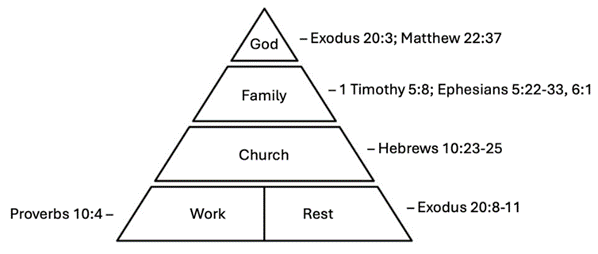
The roles, duties, and responsibilities God has given to humanity (which includes you) are good yet unequal; some are greater than others. Part of living a life of wisdom and godliness is living with this order of priorities intact.
There may be some days when you’ll need to work late because of a special deadline or project, and this will mean you’re unable to eat with your family or put your kids to bed. God understands that. You might also have a job (for example, in the emergency services) where you’re unable to attend church every Sunday morning because of a special calling you possess to preserve life and good order in society. God understands that, too. Except for maintaining God at the top, momentary occasions for re-ordering priorities are part of living in a busy world and balancing God’s many blessings, and that’s a good thing! However, they are exceptions that prove the rule, and brief interruptions to the superseding hierarchy.
To avoid burnout, it’s important to maintain consistency in our lives while allowing for occasional flexibility for things that have God-given or God-driven reasons. Consider planning your days and weeks to protect what is most important and to return to your routine after any temporary disruptions. By doing this, you prevent short-term pressures from becoming long-term patterns of overwork.
At the heart of the matter, considering our priorities will inevitably involve us saying ‘No’ to things. This can be difficult for people who are often tempted to overwork and stress, but it’s important. Avoiding burnout often means ‘taking your foot off the gas pedal’ in different areas of life. Allow slowness and rest into your schedule. We might need to step back from different responsibilities to allow ourselves to prioritise the most important things. After all, every ‘Yes’ is a ‘No’ to something else, and every ‘No’ is a ‘Yes’ to something else.
The God of Discipline
God is a God of discipline, desiring his people to exercise discipline in their lives. Not only is wisdom the task of recognising our priorities (as we’ve seen), it’s also the task of disciplining ourselves to ensure these priorities remain secure. We need to be disciplined with our priorities and habits to strike a balance between life’s blessings and pressures. The book of Proverbs is an excellent resource for understanding discipline.
Proverbs tells us that discipline is about training consistency, cultivating godly habits, and having the self-control to keep oneself from danger or sin. Proverbs 12:1 says, “Whoever loves discipline loves knowledge, but he who hates reproof is stupid.” Discipline is the backbone of a balanced life, which, by the indwelling power of the Holy Spirit, equips us to order our days, manage responsibilities, and maintain our spiritual, mental, and physical health. Without it, even the most well-intentioned efforts can become chaotic or unsustainable.
Proverbs also teaches us that discipline is crucial for managing time, energy, and priorities, allowing us to pace ourselves, plan effectively, and avoid the extremes of overwork on one hand, or neglect on the other. Proverbs 6:6 says, “Go to the ant, O sluggard; consider her ways, and be wise. Without having any chief, officer, or ruler, she prepares her bread in summer and gathers her food in harvest.”
Just as the ant prepares in advance, disciplined people plan their work and activities ahead of time, anticipating challenges and making sustainable choices to avoid burnout. While our culture tells us that we’re being ‘tough’, ‘successful’, or ‘strong’ for our overwork (which leads to burnout), we see that true strength and wisdom involve carving out time for rest or other activities to help sustain our work and life.
—
Reflection Questions:
- Order: What changes to your rhythms and routines could you make to compartmentalise your life and avoid burnout?
- Priorities: Looking back over the past few weeks, how has your time reflected your priorities? What priorities need to shift up or down to ensure you’re not overworking?
- Discipline: What does godly discipline look like in your current season of life? How might practising consistency and self-control protect you from burnout?
- Looking at your overall lifestyle, where do you see an imbalance (too much work, too little rest, or neglected spiritual habits)? What one intentional step can you take this week to realign your order, priorities, and discipline with God’s design and wisdom?
—
Part 3: Work, Family, and Rest
In Part One, we reminded ourselves of the good and gentle character of God who calls us to find refreshment in him. In Part Two, we considered how God has established (1) order, (2) priorities, and (3) discipline for a sustainable life and to avoid overwork. Now, in Part Three, we look at the two most significant facets of our lives that need the most attention and therefore require balancing correctly for a healthy lifestyle: work and family.
Work
Avoiding burnout doesn’t just mean preventing work hours from overspilling into other areas of our lives; it also means working well, in the first instance, according to how God commands us to work. When we work with a biblical perspective and according to biblical principles, we’ll find that our work life can become far more sustainable and enjoyable.
There are so many good Christian books on the topic of work, so we’re not going to study the topic in-depth. Here are just a few biblical principles to remember in our work:
1. Work with Purpose
“And whatever you do, do it heartily, as for the Lord and not for men.” – Colossians 3:23
We need purpose in our work, and work without purpose will quickly become draining and monotonous, ultimately leading to burnout. When we understand the motivations for our efforts-whether it’s providing for our family, serving others, or advancing the Kingdom of God-we transform our work from being a mere obligation into becoming a meaningful contribution in God’s good world.
Ultimately, Paul tells us in Colossians 3:23 that our work is for Christ himself, not for any human master. We work because Christ tells us to work and thereby to worship him. Paul also writes in 1 Corinthians 10:31, “So, whether you eat or drink, or whatever you do, do all to the glory of God.” Our purpose in work gives our work direction, fuels our perseverance, and helps us endure seasons of difficulty with hope.
Work becomes dangerous when it turns into an idol-something we put before God in our hearts or lives. Success, status, recognition, or money can quickly become our primary or ultimate purpose in our work. When this happens, it’s a perfect recipe for burnout. How amazing it is that God’s design for work-working for him and not for ourselves or others-leads us to a healthier mindset and spirit.
We can avoid overwork, stress, and burnout when we remember we’re working for our sovereign and good God. Make every effort to replace the fear of man or the fear of failure with the fear of God. Make serving him your primary motivation, thereby infusing all you do with significance and satisfaction. Serve the Creator rather than being enslaved to the created.
2. Work with Joy
“Serve the LORD with gladness!…” – Psalm 100:2
As pastor and author John Piper teaches, God is most glorified in us when we are most satisfied in Him (2012). Indeed, bringing true glory to God will inevitably entail bringing true and lasting joy to us, since God is Joy. God desires that our work be joyful (Neh. 8:10). Working with joy doesn’t mean our work is always easy or effortless, but it does mean that we can experience satisfaction, peace, and strength as we serve Christ in our work.
When we work with a daily reminder of the gospel of Jesus Christ-our forgiveness of sins through Christ’s death, resurrection, and ascension-we can remember who we are in Christ and approach each day with a refreshed heart. Lasting, deep joy (not transient and surface-level happiness) counteracts stress, fatigue, and cynicism and gives us endurance to continue faithfully and even inspire those around us with the gospel. When we work with joy in Christ, we can find daily strength to work well from a place of refreshment and peace.
3. Make Work Worshipful
Serving Christ in our work makes our work worship. Furthermore, having joy in Christ and the gospel in our work also transforms it into worship. However, it is easy for the day’s stresses and busyness to overpower our joy. When stress accumulates without relief, it becomes one of the most common burnout causes, especially in seasons where responsibilities feel unending or emotionally heavy.
One key part of burnout treatment involves learning how to treat work not merely as a demand but as an act of worship. When we remember that our work is service to Christ, we engage with it differently: instead of striving for perfection or approval, we seek faithfulness and grace.
What practical steps can we take to ensure we’re not drifting from worship during our work? Consider these:
– Begin and end each workday with prayer, asking God to guide your decisions and attitudes. You can also pray before and after key work tasks or meetings.
– Build godliness into your daily routines: review emails and reports carefully before sending, speak truthfully in meetings, and gently correct any mistakes instead of covering them up. You can keep a small note or phone reminder that says, “Work with integrity,” “Work with joy,” or “Work with patience.”
– Take moments during the day to notice and celebrate progress, however small, and write down things you’re grateful for in a journal or planner.
– Schedule regular breaks and protect these times from distractions. Healthy boundaries are one of the simplest and most biblical ways of how to treat burnout, especially when you’re experiencing emotional fog, irritability, or slowed productivity-very common physical symptoms of burnout.
– Recognise when you’re entering stress and then: (1) delegate work to others, (2) ask for help, (3) pay attention to how stress manifests physically or emotionally. Physical symptoms of burnout might show up as headaches, tension, disrupted sleep, low appetite, chronic fatigue, or irritability. Learning to identify early warning signs is a powerful tool in burnout treatment.
– Reflect weekly (perhaps with your spouse) on how your work aligns with God’s purposes.
Ask how your work honoured God and served others. You can journal or discuss with a trusted mentor to keep an eternal perspective on your work.
Creating worshipful routines does not remove all stress, but it gives you a way to work with God’s presence, not apart from it, which is one of the strongest protections against emotional and spiritual exhaustion.
4. Work with Rhythms of Rest
Even the most meaningful and joyful work can become draining when our days lack boundaries and rhythm. God never designed us to work endlessly at full capacity. A great deal of burnout treatment in Christian wisdom begins with learning how to treat burnout not only emotionally but physically and practically. When we add intentional rhythms of rest into our weeks and our work structure, we actively prevent the slow accumulation of stress that leads to both emotional exhaustion and physical symptoms of burnout.
God built rhythm into creation itself: six days of labor and one day of rest. Rest is not downtime from “real” work-it is part of God’s design to make productivity sustainable. Without healthy rhythms of sleep, meaningful breaks, worship, and Sabbath-style reflection, even enjoyable work becomes heavy, overwhelming, and spiritually dull.
Rest also trains us to trust God. When we stop striving, we declare that we are not God-we are finite, limited, embodied creatures who need restoration. Preventing burnout begins with humility: recognizing that our bodies, minds, and emotions require rest and that refusing to rest is not a sign of strength but a sign of spiritual imbalance.
To make rhythms of rest part of your routine, consider:
– Protecting Sunday as a true Sabbath day rather than a “catch up” day.
– Scheduling weekly or daily breaks that are non-negotiable.
– Practicing sleep hygiene, physical movement, quiet mornings, slow evenings, or moments of solitude.
– Limiting work hours for seasons of recovery if you are already experiencing physical symptoms of burnout – headaches, muscle tension, chronic fatigue, irritability, or disrupted sleep are your body’s early warning signs that internal pressure has reached unhealthy levels.
For many Christians, learning how to treat burnout does not begin with quitting a job or abandoning responsibilities. Instead, it usually starts with restoring rhythms of rest, addressing emotional exhaustion, and paying attention to the early physical symptoms of burnout.
When we recover through rest, we return to work with clarity, spiritual vitality, renewed joy, and deeper worship. Rest does not weaken productivity – it strengthens endurance.
Family
Balancing family with your other commitments might not be a problem for you. Conversely, it might be your biggest stressor and burden. Often, when we’re working at full capacity for protracted periods, it can become easy to neglect our families, even if we think we’re spending a lot of time with them. This is one of the most common causes of relationship burnout, especially when emotional presence is missing even though physical presence is there. Something my wife and I have found helpful in our marriage is identifying each other’s ‘love languages’. Everyone has a love language (how they show love to others and/or how they feel loved by others), and understanding love languages in others-such as our spouse or children-helps us to ensure they don’t feel neglected by us.
Pastor Gary Chapman (1992) identifies five love languages. He argues that God, in His infinite beauty and creativity, has caused each of us to be different in how we give and receive love and affection. Because of sin, however, it’s all too easy to misjudge one another’s love languages and so to hurt or neglect them when we’re really trying to show love. Neglecting this emotional awareness can lead to stress and misunderstanding in families, a subtle form of relationship burnout that often goes unnoticed until someone finally expresses how overwhelmed or unseen they feel.
Chapman’s love languages are:
- Words of Affirmation—Expressing love through spoken or written encouragement, compliments, and kind words. For example, saying, “I really appreciate how hard you worked today,” or leaving an encouraging note.
- Acts of Service—Showing love by doing practical things that help or serve others. For example, washing the dishes, cooking a meal, or helping with errands can be actions that communicate care and affection.
- Gifts—Expressing love through thoughtful (not necessarily costly!) gifts, even on ordinary days.
- Quality Time—Showing love by giving someone your full, undivided attention. For example, having an unhurried conversation, sharing a meal without distractions, taking a walk together, or watching a movie.
- Physical Touch—Communicating love through physical closeness and (appropriate!) touch. For example, a hug, holding hands, or a reassuring pat on the back.
Busy individuals are often so task-oriented that they can find themselves rushing from one thing to the next, seeing family love as another box to check. (It’s sad and it’s sinful, but it’s true.) People on the verge of burnout often think they’re loving their family well when, in reality, they’re neglecting them. As a result, the emotional struggles at home compound with the work pressures beyond the home, and stress levels escalate. Suddenly, the home no longer becomes a safe and restful space but a place where, once again, we can feel that we’re managing impossible expectations. When this cycle continues for a long period of time, it can lead to emotional burnout, where the home feels heavy and draining rather than life-giving.
Prioritising family and loving them well will help us avoid burnout and strengthen our marriages and relationships. Take the time to understand both your own and your family’s love languages to ensure love is being communicated aptly. This will not only refresh you but also refresh those around you, creating an emotionally healthy home and lifestyle. It’ll require humility and patience to understand others’ needs, but the Holy Spirit equips us for this task (Gal. 5:22-23).
—
Reflection Questions:
- How can Colossians 3:23 (“And whatever you do, do it heartily, as for the Lord and not for men”) and 1 Corinthians 10:31 (“So, whether you eat or drink, or whatever you do, do all to the glory of God”) help you to find purpose in your work and avoid burnout?
- How does the fear of man or the fear of failure influence your stress levels? How can remembering the gospel day by day help avoid idolising work and prevent it from leading to burnout?
- What practical steps can you implement in your daily work routine to maintain joy and worship in your tasks?
- How well do you understand the love languages of your spouse, children, or close family members, and how might applying this understanding improve your relationships and reduce stress at home?
—
Part 4: The Church and Healthy Living
Our secular Western societies tell us that for a happy lifestyle, we need healthy bodies and minds. We can read numerous books and articles on the importance of eating well, exercising, and even entertainment in maintaining a happy and sustainable life, as well as avoiding overwork and stress. These are wonderful things, and ensuring our bodies and minds are healthy is a cornerstone for avoiding stress and burnout. But we mustn’t forget the spiritual dimension, too. After all, we’re embodied spirits.
Did you know that the local church is integral to your growth as a person? That’s because the local church is integral to your growth as a Christian-as an embodied soul, a person made in the image of God and saved by the amazing work of Jesus Christ. As Christians, we’re commanded to grow in our spiritual maturity and holiness (Col. 1:28), and this often occurs in the context of the gathered church. The New Testament letters themselves, which command and encourage our spiritual health and discipline, were primarily written to gathered churches. Spiritual health is a group project!
There are many helpful Christian tools, resources, and programmes out there. You can enjoy spiritual growth and nourishment by reading good Christian books with a Christian friend, or you can participate in accountability groups with close believers, where you share your burdens and struggles. These are all great things which I encourage us all to do, but did you know that the gathered, corporate church is the only discipleship tool commanded in the New Testament?
So, how does the church help us to stay spiritually healthy in a way that flows out into other aspects of ourselves? How does the church help us to avoid burnout?
Feeding on God’s Word
“Man shall not live by bread alone, but by every word that comes from the mouth of God.” – Matthew 4:4
Coming to church each week, we are (hopefully!) sitting under good, soul-nourishing preaching. The best preaching is expositional preaching—the ‘exposing’ of God’s Word where a passage of Scripture (not merely a topic or an idea) is closely, carefully, and faithfully brought out, taught, and applied. The regular, Spirit-empowered preaching of God’s Word has God’s power to grow us by re-centering us on God’s truth. This helps to counteract the lies told to us by our world or our bosses about the necessity of overwork and how our value is tied to our productivity. This rhythm pulls us back from the edge of burnout by restoring our perspective and identity in Christ.
Make Church Restful
“Not neglecting to meet together, as is the habit of some, but encouraging one another, and all the more as you see the Day drawing near.” – Hebrews 10:25
Church attendance and involvement are a priority, regardless of your convictions on Sabbath rest and its relevance today. For most Christians, regular church attendance naturally complements their day of rest. It provides a healthy, God-given rhythm for spiritual, emotional, and relational renewal. Hebrews 10:25 reminds us that meeting together as a church should encourage us. It should be a moment in our week that energises us and spurs us on to love and good works, not one that drains us.
When church is approached rightly as a place of rest and renewal, it becomes a safeguard against burnout and a haven for us to renew our strength, preparing us to face the week ahead with clarity, peace, and joy. Those of us who are prone to burnout likely are those who find it difficult to say ‘No’, and this includes our response to church activities, too. Identify periods when you’re prone to stress and overwork, and be willing to reduce your involvement in the serving rota as needed. This doesn’t mean pulling back from your involvement in church. In fact, a good way we can avoid burnout and free up our schedules is by utilising our natural involvement and discipleship of other believers instead of focusing on programmes.
Paul writes in Galatians 6:10, “So then, as we have opportunity, let us do good to everyone, and especially to those who are of the household of faith.” Our spiritual investment in others within our churches should be done “as we have opportunity”, and this will ebb and flow with the rhythms of our life. Consider involving others in what you’re doing, or phone calling those who need encouragement while commuting, and model what it looks like to be a follower of Christ in different (even stressful) areas of your life—helping others to follow Christ better. Biblical, life-on-life discipleship will be organic, not programmatic and rigid.
Commitment
“Bear one another’s burdens, and so fulfill the law of Christ.” – Galatians 6:2
Biblical church membership means being part of the local Body of Christ—not merely ‘going to’ church but being ‘part of’ the church as a present and committed member. Joining a church, and not merely attending one, is part of what it means to live as a Christian. When believers are deeply connected to their local church, they gain a network of people to share burdens, pray for them, and offer practical help. Sadly, I’ve seen far too many people neglect membership in their local church and suffer as a result. When times of difficulty, suffering, or ill health come, they’re unable to access help from a web of support, rooted in covenant love, which was persistently offered to them and which they persistently rejected.
It’s important that we share our burdens with one another in our church. If you’re struggling with stress at work, family challenges, or emotional exhaustion, confide in a trusted church member. The Bible says that’s what they’re there for (Gal. 6:2)! Not only can a fellow church member pray with you and regularly check up on you, but they might offer to help you practically. Members might offer practical help, such as babysitting for an overwhelmed parent, running errands for someone out of town, or helping with household chores during a busy season.
It’s also important (and godly) to have the humility to be helped. Many people hesitate to let others in, fearing they’ll be a burden. But God calls us to humility and interdependence. Accepting help, and even showing signs of weakness, isn’t sinful; it’s obedience to Jesus Christ and part of ‘doing church’ together (Phil. 2:4; 1 Thes. 5:11; Heb. 10:24-2). Examples include allowing a friend to help with meal prep during a stressful week, coming over to play with your kids while you’re on a work call, or even sharing financial or logistical needs with a trusted church member. If burnout is going to lead to spiritual dryness, wavering faith, diminished prayer life, cynicism, and neglect of God’s Word and God’s people, then avoiding it is a spiritual priority the church can help you with.
—
Reflection Questions:
- How can regular involvement in the local church help you maintain spiritual, emotional, and relational health, and in what ways could neglecting church attendance contribute to burnout?
- In what practical ways can you make your church experience a time of rest and renewal rather than an added source of stress? Consider both your participation and your mindset.
- How can life-on-life discipleship and sharing burdens with other believers (Gal. 6:2; Phi. 2:4) protect you from burnout? Can you think of specific examples in your life where this has happened or could happen?
- Do you have supportive relationships in your church? Think about whether you have people who notice when you’re struggling, who can pray for you, and offer encouragement or practical help.
—
Conclusion: Rest, Recovery, and a Call to Humility
Think back to Sally, John, and Annie from the start of this field guide. We may not lead a team of doctors, run a busy IT department, or chase breaking news, but we can all relate to feeling stretched, persistently stressed, weary, and spiritually drained amidst life’s busyness. I’m sure many of us can see aspects of ourselves in them.
Burnout can manifest differently for each of us, and the warning signs vary according to individual personality type and circumstances. It’s so important for our own health (mental, emotional, physical, and spiritual) and the health of those around us that we identify when we’re on the path to burnout and take active steps to avoid it. When workplace burnout becomes chronic, we need to pursue intentional burnout recovery, exploring rhythms of rest, support, spiritual renewal, and healthier boundaries.
Sally, John, and Annie remind us that burnout isn’t just a workplace problem, or a family problem, or a life-balancing problem; it’s a spiritual problem, and that means the solution will be deeper than a vacation or even a healthier routine. Whether you are experiencing burnout in work, or carrying emotional burdens from home, learning how to deal with burnout must include humility before God, repentance from self-reliance, and a rediscovery of God’s rhythms of work and rest.
To avoid burnout, we must follow Scripture’s teaching and return to God’s design for our lives-his order, priorities, and discipline. Particularly, making deliberate and intentional steps to integrate wholly and biblically into our church family, in covenant love and relationship, provides us with a spiritually healthy foundation for work and rest. In many cases, recovery from burnout is not merely physical; it is relational, emotional, and deeply spiritual, and the local church becomes a vital place of healing.
God is omnipotent; we are not. God is omnipresent; we are not. God is unbound by time; we are bound by time. God is infinite; we are finite. God’s work is indispensable and eternal; ours is dispensable and limited. Let’s wisely apply the soul-refreshing and soul-nourishing instruction of God’s Word not only to avoid burnout but to thrive at work, home, and church.
References
- Chapman, G. (1992). The 5 Love Languages: The Secret to Love that Lasts. New York City, NY: Northfield Publishing.
- Piper, J. (2012). ‘God is Most Glorified in Us When We are Most Satisfied in Him’. Desiring God. Available at https://www.desiringgod.org/messages/god-is-most-glorified-in-us-when-we-are-most-satisfied-in-him [accessed on October 23rd 2025].
- World Health Organization. (2019). ‘Burn-out an “occupational phenomenon”: International Classification of Diseases’. Available at https://www.who.int/news/item/28-05-2019-burn-out-an-occupational-phenomenon-international-classification-of-diseases [accessed on 24th October 2025].
About the Author
JOSHUA GEORGE-SMITH is an assistant minister in Cardiff, Whales, where he, his wife, and daughter live.
#57 Wisdom In The Bible: How To Gain Godly Wisdom
Part I: The Fear of the Lord—The Foundation of True Wisdom
The first book of the Bible starts with the words “In the beginning, God created the heavens and the earth” (Gen. 1:1). From this simple yet profound introduction, we learn that there is one God, and he created all things. Some verses later, we read that “God created man in his own image” (Gen. 1:27). Human beings were created to reflect God himself. Human beings are not divine but were created in the image of God. Since God is the creator and we are creatures made in his image, then, if we want to know ourselves, we must know who God is.
The Bible also teaches that “the Lord by wisdom founded the earth” (Prov. 3:19), “in wisdom you have made them all” (Ps. 104:24), and that all things were made “for its purpose” (Prov. 16:4). This rich wisdom literature reminds us that “God saw everything that he had made, and behold, it was very good” (Gen. 1:31).
Imagine a piece of art, perhaps a painting or a sculpture. An observer can study its colors, textures, and lines, and offer theories about its meaning and purpose. However, their observations are mere speculations or, at best, deductions based on what they can see. Only the artist can say what it is and what purpose they had behind their work. If this is true for a human author who is limited and flawed, how much more can we say about a perfect God who is the author of all things that exist?
To sum this up, then, there is one God who created all things wisely and good for a purpose which he himself determined. Human beings are part of God’s wise and good creation, made in his very own image. Therefore, to know God is necessary in order to know ourselves, our purpose in life, and, consequently, to pursue wisdom. To walk this path, we often look to the wisdom of Solomon as a guide for our own journey.
Entire books have been written on the attributes of God, and our space in this life skill guide is very limited. But I want you to take some time to think about what the Bible teaches about the one true God. God is spirit, transcendent and majestic. He is infinite, self-sufficient, and immutable. Although he is knowable, God is incomprehensible (above what our minds can fully understand). God is omnipotent (all-powerful), omniscient (all-knowing), and omnipresent (not limited to space or time). He created, sustains, and rules over all things; His nature provides the only true wisdom for leadership and influence. God is also holy and just. He is perfectly pure, and he justly punishes all evil. This divine standard helps us understand the contrast of emotional intelligence vs spiritual wisdom.
The one true God is glorious beyond imagination! He was not created by us or in our image. He cannot be controlled or domesticated, nor does he need his creatures to exist—he alone has life in himself! Despite our limited understanding, the only proper response we can offer to God’s perfect attributes is a profound sense of “awe”. That is, the one true God is to be feared (respected).
No wonder the Bible affirms that “the fear of the Lord is the beginning of knowledge” (Prov. 1:7), and “the beginning of wisdom” (Prov. 9:10). The fear of God is the proper response of human beings before God and his works. But what does it mean to fear God? Isn’t fear a bad thing? Understanding discernment vs wisdom christian helps us see that this fear is the foundation for finding peace through Godly wisdom.
We aren’t talking fear like what you feel when you think there is a monster under the bed. This fear of the Lord consists in having reverent awe before God. “Let all the earth fear the Lord; let all the inhabitants of the world stand in awe of him!” (Ps. 33:8). The fear of God leads to obedience, love, and worship. As we read in Deuteronomy 10:12: “And now, Israel, what does the Lord your God require of you, but to fear the Lord your God, to walk in all his ways, to love him, to serve the Lord your God with all your heart and with all your soul”? This was God’s plan since he created us in his image—that we fear him and live for his glory.
There is bad news, though. After Adam and Eve ate of the fruit God had forbidden them to eat, we read in Genesis that they hid themselves from God (Gen. 3:8). When Adam was questioned why he hid himself, he said: “I was afraid” (Gen. 3:10). God had given Adam a command, and he disobeyed. God is holy and just, and he had told Adam that the consequence of his disobedience was death (Gen. 2:17). A holy God cannot have any communion with sin. A just God must punish all sin. Once Adam sinned, fear remained the only proper response to God. In this fall, humanity lost its wisdom as a protection from deception. But now, as a sinner, Adam’s fear was no longer just reverence and awe. Now, Adam (and every human who came after him) must fear God’s judgment and condemnation.
The prophet Isaiah also knew something of fear when he “saw the Lord sitting upon a throne, high and lifted up” (Isa. 6:1). In his vision of God’s glory, Isaiah saw angels who stand humbly before God and worship him. In contrast, Isaiah responded to the sight of God’s glory with terror: “Woe is me! For I am lost; for I am a man of unclean lips, and I dwell in the midst of a people of unclean lips, for my eyes have seen the king, the Lord of hosts” (Isa. 6:5). In God’s mercy, Isaiah did not receive what he deserved. In God’s grace, we read “your sin is taken away, and your sin atoned for” (Isa. 6:7). This encounter shows us how to gain wisdom from God through trials and the weight of our own sin.
The Bible teaches that “all have sinned and fall short of God’s glory” (Rom. 3:22), “none is righteous, no, not one” (Rom. 3:10), and “all have turned aside” (Rom. 3:12). After Adam sinned, all human beings were born into the same situation. We all failed to respond appropriately to who God is. In our foolishness, we all failed to fear, obey, love, and worship him. And because he is holy and just, all people stand guilty and are justly condemned before God. Just as Isaiah, we all need God’s mercy and grace.
In conclusion, we all failed to be wise as we were created to be in the reverent fear of God and for his glory. We cannot perfectly respond with awe and obedience to the holy, just, and glorious God who created us in his image. As sinners, the fear of the Lord starts as a fear of judgment and condemnation because all have fallen short of his glory. Nonetheless, this fear continues to be the beginning of wisdom, because once we face the reality of who God is (holy and just) and who we are (sinners), it leads us to the heart of the Christian faith: we need a Savior. We need Jesus Christ, who is the perfect embodiment of wisdom, but also in whom our broken relationship with God is restored. He is the one who took our condemnation upon himself so that we might be reconciled to God. Through Him, we begin applying Biblical wisdom to daily decisions and find Biblical wisdom for difficult situations. This is how we start overcoming foolishness in Christian life and cultivating a teachable spirit, starting first with a humble prayer for wisdom.
—
Reflection Questions:
- How does having wisdom differ from simply having knowledge?
- Why is it necessary to know who God is before we can know ourselves?
- What is the problem we face when we learn that God is holy and we are sinful? What is the solution?
—
Part II: Christ—Wisdom Incarnate and Redeemed
What cannot be said of any other human being, the Bible says about Jesus: “In whom are all the riches of wisdom and knowledge” (Col. 2:3). The necessary implication is that in the pursuit of Biblical wisdom, we must focus our attention on the person of Jesus. It is in this man that wisdom is found. But Jesus is not just the means to achieve wisdom, as if we come to him just to receive something. It is in him that wisdom is found. In other words, he is wisdom. And since Jesus is wisdom, the pursuit of wisdom is intrinsically a pursuit of him as the end goal. So, it is not possible to pursue wisdom without pursuing Jesus himself and learning how to be wise through His example.
But what makes Jesus worthy of such devotion? Before we move forward, we must stop and ask a very important question: Who is Jesus? This was the same question Jesus himself asked his disciples: “Who do you say that I am?” (Matt. 16:15). And Peter famously and rightfully affirmed: “You are the Christ, the Son of the living God” (Matt. 16:16). This affirmation sets Jesus apart from any other human being that has lived on earth and clarifies what is the difference between worldly wisdom and Heavenly wisdom.
Jesus is the Son of God. In simple terms, being the Son of God means to be God, i.e., God, the Son. This is clear in Scripture. The Jewish leaders wanted to kill Jesus because “he was even calling God his own Father, making himself equal with God” (John 5:18). Interestingly, John’s gospel starts this way: “In the beginning was the Word, and the Word was with God, and the Word was God” (John 1:1). Before he became a man, he was eternally God with the Father and the Holy Spirit.
The Promised Seed and the Spirit of Wisdom
But Peter also confessed that he was the Christ. Christ means Messiah, the anointed one. Jesus was the fulfillment of God’s promises that go all the way back to the Garden of Eden when Adam sinned. When God cursed the serpent, he said: “I will put enmity between you and the woman, and between your offspring and her offspring; he shall bruise your head, and you shall bruise his heel” (Gen. 3:15). God said that the serpent would be defeated one day by the seed of the woman. The solution for the sin of Adam and Eve was promised by God in the Garden of Eden. This is the reason why the Old Testament is full of genealogies. Most of these genealogies follow the promised seed as history unfolds and God’s plan to save humankind comes to pass. We progressively are told that this seed will be a descendant of Abraham, Isaac, Jacob, and Judah. Fast forward in time, God reveals that the promised seed will be a descendant of King David and Solomon. Later, Isaiah prophesied about the seed with these words: “And the Spirit of the Lord shall rest upon him, the spirit of wisdom and understanding, the Spirit of counsel and might, the Spirit of knowledge and the fear of the Lord. And his delight shall be in the fear of the Lord” (Isa. 11:2-3a).
The promised seed would be a man, just as God intended a man to be when he created mankind—a man whose delight was in the fear of the Lord—a man who would have a Spirit of wisdom and understanding. We read in the gospel of John: “And the Word became flesh and dwelt among us, and we have seen his glory, glory as of the only Son from the Father, full of grace and truth.” (John 1:14). It is only in the New Testament that God’s eternal and wise plan of salvation is fully revealed. This revelation is essential for seeking Godly wisdom in a confused world.
Because Jesus is God incarnate, “he is the radiance of the glory of God and the exact imprint of his nature” (Heb. 1:3a). “He is the image of the invisible God… for in him all the fullness of God was pleased to dwell” (Col. 1:15a, 19). He was fully human, “yet, without sin” (Heb. 4:15). This means he lived wisely, in the fear of God, a perfect life of obedience to the Father. His thoughts were pure, his words were true and always appropriate, and his actions were perfect. At his baptism and transfiguration, God the Father said about Jesus: “This is my beloved Son, with whom I am well pleased” (Matt. 3:17; 17:5). No one else but God the Son could be the perfect image of God and please the Father completely, demonstrating true Godly wisdom.
Redemption and New Life
But Jesus’ perfect life is not enough to remove the condemnation we deserve because of our sin. The penalty for sin is death. By God’s grace, Jesus not only lived a perfect life, but he died and resurrected. In his death, he paid the penalty for sins. The New Testament affirms that “while we were still sinners, Christ died for us” (Rom. 5:8), “Christ died for our sins” (1Cor. 15:3). Not only did he die for sinners, but he also died in their place, as a representative. “For Christ also suffered once for sins, the righteous for the unrighteous, that he might bring us to God” (1Pet. 3:18). There was an exchange. Sinners that deserved to be punished are declared just, while Jesus, the only just man who ever lived, was punished in their place. “For our sake he made him to be sin who knew no sin, so that in him we might become the righteousness of God.” (2Cor. 5:21). This exchange is the foundation for finding peace through Godly wisdom.
In his resurrection, he is able to give life to all those whom he represents, who are united to him by faith. We start from a position of spiritual death— “dead in the trespasses and sins” (Eph. 2:1). People are fools by nature, and their hearts are corrupted. The fact that Jesus is an example of wisdom is not enough for someone who is spiritually dead. All people need a new spiritual life. Jesus said that “unless one is born again, he cannot see the kingdom of God” (John 3:3). Jesus resurrected to give sinners, who are spiritually dead, a new life, a new heart, with a new set of desires and the ability to pursue wisdom. This transformation is one of the primary signs of spiritual maturity in a Christian.
Now, you can better understand why Jesus is worthy of our full devotion and is the focus and end goal in our pursuit of wisdom. He “became to us wisdom from God—and righteousness and sanctification and redemption” (1Cor. 1:30). Once God forgives our sins and gives us a new life, the proper and good fear of God is restored, because now we no longer live in the fear of condemnation. In union with Christ, we are now free to live for the reason we were created— to fear God and live for his glory, which is the path to true spiritual maturity.
Let me ask you: have you been born again? Have you repented of your sins and put your faith in Christ for your salvation? Jesus is the only one who can save sinners. He alone can make you wise.
In short, the pursuit of wisdom is the pursuit of Jesus Christ himself, as he is the perfect embodiment of wisdom and the one through whom our broken relationship with God is restored. Through his life, death, and resurrection, Christ redeemed us from the fear of condemnation, allowing us to live in a reverent fear of God and begin to reflect God’s image, which means to become like Christ (Rom. 8:29; 1Cor. 15:49), for God’s glory. This is the heart of wisdom in the Bible.
—
Reflection Questions:
- Why is knowing who Jesus is necessary in order to become wise?
- How do we go from being rebellious and foolish to redeemed and wise?
- Have you trusted in Jesus? If not, what is holding you back?
—
Part III: Prayer—Pursuing Wisdom In the Power Of The Holy Spirit
We start with prayer because it keeps us humble and reminds us that, although the pursuit of wisdom is a command that requires a continuous and deliberate effort on our part (Prov. 4:7; Eph. 5:15), wisdom is a gift that we cannot achieve on our own. “The Lord gives wisdom” (Prov. 2:6). So, James teaches that “if any of you lacks wisdom, let him ask God, who gives generously to all without reproach, and it will be given him.” (Jas. 1:5). This promise shows God’s good desire to give wisdom to those who humbly seek it.
Perhaps the most famous example of someone humbly asking God for wisdom is King Solomon, who recognized that “I am but a little child” (1Kgs. 3:7) and asked God for “an understanding mind to govern your people” (1Kgs. 3:9). And God replied to Solomon: “I give you a wise and discerning heart” (1Kgs. 3:12). Later, we read that as Solomon wisely judges, the people “perceived that the wisdom of God was in him” (1Kgs. 3:28). “And God gave Solomon wisdom and understating beyond measure” (1Kgs. 4:29). King Solomon is a clear example that wisdom is a gift that God gives to those who humbly ask. So, we should pray and continually ask God for wisdom.
At the same time, Paul’s prayer in Ephesians 3 sets a good pattern for our own prayers. The apostle teaches us to pray to the Father: “I bow my knees before the Father” (Eph. 3:14). The purpose is so that “Christ may dwell in your hearts through faith” (Eph. 3:17). But notice what Paul asks the Father: “that according to the riches of his glory he may grant you to be strengthen with power through his Spirit in your inner being” (Eph. 3:16). The power that enables Christ to dwell in us through faith is the power of the Holy Spirit in us. God “is able to do far more abundantly than all that we ask or think” (Eph. 3:20).
In the culture we live in, we are constantly told to believe in ourselves, that if we look inside ourselves, we have all the resources we need to succeed. But if the pursuit of wisdom was something we could achieve on our own, why would we need to ask God to give it to us? Wisdom is a gift of God, which is given to us by the Holy Spirit, and it comes by means of prayer. We pray to the Father that the Holy Spirit might give us wisdom. In order to be wise, we must be filled with the Spirit that can make us wise.
The perfect example of a wise man filled with the Holy Spirit is our Lord Jesus Christ. The gospels show us the centrality of the Holy Spirit in Jesus’ ministry. Let’s use the example of the gospel of Luke. It starts with conception. The angel tells Mary that “the Holy Spirit will come upon you” (Luke 1:35a). The role of the Holy Spirit was not merely that Mary would become pregnant without having sexual relations, but that “the child to be born will be called holy” (Luke 1:35b). What distinguished Jesus from any other man (his holiness), was an act of the Holy Spirit. This holy “child grew and became strong, filled with wisdom” (Luke 2:40). When he was baptized, “the Holy Spirit descended on him in bodily form, like a dove” (Luke 2:22). This descent of the Holy Spirit meant that Jesus was God’s anointed but also his empowerment for his ministry. After his baptism, “Jesus, full of the Holy Spirit… was led by the Spirit in the wilderness” (Luke 4:1), where he would be tempted by the devil. Jesus resisted the devil’s temptations in the desert by the power of the Holy Spirit. After being tempted, we read that “Jesus returned in the power of the Spirit to Galilee” (Luke 4:14). It is in the synagogue that he reads publicly a scroll of the prophet Isaiah that said, “the Spirit of the Lord is upon me” (Luke 4:18; cf. Isa. 61:), which Jesus confirms to be a prophecy concerning himself (Luke 4:21). Jesus was full of the Spirit of wisdom, which Isaiah had foretold concerning the Messiah (Isa 11:2).
In order to become more and more like Jesus, we must also be filled with the Holy Spirit. If we want to pursue wisdom, we must be like Jesus, who was filled with the Holy Spirit of wisdom. So, when Paul prays for the Ephesian church he asks that “that the God of our Lord Jesus Christ, the Father of glory, may give you the Spirit of wisdom and of revelation in the knowledge of him” (Eph. 1:17); and for the Colossian church he asks “that you may be filled with the knowledge of his will in all Spiritual wisdom and understanding” (Col. 1:9).
Similarly, we are exhorted to pray “at all times in the Spirit, with all prayer and supplication. To that end, keep alert with all perseverance, making supplication for all the saints” (Eph. 6:18). And even in our prayers we have the promise that “the Spirit helps us in our weakness. For we do not know what to pray for as we ought, but the Spirit himself intercedes for us with groanings too deep for words” (Rom. 8:26). The Spirit we pray the Father might give us to strengthen us, is the same Spirit that actually prays for us. It seems the same principle was in Paul’s mind when he commands the Philippians to “work out your own salvation with fear and trembling, for it is God who works in you, both to will and to work for his good pleasure” (Phil. 2:12b–13). We pursue wisdom in the certainty that the God who saved us and gave us a new life will not only command us but also guarantee that we are able to obey what he commands.
Let us pursue wisdom by praying at all times for God to fill us with the Holy Spirit. We pursue wisdom by praying, in the certainty that God will grant us what we desire because we pray according to his will.
Now, we must understand that when we pray for wisdom, we are not asking God to give us direct special revelation. Wisdom is what allows us to apply what we know about God and ourselves.2 The wise person is not omniscient, nor does wisdom require direct special revelation. In fact, it is because we do not know all things, nor did God reveal to us all things, that we need the ability to apply what we do know with discernment. The wise person knows that “the secret things belong to the Lord our God, but the things that are revealed belong to us and to our children forever, that we may do all the words of this law” (Deut. 29:29). Wisdom is not about having access to a special secret knowledge hidden from others, but the ability to apply to our lives what God has revealed to us, which leads us to the next point.
—
Reflection Questions:
- Is it normal/natural for you to pray that God would give you wisdom? If so, what kinds of things do you ask God for wisdom for? If not, why not?
- Why do we need to ask God for wisdom even as we’re told to pursue wisdom?
- Who gives us wisdom? How?
—
Part IV: Scripture—The Source and Guide for Wisdom
We have been defining wisdom as the ability that enables someone to apply what they know. Wisdom is more than knowledge, but it cannot be less. In fact, true wisdom presupposes that what we know is true. In order to be wise, we need to be knowledgeable. A good lawyer must know the law of their country and how the judicial system works. In the same way, if the fear of God is the proper response to who God is, then we need to know God in order to respond appropriately. “The fear of the Lord is the beginning of wisdom, and the knowledge of the Holy One is insight” (Prov. 9:10). Only fools despise knowledge.
The question, then, is not whether we need knowledge to pursue wisdom, but how we can know the truth (i.e., how we can have access to an infallible source of knowledge). This brings us back to the crucial distinction of wisdom vs knowledge. In order to be wise, we need to fear God. And in order to fear God, we must know him. We already know that God has revealed himself perfectly in the person of his Son, God incarnate, our Lord Jesus Christ. But how can we know about Christ?
You probably already know the answer to this question. The only reliable and infallible source of knowledge is the Word of God. Although we had to deal with more fundamental aspects first, I have been assuming and saying that Scripture is our source and guide in the pursuit of Biblical wisdom from the beginning of this life skill guide. As I sought wisdom to write these words, I had the concern to explicitly quote Scripture so that you might be convinced by what God revealed. As the apostle Paul reminded his son in the faith, Timothy, who “from childhood you have known the sacred writings which are able to make you wise for salvation through faith which is in Christ Jesus” (2Tim. 3:15; cf. Ps. 119:98-100). This is the primary way of finding wisdom in the Bible.
The Bible is the only infallible source of knowledge because the Bible is the Word of God. “For no prophecy was ever produced by the will of man, but men spoke from God as they were carried along by the Holy Spirit.” (2Pet. 1:21). The Bible was written by men, but what they wrote was revelation from God. While they wrote, they “were carried along by the Holy Spirit.” So, “all Scripture is breathed out by God and profitable for teaching, for reproof, for correction, and for training in righteousness, that the man of God may be complete, equipped for every good work.” (2Tim. 3:16-17). Notice first that, although written by men, the Holy Spirit guaranteed that what was written was the words breathed out by God himself. What is usually referred to as inspiration, the biblical term and image is that of expiration. The words of the Bible are the very words of God, revealing what is the difference between worldly wisdom and Heavenly wisdom. Second, because Scripture is God’s Word, it is profitable in order that we might “be complete, equipped for every good work.” Something that is complete does not need anything to be added. The Bible is, therefore, sufficient to equip us for every good work.
Of course, the Bible does not teach us to ride a bike or to change the oil in our car. The Bible is sufficient to make us “wise for salvation through faith which is in Christ Jesus.” (2 Tim. 3:15). God’s special revelation in Scripture has a very specific purpose: to make us wise. “The testimony of the Lord is sure, making wise the simple” (Ps. 19:7b). As it reveals the truth about God and us, the Bible is both necessary and sufficient to give us the knowledge of the truth in order to lead to salvation, which can only be found by trusting in Christ. This truth is not only valid for our conversion, but also for our growth in the likeness of Christ, especially when applying Biblical wisdom to daily decisions. As our knowledge of Scripture increases, we learn more about God and ourselves; we also learn to trust Christ more.
To sum this up, the pursuit of wisdom is not seeking special revelation, or mystical experiences, or subjective feelings. It is not a secret knowledge reserved for an elite few. Instead, it is revealed truth, openly declared by God through the prophets and the apostles, perfectly embodied in God’s Son, Jesus Christ, and recorded in Scripture. This acts as our wisdom as a protection from deception. God’s Word is to be “a lamp to my feet and a light to my path” (Ps. 119:105). A truth accessible to all who genuinely seek to understand it. The Holy Spirit, who inspired the Word, is the same Spirit who enables us not only to understand but to make us wise.
So, in the pursuit of wisdom it is crucial that you “do not lean on your own understanding” (Prov. 3:5) and “be not wise in your own eyes” (Prov. 3:7). As a Christian, now that you have come to know Christ, you have a special responsibility to “look carefully, then, how you walk, not as unwise but as wise, (…) do not be foolish, but understand what the will of the Lord is” (Eph. 5:15, 17). This is how we begin seeking Godly wisdom in a confused world and learn how to be wise. The will of God, which Paul wants the Ephesians to understand, is God’s revealed will. No wonder Psalm 1 describes a blessed person as someone whose “delight is in the law of the Lord, and on his law he meditates day and night. He is like a tree planted by streams of water that yields its fruit in its season, and its leaf does not wither. In all that he does, he prospers” (Ps. 1:2–3).
If you are reading this life skill guide, you most likely have a Bible (or several) or at least have access to one. So many of us are tremendously privileged that we can own a copy of God’s Word. Let’s make full use of this gift and read, study, meditate, memorize, and intentionally apply God’s Word to our lives by cultivating a teachable spirit. After all, the Word that can make us wise.
Scripture and prayer fit perfectly together. True wisdom is a gift from God—one we cannot earn on our own. Scripture is the source and guide to make us wise. A sincere prayer for wisdom is our constant confession that wisdom belongs to God alone and that we are utterly dependent on his grace. It’s the act of humbly asking the Father, in the power of the Holy Spirit, for the Godly wisdom we desperately need. It keeps our hearts rightly oriented, reminding us that every good and perfect gift, including the gift of wisdom, comes from above.
Let us be a people who are so saturated in the Word and so reliant on prayer that our lives become a living testament to the wisdom that comes from God alone.
—
Reflection Questions:
- How do the Scriptures function as the source of wisdom?
- What do your times in God’s Word look like as of recent?
—
Part V: The Local Church—The Framework for Pursuing Wisdom
Every plant requires a specific amount of sunlight for its growth, the right type of soil to serve as its foundation and provide essential nutrients, and the proper amount of water to nourish and sustain it. Without these essential elements, a plant would wither and die. Just as a plant needs a specific environment to grow, a Christian needs the local church. The local church is the proper framework where a Christian grows in knowledge and wisdom (i.e., in the image of Christ).
The Christian identity is communitarian. Once we are united to Christ, we are united to all those whom he represents. The New Testament uses several metaphors to help us understand this. For example. . .
— A people – “But you are… a holy nation, a people for his own possession… Once you were not a people, but now you are God’s people” (1Pet. 2:9-10; cf. Eph. 2:19; Tit 2:14).
— A temple – “In him you also are being built together into a dwelling place for God by the Spirit” (Eph. 2:22; cf. 1Pet. 2:5).
— A family – “the household of God, which is the church of the living God” (1Tim. 3:15; cf. Gal. 6:10; Eph. 2:19).
— A body – “For just as the body is one and has many members, and all the members of the body, though many, are one body, so it is with Christ. For in one Spirit we were all baptized into one body” (1Cor. 12:12-13a; cf. Rom. 12:4-5; Col. 1:18).
— A flock – “Pay careful attention to yourselves and to all the flock, in which the Holy Spirit has made you overseers” (Acts 20:28).
Membership in a local church is essential in the pursuit of wisdom.3 When Paul prays for the Ephesians, his desire is that “Christ may dwell in your hearts through faith” (Eph. 3:17) so that they may be able to comprehend the love of Christ “with all the saints” (Eph. 3:18). Christians can only properly comprehend the love of Christ together with other Christians. Just a few verses later, Paul tells them that God gave gifts to the church so that we might be like Christ. God gave pastors to the church “to equip the saints for the work of ministry, for building up the body of Christ, until we all attain to the unity of the faith and of the knowledge of the Son of God, to mature manhood, to the measure of the stature of the fullness of Christ,” (Eph. 4:12–13). If you want to be wise, you must become more like Christ. You become more like Christ in the context of his body, the church, where we are built up together. A Christian separated from a local church will gasp for spiritual life, much like a fish on dry land.
As members of the local church, we worship God together. Corporate worship is one of the ways we are shaped together in Christ’s likeness. As Paul says to the Ephesians, “look carefully then how you walk, not as unwise but as wise, (…) be filled with the Spirit, addressing one another in psalms and hymns and spiritual songs, singing and making melody to the Lord with your heart” (Eph. 5:15-21). In this text, Paul relates wisdom (walk as wise), being filled with the Holy Spirit, and corporate worship (represented in congregational singing). This should come as no surprise. The proper response to God is to worship him.
It is in the context of corporate worship that the Word is preached. As we established above, Scripture is the only infallible source of true knowledge. Corporate worship is God’s appointed means for his Word to be proclaimed and applied to our lives. By sitting under the faithful exposition of Scripture, we gain the knowledge that is necessary for wisdom. It is through the preaching of the Word that God teaches his people, corrects our false beliefs, and makes us like Christ. As Jesus prayed to the Father: “Sanctify them in the truth; your word is truth.” (John 17:17).
It is also in corporate worship that we obey the ordinances. The Lord Jesus instituted two ordinances to be administered by the local church: baptism and the Lord’s Supper. They are means by which the gospel is made visible—we see, taste, and feel the gospel. Of course, the baptismal water, the loaf of bread, and the cup do not have magical properties, but they were given to build us in the faith. In baptism, we see the gospel represented in the immersion of the repentant sinner. Baptism confirms and proclaims that the sinner was united to Christ in his death and resurrection (Col. 2:11–12; cf. Rom. 6:3–4). In the Lord’s Supper, we see the gospel portrayed when a local church, as one body, partakes of the Bread and the Cup (1Cor. 10:16-17). The Lord’s Supper is a memorial meal in which the body of Christ remembers Christ’s body, which he gave in the place of his people, and Christ’s blood, which he shed for the forgiveness of our sins.
Each local church also has pastors or elders. They are Christ’s gift to the church with the purpose that we might become like him. “And he gave… shepherds and teachers, to equip the saints for the work of ministry, for building up the body of Christ” (Eph. 4:11-12). They are to be men of exemplary, Christ-like character who are able to lead God’s people by God’s Word. “An overseer must be above reproach… able to teach” (1Tim. 3:2). He must be above reproach because he has to set an example to the church, being able to say like Paul: “Be imitators of me, as I am of Christ.” (1Cor. 11:1; 1Cor. 4:16; Phil. 3:17). Just as Paul, Timothy is also exhorted to “set the believers an example in speech, in conduct, in love, in faith, in purity” (1Tim. 4:12b). Godly pastors exercise their authority for the good of the church. Church members are commanded to “obey your leaders and submit to them, for they are keeping watch over your souls.” (Heb. 13:17a).
But, as important as pastors are in the life of the church, it is clear in the New Testament that all the members are actively involved in the ministry of the local church. First, realize that pastors were given “to equip the saints for the work of ministry, for building up the body of Christ” (Eph. 4:12). The body of Christ is built when the work of ministry is accomplished by the saints who were equipped by their pastors.
All the members of a local church should be committed to one another, helping one another to pursue wisdom, to be like Christ. God’s Word exhorts Christians to “love one another” (John 13:34), “serve one another” (Gal. 5:13), “bear one another’s burdens” (Gal. 6:2), “bearing with one another” (Eph. 4:2), “be kind to one another… forgiving one another” (Eph. 4:32), “comfort one another” (1Thess. 4:18), “encourage one another and build one another up” (1Thess. 5:11), “confess your sins to one another and pray for one another” (Jas. 5:16). So, “let us consider how to stir up one another to love and good works, not neglecting to meet together, as is the habit of some, but encouraging one another.” (Heb. 10:24-25).
All these commands mean that not only do we seek to help others to be like Christ, but also that we let others help us to be like Christ. “The way of a fool is right in his own eyes, but a wise man listens to advice” (Prov. 12:15). “Listen to advice and accept instruction, that you may gain wisdom in the future.” (Prov. 19:20).
To sum up, the local church is where we pursue wisdom. It is in the context of a local church, as committed members, that we learn, and grow to fear, obey, love, and worship God.
—
Reflection Questions:
- Are you a member of a local church? If not, why not?
- Why is the local church the best context for how we grow in wisdom?
- What are ways you try to serve the members of your church?
—
Conclusion: A Living Testimony—The Ongoing Pursuit of Wisdom
In this life skill guide, we have sought to understand the nature of godly wisdom, moving beyond popular understandings to anchor it firmly in a relationship with God. We began by defining wisdom not as mere knowledge, but as the ability to apply what we know. We saw that the pursuit of wisdom deals with our character, not just decisions. It’s about becoming a wise person, not simply acting wisely. Then, we explored the pursuit of wisdom which starts with (1) the fear of God, (2) the incarnate and redeemed in Christ, (3) pursued in the power of the Holy Spirit, (4) having Scripture as its source and guide, and (5) which grows in the context of the local church.
We started with the foundational principle: the fear of the Lord. True wisdom begins with a reverent awe before God, our Creator. This reverence is the proper response to God and his works, and leads to obedience, love, and worship. However, our sinful nature has turned this good fear into a fear of condemnation, which led us to our need for Christ. Jesus is not just a wise teacher or a good example. He is wisdom incarnate and redeemed. He is the perfect image of God, who lived a perfectly obedient life and died to redeem us from our sin, reconciling us to God. By being united with Christ, our fear of condemnation is replaced by a renewed, loving fear of the Lord, freeing us to live for his glory.
With our relationship to God restored in Christ by the work of the Holy Spirit in us, we are able to pursue wisdom in full dependence on God’s grace through prayer. We learned that wisdom is a gift from God, one we must humbly ask for. As we pray, we are filled with the Spirit of wisdom that rested on Jesus Himself, enabling us to grow in Christ’s likeness. This supernatural gift doesn’t come as a secret revelation but through God’s revealed Word. The Bible is our infallible source of truth, breathed out by God Himself and sufficient to equip us for every good work. It is the “lamp to our feet” that guides us, corrects us, and makes us wise for salvation. The pursuit of wisdom, therefore, is a continual act of growth in the knowledge of God’s Word and reliance on the Holy Spirit to illuminate and apply it to our lives.
Finally, we saw that the pursuit of wisdom must occur in its proper context: the local church. Just as a plant needs the right environment to flourish, Christians need the local church to grow in wisdom. The church is a people, a temple, a body, a family, and a flock where we are equipped and built up together. It is where we worship collectively, sit under the authority of faithful pastors, and practice mutual love and encouragement. The church is the God-given space where we encourage one another to love and good works, guided by the wise counsel of other Christians.
Ultimately, the pursuit of wisdom is a process that will only be completed when we get to heaven and are with Jesus. It is a lifelong journey of becoming more like Jesus, who is the perfect embodiment of wisdom. This is the very purpose for which we were created: to reflect the image of God, for his glory. We are called to be a people who are so saturated with the Word, so reliant on prayer, so devoted to Christ, and so committed to our local church that our lives become a living testimony to the wisdom that comes from God alone.
“Now to him who is able to strengthen you according to my gospel and the preaching of Jesus Christ, according to the revelation of the mystery that was kept secret for long ages, but has now been disclosed and through the prophetic writings has been made known to all nations, according to the command of the eternal God, to bring about the obedience of faith – to the only wise God be glory forevermore through Jesus Christ! Amen.” (Rom. 16:25–27)
End Notes
- I recommend the reading of Andrew David Naselli’s life skill guide “God’s Will and Making Decisions.” Andy’s life skill guide is particularly helpful in the decision-making process, exploring not only what God’s will means in the Bible, but also helping Christians to make wise decisions.
- Let me recommend you again Naselli’s life skill guide, where he defines wisdom as “the skill to live prudently and astutely.” Because Naselli focuses on decision-making, his life skill guide complements and gives very practical advice on the practice of wisdom in the decision-making process of our daily lives.
- If you are not convinced about the need to be a member of a local church, I highly recommend that you read Jonathan Leeman’s life skill guide, “The Case For Church Membership.”
About the Author
Tiago Olivera serves as the senior pastor at First Baptist Church of Lisbon in Lisbon, Portugal. He is married to his wife, Marta, and together they have three children.
#56 Rest In The Bible: Embracing Sabbath In A Busy Life
Part I: What Is Biblical Rest?
“For God alone my soul waits in silence; from him comes my salvation.He alone is my rock and my salvation, my fortress; I shall not be greatly shaken.” — Psalm 62:1-2
“The soul that trusts in Christ shall find rest to itself in Him.” ~ Richard Sibbes
When you hear the word ‘rest,’ what comes to mind? For some, it’s sleeping in, a weekend off work, or time away from the kids. For others, it might be a long vacation or a quiet moment during a busy day with a good book or your favorite show. However, it might surprise you that the biblical concept of rest is much deeper and more complex than just taking a break or relaxing.
Theologians and Christians throughout history have wrestled with this term because rest means different things in Scripture depending on context. The English word rest appears over 300 times in the English Standard Version (ESV) of the Bible, but it captures several distinct nuances that enrich our understanding.
The multi-faceted meaning of rest in Scripture
Biblical rest includes:
— Physical rest — ceasing from bodily labor, like the Sabbath day’s cessation from work (Exodus 20:8-11).
— Spiritual rest — peace and assurance that come from trusting God (Psalm 62:1; Matthew 11:28-30).
— Rest from enemies — relief from external threats or oppression (Psalm 4:8; 2 Samuel 7:1).
— Eschatological rest — ultimate rest and peace in God’s eternal kingdom (Hebrews 4:9-11; Revelation 14:13).
Thus, biblical rest is not a one-dimensional concept but a rich, layered reality that spans the physical, spiritual, and eternal realms.
A working definition of biblical rest
To navigate the richness of rest, let me try my hand at a definition:
The God-given gift of ceasing from our ordinary labor to delight in God’s present blessings while joyfully anticipating our eternal rest secured through Christ.
This definition highlights several vital truths:
— Gift: Rest is not something we earn but receive as a benefit of God’s grace.
— Ceasing from ordinary labor: It involves intentionally stopping our everyday work.
— Delighting in God’s blessings: True rest is not mere inactivity but joyful engagement with God’s good gifts.
— Eternal anticipation: Our rest in this life points forward to perfect rest in eternity.
Rest as Gift and Command
Biblical rest is a profound and paradoxical concept: it is both an incredibly gracious gift bestowed upon us by God’s infinite mercy and, simultaneously, a sacred, holy command that calls believers to pause and find renewal. Rather than being an optional luxury, rest is an essential and intentional part of God’s divine blueprint for His people, highlighting its importance in spiritual fulfillment and well-being. This reflects the deep Biblical meaning of rest and restoration.
Rest as a gift reminds us that it comes from God’s character and covenant faithfulness. He offers rest to the weary (Matthew 11:28). Rest as a command reminds us that it is a moral duty reflecting our trust in God and obedience to His law (Exodus 20:8-11). Understanding this dual nature helps us see the beauty of Sabbath rest and the priority of rest in the Bible.
This dual nature signifies that rest is attained through both faith, as it is received, and through obedience, as it is actively practiced. In other words, it embodies a balance between trusting and adhering to certain principles or commands to truly experience rest.
Rest and the whole person
We’ve all heard the saying, “You are what you eat,” and largely, the saying is true. What we eat affects our whole person. But what about rest? Does it have the same effect? The Bible reveals that rest is holistic, involving the entire person—body, mind, and soul. The body needs physical rest to restore strength, while the mind requires rest from anxious thoughts and worries. Recognizing this is crucial for healing from chronic stress through faith and learning how to quiet your mind for prayer and rest.
The soul, on the other hand, finds rest in drawing near to God, where it is freed from guilt and striving. When one part is neglected, the others suffer. For example, spiritual unrest can often show up as physical fatigue or mental anxiety, highlighting the interconnectedness of our persons and the need for holistic rest.
But we must learn to understand rest properly and see it as the gift that it truly is because biblical rest is filled with joy, worship, and spiritual refreshment. It is an active delight in God’s goodness, not just inactivity. What this means is that when we stay in for a night, take a day off, or go on vacation, which are all good things, we are only resting in the physical or mental sense. To rest fully, we must not only pursue physical and mental rest but also spiritual rest. This clarity helps us understand the difference between laziness and Biblical rest.
I often find myself restless and uneasy when I focus on my ideas of rest or when influenced by the world’s suggestions about what will truly satisfy my deepest needs. During these times, I am constantly reminded that God’s ways are right, proper, and ultimately best for my well-being and growth. This reminder helps me realign my thoughts and find peace by trusting His plan. Only then do I experience true biblical rest, and I am always grateful for it. When we struggle, it’s helpful to reflect on what is the difference between rest and laziness in the Bible.
—
Reflection Questions:
- How do you tend to define “rest” in your own life? How does this compare with the biblical definition?
- What are some common cultural misunderstandings about rest that you’ve noticed?
- Reflect on a time when you experienced true rest—what made it different from ordinary relaxation?
—
Part II: The God Who Rests — Rest Rooted in Creation
“And on the seventh day God finished his work that he had done, and he rested on the seventh day from all his work that he had done.” — Genesis 2:2
“God did not rest because He was weary, but because He had finished His work; and He would have us keep a sabbath in imitation of Him.” — Thomas Watson
In Part 1, we saw that rest is multi-dimensional and central to God’s design for His people. But the story of rest does not begin with us—it begins with God Himself. After speaking the universe into existence, God rested. This act was more than a pause or break. Since God is almighty and never tires, His rest must mean something more. He rested to declare that His creative work was complete and to establish a pattern for His image-bearers.
Understanding what it means that God rested is foundational because it shapes how we think about our own rhythms of work and rest. If God has spoken through His rest, then we must listen and follow. But why did God rest in the first place?
God’s rest is not exhaustion
It is easy to assume God rested because He was tired, but Scripture makes it clear that is not the case. “Behold, he who keeps Israel will neither slumber nor sleep” (Psalm 121:4). God does not grow weary. His rest was not recovery but completion.
God’s rest declares several truths:
— Completion — His creative work was finished, and everything He made was “very good” (Genesis 1:31).
— Sovereignty — By resting, He set the rhythm for time itself, showing His authority over all creation, including labor and rest.
— Blessing — He sanctified the seventh day and made it holy (Genesis 2:3), teaching us that rest is not only practical but sacred.
Rest as a model for humanity
Since we are made in God’s image (Genesis 1:27), His rest is our pattern. To live in harmony with His design is to embrace a rhythm of labor and renewal. Neglecting rest is not only unwise but a denial of what it means to bear God’s image.
Before sin entered the world, work was good, purposeful, and joyful. But even in paradise, rest was part of the rhythm. If humanity needed rest in Eden, how much more do we need it now that work is toilsome under the curse (Genesis 3:17-19)?
Rest is therefore not escape but participation in God’s design. It allows us to celebrate His goodness, trust His provision, and remember that we are creatures, not the Creator.
Theological significance of rest
After establishing rest in creation, God graciously confirmed it in His law. Like children who ask their parents, “Why?” when given a command, we may also wonder why God insists on rest. While He owes us no explanation, Scripture gives us glimpses into the beauty and wisdom of His design.
Rest as a sign of trust
Rest is a profound act of trust. By resting, we confess that God holds the world together, not us. Our worth and security do not come from endless striving but from His faithful providence. Israel was reminded of this in the wilderness, when manna could not be gathered on the Sabbath because God Himself provided for their needs (Exodus 16:23–30). To rest is to say, with the psalmist, “It is in vain that you rise up early and go late to rest, eating the bread of anxious toil; for he gives to his beloved sleep” (Psalm 127:2). When we look at these accounts, we begin to understand why did God create the Sabbath.
Think about it like this: what if you decided to leave your inbox unopened for a whole day? The emails would still be there, but in that act, you’d be saying, “God, I believe You are in control, not me.” Rest reminds us that peace and provision come from His hand, not our productivity. This often requires setting boundaries at work for Sabbath rest.
Rest as a sign of worship
Rest also functions as a sign of worship. By setting aside time, we declare that our days belong to Him. Rest is not simply recovery—it’s reverence. In worship, we step away from our labor to delight in God’s goodness and give Him glory. “It is good to give thanks to the Lord, to sing praises to your name, O Most High” (Psalm 92:1). Fittingly, Psalm 92 is titled “A Song for the Sabbath.” This is the heart of how to practice Sabbath today.
Have you ever noticed how even your best work leaves you wanting more? Worshipful rest redirects that longing, filling it with God Himself. As Romans 14:8 reminds us, “If we live, we live to the Lord, and if we die, we die to the Lord. So then, whether we live or whether we die, we are the Lord’s.”
Rest as a sign of redemption
Rest points us to redemption. The Sabbath rest foreshadowed the greater rest found in Christ’s finished work on the cross and His victorious resurrection. Hebrews 4:9–10 teaches, “So then, there remains a Sabbath rest for the people of God, for whoever has entered God’s rest has also rested from his works as God did from his.” Each time we rest in obedience to God’s command, we are declaring that Jesus has secured the ultimate rest for our souls—peace with God and hope of eternal life. This realization helps us find practical ways to keep the Sabbath holy today.
Rest and our frailty
Even our frailty preaches this truth. God does not tire, but we quickly wear down without sleep and Sabbath rhythms. Every yawn and every weary sigh is a built-in sermon reminding us that we are not God. Psalm 121:4 tells us, “Behold, he who keeps Israel will neither slumber nor sleep.” To resist rest is to live as if we were sovereign; to receive rest is to embrace our dependence on Him. This is a foundational lesson for teaching your children the value of rest.
Neglecting rest carries consequences. It leads to exhaustion, anxiety, and spiritual dryness. In our culture’s idolization of productivity, the temptation is to live as if rest were optional. But Scripture warns us otherwise. When we ignore God’s rhythm, we unravel physically, mentally, and spiritually. Families often need to intentionally plan Sabbath activities for families with children to protect this time.
The call to rest is therefore not a suggestion but a necessity. It is God’s loving wisdom for our flourishing.
—
Reflection Questions:
- Why do you think God chose to rest after creation if He never grows tired?
- How does understanding rest as rooted in creation change your view of the Sabbath?
- How can you practically align your weekly schedule with the rhythm of work and rest God established?
—
Part III: The Command to Rest — The Fourth Commandment
“Remember the Sabbath day, to keep it holy.” — Exodus 20:8
“The Sabbath is a most wise appointment of heaven for our spiritual advantage; it is a day wherein God’s people may have communion with Him in a special manner, and be fitting for eternal rest.” — Thomas Boston
If God, who never tires, set a pattern of work and rest, how much more do His creatures require it? God’s rest in creation not only shows His sovereignty but also serves as a model for His people. What starts as a divine example quickly turns into a divine command. At Sinai, the God who rested on the seventh day commands His covenant people to follow suit—not as a burden, but as a blessing that grounds them in His provision and presence.
Rest as gift and command
From creation, God established a rhythm of work and rest. In the law, He gave that rhythm formal expression. The Fourth Commandment charges God’s people to “remember the Sabbath day, to keep it holy.” Far from being a legalistic burden, it was a gracious provision. God called His people to set apart one day out of seven to cease from ordinary labor, gather for worship, and delight in Him. In doing so, Sabbath rest was not mere recovery—it was reorientation, a reminder that life itself centers on God’s presence and promises.
Grounded in creation and redemption
The Sabbath command shows that rest is not a cultural custom but a divine design. It is rooted in creation itself: “For in six days the LORD made heaven and earth… and rested on the seventh day” (Exodus 20:11). It is also tied to redemption: “You shall remember that you were a slave in the land of Egypt, and the LORD your God brought you out” (Deuteronomy 5:15). These anchors remind us that we rest because God rested and we rest because God redeems. This is the foundation of why did God create the Sabbath.
Imagine a dedicated farmer who works the land tirelessly every single day, without taking a break. Initially, this relentless effort yields a reliable and steady harvest, allowing him to sustain himself and others. However, over time, the relentless strain begins to take its toll. The soil becomes depleted of its nutrients, the crops start to weaken, and the fertile ground loses its vitality. This gradual decline serves as a powerful metaphor for our own souls; just as the land cannot endure continuous labor without rest, we also become exhausted and diminished without intentional periods of Sabbath rest. God, in His wisdom, established a divine rhythm — one that involves stopping and resting — which serves to restore His people. This rhythm of rest is not just a suggestion but a vital part of sustaining life, health, and vitality, reflecting His perfect design for our well-being and spiritual renewal. This is the true Biblical meaning of rest and restoration.
The Lord’s Day and the new creation
In the Old Testament, the Sabbath was kept on the seventh day. But after the resurrection of Christ, God’s people began gathering on the first day—the Lord’s Day. This was not an arbitrary change but a gospel celebration. The resurrection marked the dawn of the new creation, and the church recognized Sunday as the fulfillment of Sabbath, not its cancellation. The Puritans called it the “Market Day of the Soul,” a day to come to Christ and be refreshed. To neglect this rhythm is not simply to skip worship; it is to starve the soul of God’s appointed refreshment and can lead to signs of spiritual burnout.
What it means to keep the day holy
To “remember the Sabbath” is more than refraining from physical labor. To make something holy is to set it apart for God. On this day, ordinary tasks give way to extraordinary devotion. It is a day for worship, prayer, Scripture meditation, fellowship, and acts of mercy. Isaiah 58:13–14 says that when we turn away from our own pursuits and call the Sabbath a delight, God Himself becomes our joy. Finding practical ways to keep the Sabbath holy today is essential for our walk.
What if you treated Sunday not as just another weekend day but as a weekly holiday with God Himself? Instead of thinking about what you can’t do, think about what you get to do—lay down your burdens, step out of the rat race, and find rest for your soul in the presence of your Savior. This is how we begin overcoming the hustle culture as a christian.
Obstacles and opportunities
Keeping the day holy is not without challenge. Our culture prizes busyness, technology clamors for attention, and our own hearts resist God’s design. But these challenges make the Sabbath more necessary, not less. To keep the day requires intentionality: planning ahead, prioritizing gathered worship, guarding against distractions, and delighting in works of mercy. This may involve setting boundaries at work for Sabbath rest. When we do, the Sabbath becomes not a burden but a blessing, training our hearts for eternity. It is the ultimate expression of rest in the Bible.
—
Reflection Questions:
- How do you personally observe the Sabbath or Lord’s Day? What challenges do you face?
- In what ways can you deepen your understanding of Sabbath as both a gift and a command?
- How might the Lord’s Day become a more joyful and meaningful experience for you and your family?
—
Part IV: Rest as Trust
“In returning and rest you shall be saved; in quietness and in trust shall be your strength.” — Isaiah 30:15
“To trust God when we cannot trace Him is the very essence of faith; to rest in Him amid the storm is the triumph of faith.” — Charles Spurgeon
If it is clear that we are commanded to rest, what happens when we don’t feel like resting? Or what about when other pressing matters demand our attention, making it even more difficult to fulfill this command? Trust plays a crucial role here — trusting that taking time to rest is essential, even when it feels inconvenient or less urgent than other tasks.
Resting in God’s sovereignty
If rhythm reminds us that rest belongs in the order of life, trust reminds us that rest belongs in the posture of the heart. Rest is not merely ceasing from labor; it is yielding to God’s sovereignty. It acknowledges that the world does not rest on our shoulders but on His. When we pause, we are not losing control—we are confessing that control was never ours to begin with.
The struggle of self-reliance
Why do we resist rest? Often, it is because we fear that if we stop, everything will unravel. When God promised Israel daily provision, some gathered extra out of unbelief—and it spoiled in their hands (Exodus 16:20). We do the same when we cling anxiously to our work, as if God’s promises are insufficient.
Have you ever stayed awake at night, mind racing with “what ifs”? What if the bills don’t get paid? What if I fail at work? What if I can’t hold everything together? In those moments, our lack of sleep reveals our lack of trust. But Psalm 127:2 reminds us, “He gives to His beloved sleep.” Rest becomes an act of faith, declaring: “Lord, You are awake, so I don’t have to be.”
Rest as active faith
Trust transforms mere rest into a form of worship. For the people of Israel, observing the Sabbath meant abandoning work in fields and caring for flocks for an entire day, fully trusting that God would provide for their needs. This act was not an indication of laziness; rather, it was a powerful demonstration of faith in action. In our modern lives, rest continues to beckon us to place our unfinished tasks and impending deadlines into God’s hands. We choose to rest not because all our work has been completed, but because we recognize that His work is sufficient and complete, and we can rely on him to provide what we need.
Quietness of soul
Let’s look deeper into the idea that biblical rest is not only physical but spiritual. Isaiah speaks of “quietness and trust”—a settled heart anchored in God’s care. Jesus modeled this on the Sea of Galilee, sleeping in the boat while a storm raged. On this occasion, the disciples panicked, but Jesus rested in His Father’s hand. To rest is to trust and to know that no storm, however fierce, lies outside of God’s control.
Rest as witness
When we truly rest in God, it sends a profound message to the world about a different way to live—a way rooted in trust and divine provision. In a culture that relentlessly glorifies busyness, achievement, and constant activity, our chosen act of rest becomes a powerful testimony, demonstrating that our core identity is not defined by our performance, productivity, or outward success, but rather by our relationship with Christ. A life characterized by trust-filled, restful dependence on God transforms how we navigate daily life and becomes a quiet yet compelling witness that profoundly proclaims: “Our God is enough.” Through our intentional rest, we reflect the sufficiency and suffusing peace of God, offering hope and a tangible reminder that true fulfillment and security come from Him alone.
When rest is difficult, consider whether there’s a deeper issue of not trusting that God is who He says He is. Maybe there’s something at the core of your restlessness that says, I’m unable to fully trust God.
—
Reflection Questions :
- What fears or anxieties tempt you to resist resting in God’s care?
- How could practicing rest become a way of deepening your faith?
- How might your rhythms of rest serve as a testimony to those who do not yet know Christ?
—
Part V: Rest as Delight
“If you turn back your foot from the Sabbath, from doing your pleasure on my holy day, and call the Sabbath a delight and the holy day of the LORD honorable; if you honor it, not going your own ways, or seeking your own pleasure, or talking idly; then you shall take delight in the LORD, and I will make you ride on the heights of the earth.” — Isaiah 58:13–14
“When God sanctifies a day, He does not mean it for weariness but for refreshment, not for bondage but for blessing.” — Richard Sibbes
Having learned to rest by trusting God, we now discover the joy that flows from such trust. True rest is not merely the absence of labor or worry—it is the presence of delight in God. The Sabbath was never intended as a burden but as a blessing. In Isaiah 58, God invites His people to call the Sabbath a delight, reminding us that rest is a gift meant to stir our affections for Him.
Rest as celebration
Almost everyone I know enjoys a good celebration; even my most introverted friends enjoy it, even if just for a short time. Rest is more than just relief from labor; it is a profound celebration of God’s goodness and grace. Israel’s Sabbaths and festivals were vibrant times, filled with worship, joyful feasting, and fellowship. These rhythms served as powerful reminders of God’s mighty works in creation and redemption, fostering a deep sense of gratitude and awe. Similarly, our rest is designed to reorient our hearts, cultivating gratitude and a deeper connection to God’s grace and sovereignty.
Have you ever been so caught up in busyness that you forgot to enjoy the blessings right in front of you? Maybe you worked so hard to prepare a family meal that you barely tasted it yourself. Rest forces us to slow down and savor—not just the food, but the Giver of every good gift—God himself.
God’s presence as our delight
The essence of Sabbath delight is not merely about resting from work, but about cultivating a profound intimacy with God. To truly rest in Him means to find joy and fulfillment in His presence, recognizing that such communion offers either momentary refreshment or eternal satisfaction. David says as much when he says to God, “In your presence there is fullness of joy; at your right hand are pleasures forevermore” (Ps. 16:11).
When we intentionally step away from the distractions and demands of daily life, we create space to engage deeply with God, tasting a glimpse of the joy and pleasure that will ultimately be ours in eternity.
A good gift now
That’s the beauty of rest in the here and now. The rest presented to us in scripture is a preview of the eternal Sabbath yet to come. Every Lord’s Day worship service, every quiet hour of Scripture and prayer, every shared meal of fellowship with another Christian is a small taste of heaven. We rest not only from work but in joy, experiencing in part what will one day be ours in full.
I love going to the beach. I enjoy fishing, swimming, lounging, and eating. There’s not much I enjoy more than spending time at the beach with my family. But that’s the key. The beach wouldn’t be as enjoyable if I weren’t with the people I love. Their presence turns a place I like into a place I love. Similarly, we experience God’s presence in profound ways when we rest according to His design, and it’s His presence that makes rest a delight.
—
Reflection Questions:
- Do you view rest as a burden to endure or a delight to embrace?
- What practices help you experience joy in God’s presence during times of rest?
- How can you reframe Sabbath rest as a celebration rather than a restriction?
—
Part VI: Rest and Vocation
Six days you shall labor, and do all your work, but the seventh day is a Sabbath to the LORD your God.” — Exodus 20:9-10
“Every creature is God’s servant, and hath his work to do wherein to glorify God; some in one calling, some in another.”— Thomas Manton
We are told to rest but also to work. The joy and delight of resting in God does not remove us from our callings to work; instead, it equips us for them. In this sense, work and rest are not enemies but partners. God gave both as good gifts: six days of labor and one day of Sabbath. Together, they create a rhythm intended to glorify Him and protect our hearts from idolatry. This is the essence of rest in the Bible.
The dignity of work
From the very beginning, as described in Genesis 1:28, God entrusted humanity with meaningful and purposeful labor. It is important to understand that work itself is not a curse; rather, it is sin that brings about the curse and suffering. Work was before the fall as a gift from God. When we pursue our vocations with integrity, gratitude, and a sincere heart, our work transforms into an act of worship and devotion, whether we are working in the office, managing household responsibilities, or serving in the church—work is worship. However, it is crucial to recognize that without proper Sabbath rest, our work can become distorted, leading to unhealthy patterns such as idolatry, relentless drivenness, or deep despair. These are often clear signs of spiritual burnout that undermine the very purpose and joy that work is meant to bring.
Rest as the companion of vocation
Rest reminds us that our value does not come from our productivity but from God’s love. It keeps us humble, confessing our limits and exalting His sovereignty. Neglecting rest often leads to burnout and abusing rest leads to slothfulness. But rightly received, rest restores us for labor, and labor gives meaning to rest. Navigating this balance helps us understand the difference between laziness and Biblical rest.
We’ve all heard enjoyable music whatever genre you may prefer. But no matter your taste, we can agree that good music needs cadence and melody to be truly enjoyable. What if your life were a song with no pauses? Music without rests quickly turns from beautiful melody to annoying noise. Similarly, work without rest becomes chaos. Pauses make the melody beautiful, and this is why resting makes you more productive biblically.
Work and rest as worship
Both work and rest glorify God when rightly ordered. Work honors Him through diligence, service, and stewardship. Rest honors Him by ceasing from labor in obedience, delighting in His goodness, and anticipating eternal rest. Together they testify to a life lived under God’s lordship. This is the core Biblical meaning of rest and restoration.
Trusting God with our labor
Overwork often uncovers a deep-seated unbelief. That is, we tend to live as if every outcome and achievement hinges solely on our efforts and strength. In truth, rest is not merely a pause from activity but a profound act of faith—it publicly declares our trust in God’s sustaining power and His blessing over our endeavors. By choosing to rest, we willingly relinquish the false illusion of self-sufficiency and independence, acknowledging instead that all provision, success, and stability ultimately originate from God. This act of surrender reinforces our reliance on God’s grace and aligns our lives with His divine sovereignty.
I mentioned my love for family time at the beach earlier. What I didn’t say is that after a certain amount of time at the beach, I feel the urge to get back to work. There’s something about that feeling that signals I have rested well and am ready to return to my vocation. While most people take yearly vacations to help us rest and reset so we can get back to work, it’s important to maintain daily, weekly, and monthly rhythms of rest to stay prepared for all that God would have us do in our work. This is the practical reality of how to practice Sabbath today.
—
Reflection Questions:
- How does your view of work reflect God’s calling and glory?
- In what ways does rest enhance your effectiveness in your vocation?
- Where might overwork in your life reveal a lack of trust in God’s provision?
—
Part VII: Rhythms of Rest
So teach us to number our days that we may get a heart of wisdom.” — Psalm 90:12
“The Sabbath is the golden clasp which uniteth the end of one week and the beginning of another, that both our labor and our rest may be sanctified to the Lord.”— Samuel Rutherford
Rest is not accidental; it is intentional. God did not leave us to guess when and how to rest—He gave us rhythms to shape our days, weeks, and seasons. By practicing these rhythms, we not only guard against exhaustion but also cultivate a life that delights in God’s presence and honors His design.
Daily rest: abiding in Christ
Every day offers opportunities to practice small but meaningful rhythms of rest. Morning prayer and Scripture reading remind us that we do not begin the day in our own strength. Brief pauses throughout the day—stepping away from screens, walking in creation, or praying during a lunch break all serve to recalibrate our hearts toward God.
Evenings, too, are invitations to rest. Lying down to sleep is itself an act of trust, for we acknowledge God’s watchful care while we are most vulnerable. Think of how Jesus himself withdrew from the crowds to pray and be renewed (Mark 1:35). Our daily rest mirrors his example.
Families should also participate in daily family worship practices. Whether there are two of you or twelve, a short time of scripture reading accompanied by a brief explanation, song, and prayer is essential for families as they develop healthy rhythms of biblical rest.
Weekly rest: The Lord’s Day
At the heart of God’s rhythm for His people stands the Lord’s Day. From creation to the resurrection of Christ, the weekly pattern of six days of labor and one day of rest is woven into the fabric of life.
Sunday morning worship is not merely a duty but the pinnacle of Christian rest. Gathering with the church reminds us that we are not sustained by our own efforts but by Christ’s finished work. When we sing, pray, and sit under the Word, we are tasting something of the eternal rest that will be ours in heaven when we are with Christ. It is a weekly reminder that our identity is not in what we produce but in whose we are.
Practically, preparing for Sunday can also be an act of rest. Setting aside Saturday evening to quiet the heart, limit distractions, and prepare for worship allows us to enter the Lord’s Day with joy. Families might pray together for the upcoming service, discuss the sermon text, or simply go to bed early—small acts that bear great fruit in worship.
Monthly rest: renewal and reflection
Beyond daily and weekly practices, it is wise to consider monthly rhythms of rest. These may look different for each household, but they often include intentional reflection, extended time in prayer, or special family traditions.
For example, some families take one Saturday a month for a technology fast—turning off devices to enjoy Scripture reading, fellowship, or time in nature. Others may set aside an extended family worship night to sing hymns, pray, and share testimonies of God’s faithfulness. These practices help us slow down and remember the bigger picture of God’s work in our lives.
Think of it as spiritual maintenance. Just as a car runs better with regular oil changes and routine maintenance, so too does the soul flourish when we build intentional pauses for rest and reflection.
Each of these rhythms—daily, weekly, and monthly—serves a larger purpose. They prepare us to return to our vocational callings with renewed strength and perspective. By honoring these patterns, we align our lives with God’s wisdom, resisting the constant pressure of the world to always be busy and always be producing. Instead, we live as those who trust in the God who neither slumbers nor sleeps.
By now, you may feel the weight of restlessness. Even when we try to balance work and rest, we fall short. Our schedules overflow, our hearts grow weary, and our consciences condemn us for never doing enough. All we have looked at so far reminds us that work and rest belong together under God, yet who among us has truly kept that rhythm perfectly? Not me!
This is why the gospel shines so brightly: in Christ, we find the rest our souls have always longed for. What God designed in creation and commanded in the law is fulfilled in Jesus Christ. He offers not partial relief but complete and lasting rest.
The nature of gospel rest
The rest Jesus gives is not simply physical refreshment but deep, spiritual peace. It addresses the unrest of guilt by bringing forgiveness. It heals the brokenness of sin by reconciling us to God. It sustains us in trials with joy and perseverance.
Paul reminds us, “Since we have been justified by faith, we have peace with God through our Lord Jesus Christ” (Romans 5:1). Rest comes not from finished to-do lists but from Christ’s finished work. Believers rest when they trust that His perfect obedience and sacrificial death are enough for them.
Have you ever had a night where you lay in bed, exhausted, but your mind refused to stop running? Maybe you replayed the mistakes of the day, worried about tomorrow’s tasks, or carried the burden of guilt. Physical rest was available, but proper rest escaped you.
That is a picture of life without Christ. The body may pause, but the soul never rests. Only when we come to Him do we find the relief of laying down every burden—our shame, our striving, our fears—at His feet. His yoke is easy because he has already carried the weight we could not bear.
Union with Christ: the center of rest
At the heart of biblical rest is our union with Christ. In Him, we are adopted into God’s family, sealed with His Spirit, and freed from condemnation. Our worth is no longer tied to performance but anchored in God’s unchanging love.
This perspective fundamentally changes our understanding of both work and rest. We do not rest because we have finally achieved enough or met certain standards; rather, our rest is rooted in the truth that Christ has accomplished everything necessary for our salvation. As His Spirit continually renews us from within, rest does not breed laziness or complacency, but instead fuels us with strength and vitality for living a life dedicated to holiness. Genuine sanctification and spiritual growth emerge from a heart that rests confidently in Christ’s finished work, rather than from anxious efforts to earn God’s favor or achieve righteousness through our own efforts.
—
Reflection Questions :
- What does it mean to you personally to “come to Jesus” for rest?
- How does your union with Christ reshape your daily rhythms of work and rest?
- How does the promise of Christ’s easy yoke sustain you when life feels heavy?
—
Part VIII: Eternal Rest
“There remains a Sabbath rest for the people of God.” — Hebrews 4:9
“Heaven is a place of perfect rest… There the saints shall have rest from sin, a blessed tranquility, and a calm in the conscience; there shall be nothing to disquiet, afflict, or grieve them. The wicked have their labor now, the godly their rest then.” — Thomas Watson
The rest we experience in Christ now is real, but it is not yet complete. Our bodies still grow weary, our minds still wrestle with anxieties, and our souls still fight against sin. But the gospel assures us that a greater rest is coming—a rest without end. What Christ has secured for us will one day be fully realized when we see Him face to face.
The promise of eternal rest
Hebrews 4 points us to a rest that surpasses every earthly Sabbath. Revelation paints glimpses of this eternal Sabbath: “He will wipe away every tear from their eyes, and death shall be no more, neither shall there be mourning, nor crying, nor pain anymore” (Revelation 21:4). In that place, there will be no more restless nights, no more guilty consciences, no more burdens to carry. Only unbroken fellowship with God, full joy, and lasting peace.
Have you ever taken a vacation that promised rest but left you returning more tired than before? Heaven is the opposite of that. It is perfect rest—no disappointment, no letdown, no need for “another break.” It is the final fulfillment of every longing of the soul.
Heaven: the ultimate Sabbath
This eternal rest is not inactivity or boredom but worship and joy in the presence of God. Revelation tells us the saints will reign with Christ (Revelation 5:10). Our rest will be filled with holy activity—serving, praising, rejoicing—without exhaustion, frustration, or sin. The rhythm of weekly rest here on earth is but a foretaste of the endless Sabbath we will one day enter.
Living in light of eternity
The hope of eternal rest offers us a profound source of strength and comfort in our daily lives. It serves as a steadfast anchor during times of trials and tribulations, providing a sense of stability and reassurance. This hope shapes our perspective on suffering, helping us to endure with patience and faith, knowing that our pain is temporary in the grand scheme of eternity. It also fills our present moments with joy and peace, because we trust in a future where all things are made right. Understanding that the struggles and hardships of this worldly existence are fleeting transforms our approach to life and its challenges. It encourages us to hold loosely to the possessions, ambitions, and concerns of this world, recognizing their temporary nature, and to focus instead on what is eternal—values and truths that will never fade or perish. This perspective not only sustains us through difficult times but also guides us in living with purpose and hope, anchored in the promise of everlasting life.
As Paul reminds us, “This light momentary affliction is preparing for us an eternal weight of glory beyond all comparison” (2 Corinthians 4:17). To rest in eternity is to live now with eyes fixed on Christ, trusting that this world is not our final home.
—
Reflection Questions :
- How does the promise of eternal rest sustain you in your present struggles?
- In what ways can Sabbath rest now prepare your heart for heaven?
- What daily practices help you live with an eternal perspective?
—
Conclusion: Rest Without Guilt
“Return, O my soul, to your rest; for the Lord has dealt bountifully with you.” — Psalm 116:7
A Journey through rest
As we close, let us reflect on the journey we’ve walked together. Rest is not an afterthought in God’s design but a central theme woven into creation, redemption, and eternity. God Himself rested after His creative work (Genesis 2:2–3), setting a pattern for all humanity. He commanded His people to honor the Sabbath rest, reminding them that they were no longer slaves but beloved children delivered by His hand (Deuteronomy 5:12–15). And ultimately, all rest finds its fulfillment in Jesus Christ, who invites the weary to come to Him for peace (Matthew 11:28–30). We have seen through many Bible verses about rest that this is His heart for us.
We have seen how rest touches every part of life. It shapes our bodies, our minds, our vocations, and our worship. It protects us from idolatry and signs of spiritual burnout. It teaches us to trust God instead of clinging to self-sufficiency. And it prepares us for the eternal Sabbath, where we will dwell with Christ forever (Hebrews 4:9–10). This is the core Biblical meaning of rest and restoration.
This is the story of rest. But it is not merely doctrine for the mind—it is balm for the soul. God offers rest in the pressures of work, the chaos of family life, the loneliness of grief, the weariness of ministry, and the weight of sin. Rest is His answer for all of it. This is what does the Bible say about rest for our weary hearts.
True rest is relational. It is not found in schedules or vacations, but in communion with God through Christ. Sin steals rest by separating us from Him; the gospel restores rest by reconciling us to Him. It is the only way of overcoming the hustle culture as a christian.
So what if Christians were known not only for hard work but for holy rest? What if our homes reflected peace, and our churches modeled rhythms of worship that testified Christ is enough? The world is exhausted and restless. What a testimony it would be if the church embodied true rest in the Bible—rest found in Christ alone.
So, will you work hard to rest well?
About the Author
Tyler Cash serves as the senior pastor at Christ Covenant Fellowship in Lynchburg Virginia. He is married to his wife, Sasha, and together they have three children.
#52 How To Trust God: Faith When Life Falls Apart
Part I: Lament
1. What is lament?
Lament is not a word with a high usage rate in today’s age. In fact, I would bet that most don’t really have an idea about what lament is. At best, I think people know which emotion lament is most closely associated with—sadness. But lament isn’t simply an emotion; it’s an activity. Lament is giving expression and order to grief and sadness. It vocalizes and organizes emotional distress and pain. Admittedly, that is a somewhat abstract definition of lament. After all, when you’re in a time of deep distress, you rarely feel like ordering or organizing anything, let alone the thing creating the distress.
The kind of ordering we’re talking about here isn’t what you do with your closets or pantry or toolbox when they become unruly—at least not entirely like that. It’s not as though in order to lament, you must categorize every contributing factor and analyze each in order of priority. Instead, lament is order through exit. It happens when you reach into the grief and let it out by speaking—saying out loud what it is and how you feel about it. This is a crucial step in understanding God’s purpose behind the trials and storms of life.
Now, what you say can vary greatly based on the severity or kind of grief you’re experiencing. Have you ever suffered a loss or felt a sadness so great that it seemed like all you could do was weep rather than speak? I have. Other times, lament means saying everything that can be said. This is what you do when you journal for pages on end about the sadness you’re experiencing. It’s what you do on a road trip, where it’s just you and the windshield for hours, and yet, those hours don’t seem sufficient to get it all out. This is a practical way of finding God’s presence in the midst of suffering and hardship.
So, lament is order through exit in that it involves releasing grief by vocalizing it. It’s also order through direction. By this, I mean that lament often comes with an expressed desire for how things could be better. “I wish this never happened…” “I wish I could bring him back…” “I wish I were something different…” I think we’ve all made “I wish” statements like these at one time or another. We grieve what is or what is not, and we wish it to be otherwise. No one had to teach us to do that; it comes naturally. We don’t often have to remember to lament; we just do it as trouble presents itself. This natural response is often the starting point for what to do biblically when you are facing an overwhelming crisis.
2. How is lament helpful?
One of the most pertinent examples of lament in the Bible comes from the book of Job. If you’ve grown up in church, you’ve likely heard of Job. From the first two chapters of the book of Job, we learn that Job was a wealthy man with a big family. More importantly, Job was upright before God. He trusted God and sought to serve God in everything he did. Surprisingly, it was precisely Job’s character that qualified him to suffer unimaginable loss. At the hand of Satan, God allowed for everything to be taken from Job to prove that Job would refuse to curse God. In the testing, Job lost his property and his possessions. Worse yet, he lost his children in a tragic windstorm that brought a roof down over their heads. Satan was even allowed to strike Job’s body, covering him with painful sores from head to toe. If anyone could say that their life fell apart, it was Job. Job’s story addresses the age-old question: why does God allow suffering and how to keep trusting Him?
What was Job’s response to such staggering loss? He sat silently on the ground for seven days and nights while his friends stared at him, having not one clue as to what they could say to ease his pain (Job 2:13). After a week of silent suffering, Job spoke, and what he said was a chilling lament. His first words were: “Let the day perish on which I was born, and the night that said, ‘A man is conceived’” (Job 3:1). Later in the same soliloquy, Job asks, “Why did I not die at birth, come out from the womb and expire?” (Job 3:11). And again Job asks, “Why is light given to him who is in misery, and life to the bitter in soul, who long for death, but it comes not. . .” (Job 3:20-21a). This honest struggle is at the core of faith in difficult times.
For Job, dying at birth would be better than living a long life because he would have avoided suffering. It’s not that death is better than life generally, but that death is better than Job’s life, which had become utterly intolerable. There is much we could say about God and suffering and Job, but for now, we need to focus on what Job’s lament teaches us about lament in general.
Job’s example helps us see lament as a good first step in responding when life falls apart. Suffering creates disorientation and chaos. No matter how hard we try to wrestle our feelings with our words, sometimes our words fail to sum it all up. And yet, our words help us begin to process, begin to understand, or at least accept what is. In Job’s case, it took a week of silence to get to the place where he could say anything at all, and what he said wasn’t exactly in the realm of rationality. Just read Job 3. He wished all the natural order had protested and prevented his birth!
Lament doesn’t always have to be rational because lament isn’t where the process stops, but where it begins. As you grieve your losses and respond to your pains, you don’t want to be perpetually in a state of lament. Rather, you want to eventually accept what has happened, how to find meaning in pain according to biblical teachings, trust the Lord’s providence in it, and help others follow Jesus through what you learn from your own suffering. Lament leads to all these things.
The world offers many alternatives to honest lament. There’s the bottle-it-up approach, which says if you ignore the pain, it will eventually go away. But time doesn’t heal all wounds, and it definitely doesn’t heal all wounds properly. Like failing to set a broken bone can lead to walking with a limp, bottling up pain will cause perpetual problems for you in life and in your walk with the Lord.
Another alternative to lament is the distract-yourself approach, which says if you simply pursue other pleasures or bury yourself at work, then grief will eventually get choked out. There is a long line of brokenness associated with this approach. Grief too often acts as an assailant, ready to attack without warning. To fend off grief, you’re too often driven deeper and deeper into your distraction until eventually your distraction turns around and bites back. You can only pursue drugs, sex, gambling, serial shopping, overworking, or any other distraction for so long before you’re pinned between it and your grief. One or the other will win out. This is where Christian habits to strengthen your spirit during prolonged hardship are so vital to prevent a spiritual collapse.
Don’t bottle up your grief. Don’t try to distract yourself until it goes away. Instead, lament.
3. How does God perceive our lament?
My friends, God invites us to bring our laments to him. Our lament over our own brokenness and the brokenness that surrounds us doesn’t intimidate or anger him. Instead, he receives us as a good father does his hurting child. One of the sweetest portions of Jesus’s teaching occurs when he says, “Come to me, all who labor and are heavy laden, and I will give you rest” (Matt. 11:28). In some sense, lament is wrapped up in his invitation to “come”. This is part of what does the Bible say about finding peace in the middle of a crisis. Do you have burdens and sorrows that seem too heavy to carry? You should come to Jesus. He will not despair of you or turn you away. Instead, he will give you rest.
Sadly, many Christians are under the impression that God looks down on lament. But the Bible is full of examples of lament. An entire book in the Bible is called Lamentations! Just look at the Psalms—nearly half (65 or so) are committed laments before God.
I think there are two reasons for this: one personal and one corporate. Personally, Christians may feel like trusting in the Lord is somehow incompatible with lament that is proportionate to their pain. “If the Lord is sovereign over every detail of my life (which he is!), then I just need to grit my teeth and believe in his good purposes without getting down about how much it currently hurts!” Yes, God is sovereign. And yes, God knows exactly what he will accomplish by allowing us to suffer. This is the foundation of developing unshakable faith that survives the toughest life tests.
But his sovereignty over suffering does not leave him cold or impatient with us when we express our sorrows to him. King David writes in Psalm 103, “As a father shows compassion to his children, so the Lord shows compassion to those who fear him. For he knows our frame; he remembers that we are dust” (Ps. 103:13-14). God may know what our suffering will mean in the end, but he also knows that we don’t know right now. He knows that we can’t see the whole picture. So, he invites us to lament to him even as we fight for faith. So, don’t feel embarrassed to lament to God. Your sadness over suffering is not a contradiction to your faith. This is part of trusting God in crisis.
I think another reason that Christians have forgotten to lament is because churches have forgotten to lament on the Lord’s Day. Many Christian worship services are aimed at unbelievers or are tuned to surface-level Christianity. The result is gatherings that are chipper and upbeat but leave no room for lament. Like churches should pray prayers and sing songs of confession of sin and praise to God, so they should also lament. At my church, we routinely have a prayer of lament followed by a song that emphasizes God as a comforter to his people. Over time, I have learned how to pray effectively when you are in a desperate crisis by listening and praying alongside those who have led these prayers during our Sunday morning gatherings. If your church has forgotten to lament, your fellow members are likely tempted to forget as well.
Lament is not simply verbal processing, though it is not less than that. Lament is taking our burdens to the God who hears and cares. David laments in Psalm 42: “My tears have been my food day and night, while they say to me all day long, ‘Where is your God? . . . Why are you cast down, O my soul, and why are you in turmoil within me? Hope in God; for I shall again praise him, my salvation and my God” (Ps. 42:3, 5). Lament reminds us that God is our salvation, and he will not fail us. These are powerful Bible verses to meditate on when facing an impossible situation.
—
Reflection Questions:
- Do you find lament difficult? Why or why not?
- How can lament help you process your grief before God?
- Read Psalm 3, 13, 32, and 44. What stands out to you about these songs of lament?
- Have you ever tried an alternative like ignoring or distracting yourself from pain? How has that worked?
—
Part II: Learn Who God Is
So, when life feels like it’s falling apart, we should lament. We should also remember who God is. God is sovereign, just, and savior.
1. God is sovereign.
When I was a teenager trying to follow Jesus, I struggled to understand how God could be sovereign over a world full of sin and suffering. To be honest, I still struggle with that concept, but not in the same way as I used to. You see, before, I wasn’t aware of how pervasive God’s sovereignty is in the Bible. I think I probably assumed the Bible was as embarrassed by God’s sovereignty as I was. After all, how could we think that God is somehow sovereign over so many terrible things that happen in this world and our lives? Surely, these things are simply the result of sin and have nothing to do with God, right? Well. . . yes and no.
It’s true that suffering is the result of sin. Paul wrote to the Romans, “Therefore just as sin came into the world through one man, and death through sin, and so death spread to all men because all sinned” (Rom. 5:12). So, in one sense we may explain human suffering, which is a precursor to death, as being the result of human action—namely, sin against God. This is an essential part of why does God allow suffering.
In another sense, however, we must confess with the Scriptures that God is sovereign over sin and suffering. But let me give you two pieces of evidence that confirm God is in fact sovereign over everything—sin and suffering included. First, there is Jesus’ cross. What is Jesus’s cross in response to? Our sin. Again, Paul makes it clear in Romans 5 that just as sin entered the world through Adam (Gen. 3), so life comes through Christ’s life and death on the cross (Rom. 5:19). And Christ’s death on the cross was not God’s plan B, evoked as an emergency response to Adam’s sin. Rather, Luke writes, “this Jesus, delivered up according to the definite plan and foreknowledge of God, you crucified and killed by the hands of lawless men” (Acts 2:23). So, before the world was established, God intended to offer his only son, the Lord Jesus, on behalf of sinners, which presupposes sin would enter this world.
Second, God’s Word regularly teaches that God is sovereign over sin and suffering. This is nowhere more apparent than in the book of Job. Famously, after Job lost everything he knew and loved, he blessed God and said, “Naked I came from my mother’s woman and naked shall I return. The Lord gave, and the Lord has taken away. . .” (Job 1:21). But wait Job, wasn’t it Satan who caused all your suffering? Well, Job didn’t know of the exchange between God and Satan, which led to his losses. And yet, throughout the book, Job insisted on hearing an explanation not from Satan but from God himself. When God finally answered Job’s request, he happily asserted his sovereignty over all of creation, including death and Satan (see divine speeches in Job 38-41). Job responded to God’s sovereignty of his suffering by saying, “I know you can do all things, and that no purpose of yours can be thwarted.” (Job 42:2-3). This is what does the Bible say about faith: it is built on the reality that no plan of God’s can be thwarted.
Why does this matter? For one, it matters because God’s sovereignty guarantees victory. Imagine if God was not sovereign over your life when it fell apart. . . who was responsible for your calamity? Who ultimately approved of your trial, and what plan does your trial accord with? My friend, God is good and sovereign and, as Job confessed, no plan of his can be thwarted. You don’t want a god who can be beaten. You don’t want a god who answers to someone else. You want a big, sovereign God who works all things for his purposes. This is the foundation of how to trust God.
2. God is good.
One of the concerns about monarchy is whether the monarch is good or evil. You see, absolute power wielded by an evil king is dangerous for all who find themselves under him. God is not a wicked king. In fact, there is no impurity in him. Moses said of God, “The Rock, his work is perfect, for all his ways are justice. A God of faithfulness and without iniquity, just and upright is he” (Deut. 32:4). What’s more is that there is no being like him. Only God defines moral goodness because only God is morally perfect. That is, in part, what we mean when we say God is holy. We’re communicating that God is totally alone in moral perfection and, as we learned in the previous section, absolute power. That is why we do not need to fear God’s sovereignty.
When your life falls apart, you may be tempted to think that God is using his sovereign power to commit evil against you. My friend, God is sovereign and good. He does no evil. Your suffering may be the result of your sin or the sins of others, but it is never the result of God’s sin because God does not sin. When you’re in the trenches and your life is in shambles, you must know that God is good. This is how to trust God when everything is going wrong in your life. It is this fact that you may be most likely to doubt or deny, but it is this fact that the Bible teaches over and over again.
I recently had the chance to share the gospel with an agnostic who had previously believed in Jesus but later apostatized because he couldn’t understand how God could allow so much death and bloodshed in the Old Testament. One of the key examples he cited was Noah and the ark. “How could God flood the earth when it was full of innocent people?” my friend asked. I said to him, “Perry, the problem is with that word innocent. There are no innocent people. We, unlike God, are morally compromised. The reason it’s such a big deal is that God is infinitely good. He isn’t partly upright; he is eternally upright. And we have offended him. His judgement on humanity is right because he is right and we are wrong.”
There is a day coming for me, Perry, and you when we will stand before this morally perfect God and give an answer for how we’ve lived our lives. What do you think you’ll say when you face his goodness and know yourself to be everything other than good? To be safe from God’s good judgement over your sin, you must put your trust in Jesus. You see, God poured out his wrath against sin on Jesus for all those who would turn from their sin and trust in him. If you are trusting in Jesus, then you will not face judgement but instead will receive God’s goodness, which is yours in Christ. This is what does the Bible say about trust.
3. God has promised good to those who trust in Jesus.
Romans 8:28 is routinely printed on coffee cups, pens, and t-shirts. This verse’s popularity is not without good reason. Paul wrote to the Romans, “And we know that for those who love God all things work together for good, for those who are called according to his purpose” (Rom. 8:28). All things?! Yes, all things. Including those things which have caused my life to feel like it’s falling apart? Yes, even those things. God has promised heavenly good for everyone who loves him. This is the anchor for Bible verses for strength and hope during difficult times and trials.
My wife and I prayed for children for years, but it seemed as though God wasn’t listening. We were diagnosed with “unexplained infertility”. And yet, we were childless.
Then, one day, my wife announced to me that we were pregnant. It was as though heaven finally heard and responded to our many requests. We were going to have a family. We praised the Lord from the mountaintops.
A handful of weeks later, sitting with my wife’s hand in mine, we were given the terrible news that our baby didn’t make it. Her hand tightened around mine. The air leaked out of the room. When the door closed, my wife began to wail. Even recalling it for you now is bringing up a deep sadness that I feel over the loss of that little one. This was a moment where we needed Bible verses for strength and hope.
Our lives felt like they had fallen apart. Where was our God, who promised all things would work out for us? We loved him, didn’t we? Was he toying with us all this time? These were the questions we were asking. This was the grief that we were lamenting.
My wife and I now have five children whom we adopted in 2023. They are beautiful, and we are overjoyed to be their mom and dad. As I think back on our infertility and loss, I am made to praise the Lord because, while I didn’t know how he was going to work everything out for our good (and our children’s good!), God did. He wasn’t punting on his promise to us. He was arranging our lives to intersect with our children’s lives. He was putting our family together according to his wisdom, not ours.
If you love God and are called according to his purpose, then you have his personal guarantee that he is working everything out for your good. Now, what “good” means is for him to decide. Here’s what you can bet on, though—God’s goodness to you is not less than eternity with him in his joy. God has promised to work out your life here so that you spend eternity with him there. Your life will fall apart. You will suffer sorrow. But God will use all of it for his glory and your good. This is the core of why does God allow suffering and how to keep trusting Him.
Corrie ten Boom wrote the poem “My Life Is but a Weaving.” I have returned to her words more times than I can say in response to suffering. She writes:
My life is but a weaving
Between my God and me. I cannot choose the colors He weaveth steadily.
Oft’ time He weaveth sorrow; And I in foolish pride Forget He sees the upper
And I the underside
Not ‘til the loom is silent And the shuttles cease to fly Will God unroll the canvas And reveal the reason why.
The dark threads are as needful In the weaver’s skillful hand As the threads of gold and silver In the pattern He has planned He knows,
He loves, He cares; Nothing this truth can dim. He gives the very best to those
Who leave the choice to Him.
—
Reflection questions:
- Will you leave the choice to your sovereign, good, saving God?
- How does knowing God is over your suffering help you endure it?
- Does suffering make you doubt God’s goodness? Why?
- What comfort do you find in knowing that God promises to work out everything for your good?
—
Part III: Lean on God and Others
In January 2025, my parents’ lives fell apart. The culprit? A tree fell on their house. I’m not talking about a little branch or a small sapling, okay? It was a 30,000-pound oak tree. Thankfully, it hit the chimney before smashing through the roof. The contractor said that if it had hit the roof first, it would have split the house and gone straight into the basement. Even still, the damage caused by that tree is currently north of $250,000. My parents have been out of their house for six months and have no idea when the repairs will finally be complete, allowing them to return home. They’ve suffered a lot.
Even in the face of suffering, I have been so encouraged by how they have leaned on the Lord and others for help. This trial in their lives has not deflated them or caused them to doubt God’s goodness. In fact, they’ve leaned into God’s promises to them and allowed others to be Christ’s hands and feet for them. This is a practical example of how to trust God when everything is going wrong in your life.
In this section, I want us to think about how we can lean on God and others for help when our lives feel like they’re falling apart.
1. Rely on God’s Word.
Jesus’s sermon on the mount is probably the most famous sermon of all time. Jesus concluded that address by drawing a comparison between two houses: one which was built on rock and another which was built on sand. In the case of both homes, “the rain fell, and the floods came, and the winds blew. . .” (Matt. 7:25, 27). The outcomes of both homes, however, were drastically different. The house built on the rock “did not fall” but stood defiantly against the storm. The house built on sand, on the other hand, not only fell but “great was the fall of it” (Matt. 7:27). Which was the house built on the rock? Jesus said this house represents those who “hear these words of mine and do them…” (Matt. 7:24). This remains the foundational answer to what does the Bible say about faith.
So, what about you? What will you build your life on? The options are admittedly endless. You could build on money, fame, power, popularity, skill, family, sex, or a whole host of other things. Or, you could build your house on the rock that is God’s Word. Unapologetically, Jesus says that if you choose the latter, you’re a “foolish man” (or woman) (Matt. 7:26).
Unlike fleeting alternatives, God’s Word is enduring. It provides the Bible verses for strength and hope that do not wither. Isaiah writes, “The grass withers, the flower fades, but the word of our God will stand forever” (Is. 40:7-8). You see, unlike these alternatives, God’s Word is enduring. This is the cornerstone of what does the Bible say about trust.
2. Pray for God’s help.
I recently led my small group in a study through the book of James. I was struck anew by how bold James was in his instruction to us regarding how we ought to pray. He tells us in James 4:2, “You do not have, because you do not ask.” Translation? Prayer is a really big deal.
When you are in a situation where you feel like your life is falling apart, you should pray. This is what to do biblically when you are facing an overwhelming crisis. You need to pray for God’s help. David writes, “In my distress I called upon the Lord; to my God I cried for help. From his temple he heard my voice, and my cry to him reached his ears” (Ps. 18:6). Your cry will also reach his ears. So when you’re facing distress, call out to God for help. This is how you implement Biblical principles for staying faithful when life is falling apart.
3. Lean on God’s people.
One of the most encouraging aspects of my parents’ trial has been the way members of their church have truly loved them through it all. Are you plugged into a church where your fellow members are committed to your spiritual and physical well-being? If not, you need to be. The Christian life wasn’t meant to be lived alone. This community is part of finding God’s presence in the midst of suffering and hardship.
Everyone needs a “Junior”—someone who draws near, sits with you in your sadness, and encourages you. Often it is through God’s people that we most palpably feel God’s presence and receive his help. This is a vital part of how to keep your faith strong when you feel like giving up.
By building your life on the Word, praying for help, and leaning on the body of Christ, you are developing unshakable faith that survives the toughest life tests. These are the Christian habits to strengthen your spirit during prolonged hardship that will carry you through.
—
Reflection questions:
- How has your time in God’s Word been lately? Are you struggling to see its relevance? Are you growing in your understanding of who God is and what he expects from you?
- How has God’s Word brought you comfort in trials and suffering?
- What does time in prayer look like for you? Do you struggle with distractions? If so, talk with your mentor about how you might grow in this spiritual discipline.
- What does your current relationship with your church look like? How could you be more intentional about loving those saints?
- How have you seen God’s people rally to care for you when you’ve suffered?
—
Part IV: Love Others with Your Story
I once met a woman named Tina. Tina’s childhood was marked by abuse and abandonment. Her mother was a person with schizophrenia who often had to be institutionalized, leaving Tina and her brothers to fend for themselves. Tina never met her father but did know and love her brother’s father as her own. That is, until he took off when she was ten. Between the ages of ten and eighteen, Tina can recall more than a dozen foster homes waiting for her mom to get out of the hospital. Most tragically, Tina was sexually abused by a sheriff, the sheriff’s son, and her pastor.
Her story turns my stomach and brings tears to my eyes. How could anyone treat a child so horribly? By God’s grace, Tina heard and believed the gospel when she was twelve years old. Even though she suffered so much from that time until she was old enough to leave her hometown, she never stopped trusting in Jesus, believing that he would save her. As an adult, Tina has counseled and cared for countless women with similar backgrounds. I once heard her say, “I am humbled to have been counted worthy to suffer so much so that I could help so many who have suffered similar things.” Wow. That is an amazing testimony of God’s grace.
1. God uses our grief for others’ good.
I wonder if you’ve thought about how God might want to use your story to help others who have suffered like you have. Your story may not be exactly like Tina’s, but like Tina, God intends to use your story to help others also. I once heard it said by a pastor that God never wastes our pain. I think that’s true in more ways than one. It’s true that God uses our pain for our good by making us more like Jesus through it. It’s also true that he uses our pain to help others grow to be more like Jesus through the pain of their own.
Paul wrote to the Corinthian church, “Blessed be the God and Father of our Lord Jesus Christ, the Father of mercies and God of all comfort, who comforts us in all our affliction, so that we may be able to comfort those who are in any affliction, with the comfort with which we ourselves are comforted by God” (2 Cor. 1:3-4). Did you notice the connection between our being afflicted and yet comforted so that we might be a comfort to the afflicted? What this connection shows us is threefold: 1. That God is the God of comfort. 2. That God brings comfort to the afflicted. 3. That the relationship between God and his people is so close that God can meaningfully deliver comfort to one of his afflicted children by another.
Do you want to be used by God? Then use your own sufferings to help others who are suffering. Use the comfort that God brings you to comfort others. Practically, this could mean giving counsel or encouragement to someone suffering. More often, though, this means sitting with the person whose life has fallen apart, telling them that you love them, and committing to pray for and care for them in whatever way you can.
2. Seek to give God glory for your afflictions.
This one seems counterintuitive. Giving God glory for blessings? Easy. That makes sense. Giving him glory for suffering? That’s a bit harder to figure out. Enter James. James was writing to a number of suffering Christians about what they should do with their suffering. He said to them, “Count it all joy, my brothers, when you meet trials of various kinds” (Jas. 1:2). Count it all joy? Why would trouble propagate joy? James writes, “for you know that the testing of your faith produces steadfastness. And let steadfastness have its full effect, that you may be perfect and complete, lacking in nothing” (Jas. 1:3-4). Suffering leads to Christlikeness, and Christlikeness is most to be valued.
I think we can go a little deeper with the relationship between your suffering and Christlikeness. The hallmark of Christ’s ministry to us is his suffering and dying in our stead. Notice how Paul connects Christ’s suffering with his own and how he sees both serving the common interests of God’s people. He writes to the Colossians, “Now I rejoice in my sufferings. . .” Sounds like James, right? “. . . for your sake, and in my flesh I am filling up what is lacking in Christs afflictions for the sake of his body, that is, the church” (Col. 1:24). The idea of “filling up what is lacking” is not an indication that Christ’s sufferings are insufficient. Rather, Paul understands himself to be a partner with Christ in Christ’s ministry of building up his body. And this ministry, which Christ and Paul have, is uniquely tied to suffering.
This ministry is not just Christ’s and Paul’s. It’s also yours and mine. So often when we suffer, our temptation is to turn inward, focusing on our own distress. To be fair, there is a place for this. After all, I led this guide with a section on lament. And yet, in order to join Christ and Paul’s ministry of suffering for the building up of the body, you have to think beyond yourself for others’ sake. If you’re not accustomed to caring for others amid your own trouble, let me encourage you to start today.
I remember talking to my grandmother one afternoon, just a few days after learning our baby was gone. She compassionately challenged me to consider how Rachel and I might use our suffering for the good of others. She even suggested that we try and bless another couple in our church who were where we wanted to be—anticipating the arrival of their baby. At first, I brushed her off. “Yeah, okay, Grammy. Thanks for that!” Later that week, I met my friend Darren. Darren and his wife, Krystal, had been members of our church for more than a decade and had a large circle of friends. However, since we were new, Darren and Krystal invited my wife and me to dinner. As we passed over the 395 bridge into Virginia on our way to a burger joint in Arlington, Krystal told us that they were expecting their first. Then she told us the due date. My heart sank. She was exactly as far along as Rachel should have been.
For however much I wanted out of the car, I’m sure Rachel wanted out even more. The rest of the evening was okay. They didn’t know about our loss, and we didn’t say anything. When we got back to our apartment, I assumed the evening was a misfire and that we’d find friends elsewhere. However, Darren shortly thereafter reached out to hang out again. I didn’t want to. But I remembered my grandma’s words in the back of my mind and said yes. Over the next six months, we became fast friends with Darren and Krystal. They were generous about including us in their preparation for their son, Sam. Sam is like a nephew to Rachel and me now. I cannot express how much good the Lord did to us through Darren and Krystal, even as we tried to do good to them.
If the Lord has allowed suffering to come into your life, my friend, it guarantees that he has reasons for it that go beyond you. What a blessing that God intends to use you. So, as he does, give him glory. Join Paul and rejoice in your sufferings, which are for the building up of the body. Listen to James and count it all joy when you suffer. It’s not wasted.
—
Reflection questions:
- What is the relationship between your suffering, Christ’s suffering, and the suffering of other Christians in your life?
- Is there anyone you think the Lord is leading you to encourage or come alongside amid their trials?
- How can you start giving God glory for how he has allowed you to suffer?
- What prayer requests can you share with your mentor/mentee specific to loving others with your story?
—
Conclusion
If you live long enough, life will eventually fall apart. It’s going to get tough. You’re going to lose. You’re going to hurt. You’re going to fall down. The good news? God has provided everything you need in Jesus and in his people in order to persevere. So, lament before him. Learn more about God’s character and allow his character to inform your suffering. Lean on God and on his people. And lastly, love others who are suffering similarly.
About the Author
Taylor Hartley serves as the editorial director at 9Marks in Washington, D.C. He is married to his wife, Rachel, and together they have one son, Bode. Taylor earned his M.Div. from Southern Baptist Theological Seminary and is currently working on his Th.M. at London Seminary in the UK.
#46 La paz de Dios y cómo encontrarla
Parte I: Cómo establecer la paz con Dios
¿Qué es la paz?
¿Qué se te viene a la mente cuando oyes la palabra «paz»? ¿Un poco de quietud y silencio? ¿Un descanso del trabajo o de los niños? Tal vez piensas en la tranquilidad: un poco de música zen, un masaje, observar la playa o un arroyo en el bosque… Tal vez piensas en la paz en tus relaciones: sin chismes, sin peleas, sin drama, sin tensiones. Quizás imagines la paz global, es decir, no más holocaustos, apartheids, genocidios o amenazas de guerras nucleares.
Según las Escrituras, la paz se trata de la presencia de algo o de alguien. La verdadera paz se encuentra en Dios. La paz viene a restaurar lo que el pecado ha roto. La paz perfecta es una recomposición total, un retorno al buen orden y diseño de Dios. Es la ausencia de lo que debería estar ausente y la presencia de lo que debería estar presente. Todo en el lugar correcto. Todo restaurado.
La palabra hebrea para «paz» es shalom. Aparece 236 veces en el Antiguo Testamento y no habla solo de calma, sino también de plenitud.
Job describió una vez su casa como un lugar de shalom, porque no le faltaba nada. David preguntó por el shalom de sus hermanos en medio de la batalla. Cuando Salomón terminó el templo, trajo shalom a ese lugar.
«Dar shalom» a algo es restaurarlo, hacerlo completo otra vez. Cuando Dios creó el mundo, lo hizo entero, completo. Pero el pecado rompió esa integridad. Antes había armonía; ahora hay hostilidad. Antes había intimidad con Dios, pero el pecado creó separación y alienación.
Luego de haber pecado, Adán y Eva se escondieron de Dios porque el pecado los apartó de Él. Dios prometió a Adán y a Eva que la simiente de la mujer aplastaría la cabeza de la serpiente. Esa simiente no es otro que Jesucristo. Isaías, el profeta, llamó a Jesús «Príncipe de Paz». De hecho, cuando Jesús nació, los ángeles aparecieron anunciando: «Gloria a Dios en las alturas, y en la tierra paz a los que gozan de su buena voluntad» (Lucas 2:14).
¿Cómo logró Jesús esta paz? Los ángeles no solo la anunciaron; Jesús tuvo que conseguirla. Obtuvo esta paz tan anunciada a través de su vida, muerte y resurrección.
El Evangelio de Jesucristo es el punto de partida para toda alma que busque la paz. Pero, antes de recibirla, debemos reconocer por qué la necesitamos.
¿Por qué necesitamos paz con Dios?
Matthew Henry preguntó una vez: «¿Qué paz pueden tener quienes no están en paz con Dios?». La respuesta es la siguiente: no existe la paz sin Dios.
La verdadera paz, aquella que calma la culpa, tranquiliza el alma y nos fortalece en el sufrimiento, no existe por fuera de la reconciliación con Dios. ¿Por qué? Porque nuestro mayor problema no es emocional, político ni psicológico: es relacional.
Nuestra inquietud comienza con nuestra rebeldía. Hasta que no nos reconciliemos con el Creador, no habrá nada que pueda calmar realmente nuestros miedos.
Podemos intentar ocultar nuestro descontento con logros o con indiferencia, pero mientras no enfrentemos al pecado, nuestra conciencia susurrará: «No estás bien, no estás en lo correcto. No estás seguro».
La verdad es que nuestra conciencia está en lo cierto.
Si quieres la paz de Dios, primero debes hacer las paces con Dios, no contigo mismo.
La Biblia nos enseña que el pecado ha creado un abismo entre Dios y nosotros. Romanos 5:10 dice que antes de que vayamos a Cristo, somos enemigos. Los enemigos no son pasivos e indiferentes. Están en un estado perpetuo de animosidad activa. Antes de que acudamos a Cristo, la Biblia nos llama rebeldes, transgresores e insurgentes en el Reino
de Dios.
Romanos 3:23 dice: «Pues todos han pecado y están privados de la gloria de Dios». Eso significa que nadie llega a este mundo a salvo. Todos comenzamos alejados de Dios y en un estado de guerra contra Él.
Ningún hombre puede ganar una guerra contra Dios. Él es santo. El hombre es culpable. Sin importar que tan amoroso sea Dios, nunca ignorará nuestra rebeldía, porque es justo. Es por eso que la paz con Dios es imposible por nuestra parte. No podemos sobornar a un Dios santo con un buen comportamiento. No podemos esconder nuestra culpa con resoluciones y rituales. Si se establece la paz, es por iniciativa de Dios.
Él debe actuar primero. Y ya lo ha hecho. Dios envió a su Hijo al mundo para hacer las paces. Necesitábamos a alguien para negociar y alcanzar un tratado de paz, y eso nos ofrece el cristianismo: un tratado de paz escrito con la sangre de Cristo.
Esta es la base de cualquier tipo de paz que puedas experimentar. Hasta que no finalice la guerra contra Dios, la paz solo será producto de tu imaginación. Tal vez encuentres momentos de quietud, pero no hallarás descanso. Podrás adormecer tu culpa, pero jamás deshacerte de ella. La paz comienza en la cruz, pues es allí donde termina la hostilidad.
¿Cómo pueden los rebeldes reconciliarse con un Dios santo?
Romanos 5:1 lo explica de esta manera: «En consecuencia, ya que hemos sido justificados mediante la fe, tenemos paz con Dios por medio de nuestro Señor Jesucristo». Dios justifica a los pecadores. Los declara justos a través de la fe en Cristo, no porque lo merezcan, sino por lo que su Hijo ha hecho. Jesús entró al juicio, tomó nuestro lugar y recibió el veredicto completo. Dios no ignoró los cargos ni bajó su estándar santo. Cumplió con la justicia por medio de una sustitución.
En la cruz, Jesús absorbió la ira que nos habíamos ganado. Soportó la maldición. Cumplió con la ley. Pagó la deuda en su totalidad. Cuando crees en Él, te unes a Él. Su muerte cuenta por ti. Su vida cubre la tuya.
El Juez te declara «justo». Y cuando se pronuncia la justificación, comienza la paz.
Esta paz no es un sentimiento efímero, sino una realidad objetiva. No varía según tus circunstancias. Está arraigada en la obra completada de Cristo y asegurada por el veredicto justo del mismo Dios. Cuando Dios te declara justo, es un veredicto legal, espiritual y eterno. Ya no está contra ti, sino para ti, por completo y para siempre.
¿Por qué Dios haría esto? ¿Por qué acercarse a quienes lo enfrentaban? Romanos 5:8 nos da la respuesta: «Pero Dios demuestra su amor por nosotros en esto: en que cuando todavía éramos pecadores, Cristo murió por nosotros». Dios no esperó a que nosotros nos redimiéramos. No nos pidió que cambiáramos para brindarnos su gracia. Nos brindó su gracia para que cambiáramos. Este es el centro del evangelio de paz. Jesús no solo nos señaló el camino hacia la paz, transitó el camino hacia el Calvario y nos la compró.
Una vez que haces las paces con Dios, ya no eres su enemigo. Eres su hijo. La guerra se acabó. El veredicto fue pronunciado. Fuiste justificado. Pero la justificación no es el fin de la historia; es el comienzo de una vida nueva, una vida donde Dios no solo se deshace de la hostilidad, sino también llena tu alma de paz. Es aquí donde pasamos de la paz con Dios a la paz de Dios. La paz con Dios es legal, objetiva, permanente. Se basa en la obra de Cristo y está sellada por su justicia. La paz de Dios es personal, segura y eterna.
—
Discusión y reflexión:
- ¿Cuáles son algunas formas de paz falsa que te ves tentado a buscar?
- ¿De qué maneras las dificultades expusieron aquello en lo que realmente confías?
- ¿Ya has hecho las paces con Dios, o sigues intentando obtener su aprobación?
- ¿Cómo cambiaría tu actitud cotidiana si realmente creyeses que Dios es tu amigo ahora?
—
Parte II: Cómo experimentar la paz de Dios
La paz de Dios es personal
Filipenses 4:9: «Pongan en práctica lo que de mí han aprendido, recibido y oído, además de lo que han visto en mí y el Dios de paz estará con ustedes». La paz es personal. Es palpable.
Dios no te da la paz de la forma en que un repartidor de Amazon te entrega un paquete. La paz viene de su presencia. La paz fluye desde tu relación con Él. Pablo no dice «la paz estará con ustedes» como si fuera un sentimiento abstracto e impersonal. Nos dice cómo estará esa paz con nosotros: «el Dios de paz estará con ustedes».
Por lo tanto, no obtenemos solo alivio, obtenemos una relación. No recibimos solo un sentimiento, recibimos al Padre.
Las personas con formación militar, especialmente las mujeres y los hijos de los militares, conocen esto bien. Cuando papá se va por meses o incluso años, ¿se conforman solo con recordarlo? ¿Una foto, una carta o una emoción positiva reemplazan su presencia? ¡No! Quieren a su esposo o a su padre en carne y hueso. ¿Por qué? Porque su cercanía les trae calma. Su voz les trae paz.
Hace un tiempo, me encontré con un video en YouTube llamado «Un sargento sorprende a su hijo durante una clase de taekwondo». En el video se ve a un padre recién llegado de un año de misión, practicando combate con su hijo, quien tiene los ojos vendados. Mientras intercambian golpes, el padre dice: «Mantén tus manos en alto, Chip». El niño no puede ver a su padre, pero cuando este repite las instrucciones, «Mantén tus manos en alto, Chip», reconoce su voz y de inmediato se quita la venda y abraza a su padre.
Hay ocasiones en las que Dios se siente lejos, pero podemos confiar en que Él siempre está a nuestro lado. Su voz siempre nos alienta a través de su Palabra eterna. Nos ha prometido estar siempre con nosotros, y podemos estar seguros de que su presencia es nuestra paz.
El salmista en Salmos 73:28 dijo: «Para mí el bien es estar cerca de Dios. He hecho del Señor Soberano mi refugio para contar todas sus obras».
Efesios 2:14a dice: «Porque Cristo es nuestra paz», y donde Él está, la paz reina. Es por eso que Pablo dice: «El Señor está cerca» (Filipenses 4:5b). No se aleja. Está cerca nuestro, morando con su pueblo.
Es por esto que la paz no puede sostenerse de otra forma que no sea caminando junto a Cristo. Cuanto más te alejas de Él, más se te escapa la paz. Esto no sucede porque Él se esté alejando, sino porque pierdes de vista a quien es tu refugio. Él ha prometido nunca abandonarte y si permaneces en Él, experimentarás su paz. La paz de Dios es personal porque la experimentamos en la presencia personal de Emmanuel, Dios con nosotros.
La paz de Dios está protegida
La paz de Dios no solo está presente y es personal, sino que también está poderosamente protegida.
Filipenses 4:7: «Y la paz de Dios, que sobrepasa todo entendimiento, cuidará sus corazones y sus pensamientos en Cristo Jesús».
¿Has pensado en qué significa que la paz de Dios «sobrepasa todo entendimiento»? Sobrepasa el entendimiento no porque sea irracional, sino porque excede los límites de la razón humana.
Cuando la vida se desmorona, esta paz no solo se siente fuerte: es fuerte. Cuando pierdes tu trabajo y te preguntas cómo vas a sobrevivir, Dios está ahí para proteger tu paz. Cuando estás en el hospital y recibes tu diagnóstico, Dios está a tu lado protegiendo tu paz. Cuando estás junto a la tumba y la pérdida finalmente te impacta, Él está más cerca tuyo de lo que imaginas.
La paz de Dios no elimina las adversidades, pero te sostiene en medio de ellas. No te hace olvidar el dolor, pero te ayuda a procesarlo a la luz de sus promesas. Esta paz no es un truco de la mente, es obra del Espíritu. Muchos creyentes sufren porque esperan que la paz alivie todos sus problemas, pero la paz de Dios suele experimentarse en medio de ellos.
La paz de Dios es eterna
La paz de Dios es personal, está protegida y es eterna. Una vez dentro de ti, no te abandona nunca.
Isaías 54:10: «“Aunque cambien de lugar las montañas y se tambaleen las colinas, no cambiará mi fiel amor por ti ni vacilará mi pacto de paz”, dice el Señor, que de ti se compadece».
Cuando tienes paz con Dios, esta no desaparece con el tiempo ni fluctúa con tus emociones. La paz envejece bien. No se arruga, no desaparece ni se debilita. La paz con Dios no es una experiencia de una sola vez en la conversión, ni algo del pasado. Es una realidad presente y permanente.
El hecho de que estés justificado quiere decir que no tienes que preocuparte por estar o no en paz con Dios, porque estás anclado a Él.
Romanos 5:10 nos habla de esto: «Porque, si cuando éramos enemigos de Dios, fuimos reconciliados con Él mediante la muerte de su Hijo, ¡con cuánta más razón, habiendo sido reconciliados, seremos salvados por su vida!».
La muerte de Cristo nos dio la paz. La vida de Cristo la mantiene con nosotros.
Jesús dijo en Juan 14:27: «La paz les dejo; mi paz les doy. Yo no se la doy a ustedes como la da el mundo. No se angustien ni se acobarden».
La paz del mundo es circunstancial. La paz de Dios es un pacto. Una vez que nos la da, no nos la quita. La resurrección de Cristo y la presencia de su Espíritu es tu sello y garantía. El Espíritu de Dios vive de forma permanente en nuestros corazones, y por eso siempre tendremos paz.
Cristo compró tu paz a un gran precio, así que puedes estar seguro de que ahora la preservará. No solo la preserva, sino que también la nutre y la cultiva mientras te rindes a su Espíritu que mora en nosotros.
Pablo nos dice en Romanos 15:13 que esta paz fluye de la esperanza y la alegría a través del poder del Espíritu Santo: «Que el Dios de la esperanza los llene de toda alegría y paz a ustedes que creen en Él, para que rebosen de esperanza por el poder del Espíritu Santo».
Tendrás altibajos en la vida y en tu fortaleza emocional, pero la paz es una promesa inquebrantable arraigada en el carácter de Dios. Su paz nunca te dejará porque Él nunca te dejará (Hebreos 13:5). Esto no quiere decir que tu paz nunca se tambaleará, pero, cuando lo haga, puedes recordar las promesas de Dios y estar seguro de ellas.
Eso nos lleva a nuestra próxima pregunta: ¿cómo podemos cultivar y fortalecer nuestra paz? Si la justificación es la raíz, el crecimiento en Cristo es el fruto. Observa a continuación cómo puedes fortalecer la experiencia de la paz de Dios, no solo en la teoría sino también en la práctica.
Ora por todo
Si quieres caminar en la paz de Dios, debes aprender a presentar todo ante Él por medio de la oración; no solo las cosas grandes y las emergencias, ¡todo! Esto incluye tus pensamientos ansiosos, tus noches sin dormir y tu mente inquieta. El Señor nos dice exactamente qué hacer con nuestra ansiedad en Filipenses 4:6-7: «No se preocupen por nada; más bien, en toda ocasión, con oración y ruego, presenten sus peticiones a Dios y denle gracias. Y la paz de Dios, que sobrepasa todo entendimiento, cuidará sus corazones y sus pensamientos en Cristo Jesús».
Entonces, según Pablo, la paz de Dios no llega cuando tienes todo bajo control. Llega cuando le entregas todo. Cuando empieces a sentir ansiedad en tu corazón, y esa pequeña voz en tu cabeza comience a enumerar tus miedos, debes recordar que Dios quiere que acudas a Él en oración; no porque no sepa por lo que estás pasando, sino para que puedas recordar quién es Él.
La oración es tu arma para luchar contra la ansiedad. Cuando Martín Lutero enfrentaba oposiciones espirituales intensas, solía decir: «Ven, cantemos un salmo y alejemos al diablo».
¿Con cuánta frecuencia las canciones que cantas te recuerdan las verdades que sueles olvidar? Hay algo en los buenos himnos que nos ayuda a recordar quién es Dios y lo que ha hecho. Necesitamos buena música para predicar a nuestras preocupaciones. Necesitamos letras comprobadas para redirigir nuestros pensamientos cuando nuestras emociones están fuera de control.
Dios te promete que tendrás paz si le presentas tus cargas en lugar de intentar lidiar con ellas por tu cuenta, y si eliges la oración por sobre el pánico. ¿Quieres experimentar aún más la paz de Dios? ¡Canta! Lo digo en serio; canta más. Haz que tus canciones sean oraciones. Canta y clama: «¡Dios, yo creo! ¡Ayúdame a enfrentar la incredulidad!».
¿Tu pecado te acusa de culpable? Canta: «Y con su muerte el Salvador, ya mi pecado perdonó». ¿Te ves tentado a dudar del amor de Dios? Recuerda tu adopción: «Y en sus manos, por su amor, mi nombre ya grabado está; y mientras en su trono esté, nadie de Él me apartará».¿Tu pasado te incrimina? Puedes descansar en esto: «Cuánto me gozo en su salvación, fue pleno su amor y perdón; clavó mi pecar, en la cruz lo olvidó».
Orar a través de buenas canciones calmarán tu corazón y evitarán que tu paz flaquee. Ora y canta sin cesar.
Medita sobre lo que es verdadero
Si la oración te ayuda a ver claro, meditar la verdad te ayudará a caminar por la senda correcta. Filipenses 4:8: «Por último, hermanos, consideren bien todo lo verdadero, todo lo respetable, todo lo justo, todo lo puro, todo lo amable, todo lo digno de admiración, en fin, todo lo que sea excelente o merezca elogio».
La batalla por la paz a menudo se gana o se pierde en la mente. El Espíritu usa la verdad para disipar las mentiras. Cuando tu mente se renueva con las promesas de la Palabra de Dios, tu alma aprende a descansar, incluso cuando las circunstancias sugieren otra cosa.
Pero si permites que tu mente esté ocupada con preocupaciones, dudas y suaves susurros de falsedad, tendrás dificultades para experimentar
la paz.
Piensa en las conversaciones que tienes contigo mismo. ¿Eres la persona más negativa en tu vida? ¿Escuchas una voz interna que te dice «eres un fracaso», «estás solo» o «nadie entiende cómo te sientes o por lo que estás pasando»? Las mentiras no están deambulando por fuera de tu mente, quieren entrar y vivir allí de forma permanente. Satanás, la atracción del pecado y tus propias inseguridades intentaran convencerte constantemente de que no puedes confiar en la Palabra de Dios.
Esta es la razón por la que el profeta Isaías dice en Isaías 26:3: «Al de carácter firme lo guardarás en perfecta paz, porque en ti confía». Dios no solo guarda nuestros corazones, sino también nuestras mentes. Observa, sin embargo, que no guarda todas las mentes, solo las que se centran
en Él.
Eso no sucede por accidente. Debes pelear por ello. Debes elegir deliberadamente en qué piensas. Experimentarás la paz profunda de Dios y esta permanecerá en tu alma, pero solo cuando puedas silenciar las mentiras que merodean en tu cabeza.
Tus pensamientos conducen a emociones, y esas emociones llevan a realizar acciones. Las cosas en las que crees en los momentos tranquilos de descuido moldearán profundamente la forma en la que respondes al caos. Si crees que Dios es distante, te sentirás abandonado y solo. Pero si realmente crees que Él es un ancla fuerte en la que puedes confiar, tu alma se estabilizará. La paz no surge solo de los pensamientos positivos: crece a partir de una verdad sólida.
¿Cómo puedes experimentar más de la paz de Dios en tu vida? Ora por todo y medita regularmente sobre lo que es verdadero.
Practica lo que sabes
Filipenses 4:9: «Pongan en práctica lo que de mí han aprendido, recibido y oído, además de lo que han visto en mí y el Dios de paz estará con ustedes». La paz no se promete solo a los que creen, sino a los que obedecen. Una cosa es conocer la verdad, y otra cosa es vivir de acuerdo con ella.
Salmos 119:165: «Los que aman tu Ley disfrutan de gran paz y nada los hace tropezar». Aquí se asume que amar la Palabra de Dios es obedecerla. Quienes aman la Palabra de Dios y viven según ella experimentan la paz, no una paz mínima, sino mucha paz. Paz en abundancia. Una paz asentada y duradera.
Es importante observar quiénes experimentan la paz. No los desobedientes, sino aquellos que aman la ley de Dios; quienes no la siguen por obligación, sino porque se deleitan en ella de corazón.
Salmos 1:2: «Sino que en la Ley del Señor se deleita, y día y noche medita en ella».
Amar la ley de Dios es amar la voz de Dios, sus caminos y su voluntad. Quienes no lo hacen, no encontrarán la paz. Una de las cosas más profundas que me ha dicho mi esposa es: «No hay nada más satisfactorio que tener una conciencia limpia». Tiene toda la razón. La paz fluye con más naturalidad cuando la conciencia está limpia. No puedes esconder tus pecados y esperar tener un alma estable. No puedes pedir de forma genuina la paz de Dios mientras ignoras deliberadamente sus mandamientos. La desobediencia siempre altera la paz, no porque Dios nos quite su amor, sino porque el pecado nubla tu confianza y crea distancia en tu relación con Él.
El pecado siempre nos promete muchas cosas y cumple muy pocas.
Te seduce con la promesa efímera del alivio, y te deja con una profunda intranquilidad. Puede que se sienta como libertad por un momento, pero de a poco te asfixia el alma. Cuando te enfrentas al compromiso,
tu paz se desinfla como si fuera aire en un neumático. Por otro lado, es posible que la obediencia requiera algo por adelantado, como renunciar a algo o tomar una decisión difícil, pero nos lleva consistentemente a la verdadera paz, la claridad y una comunión más profunda con Dios.
Recuerda: crecer en la santidad no se trata de perfección, sino de dirección. Se trata de un corazón que escucha activamente cuando Dios habla, se vuelve de forma genuina cuando Él convence, y acude con fidelidad cuando Él llama.
La obediencia afirma: «Que sea a tu manera, Señor, y no a la mía». Aceptar la voluntad de Dios en lugar de la tuya no te dará la paz, pero la invitará a tu vida. La paz no es el premio que obtenemos por nuestro desempeño, es el fruto natural de una relación íntima con Dios.
Así que, si te falta paz en tu vida, puede que sea momento de repasar algunas cosas. Carecerás de comodidad si coqueteas con el pecado y te niegas a ser corregido. La paz de Dios se queda con quienes caminan activamente junto al Dios de paz. Si caminas en fe y obediencia, tu alma encontrará el descanso prometido.
Discusión y reflexión:
- Cuando sientes ansiedad, ¿qué es lo primero que haces, orar o entrar en pánico?
- ¿Cuáles son algunas verdades de la Palabra de Dios que necesites recordar más a menudo?
- ¿Existe algún pecado oculto que esté afectando tu paz con Dios?
- ¿Qué quiere decir que la paz es una Persona y no solo un sentimiento?
- ¿Confías en Cristo como tu paz? De ser así, ¿cómo moldea esto la manera en la que ves las adversidades?
Parte III: Cómo disfrutar del Dios de la paz
En la gran película de artes marciales kung fu panda, hay una escena en la que el maestro shifu ayuda a po a concentrarse y hallar su paz interior. Po se sienta bajo un cerezo en flor a meditar buscando la guía del universo. Luego, repite el mantra: «paz interior… paz interior… paz interior». En eso, su mente se distrae y su «paz interior» se convierte en «ritmo interior»… ¡y empieza a cantar y bailar!
Creo que todos nos identificamos con po más de lo que nos gustaría admitir. Nuestras mentes a menudo divagan cuando oramos o leemos la biblia, pensando en cosas tales como qué vamos a comer. Puede que comencemos con buenas intenciones, silenciando nuestro corazón y orando con sinceridad, pero muy pronto volvemos a enfocarnos en las distracciones de la vida: horarios, notificaciones, ansiedad, ambiciones. Nuestro deseo de paz se ve saboteado por nuestro apetito de control o comodidad.
Pero la buena noticia es la siguiente: la paz de dios no es algo que creamos nosotros. Es algo que recibimos cuando nos regocijamos en él. Lejos de cristo no hay comunión, no hay cercanía ni gozo del dios de paz. Es a través de su sangre que se hizo la paz (Col 1:20), y permaneciendo en él experimentamos la alegría y el resto de esa paz.
Sabiendo eso, ahora enfoquemos nuestra atención en el acrónimo P.E.A.C.E. («paz», en inglés) para recordar con más facilidad la alegría experiencial y relacional de caminar junto a dios. Este acrónimo nos presenta cinco formas en las que podemos disfrutar del dios de paz.
P: Permanece en la presencia de Cristo
Salmos 16:11: «me has dado a conocer el camino de la vida; me llenarás de alegría en tu presencia y de dicha eterna a tu derecha». En este fragmento, david le está orando a yavé, el dios que cumple su pacto. En el salmo se deja ver la íntima relación de david con su dios. No está especulando: tiene confianza absoluta en yavé. ¿en qué confía específicamente? Dice que yavé le dará a conocer el camino de la vida. El verbo «dar a conocer» implica revelación, orientación y enseñanza. Dios no está distante ni en silencio. Le muestra el camino a david de forma personal y específica. No es que dios solo señale y dé indicaciones: él marca el camino y lo ilumina para que david pueda caminar con rectitud.
La única forma en la que puedes asegurarte de estar en el camino correcto es caminando en la presencia de dios. Cuando david dice «en tu presencia», literalmente se refiere a «frente a tu rostro». Esta es una cercanía personal y relacional con dios. No es una idea vaga de dios; se trata de la cercanía con él.
Recuerdo que uno de mis entrenadores de baloncesto en la universidad se enojó conmigo un día porque pensó que no estaba defendiendo bien. Se puso frente a mí y me dijo: «Menta». «¿Qué?», le respondí. «Menta», dijo. «Estás mascando una goma de menta. Quiero que estés tan cerca del número 10 que puedas saber qué goma de mascar tiene en la boca. Tienes que ponerte frente a su rostro. Quiero que su novia en las gradas se ponga celosa de lo mucho que te acercas a él. ¡ponte en su cara!».
Creo que seríamos cristianos mucho más felices si tuviésemos más contacto cara a cara con dios.
Piensa nuevamente en salmos 16:11. ¿cuál es el resultado inevitable de este encuentro «cara a cara» con dios? El salmista canta: «Me llenarás de alegría en tu presencia». Observa el sentido de plenitud que el salmista comunica aquí. La palabra «llenar» nos habla de abundancia, satisfacción, total alegría, ninguna carencia. Puedes estar seguro de que nada que venga de dios es insuficiente o incompleto.
Si estás persiguiendo la felicidad del mundo, descubrirás (si es que ya no lo has hecho) que siempre corre más rápido que tú. Aquí, el salmista nos comparte una alegría que no escapa de nosotros, sino que corre hacia nosotros. La presencia de dios no es un chaparrón temporal, es un manantial de agua viva que nunca se seca. Nos brinda una satisfacción profunda y duradera, que sacude y desborda nuestras almas.
El salmista expresa esta abundancia así, en Salmos 4:7: «Tú has hecho que mi corazón rebose de alegría, alegría mayor que la que tienen los que disfrutan de trigo y vino nuevo en abundancia». Jesús ofrece incluso más claridad sobre la fuente y el nivel de alegría proporcionada en juan 15:11: «Les he dicho esto para que tengan mi alegría y así su alegría sea completa». Nuestra alegría es total, completa y perfecta en su alegría. Jesús nos comparte su alegría perfecta, eterna y sobrenatural.
Esta es la promesa asombrosa que nos hizo dios, tal como lo indica romanos 14:17: «Porque el reino de dios no es cuestión de comidas o bebidas, sino de justicia, paz y alegría en el espíritu santo».
Piensa en la conclusión de Salmos 16:11: «Me llenarás de alegría en tu presencia y de dicha eterna a tu derecha».
Salmos 16:11 nos recuerda que no tenemos nuestra medida individual de alegría como cristianos, sino que tenemos acceso a la fuente que nos brinda y sostiene con alegría infinita.
Moisés dijo en una ocasión: «—O vas con todos nosotros […], o mejor no nos hagas salir de aquí» (Éxodo 33:15). Más tarde, pedro evocó este mismo sentimiento al decir: «Señor, ¿a quién iremos? Tú tienes palabras de vida eterna». Tanto moisés como pedro querían estar continuamente en la presencia de dios. Comprendían que su mayor alegría estaba en donde estaba él.
Para disfrutar del dios de paz, en primer lugar debes desear su presencia. El sentimiento de paz no es el objetivo principal; la presencia de cristo lo es. Cuando priorizamos nuestra cercanía con cristo, nos posicionamos para recibir su paz, que fluye desde su mismo ser.
Por lo tanto, tenemos que estar alerta ante dos peligros que quieren alterar nuestra paz: la distancia y la distracción. Vemos esto ejemplificado en la historia de maría y marta. Marta estaba tan distraída que se encontraba distanciada de cristo. Cuanto más se alejaba de su presencia, menos tranquila se sentía. No estaba en paz. Al contrario, estaba ansiosa, y su ansiedad afectó su relación con su hermana. Había perdido la paz tanto por dentro como por fuera. María, por otro lado, estaba en perfecta paz. Tomó la decisión correcta: estar cerca de cristo, sentada a sus pies.
En toda la escritura podemos ver que hay una gran recompensa si nos acercamos a cristo. Santiago 4:8a promete: «Acérquense a dios y él se acercará a ustedes». Incluso se nos indica cómo acercarnos. Hebreos 10:22 exhorta: «Acerquémonos, pues, a dios con corazón sincero y con la plena seguridad que da la fe, interiormente purificados de una conciencia culpable y los cuerpos lavados con agua pura». Por medio de cristo tenemos acceso directo para acercarnos al dios de paz.
¿Cómo debemos acercarnos a dios? Con un corazón sincero y una fe segura. Leer la biblia a diario de forma disciplinada es una práctica muy sabia. Sin embargo, la comunión con dios va más allá de tu ritual matutino de beber café y leer un devocional. No te apresures a tachar a jesús de tu lista de pendientes tras hacer esto. Date el tiempo de permanecer en su presencia. Asegúrate de reservar un momento para orar sin apresurarte y reflexionar en silencio. La clave es la comunión de calidad. El enemigo sabe que cuanto más ocupado estés, menos paz y alegría espiritual experimentarás.
Debemos hacernos tiempo para que nuestros corazones sean cautivados por la belleza del Señor. Para disfrutar verdaderamente del dios de paz, debemos levantar la vista y exaltar la gloria de Cristo.
E: Exalta la gloria de Cristo
Fuimos hechos para admirar la gloria, y la gloria suprema de Dios se revela en el rostro de Jesucristo. 2 Corintios 4:6 lo pone de esta forma: «Porque Dios, que dijo: “¡Que la luz resplandezca en las tinieblas!”, hizo brillar su luz en nuestro corazón para que conociéramos la gloria de Dios que resplandece en el rostro de Jesucristo». Juan 1:14 también explica que la gloria de Dios se nos revela a través de Cristo: «Y el Verbo se hizo hombre y habitó entre nosotros. Y contemplamos su gloria, la gloria que corresponde al Hijo único del Padre, lleno de gracia y de verdad».
Que cada sermón que oigas, cada himno que cantes y cada versículo que medites sean como una mirada fresca al fulgor de Cristo. Cuanto más claramente admiramos la gloria de Cristo, más calmos y en paz están nuestros corazones. Su gloria nos sostiene. Su gloria levanta nuestra mirada de las sombras terrenales y nos recuerda que nuestra alegría tiene su origen en la belleza inmutable de Jesús.
Reflejamos aquello en lo que nos enfocamos. Si mantenemos nuestra vista en Jesús, su carácter se dejará ver en nuestra confianza tranquila y permanente, la presencia de su paz.
A: Aférrate a la Palabra de Cristo
No puedes exaltar la gloria de Cristo sin cumplir con lo que dice su Palabra. El mismo Jesús afirmó: «No solo de pan vive el hombre, sino de toda palabra que sale de la boca de Dios» (Mt 4:4). Tal como el cuerpo no puede sobrevivir sin su alimento diario, el alma no tiene dirección ni puede florecer sin la comunión diaria en la Palabra. Jesús dijo: «Yo les he dicho estas cosas para que en mí hallen paz» (Juan 16:33a). Las palabras de Jesús son instrumentos de paz, calman nuestras emociones, anclan nuestros pensamientos y moldean nuestros deseos. En un mundo en donde tu mente se ve arrastrada en mil direcciones diferentes, aferrarse a la Palabra de Cristo brinda claridad, estabilidad y tranquilidad.
Pablo relaciona la paz de Cristo y su palabra en Colosenses 3:15-16: «Que gobierne en sus corazones la paz de Cristo, a la cual fueron llamados en un solo cuerpo. Y sean agradecidos. Que habite en ustedes la palabra de Cristo con toda su riqueza: instrúyanse y aconséjense unos a otros con toda sabiduría; canten Salmos, himnos y canciones espirituales a Dios, con gratitud de corazón».
La paz de Cristo gobierna el corazón cuando su Palabra habita con abundancia en la mente. Nada puede silenciar el ruido del mundo con tanta efectividad y fijar tu atención en la verdad que trae paz y libertad como la palabra de Cristo (Juan 8:31-32).
Las Escrituras nos presentan una paz fortalecedora, una resiliencia que no tambalea ni siquiera en las dificultades. ¿Deseas obtener una estabilidad que no fluctúe con las circunstancias? Llena tu mente con las Escrituras, no para tachar un pendiente, sino para estar en comunión con el mismo Cristo. Escucha la asombrosa promesa en Juan 15:7: «Si permanecen en mí y mis palabras permanecen en ustedes, pidan lo que quieran y se les concederá». Permanecer es quedarse, habitar, vivir ahí. Jesús no quiere que observemos desde fuera, quiere que vivamos en la Palabra.
Cuanto más estamos en la Palabra, más moldea Él nuestra visión del mundo. Cuanto más vemos el mundo a través de sus ojos, más alimenta Él nuestros afectos. ¿Cuál es el resultado de esto? Nuestros deseos se alinean con los suyos, y a medida que Él los cumple, experimentamos sus bendiciones.
Cultiva ritmos de una inmersión rica y pausada en las Escrituras. Lee lentamente. Medita con profundidad. Memoriza con fidelidad. Deja que la Palabra habite abundantemente en ti, porque donde esté su Palabra es donde se conoce su presencia y se siente su paz.
C: Comunión con el pueblo de Cristo
La paz de Dios no se nos brinda para que la disfrutemos en soledad. Dios desea que esa paz prospere en compañía. Para disfrutar con más plenitud al Dios de paz, debemos estar en comunión con las personas de paz. El Dios de paz no nos llama a una paz privada, sino compartida.
Una de las mentiras más grandes de nuestra época es que la paz se encuentra aislándonos de los demás. La paz bíblica es profundamente relacional. No puedes disfrutar del Dios de paz completamente sin caminar cerca de quienes, como tú, han sido unidos a Cristo por medio de su sangre. Si quieres estar cara a cara con Cristo, debes estar cara a cara con su cuerpo, la Iglesia.
Déjame poner un ejemplo. Siempre he sido un gran fanático de los Lakers. Se podría decir que está en mi sangre. He asistido a sus juegos desde que estaba en el vientre de mi madre. Cuando hablo de los Lakers, no digo «los Lakers», digo «mis Lakers». Digo que «nosotros» ganamos 17 campeonatos. Digo que «nosotros», y no los Celtics, hemos tenido los mejores equipos de la historia. Así de profunda es mi identificación con ellos. Pero ya no vivo en Los Ángeles, vivo en territorio de los Warriors ahora. Así que cuando veo a alguien en la calle con la camiseta púrpura y dorada, siento una conexión instantánea: un choque de puños, un gesto de asentimiento, incluso conversaciones enteras sobre las épocas de gloria de Magic o de Kobe. Completos desconocidos nos sentimos como amigos de toda la vida porque tenemos la misma pertenencia. Es una camaradería basada en una lealtad compartida.
Ahora, si eso sucede con algo tan temporal y trivial como mi equipo favorito de básquetbol, imagina lo verdadero que es para los cristianos unidos a Cristo. No solo estamos alentando al mismo equipo: somos redimidos por el mismo Salvador, bautizados en el mismo cuerpo y adoptados por el mismo Padre. No solo compartimos una camiseta, compartimos al mismo Cristo. Estamos unidos no por lealtad a una franquicia, sino por la sangre de la cruz. Cuando entras a una iglesia local como cristiano, no estás caminando entre una multitud de extraños: estás llegando a una reunión familiar. Ese hombre mayor al que apenas conoces es tu hermano. Esa joven es tu hermana.
La cruz no solo crea paz vertical, sino también horizontal. El Nuevo Testamento lo deja muy claro: Jesús no solo nos reconcilió con Dios, sino también entre nosotros. Efesios 2:14: «Porque Cristo es nuestra paz: de los dos pueblos ha hecho uno solo, derribando mediante su sacrificio el muro de enemistad que nos separaba».
En el mundo del siglo I, pocas rivalidades eran tan fuertes como la hostilidad entre judíos y gentiles, pero Pablo declaró aquí algo impactante sobre Jesús: «Él es nuestra paz». No dice que Cristo traiga la paz o que enseñe sobre la paz, sino que Él es la persona que encarna y asegura la paz. Es la paz personificada. Jesús «hizo de los dos pueblos uno solo». Esto es sobrenatural. Crea en sí mismo una nueva humanidad (Efesios 2:15). Nuestra unidad no es un compromiso, es una nueva creación.
De este lado de la cruz, Pablo puede decir en Gálatas 3:28: «Ya no hay judío ni no judío, esclavo ni libre, hombre ni mujer, sino que todos ustedes son uno solo en Cristo Jesús».
Si Cristo derribó el muro divisorio, la Iglesia es evidencia de que realmente ya no está. La Iglesia no es solo beneficiaria de la paz, es la manifestación de la paz. Cada iglesia local es una declaración visible de que la obra reconciliadora de Cristo es real.
Medita los siguientes versículos:
Efesios 4:3: «Esfuércense por mantener la unidad del Espíritu mediante el vínculo de la paz».
Filipenses 2:1b: «Algún compañerismo en el Espíritu, algún afecto entrañable».
Romanos 14:19: «Por lo tanto, esforcémonos por promover todo lo que conduzca a la paz y a la mutua edificación».
Vivimos en un mundo de conexiones superficiales. Hoy en día puedes acceder a buenos sermones, pódcast y música de alabanza sin siquiera entrar en una iglesia ni construir vínculos reales. Pero el diseño de Dios no es que solo estés informado, sino que seas transformado en comunidad.
Hebreos 10:24-25 nos exhorta: «Preocupémonos los unos por los otros, a fin de estimularnos al amor y a las buenas obras. No dejemos de congregarnos, como acostumbran hacer algunos, sino animémonos unos a otros, y con mayor razón ahora que vemos que aquel día se acerca». Hechos 2:46-47: «No dejaban de reunirse unánimes en el Templo ni un solo día. De casa en casa partían el pan y compartían la comida con alegría y generosidad, alabando a Dios y disfrutando de la estimación general del pueblo. Y cada día el Señor añadía al grupo los que iban siendo salvos».
La comunión con el pueblo de Cristo no es opcional; es esencial para disfrutar del Dios de paz. La iglesia es donde el amor, la responsabilidad, el servicio, la alegría y el aliento mutuos echan raíces y crecen. ¿En qué otro lugar del planeta sucede eso? ¿Qué otra cosa en la tierra tiene el poder de juntar a enemigos y convertirlos en familia? Fuera del evangelio, ¿qué puede lograr una unidad tan perfecta a partir de una diversidad tan profunda?
Lo que Cristo genera en la Iglesia no es solo la capacidad de tolerarse los unos a los otros. Crea una paz profunda, alegre, sacrificada y afianzada en el evangelio que nos unifica. Las políticas y las normas no crean ese tipo de paz. Solo la preciosa sangre de Cristo tiene ese poder.
E: Entrega todo al cuidado de Cristo
Cuando caminamos en compañía del pueblo de Dios, saboreamos la alegría y estabilidad que nos trae la paz compartida. Pero incluso en comunidad, nuestros corazones aún luchan contra las preocupaciones y el miedo. Por lo tanto, si vamos a disfrutar del Dios de paz continuamente, debemos aprender a confiar todo a las manos soberanas de Cristo.
Será difícil para ti disfrutar de Dios si quieres controlar a Dios. No creo
que nadie admita que quiere controlar a Dios, pero todos queremos controlar nuestras circunstancias. Queremos controlar a las personas y los resultados. Queremos controlar el futuro. Aún así, este nivel de control es imposible para nosotros. De hecho, acercarse a Cristo significa dejar ir la ilusión de control. Para disfrutar al Dios de paz, debes dejar todos tus asuntos en las manos de Cristo.
Jesús es la única fuente y sustento soberano de nuestra paz. Sostiene el universo en sus manos, así como también tu futuro, tus miedos, tu familia, tus amigos, tus finanzas, y todo lo que se te ocurra. Cuando confías en este Jesús, la paz te envuelve. Cuando dejas de pensar en «qué pasaría si…» y comienzas a alegrarte en el presente, tu alma estará tranquila.
Es fascinante observar el miedo de los discípulos durante el ministerio de Jesús. En los Evangelios, los discípulos solían estar intranquilos por miedo, ansiedad o confusión. Su falta de paz no se debía a Cristo estuviese ausente, sino a que no confiaban en Él. Ya fuera por miedo ante las tormentas, la falta de comida, el sufrimiento, la persecución u otro tipo de incertidumbre, sus corazones afligidos revelaban una falta de confianza en Cristo. Dudaban de su poder, su provisión, su sabiduría, su presencia o su plan. En cada momento, Jesús los corregía con gentileza, no solo resolviendo su problema sino también revelando más de sí mismo. La lección consistente es esta: la paz no se alcanza cuando las circunstancias cambian, sino cuando confiamos más en Cristo. Para disfrutar del Dios de paz, debemos confiarnos completamente a Jesucristo. 1 Pedro 5:7: «Depositen en Él toda ansiedad, porque él cuida de ustedes».
«Depositar» significa entregar, deshacerse de algo a propósito. Es un verbo fuerte y vívido que describe el acto consciente de dejar ir. El Dios de paz nos urge a deshacernos de nuestras cargas y ponerlas sobre sus hombros capacitados. Salmos 55:22a nos exhorta: «Entrégale tus afanes al Señor y Él te sostendrá; no permitirá que el justo caiga».
Pedro nos dice que podemos depositar nuestras ansiedades en Jesús, todos los problemas y las preocupaciones, todo lo que divida tu mente o distraiga tu corazón, todo lo que te mantenga despierto por la noche. No tienes que intentar controlar tus sentimientos. Puedes tomar todos tus sentimientos reales y puros y depositarlos en Cristo, porque Él cuida de ti.
Esta es la base de la exhortación. ¿Por qué deberíamos depositar nuestras ansiedades en Él? Porque Él nos cuida. No es un interés casual, sino una preocupación vigilante y atenta a tu persona. No solo le importan los problemas en general, le importas específicamente tú.
No estás depositando tu ansiedad en el vacío, se la estás dando a un Dios que te ama, te ve, te conoce y lleva tus cargas. No hay ningún detalle de tu vida que sea demasiado pequeño para su preocupación amorosa.
Conclusión: La paz de Dios es real y puedes conocerla.
Hemos visto que la paz, como un río, no se halla en una forma de pensar o en un estado de ánimo, sino en un hombre. En Jesucristo, no solo recibimos la paz, recibimos al Dios de paz.
Frances Havergal creía eso. Escribió la letra de su famoso himno, «Como un río glorioso», no desde un lugar de comodidad, sino desde una vida dedicada al servicio de Cristo. Sus últimos días estuvieron marcados por la debilidad física, pero su alma estaba llena de fortaleza. En su lecho de muerte, a la corta edad de 42 años, uno de sus doctores le dijo al salir del cuarto: «Adiós, no la volveré a ver».
Ella dijo: —¿De verdad cree que me iré? —Sí —respondió él—.
—¿Hoy mismo?
—Es probable.
—Hermoso —dijo ella—. Demasiado bueno para ser verdad.
Luego, miró hacia arriba y dijo sonriendo: «¡Es espléndido estar tan cerca de las puertas del cielo!». Le pidió a su hermano que le cantara algunos himnos y él le dijo: «Has hablado y escrito mucho sobre el Rey, y pronto lo verás en toda su belleza».
—¡Es espléndido! —respondió—. Pensé que Él me dejaría aquí por mucho tiempo, pero es tan bueno que me está llevando consigo ahora.
Un poco más tarde, murmuró: «Ven, Señor Jesús, ven y llévame». Y cantó una de sus propias canciones.
Jesús, en ti confiaré,
confiaré en ti con mi alma.
Culpable, perdida, y desamparada,
Tú me has completado.
No hay nadie en el cielo
ni en la Tierra como tú.
Has muerto por los pecadores,
entonces por mí también, Señor.
Esa es la alegría del creyente: no solo obtenemos la paz, obtenemos a Cristo. Si lo tienes a Él, lo tienes todo. Tienes una paz que permanece en medio del sufrimiento, se profundiza en la muerte y se regocija en la eternidad. Disfrutemos no solo de lo que Cristo nos da, sino también del mismo Cristo.
Al permanecer en Jehová, los corazones son plenamente bendecidos
y encuentran, tal como Él prometió, paz y descanso perfectos.
Acerca del autor
Dominic Avila sirve como pastor principal de la Iglesia Grace en Monterey Bay, California. Él y su esposa, Jessica, tienen tres hijos.
#33 How to Overcome Anxiety: A Biblical Perspective
Part 1: Understanding Anxiety through a Biblical Lens
Key Scripture: Philippians 4:6-7
“Do not be anxious about anything, but in every situation, by prayer and petition, with thanksgiving, present your requests to God. And the peace of God, which transcends all understanding, will guard your hearts and your minds in Christ Jesus.”
Anxiety: A Struggle We All Face
Anxiety is something we all experience at some point in life. It can be a sudden wave of nervousness before a big decision, a restless night filled with worry, or a constant, nagging fear that never seems to go away. Many people eventually ask themselves, what is anxiety, and why it feels so powerful even when no immediate danger is present. It can be triggered by uncertainty, past experiences, or even the pressure of trying to control things that are beyond our ability to manage.
Some people experience anxiety in small moments—before a test, a job interview, or a tough conversation. This kind of situational fear is often described today as performance anxiety, where the fear of failure or judgment overwhelms the moment itself. Others feel anxiety in deeper ways, battling daily fears about the future, financial struggles, health issues, or relationships. Anxiety can feel overwhelming, like a weight pressing down on your chest or a storm raging in your mind that refuses to settle.
Even faithful believers, people who love God deeply, wrestle with anxiety. The Bible does not ignore this reality. It speaks directly to our fears and offers a different way to respond—one that invites us to trust God in the middle of uncertainty. When anxiety becomes persistent, many begin to wonder, why do I have anxiety, especially when their faith feels sincere and their desire to trust God is real.
But what exactly is anxiety from a biblical perspective? Is it just a normal human emotion, or is there something deeper going on?
Defining Anxiety: A Normal Human Experience vs. a Spiritual Struggle
Anxiety, in its simplest form, is a response to fear. It is what happens when we feel uncertain about what is ahead, when we do not feel safe, or when we doubt our ability to handle a situation. From a purely human standpoint, anxiety is a natural part of life. Our bodies and minds were created to recognize danger and react accordingly.
For example, if you were walking through the woods and suddenly saw a bear, your body would immediately respond—your heart would race, adrenaline would surge, and your brain would signal you to run. That kind of fear is useful because it helps protect us from harm.
But anxiety is different. Instead of being a reaction to real danger, anxiety is often a response to what-if scenarios.
– What if I fail?
– What if something bad happens?
– What if I never find a way out of this situation?
Over time, these patterns can resemble what modern psychology describes as types of anxiety disorders, where fear no longer serves protection but becomes a constant internal pressure.
Anxiety convinces us that we are in danger, even when we are not. It tells us that we must be in control and that things will fall apart if we do not have all the answers. The Bible recognizes this struggle, and while it acknowledges that anxiety is a part of life, it also calls us to respond to it differently.
What Does the Bible Say About Anxiety?
God does not dismiss our fears or tell us to simply “stop worrying.” Instead, He provides a way to experience real peace, even in the middle of anxious moments. Scripture consistently points us toward trust, prayer, and surrender as the path forward—showing us not just what anxiety is, but how to overcome anxiety by placing our fears in God’s hands rather than carrying them alone.
1. Anxiety is heavy, but God offers peace.
“Anxiety weighs down the heart, but a kind word cheers it up.”
— Proverbs 12:25
This verse reminds us that anxiety is a real burden, not an imaginary one. Yet God meets us in that heaviness with comfort, truth, and hope. His Word lifts what anxiety presses down.
The analogy that comes to mind when I read this verse is of someone suffering from anxiety. It’s as if a heavy weight rests on their back, curbing their ability to breathe. Anxiety can be devastating, weighing down on our hearts and rendering us fatigued and downcast. These experiences describe many of the symptoms of anxiety, which often affect us physically, emotionally, and spiritually at the same time. The second part of the verse states, “A kind word cheers it up.” This brings forth the idea that we do not have to bear the burden of anxiety by ourselves. There are people in our lives whom God has given to uplift us, and He Himself provides words of truth that are deeply comforting.
2. God invites us to cast our worries on Him.
“Cast all your anxiety on him because he cares for you.” — 1 Peter 5:7
God does not just tell us to stop worrying—He tells us what to do with our worries. He invites us to give them to Him. This is not a one-time event but a daily practice. Every time anxiety arises, we have a choice: will we carry it alone, or will we hand it over to the One who cares for us? Learning this posture of surrender is a vital part of how to overcome anxiety in a way that leads to lasting peace rather than temporary relief.
3. Worry does not add to our lives.
“Can any one of you by worrying add a single hour to your life?”
— Matthew 6:27
Jesus asks a powerful question here. Worrying does not fix our problems; it does not bring solutions. It often worsens the situation by depleting our energy and muddling our thoughts.
These words of Jesus remind us that, instead of worrying, we should trust in God to supply our needs.
Understanding the Reaction of Anxiety and Self-Doubt
Recognizing anxious reactions is one step toward how to overcome anxiety. Because anxiety is not always apparent, it sometimes reveals itself in the form of excessive thoughts, avoidance behaviors, and perfectionism.
The following are some common forms of anxiety:
– Physical symptoms – experiencing a racing heart, tightness in the chest, headaches, and sleeplessness.
– Mental patterns – overthinking, anticipating catastrophe, and becoming overwhelmed
by constant “what if” scenarios.
– Spiritual struggles – doubting God’s goodness, feeling distance in prayer,
or struggling to trust Him fully.
This recognition helps transform fear by bringing it to God, where it can be replaced with peace.
When Does Anxiety Become a Spiritual Battle?
Not all anxiety is sinful in nature. It is perfectly human to feel anxious about an important occasion or to care deeply about a family member. However, when anxiety takes control of our thoughts and decisions and begins to cause us to question God’s promises, it crosses a line and becomes a spiritual battle.
Nothing would please the enemy more than instilling fear in us and diverting our attention away from God’s boundless goodness. He knows that anxiety keeps us from embracing the freedom that Christ offers.
Regardless of the struggle, God has given us everything we need to fight back. We are surrounded by a community of believers to rely on in times of trouble. His Spirit strengthens us, and His Word is filled with promises of peace that guide us, step by step, in how to overcome anxiety through faith rather than fear.
—
Discussion Questions for Mentor and Mentee
- In what manner does anxiety manifest itself in your life? Do you tend to be an over-thinker, feel physically tense, or grapple with self-doubt as you try to figure out how to overcome anxiety in everyday situations?
- Do you often experience repetitive thoughts that begin with “what if”? What are some examples, and how do those thoughts affect the way you interact with others or approach new situations, especially if you struggle with how to overcome social anxiety?
- Have you ever experienced anxiety interfering with your relationship with God? How so?
- What verse from this session speaks to you the most? Why?
—
Encouragement for the Week: Bringing Anxiety to God
As we move forward, take time this week to notice when anxiety arises. Instead of letting it take control, pause and turn to God. Meditate on Philippians 4:6–7, and when anxious thoughts come, remind yourself:
“God is in control. I do not have to carry this alone.”
This simple practice helps shift your focus from fear to trust and is an important step in learning how to overcome anxiety through daily dependence on God.
Action Step:
– Write down one specific anxiety you are carrying today. Each morning, pray and surrender it to God. End each night by thanking Him for His peace, even if you don’t feel it yet. Over time, this rhythm of surrender builds spiritual resilience and helps retrain your response to anxious thoughts, including fears that arise in social settings.
God is not asking you to overcome anxiety on your own—He is inviting you to trust Him step by step, whether you are dealing with general worry or learning how to overcome social anxiety in relationships and community.
Detecting Anxious Reactions and Self-Doubt in Our Lives
Key Scripture: Philippians 4:6-7
“Do not be anxious about anything, but in every situation, by prayer and petition, with thanksgiving, present your requests to God. And the peace of God, which transcends all understanding, will guard your hearts and your minds in Christ Jesus.”
Recognizing Anxiety in Our Lives
Anxiety has a way of sneaking into our lives without us even realizing it. It can begin as a slight worry—something we brush off as just being “stressed” or “overwhelmed.” But over time, it grows. It starts shaping our thoughts, our actions, and even our faith.
Some people experience anxiety as a constant hum in the background of their minds, always present but never fully acknowledged. Others feel it like a sudden wave crashing over them—unexpected and overpowering. In social settings, this may show up as fear of being judged, saying the wrong thing, or being misunderstood, which is why learning how to overcome social anxiety often begins with recognizing these internal patterns rather than merely changing outward behavior.
However anxiety shows up, one thing is certain: it affects us deeply, and if left unchecked, it can distort the way we see ourselves, our circumstances, and even God. We may begin to assume the worst, withdraw from others, or place unrealistic expectations on ourselves.
That’s why one of the first steps in learning how to overcome anxiety is learning to detect it honestly. If we don’t recognize how anxiety is influencing us—our thoughts, our reactions, and our relationships—we won’t be able to take meaningful steps toward healing. Awareness does not fix everything, but it opens the door to prayer, truth, and transformation.
And thankfully, the Bible does not leave us without direction. Scripture invites us to bring our anxious thoughts into the light, to place them before God, and to allow His peace—not our circumstances—to guard our hearts and minds.
The Connection Between Anxiety and Self-Doubt
Anxiety and self-doubt are closely connected. When we worry, it often leads to questioning ourselves:
– Am I good enough?
– What if I fail?
– What if I make the wrong decision?
– What if people see that I’m not as strong as they think I am?
This pattern of thinking can be dangerous. Self-doubt makes us second-guess our worth, our abilities, and even our faith. It can paralyze us, keeping us from stepping into the things God has called us to do. For many people, this is especially true in relational settings, where fear of judgment or rejection raises the question of how to overcome social anxiety in a way that honors God and preserves peace.
But here’s the good news: God has already spoken truth over us. He has already declared our worth, our identity, and our purpose. We don’t have to live in a cycle of doubt and fear.
Philippians 4:6–7 reminds us that we are called to bring our anxieties to God in prayer. When we do, He replaces our worry with peace—peace that doesn’t always make sense but is real and unshakable.
How Anxiety Manifests in Our Lives
Anxiety is not always easy to detect. It doesn’t always show up as obvious worry or fear. Sometimes, it hides in our habits, our thoughts, and even our relationships. Here are a few common ways anxiety may be showing up in your life:
1. Physical Symptoms
Anxiety isn’t just something we experience in our minds—it can affect our bodies as well. Many people don’t realize that their headaches, muscle tension, or trouble sleeping may, in fact, be tied to stress and worry.
Common physical symptoms of anxiety include:
– Rapid heartbeat or shortness of breath
– Trouble sleeping or frequent nightmares
– Stomach issues or loss of appetite
– Fatigue or feeling constantly drained
When anxiety begins to affect our bodies, it is a sign that we are carrying more than we were meant to. God did not create us to live under constant stress. He invites us to bring our burdens to Him and trust that He will sustain us (Psalm 55:22).
2. Overthinking and Mental Spirals
Do you ever find yourself replaying conversations in your head, wondering if you said the wrong thing? Or lying awake at night thinking about everything that could go wrong?
This is what anxiety does—it keeps our minds stuck in a loop of “what if” thinking. We try to prepare for every possible outcome, but instead of bringing peace, it only creates more stress.
Jesus spoke directly to this in Matthew 6:34: “Therefore, do not worry about tomorrow, for tomorrow will worry about itself. Each day has enough trouble of its own.”
This is a powerful reminder that we are not called to carry the weight of the future. God is already there. He already knows what will happen, and He is more than capable of leading us through it.
Instead of obsessing over the unknown, we are invited to trust God for today and let tomorrow rest in His hands.
3. Avoidance and Procrastination
Sometimes, anxiety doesn’t look like worry—it looks like avoidance.
When we feel overwhelmed, we might push things off, telling ourselves, “I’ll deal with that later.” But deep down, we’re not delaying because we’re busy—we’re delaying because we’re afraid.
– Afraid of failing
– Afraid of making the wrong choice
– Afraid of facing something difficult
This can apply to work, relationships, and even our faith. Maybe you’ve felt God nudging you toward something—serving in a ministry, having a hard conversation, or stepping into a new opportunity—but fear keeps holding you back.
God never intended for fear to keep us from living the life He has called us to. 2 Timothy 1:7 reminds us: “For the Spirit God gave us does not make us timid, but gives us power, love, and self-discipline.”
When we recognize that avoidance is actually fear in disguise, we can begin to face those fears with faith instead of running from them.
4. Seeking Control
Many times, anxiety makes us feel like we have to control everything.
– We over-plan and overthink because we’re afraid of something going wrong.
– We struggle to trust others because we feel like we have to do everything ourselves.
– We hold onto our worries instead of surrendering them to God.
But control is an illusion. The truth is, we were never meant to have control over everything. That is God’s job, not ours.
Isaiah 41:10 reminds us: “So do not fear, for I am with you; do not be dismayed, for I am your God. I will strengthen you and help you; I will uphold you with my righteous right hand.”
God is not asking us to hold everything together—He is asking us to trust that He is already holding it all together.
—
Discussion Questions for Mentor and Mentee
- When anxiety shows up in your life, how do you typically respond?
- Do you see any of these patterns—physical symptoms, overthinking, avoidance,
or control—in your own life? - How does self-doubt affect your relationship with God?
- What is one step you can take this week to recognize and surrender anxiety to God?
—
Encouragement for the Week: Replacing Anxiety with Truth
Anxiety is persistent. But so is God’s peace.
This week, take time to notice when anxious thoughts arise. Instead of letting them take control, replace them with truth. Whenever you feel overwhelmed, pause and repeat Philippians 4:6–7, reminding yourself:
“God is in control. I do not have to carry this alone.”
This verse is a powerful scripture for anxiety, reminding us that peace does not come from controlling our circumstances but from entrusting them to God.
Action Step:
– Each morning, write down one anxious thought that comes to mind.
– Next to it, write a Bible verse that speaks against that fear, choosing a scripture for anxiety that directly addresses what you are feeling.
– Pray over it, asking God to help you replace worry with His peace.
Anxiety may not disappear overnight, but as we practice surrendering it to God, we will begin to experience the peace that He has promised.
When Do Anxiety Levels Become Too Difficult to Handle in Your Experience?
Key Scripture: Philippians 4:6-7
“Do not be anxious about anything, but in every situation, by prayer and petition, with thanksgiving, present your requests to God. And the peace of God, which transcends all understanding, will guard your hearts and your minds in Christ Jesus.”
Recognizing When Anxiety Becomes Too Much
Anxiety is the body’s natural human response to stress, judgment, or fear. If it is left unaddressed, however, anxiety can deepen and expand, affecting not only our thoughts but also our hearts and our faith. What begins as a momentary concern can slowly grow into a constant presence that shapes how we see ourselves, others, and even God.
You may have been there before—or you may be there right now.
Often, anxiety starts with small worries that seem manageable. Over time, those worries take up more mental space. Your thoughts become consumed with endless “what if” scenarios. Your heart feels heavy. Prayer becomes difficult, even though you long for relief. You may feel exhausted despite doing very little, withdraw from others, or struggle to focus on everyday tasks.
At this point, anxiety is no longer just an occasional emotion. It becomes a burdensome force that robs us of joy, peace, and confidence, and can quietly erode our trust in God’s care.
This is where we must pause and ask important questions. Do you recognize these signs in your own life? Have your anxious thoughts grown beyond what feels manageable on your own? And are you willing to seek support—not only from others, but from God through His Word?
As we continue through this session, we will learn how to recognize these moments honestly and respond to them wisely, turning again to Scripture and to the God who promises to guard our hearts and minds with His peace.
Knowing Your Anxiety Is Getting Out of Control
The Word of God says that you should share your troubles and anxiety with Him, but this can get unbearable and difficult to handle. And if you feel like you are alone, don’t worry because you are not. Many people, even firm believers, have been in that place.
Here are a few signs that anxiety may be becoming too challenging to handle on your own:
1. Anxiety Is Affecting Your Relationship with God
Prayer becomes harder. Reading the Bible feels like a chore. You start questioning everything and even doubting if God has any control over this or if He can resolve some of your issues. Instead of putting your trust in Him, you become distant and start believing that no one is going to listen.
This is the first and most overwhelming e3ect anxiety has on us—it creates distance between us, God, and even our loved ones. For some, this distance becomes especially noticeable in the form of social anxiety, where fear and self-consciousness begin to shape how we interact with others. When we are stuck in this cycle of fear and worry, it can be hard to hear His voice or feel His peace.
But the truth is that God has not moved away from you. You only feel this way because of your mind and the effects of anxiety. But He is still near.
Psalm 34:18 reminds us: “The Lord is close to the brokenhearted and saves those who are crushed in spirit.”
God will never get frustrated with you for feeling anxious. Nor will He be disappointed in your struggle. Instead, He invites you to come to Him, even when you don’t feel like it.
2. Anxiety Is Affecting Your Daily Life
A major indicator that anxiety has grown out of control is when it disrupts your ability to live normally. One common symptom is social withdrawal, often connected to social anxiety, where interacting with others feels exhausting or overwhelming. Does it become hard to stay focused on tasks like work assignments, college projects, or managing daily responsibilities?
Even if you have not done much, anxiety can still tire both your body and mind. It causes restless nights, endless tossing and turning, and racing thoughts that refuse to quiet down. Excessive worry can leave you feeling confused and disconnected, making it difficult to discern the path God has laid out for your life.
Jesus tells us in John 10:10, “I have come that they may have life and have it to the full.”
God does not want you to live in constant discomfort, stress, or fear. He desires peace, joy, and freedom for you. When anxiety begins to dominate daily life, it is not a sign of failure—it is a signal that something needs attention and care.
3. You Get Negative Thoughts
When you are not doing anything about it, anxiety grows on stress and fear. It starts out small, which can be overlooked, but it grows very quickly and impacts a big part of your life once it’s out of control.
– “What if something bad happens?”
– “What if I’m not good enough?”
– “What if I never feel better?”
These thoughts can form a prison in your mind and trap you in it, blinding you to the truth of God’s promises. This is why turning to bible verses for anxiety is so important—they help replace lies with truth and fear with faith.
But with the help of the Holy Bible, you can break this cycle. Romans 12:2 reminds us, “Do not conform to the pattern of this world, but be transformed by the renewing of your mind.” This verse shows us that lasting change begins not with controlling circumstances, but with renewing the way we think.
We do not have to let our anxious thoughts rule over us. With God’s help, and by consistently meditating on bible verses for anxiety—such as Philippians 4:6–7 and 1 Peter 5:7—you can refresh and renew your mind, filling it with hope, peace, and the truth of God.
4. Anxiety Affects Your Physical Health
Anxiety is not just an emotional struggle; it also affects your physical well-being.
These are some physical symptoms of severe anxiety:
– Headaches or tension in your muscles
– Trouble sleeping or nightmares
– Stomach issues or loss of appetite
– Rapid heartbeat or shortness of breath
– Feeling restless or unable to relax
These physical signs remind us that anxiety impacts the whole person—mind, body, and spirit—and that God’s truth is meant to bring healing and peace to every part of us.
Our body and mind are one, and because of that, we also experience physical signs.
This is why God’s peace is not just emotional—it’s physical. He promises to bring rest to our entire being. Matthew 11:28 says: “Come to me, all you who are weary and burdened, and I will give you rest.”
God does not only heal you spiritually but brings real, deep peace to our minds and bodies as well.
What to Do When You Experience Overwhelming Anxiety
If you recognize any of these signs in you, do not give up because God will not leave you alone. He will be with you at all times to help you.
Do three of these things when your anxiety gets unbearable:
1. Be Honest with God
Tell Him what you’re feeling. Don’t hold back. God already knows your heart, and He wants you to bring your worries to Him. Psalm 62:8 says: “Trust in him at all times, you people; pour out your hearts to him, for God is our refuge.”
God isn’t expecting you to have it all figured out—He just wants you to come to Him.
2. Seek Wise Counsel
Sometimes, we need help from others to walk through our anxiety. Talking to a mentor, a pastor, or a Christian counselor can make a huge difference.
Proverbs 11:14 reminds us: “For lack of guidance, a nation falls, but victory is won through many advisers.”
There is no shame in seeking help. In fact, it’s a sign of wisdom.
3. Meditate on God’s Promises
When anxiety feels overwhelming, one of the most powerful things you can do is fill your mind with God’s truth. Turning regularly to bible verses about anxiety helps anchor your thoughts in what God says, rather than what fear suggests.
Here are a few verses to hold onto:
– Isaiah 41:10 – “So do not fear, for I am with you; do not be dismayed, for I am your God. I will strengthen you and help you; I will uphold you with my righteous right hand.”
– 2 Timothy 1:7 – “For the Spirit God gave us does not make us timid, but gives us power, love, and self-discipline.”
– John 14:27 – “Peace I leave with you; my peace I give you. I do not give to you as the world gives. Do not let your hearts be troubled, and do not be afraid.”
These bible verses about anxiety remind us that fear does not have the final word. Your overwhelming feelings of anxiety do not define you, because God is greater than your fears,
and His peace surpasses your distress.
Take one small step this week to place your worries into God’s hands. Trust that He remains
with you throughout this process, whether through prayer, conversations with a mentor,
or quiet meditation on His promises.
You are not alone. God is your refuge, and He will guide you through every challenge.
Part 2: God’s Sovereignty over Our Fears
Key Scripture: Matthew 6:25-27
“Therefore, I tell you, do not worry about your life, what you will eat or drink, or about your body, what you will wear. Is not life more than food and the body more than clothes? Look at the birds of the air; they do not sow or reap or store away in barns, and yet your heavenly Father feeds them. Are you not much more valuable than they? Can any one of you, by worrying, add a single hour to your life?”
Who Is in Control?
Anxiety is unpredictable and often makes us feel like we are not in control of ourselves. Bills, relationships, sickness, and even our carefully made plans do not always turn out as expected, and this uncertainty can quickly give rise to fear and anxiety. The weight of trying to manage everything on our own can wear us down and leave us exhausted.
But the truth is that you were never meant to be in control of everything. God is.
According to Scripture, God has complete authority over all things because He is sovereign. Nothing that happens in this world escapes His knowledge, and His power is not limited by our circumstances. Even when anxiety fear grips our hearts and the future feels uncertain, God already knows what lies ahead. When we trust in His sovereignty, we are freed from carrying burdens that were never meant to rest on our shoulders.
Although we may understand God’s supreme power intellectually, it is often difficult to rely on Him practically when anxiety takes hold. Learning to rest in God’s sovereign rule means closing the gap between what we know about Him and how we actually live. This is where faith is tested and strengthened. The upcoming discussion will explore how to make that shift.
Fear vs. Trust: A Spiritual Tug-of-War
Anxiety often revolves around what if questions. When fear and anxiety take center stage, our thoughts can spiral:
– What if I fail?
– What if I make the wrong decision?
– What if I lose what matters most to me?
Fear thrives in uncertainty. It pulls our focus toward potential outcomes we cannot control and away from the God who holds all things together. This constant state of anxiety fear keeps us fixated on what could go wrong rather than on who God is.
Trusting God, however, changes the question. Instead of living in what if, faith moves us toward even if.
– Even if I fail, God’s plan for my life is still good.
– Even if I don’t know the future, God does, and He is guiding me.
– Even if I face trials, God will strengthen me and never leave me.
Developing genuine trust takes time. Believing in God’s sovereignty means learning to rely on Him not only during calm seasons of life, but also in moments of uncertainty, when fear tries to take control. As trust grows, fear loosens its grip, and peace begins to take root.
The Story of Peter Walking on Water (Matthew 14:22-33)
In this passage, we see a powerful example of what happens when fear competes with faith. Peter steps out of the boat in obedience, but when he notices the wind and waves, fear overtakes him and he begins to sink. Yet even then, Jesus reaches out and rescues him. This story reminds us that while fear may cause us to falter, God’s sovereignty and grace remain steady.
One of the best examples of fear vs. trust is found in Matthew 14.
Peter and the other disciples were in a boat when they saw Jesus walking toward them on the water. At first, they were terrified, thinking He was a ghost. But Jesus reassured them, saying, “Take courage! It is I. Don’t be afraid.” (Matthew 14:27).
At that moment, Peter did something remarkable. He called out to Jesus and said, “Lord, if it’s you, tell me to come to you on the water.” (Matthew 14:28). Jesus told him to come, and Peter stepped out of the boat, walking toward Him.
As long as Peter kept his eyes on Jesus, he was walking on water. But as soon as he looked at the wind and the waves, fear took over. He began to sink, crying out, “Lord, save me!”
Immediately, Jesus reached out His hand and caught him, saying, “You of little faith, why did you doubt?” (Matthew 14:31).
This demonstrates that by keeping our vision on Jesus, we gain the ability to conquer our fears. When we direct our attention towards the storm, we fall into anxiety.
We will experience occasions in our lives when our fear becomes overwhelming, similar to Peter. But Jesus’ arms are open to us at all times. Jesus does not criticize our fear but leads us onto a better path to trust in Him.
Practical Steps to Trusting God’s Sovereignty
If we are going to trust God amid anxiety, we need to take intentional steps to shift our focus from fear to faith. Here are three practical ways to do that:
1. Replace Worry with Prayer
When anxiety creeps in, our natural response is often to overthink and try to solve everything in our minds. But Philippians 4:6–7 gives us a different strategy and serves as a clear prayer for anxiety rooted in Scripture:
“Do not be anxious about anything, but in every situation, by prayer and petition, with thanksgiving, present your requests to God. And the peace of God, which transcends all understanding, will guard your hearts and your minds in Christ Jesus.”
We are invited to bring our troubles to God through prayer rather than surrendering ourselves to worry. God already knows what weighs on your heart; a prayer for anxiety is not about informing Him of your needs, but about acknowledging your fears and allowing Him to replace them with peace.
Application:
During this week, make it a habit to redirect anxious thoughts by turning to prayer instead of dwelling on worry. Write your concerns in a journal and then offer them to God, asking Him to assume full authority over the things you cannot control. This simple practice turns prayer into an intentional act of trust.
2. Focus on Today, Not Tomorrow
Jesus reminds us in Matthew 6:34, “Therefore, do not worry about tomorrow, for tomorrow will worry about itself. Each day has enough trouble of its own.”
Anxiety often feeds on imagined futures that have not yet occurred. By drawing our attention back to the present, Jesus teaches us to live in daily dependence on God rather than constant anticipation of what might go wrong.
Living one day at a time does not mean ignoring responsibility; it means trusting that God’s grace is sufficient for today. When we learn to focus on the present moment, we create space to experience God’s peace and rest, even in the midst of uncertainty.
Application:
– When you find yourself worrying about the future, ask yourself what you should pray to God for.
– When thoughts about the future enter your mind, focus on Matthew 6:34.
3. Remember God’s Past Faithfulness
One of the best ways to trust God for the future is to remember how He has been faithful in the past.
Psalm 77:11-12 says: “I will remember the deeds of the Lord; yes, I will remember your miracles of long ago. I will consider all your works and meditate on all your mighty deeds.”
When we look back and see how God has provided, guided, and protected us before, it strengthens our faith to trust Him again.
Application:
– Make a record of all times when God displayed faithfulness toward you throughout your life. Store this list in a safe place and use it whenever anxiety attacks you again.
– You should relate your story about how God rescued you through previous challenges to someone.
—
Discussion Questions for Mentor and Mentee
- What causes you the most anxiety?
- What steps do you take when your emotions are controlled by anxiety?
- Has God’s sovereign power ever become present in one of your life’s moments?
- From the three simple steps, which practice feels most demanding for you to put into use?
—
Letting God be your source of trust does not stop you from experiencing fear occasionally. It means you will place it in God’s hand, and He will take care of it for you.
When anxiety levels become high this week, make a conscious pause and engage in prayer. “Lord, I trust that You are in control. I don’t have to figure everything out because You already have a plan. Help me to trust You more today.” God’s sovereignty is not just a theological idea—it is a truth that brings deep, lasting peace. Let’s choose to rest in it.
Part 3: Renewing the Mind through Scripture and Prayer
Key Scripture: Romans 12:2
“Do not conform to the pattern of this world, but be transformed by the renewing of your mind. Then you will be able to test and approve what God’s will is—his good, pleasing, and perfect will.”
The Battle of the Mind
Anxiety often starts in the mind. A single worry can spiral into overwhelming fear, and before we know it, we are stuck in a cycle of negative thinking. The mind is powerful—what we dwell on shapes how we feel, how we act, and even how we experience God.
That’s why the Bible tells us not to conform to the world’s way of thinking but to renew our minds with His truth. Romans 12:2 makes it clear: true transformation happens when we allow God to change our thoughts.
The world tells us:
– “You have to figure everything out on your own.”
– “You are not good enough.”
– “You will never overcome your anxiety.”
But God’s Word says something different:
– “Trust in the Lord with all your heart and lean not on your own understanding.” (Proverbs 3:5)
– “You are fearfully and wonderfully made.” (Psalm 139:14)
– “Cast all your anxiety on him because he cares for you.” (1 Peter 5:7)
The more we meditate on God’s truth, the less room anxiety has to control us. But renewing the mind is not a one-time event—it’s a daily practice.
Transforming Anxious Thoughts with God’s Word
When anxiety creeps in, what do we do? Do we let it take over, or do we counter it with truth? Many people searching for how to reduce stress and anxiety discover that the battle is often won or lost in the mind.
Jesus gave us the perfect example of how to fight back against negative thoughts. In Matthew 4, when Satan tempted Him in the wilderness, Jesus didn’t argue or panic—He responded with Scripture. Each time the enemy spoke lies, Jesus answered with, “It is written.”
This shows us that God’s Word is central to overcoming anxiety, not by denying fear, but by confronting it with truth.
This is the key to transforming anxious thoughts: we replace them with what God has already spoken.
Here’s how to do it:
1. Identify the anxious thought.
“I feel like I’m completely alone in this.”
2. Find a Bible verse that speaks the truth.
“Never will I leave you; never will I forsake you.” (Hebrews 13:5)
3. Speak that truth out loud.
“God is with me. I am not alone. His presence goes before me.”
Application:
– Start a “Truth Over Fear” list: write down common anxious thoughts and pair each one with a Bible verse that counters it.
– When anxiety arises, pause and ask, “What does God’s Word say about this situation?”
Over time, this practice reshapes the way we think. Instead of fear setting the agenda, God’s truth becomes the foundation of our thoughts, helping us grow steadily in overcoming anxiety.
Practical Application: Journaling, Memorizing Verses, Gratitude Practice
Renewing the mind requires intentional action. It’s not enough to simply hear the truth—we must engage with it daily. Journaling helps externalize anxious thoughts, memorizing Scripture anchors truth in our hearts, and practicing gratitude shifts our attention away from fear and toward God’s faithfulness. Together, these habits form a powerful approach to how to reduce stress and anxiety through consistent reliance on God’s Word.
1. Journaling: Writing Through the Anxiety
Sometimes, our thoughts feel too tangled to process. That’s where journaling comes in. Writing helps us bring our worries into the light and lay them before God.
Try this:
– Each morning, write down three things that are making you anxious.
– Next to each one, write a prayer of surrender.
– Look back at your past entries and see how God has been faithful.
2. Memorizing Scripture: Equipping Your Mind
When anxiety strikes, we don’t always have time to look up Bible verses. That’s why memorizing Scripture is so important—it allows us to carry God’s truth with us at all times.
Try this:
– Choose one verse per week to memorize. Write it on a notecard and carry it with you.
– When anxiety arises, repeat the verse out loud until peace replaces fear.
3. Gratitude Practice: Shifting the Focus
Anxiety thrives on what’s wrong. Gratitude shifts our focus to what’s right.
Try this:
– Every night, write down three things you’re grateful for.
– Thank God specifically for each one.
Gratitude doesn’t ignore problems—it just reminds us that God is still at work in the midst of them.
—
Discussion: How Has Scripture Helped in Moments of Anxiety?
- Have you ever experienced a time when a Bible verse helped you overcome fear?
- What anxious thoughts do you struggle with the most?
- What is one practical way you can renew your mind this week?
Final Encouragement: Anxiety may not disappear overnight, but as we renew our minds daily, we will see transformation. Keep showing up. Keep replacing fear with truth. God’s peace is a process, and He is walking with you every step of the way.
—
Part 4: Living in Faith and Encouraging Others
Key Scripture: 2 Timothy 1:7
“For the Spirit God gave us does not make us timid, but gives us power, love, and self-discipline.”
Walking Daily in God’s Peace
Anxiety often makes us feel powerless. But God has given us His Spirit—a Spirit of power, love, and self-discipline. Learning how to reduce the anxiety we experience begins with remembering that we are not relying on our own strength, but on the Spirit God has placed within us.
Living in faith means choosing peace, even when circumstances don’t change. It’s about walking in trust rather than fear. This doesn’t mean anxiety never comes back—it means we don’t have to let it control us anymore.
Sharing Testimonies and Supporting Others
One of the most powerful ways to strengthen our faith is to share our story.
Revelation 12:11 says: “They triumphed over him by the blood of the Lamb and by the word of their testimony.”
When we testify to what God has done, we not only remind ourselves of His faithfulness—we also help others discover how to reduce the anxiety they are carrying by pointing them to God’s work in real life.
Try this:
– Think of one time God helped you through anxiety.
– Share that story with a friend or write it in a journal.
Encouraging Others Who Struggle with Anxiety
God never intended for us to walk alone. When we see someone struggling with anxiety, we can be the voice of encouragement they need.
How to support others:
– Pray with them. Sometimes the most powerful response is standing in the gap through prayer.
– Speak truth over them. Remind them of God’s promises when fear clouds their thinking.
– Be present. Often, people don’t need advice—they need companionship in their struggle.
Proverbs 12:25 says: “Anxiety weighs down the heart, but a kind word cheers it up.”
Your words have the power to bring life and encouragement to someone battling anxiety.
—
Discussion: How Can You Help Others Overcome Anxiety Biblically?
- Who in your life is struggling with anxiety right now?
- What is one way you can encourage them this week?
- How does sharing testimonies build faith in both the listener and the one sharing?
—
Final Encouragement
Anxiety does not have to be the end of your story. God is greater than fear, and He has already given you victory through Christ.
This week, walk in faith. When fear tries to creep in, declare the truth of
2 Timothy 1:7: “God has not given me a spirit of fear, but of power, love, and a sound mind.”
And as you grow in peace, don’t keep it to yourself—be an encouragement to someone else.
And as you grow in peace, don’t keep it to yourself—be an encouragement to someone else. God has brought you this far and will continue to carry you forward. You are not alone, and you are deeply loved.
About the Author
The Christian Lingua Team is the world’s largest Christian translation agency offering translation and overdub services for video, audio, and projects worldwide.
#32 The Refining Fire — Finding Purpose In Your Fiery Trial
Part I: Every Christian Can Expect Trials
Peter, writing his first letter, warned his readers to “not be surprised at the fiery trial when it comes upon you” (1 Pet. 4:12). Evidently, he assumed that some of his readers needed to hear this. This is the Refining Fire in the Bible at work. Some may have been thinking that once you are saved, life is a bed of roses! It is hard to believe that first century Christians were that naïve given the fact that Roman Emperors were openly persecuting followers of Jesus. Christians would not say, “Caesar is Lord,” which would have acknowledged that he was a god. But perhaps some Christians thought that if you kept your head down and stayed out of the public gaze, life would be trial-free. We are all capable of delusional thinking. Perhaps some early Christians thought that trials are the result of sinful behavior (and, of course, sometimes they are). The remedy, then, is to live a godly life and stay out of trouble.
Some of the very last words Jesus spoke directly to his disciples consisted of a warning about trouble: “In the world you will have tribulation” (John 16:33). But these were spoken to the disciples, the twelve who were in the front lines of the warfare. Perhaps that means “ordinary” Christians can expect a life free of trials.
Wrong!
It is interesting that early in the ministry of the Apostle Paul, following his first missionary journey, he seems to have learned a life lesson: “through many tribulations we must enter the kingdom of God” (Acts 14:22). The context of this statement is in a place called Derbe. He had been stoned and left for dead in Lystra. But he had recovered and gone back into the city for the evening, and the next day he went on to Derbe where he “made many disciples” (Acts 14:21). It is to these young disciples that Paul warns of “many tribulations.” Every Christian must prepare for trouble and develop spiritual endurance.
In addition to passages that we have already looked at, consider the following:
“Count it all joy, my brothers, when you meet trials of various kinds” (James 1:2).
“Many are the afflictions of the righteous, but the Lord delivers him out of them all” (Ps. 34:19).
“Indeed, all who desire to live a godly life in Christ Jesus will be persecuted” (2 Tim. 3:12).
Every Christian can expect to encounter trials. But the Bible also tells us that we may experience more than one kind of trial. Peter writes about “various trials” (1 Pet. 1:6, emphasis added). And James gives advice to his brothers whenever they “meet trials of various kinds” (James 1:2, emphasis added). Both apostles use the same Greek word, translated “various.” It would be the word one might use to describe a multi-colored garment. This is what is a fiery trial in the Bible — a multifaceted testing of the soul.
Trials come in different shapes and sizes. There are physical trials. Think of cancer, neuropathy, blindness, or just the aches and pains of growing old. There are also psychological trials. Think of agoraphobia, depression, or post-traumatic stress disorder (PTSD). Then there are spiritual trials, the loss of assurance, for example, or seasons when Satan has you in his cross-hairs (what Paul has in mind when he talks about an “evil day” [Eph. 6:13]). This often involves dodging the Fiery darts of the wicked.
Not only should we expect different kinds of trials, the trials we face may vary in degree. Both Stephen and James (John’s brother and one of The Twelve) were killed in the early days of the church (Acts 7:60; 12:2). Others, like Daniel in the lion’s den, will face a similar threat but escape the trial unscathed (Dan. 6:16–23). Some may experience one or two major trials in their lives, and others may endure constant, unrelenting trials. This is where we must learn standing firm in faith under pressure. God knows what we can endure, and the Bible makes a promise that he knows our breaking point: “No temptation has overtaken you that is not common to man. God is faithful, and he will not let you be tempted beyond your ability, but with the temptation he will also provide the way of escape, that you may be able to endure it” (1 Cor. 10:13).
Why Are Trials Necessary?
Why is it necessary that Christians experience trials? There are many answers, and some are known only to the mind of God. Let me suggest seven:
- Satan exists. It is difficult to imagine just how cruel and spiteful he is. He hates everything that God does, including those whom God redeems and calls his children. Paul gives us a clear warning in Ephesians 6: “For we do not wrestle against flesh and blood, but against the rulers, against the authorities, against the cosmic powers over this present darkness, against the spiritual forces of evil in the heavenly places” (Eph. 6:12).
- We live in a fallen world. We are not in Eden. Though we are promised heaven when we die, that reality is not yet ours. Evil is all around us and often within us. The world groans because it is not what it is meant to be: “For we know that the whole creation has been groaning together in the pains of childbirth until now” (Rom. 8:22). The trial we experience is the result of living in a world that is out of sorts.
- There is evil in the world, but there is also evil within our hearts. As Christians, we live, as theologians sometimes put it, in the tension between the now and the not yet. We are redeemed. We are the children of God. When Paul writes to the Colossian believers, he calls them “saints” (literally, “holy ones,” [Col. 1:1]). But we are not yet in heaven. We have new hearts and new wills and new affections, but we are not yet free from all corruption. Paul expresses the tension this way: “For I do not do the good I want, but the evil I do not want is what I keep on doing” (Rom. 7:19). Sin no longer governs us, but it has not yet fully disappeared. Because we are still in the not yet, trials come upon us. This is often part of the Refining Fire process.
- The Bible makes it clear that trials produce good fruit. Paul puts it this way: “we rejoice in our sufferings, knowing that suffering produces endurance, and endurance produces character, and character produces hope, and hope does not put us to shame, because God’s love has been poured into our hearts through the Holy Spirit who has been given to us” (Rom. 5:3–5). This is how trials build spiritual maturity. Being forced to deal with a trial produces perseverance or endurance. Those who have not faced trials have spiritual muscles that are flabby and weak. Trials produce the kind of stamina that enables the believer to keep going. Endurance, Paul says, produces character. He is thinking of the quality of having been tested and survived. God isn’t interested in producing something that will not last. To produce the right result may take many blows. Then Paul adds that the ultimate goal of trials is to produce hope — the hope of glory. James says a similar thing in the opening chapter of his letter: “for you know that the testing of your faith produces steadfastness. And let steadfastness have its full effect, that you may be perfect and complete, lacking in nothing” (James 1:3–4).
- Trials (should) make us cry out to God in prayer. The reason for trials can be the providence of God to make us feel how much more dependent upon his grace we should be. In our weakness, we are forced to cry out to him. When Paul experienced the thorn in his flesh, his instinct was to ask that it be taken away. But that did not happen. Instead, God allowed it to remain, adding, “[m]y grace is sufficient for you, for my power is made perfect in weakness” (2 Cor. 12:9). Like Jacob, Paul was forced to limp as he walked the narrow road that leads to eternal life, knowing that with every step, the Lord was beside him. This is the secret to finding strength in weakness.
- Some trials are the disciplining hand of God. Sometimes, trials are the result of our sinful behavior. Trials like these are designed to wake us up to the reality of our condition, our need to repent of some sinful behavior and seek the Lord with all our strength. This is the purpose of the furnace of affliction. The author of Hebrews suggests that such discipline is evidence that we are God’s adopted children: “If you are left without discipline, in which all have participated, then you are illegitimate children and not sons. Besides this, we have had earthly fathers who disciplined us and we respected them. Shall we not much more be subject to the Father of spirits and live? For they disciplined us for a short time as it seemed best to them, but he disciplines us for our good, that we may share his holiness. For the moment all discipline seems painful rather than pleasant, but later it yields the peaceful fruit of righteousness to those who have been trained by it” (Heb. 12:8–11).
- Paul makes it clear the fiery trial is God’s way of making us more like Jesus. Trials provoke us to godly responses. Not always, of course. We can always be stubborn and react to them with disdain and cynicism. But if we submit to trials, great good may emerge from the darkness. This is the reward of enduring trials biblically. This is what Paul says: “Therefore, since we have been justified by faith, we have peace with God through our Lord Jesus Christ. Through him we have also obtained access by faith into this grace in which we stand, and we rejoice in hope of the glory of God. Not only that, but we rejoice in our sufferings, knowing that suffering produces endurance, and endurance produces character, and character produces hope, and hope does not put us to shame, because God’s love has been poured into our hearts through the Holy Spirit who has been given to us” (Rom. 5:1–5).
What is interesting about this passage is that suffering is mentioned immediately following a statement of how we can be justified before God. It seems that he wants us to know that justified Christians, who have been made right with God through faith alone in Christ alone, apart from the works of the law, will suffer in some way. Having stated that a result of justification is a foretaste of the glory of God, he brings us down sharply to the reality that we are still in this world, and we still have a great deal of remaining sin to deal with.
Endurance. Suffering produces (in the godly who respond with submission to the providence of God) endurance, or stickability. Those who have not faced trials have spiritual muscles that are flabby and weak. Trials produce the kind of stamina that enables the believer to keep going.
Character. Endurance produces character. That’s true at the most obvious level. People who have been through difficulties often have a spiritual toughness to them. It is the character of having been tested and emerging stronger for it. Something that has been tested and tried demonstrates that it is genuine. A craftsman puts it to the test. He wants it to last. He isn’t interested in producing cheap imitations, but the real thing, something that will endure. God wants to build something — someone — that will last forever.
Hope. Hope of the glory of God. Everything that God does in our lives is a sign that what he has already begun to do in you, he will consummate in glory. If he didn’t intend to reshape you, he would leave you alone. Think of Job 23:10: “When he has tried me, I shall come out as gold.” This highlights God’s promises for those in the fire.
Trials make us more like Jesus. Suffering can destroy. Or it can transform. It only does that when we see that God has a different set of priorities than ours. He is interested in the long term and lasting, not the short term. This is the Christian perspective on resilience.
And sometimes, the reason for a particular trial is known only to God. Not all suffering is chastisement. The Bible recognizes “innocent suffering.” We shall speak to this later, but the book of Job provides an example of devastating trials in the life of one of the godliest men that ever lived. Not every providence can be dissected and analyzed. There is a mystery to the hand of God in our lives. Sometimes the answer to the question, “Why?” is simply, “I don’t know.” But even if the answer eludes us, how to trust God when everything is going wrong begins with knowing His love in Christ is always sure and certain.
—
Discussion & Reflection:
- Did any of the reasons given above surprise or challenge you?
- Do they shed new light on difficulties you’ve faced?
—
Part II: Case Studies
To better understand the cause of trials, we will take three examples found in Scripture: Joseph, Job, and Paul.
Joseph
The story of Joseph’s suffering is recounted in detail in Genesis 37, 39–50. Almost a quarter of the book of Genesis is devoted to him. It begins when Joseph is seventeen. His father Jacob made it clear that he liked Joseph more than his brothers, making for him “a robe of many colors” (Gen. 37:3). And when Joseph’s brothers saw their father’s preference for Joseph, they “hated him and could not speak peacefully to him” (Gen. 37:4). When Joseph begins having dreams in which he rises to greatness above his father and brothers, they become jealous of him.
One day, when the brothers were tending sheep in a distant place, Jacob sent Joseph to inquire after them, but when he arrived, the brothers conspired to kill him. Rather than put him to death, they sell him as a slave to a band of Midianites, and Joseph finds himself in the house of Potiphar, Pharaoh’s “captain of the guard” (Gen. 37:36).
God’s hand was upon Joseph the entire time: “The Lord was with Joseph, and he became a successful man” (Gen. 39:2). Potiphar made Joseph “overseer of his house and put him in charge of all that he had” (Gen. 39:4). But trials followed when Joseph refused the sexual advances of Potiphar’s wife and was sent to prison.
Joseph exercises his ability to interpret dreams when the Pharaoh’s cupbearer and baker find themselves in the same prison. Later, when the cupbearer is restored to the palace (the baker having been executed), Pharaoh has a dream and asks if anyone can help interpret it. Suddenly, the cupbearer remembers Joseph has this ability, and he is brought into the presence of the Pharaoh.
Then the story continues to unfold. Joseph finds himself in the favor of the Egyptian Pharaoh and becomes the second most powerful person in Egypt, in charge of the grain supplies during a seven-year long period of plenty and a seven-year long period of famine.
Jacob, who had been shown Joseph’s blood-stained robe, had believed the brothers’ narrative that the boy was dead. Years later, when Jacob sends his sons to Egypt to buy grain, Joseph eventually reveals himself to them and later to Jacob. In a defining moment, Joseph tells his brothers: “you meant evil against me, but God meant it for good” (Gen. 50:20). This is a foundational example of Joseph’s trials and God’s sovereignt.
The narrative never suggests that Joseph’s trials were the result of his own actions. Clearly, Joseph’s brothers are at fault in their jealousy and rage over their father’s favoritism. And Jacob is at fault for showing more favor to Joseph than to his other sons. But Genesis 50:20 suggests something more complex. There is a sense in which Joseph’s brothers are to blame, and there is also another sense in which the cause of Joseph’s trials lies in the hand of God. God overrules, superintends, and orders providence to occur in such a manner that Joseph experiences pain and suffering because of the sinful behavior of his brothers, but God is not the author of the sin that caused Joseph’s pain. God is sovereign and creates the circumstances in which sin is possible, but he is not the one who creates the sin. This highlights how to trust God when everything is going wrong.
This last sentence is difficult to understand. Perhaps we may illustrate it this way: A person may write a novel in which a murder takes place, but he is not the one who committed the murder. Similarly, God rules in such a manner that nothing happens without him willing it to happen, but he is not the one who commits the sin that results in pain. He permits the sin to occur, but he is not the author of it.
The life of Joseph illustrates the way in which God may permit trials to occur through the sinful actions of others for a reason. And that reason, in Joseph’s case, was to ensure the survival of the line of Jacob and the covenant promises that God had given his grandfather, Abraham. Joseph is an example of a trial that has a very discernible reason. But these reasons are only discernible after the fact. As the puritan John Flavel wrote, “The providence of God is like Hebrew words—It can be read only backwards.” However, sometimes the reason for suffering cannot be explained to our satisfaction. This is a primary why does God allow trials and tribulations answer.
Job
The prophet Ezekiel mentions Job along with Daniel and Noah as examples of godly men, suggesting that Job was an historical person rather than a mere literary figure. Like the Hebrew patriarchs, Job lived more than 100 years (Job 42:16).
The book of Job begins with a prologue that tells us of Job’s wife (Job 2:9) and ten children (seven sons and three daughters [Job 1:2]). We also learn of his godliness, which is mentioned three times, once by the author (Job 1:1), and twice by God himself (Job 1:8; 2:3): “there is none like him on the earth, a blameless and upright man, who fears God and turns away from evil” (Job 2:3).
Two accounts of immense trials are recorded in the first chapter: the first when raiding parties of Sabeans (Job 1:15) and Chaldeans (Job 1:17) robbed him of his livestock and a “great wind” killed his ten children (Job 1:19). Job’s immediate response is one of faith: “Naked I came from my mother’s womb, and naked shall I return. The Lord gave, and the Lord has taken away; blessed be the name of the Lord” (Job 1:21).
In Chapter 2, yet another trial befalls Job when he is struck by a deadly disease described as “loathsome sores from the sole of his foot to the crown of his head” (Job 2:7). When his wife tells him to “[c]urse God and die” (Job 2:9) — a counsel of unbelief and folly — Job again responds with faith: “Shall we receive good from God, and shall we not receive evil?” (Job 2:10). The author makes it clear that the cause of Job’s trials did not lie in any sin of Job’s: “In all this Job did not sin with his lips” (Job 2:10). This is the Biblical definition of suffering in its most intense form.
What Job does not know, and what we are privately told, is that behind these earthly trials lies a cosmic battle between good and evil, God and Satan (Job 1:6–9, 12; 2:1–4, 6–7). Satan wagers that the only reason for Job’s godliness is that he has not endured suffering. Satan tells God that if Job were to be put to the test through trial, Job would lose his faith and “curse you to your face” (Job 1:11; 2:5).
From one point of view, the cause of Job’s suffering is Satan and the Fiery darts of the wicked. But the author of the book of Job wants us to see that the fundamental reason for Job’s suffering lies in the sovereignty of God. We are not given an explanation as to how God is totally sovereign and not the author of sin, though that moral issue lies over the entire book.
Job’s friends have only one counsel: that the root cause of Job’s suffering lies in his own sin, of which he needs to repent. This often leads to feeling abandoned by God during trials when such advice is given. However, Job was not privy to the voice of God in the opening two chapters, and it is only in Chapter 38 that God summons Job to account for himself.
Rather than Job ask the questions and God provide the answers, God turns the tables and asks upwards of sixty questions, none of which Job can answer. Why did God create the mysteries of the world? The answer is at one level, “I do not know.” And the problem of pain is like that. Why does one suffer and another not? We do not know. But there is another answer, one that Job accedes to:
I had heard of you by the hearing of the ear, but now my eye sees you; therefore I despise myself, and repent in dust and ashes. (Job 42:5–6)
It is not important that Job understand the cause of his suffering — it lies in the unfathomable and mysterious purposes of God. It is only necessary that Job trust him. Job is an example of innocent suffering. He had to live by faith that the reason is known only to the mind of God, which is a key part of Biblical steps to overcoming adversity.
Paul
Paul suffered in multiple ways, but he drew specific attention to a trial he labeled as a “thorn…in the flesh” (2 Cor. 12:7). Paul tells us that such an experience could easily have become a matter of pride. “So to keep me from becoming conceited because of the surpassing greatness of the revelations, a thorn was given me in the flesh, a messenger of Satan to harass me, to keep me from becoming conceited” (2 Cor. 12:7).
As with Job, the cause of the trial, at one level, is Satan. But Satan cannot do anything without divine permission. This is part of the Refining Fire that God uses to keep us humble. What was the “thorn”? We are not told. But we do know it led to overcoming spiritual exhaustion in suffering by relying on God’s power.
Paul’s immediate instinct is to pray that God take it away. Three times Paul took the matter to the Lord and asked that the trial cease. Even Jesus, in the hour of his trial, asked that the cup of God’s wrath be taken from him, “if it be possible” (Matt. 26:39). Nowhere should such an instinct be viewed as cowardice.
Paul experienced the grace of submission only through struggle and prayer. And that will be true for us, too. Some prayers are not answered in the way we may desire. That Paul took three seasons of prayer to ask for the trial to be taken away tells us that this may have lasted a considerable amount of time before the apostle heard the Lord say to him, “My grace is sufficient for you, for my power is made perfect in weakness” (2 Cor. 12:9). This is the secret to finding peace in the midst of a storm.
Paul learned the grace of God is sufficient in every trial. It is the grace of power in the face of human weakness. And what are the requirements necessary to experience this powerful grace? Acknowledged weakness and felt need. This is a central Biblical definition of suffering—it brings us to the end of ourselves. Once this spiritual strength is experienced, we can say, “Therefore I will boast all the more gladly of my weaknesses, so that the power of Christ may rest upon me. For when I am weak, then I am strong” (2 Cor. 12:9–10). This is how we find finding strength in weakness.
—
Discussion & Reflection:
- What aspect of Joseph’s, Job’s, and Paul’s story is most instructive for you?
- Are there any other biblical figures — or even people you know — whose suffering you could use as a “case study”?
—
Part III: How Not to Respond
There are responses to trials that are wrong. Allow me to mention three.
Despair
First is the response of despair. It is the loss of all hope. Circumstances may rob us of all comfort and suggest that there is no way out. Christians may forget God’s promises for those in the fire and wallow in self-pity and despair. Paul told the Corinthians, “We are afflicted in every way, but not crushed; perplexed, but not driven to despair” (2 Cor. 4:8). Psalm 43:5 provides a model on how to address despair:
Why are you cast down, O my soul,
and why are you in turmoil within me?
Hope in God; for I shall again praise him,
my salvation and my God.
The Psalms are always realistic about what to expect in life. They never sugar-coat our expectations. Singing them in public worship brings a level-headedness that other songs do not. As one author asked, “What do miserable Christians sing?” Because the fact is, we often find ourselves overwhelmed by life’s Refining Fire. And our worship, in private or in public, should reflect that truth. Worship that doesn’t contain the harsh realities of the Psalms will always be superficial and even unrealistic.
Take, for example, Psalm 6. It is, at one level, a psalm of great despair. Take a moment to read it carefully:
O Lord, rebuke me not in your anger,
nor discipline me in your wrath.
Be gracious to me, O Lord, for I am languishing;
heal me, O Lord, for my bones are troubled.
My soul also is greatly troubled. But you, O Lord—how long?
Turn, O Lord, deliver my life;
save me for the sake of your steadfast love.
For in death there is no remembrance of you;
in Sheol who will give you praise?
I am weary with my moaning;
every night I flood my bed with tears;
I drench my couch with my weeping.
My eye wastes away because of grief;
it grows weak because of all my foes.
Depart from me, all you workers of evil,
for the Lord has heard the sound of my weeping.
The Lord has heard my plea;
the Lord accepts my prayer.
All my enemies shall be ashamed and greatly troubled;
they shall turn back and be put to shame in a moment.
We cannot expound all of it here, but notice the extent of the Psalmist’s despair: he thinks he is about to enter Sheol, the place of the dead. His eyes are wasting away with grief. Workers of evil (enemies) surround him, perhaps firing the Fiery darts of the wicked at his soul. As is often the case with the Psalms, the moment of greatest tension occurs in the middle of the psalm:
I am weary with my moaning;
every night I flood my bed with tears;
I drench my couch with my weeping. (Ps. 6:6)
That’s despair, for sure! But note, too, the way out of despair. He prays, even in his despair: “Be gracious to me…heal me…turn O Lord, deliver my life…save me.” This is the prayer of a man who knows that God has not abandoned him, even when feeling abandoned by God during trials. In the darkness and gloom, Christians must say with the Psalmist: “The Lord has heard my plea; the Lord accepts my prayer” (Ps. 6:9).
And what precisely does the psalmist lay hold of in his cries to the Lord? God’s “steadfast love” (Ps. 6:4). This is the Hebrew word, Ḥeseḏ. The loving kindness, or steadfast love, of God is related to his covenant. There is a covenant bond between the Lord and those who are his that cannot be broken. And even when despair threatens, it is this bond that dispels the despair and brings light and hope.
Stoicism
Second, the believer should stay clear of Stoicism.
Stoicism has been around from the times of the Greeks and Romans. We need not get into the technicalities of Stoicism, but its basis point is what we euphemistically refer to as the “stiff upper lip” approach to suffering. Its counsel in the face of trial is detachment, even denial. In this sense, evil, pain, and suffering are illusions. Virtue is what counts; it is the only good. Almost every psalm in the canon of Scripture is condemned by the philosophy of Stoicism.
There is, of course, much more to Stoicism, but in its crass form, it is a denial of the passions that are a part of the human psyche. Stoicism, for example, would condemn Jesus’ tears at hearing of the death of his friend Lazarus, or his mental pain in Gethsemane when he sweated “great drops of blood falling down to the ground” (Luke 22:44). True, our emotions must be self-controlled, but they are not to be denied and suppressed altogether. We have the right to ask, as Job did, why does God allow trials and tribulations, even if God does not provide the answer.
Stoicism finds its strength from within. It is a religion of human effort and will-power. Christianity is different. Paul, for example, speaks of finding contentment in every circumstance:
I have learned in whatever situation I am to be content. I know how to be brought low, and I know how to abound. In any and every circumstance, I have learned the secret of facing plenty and hunger, abundance and need. I can do all things through him who strengthens me. (Phil. 4:11–13)
Notice two things about what Paul says in this passage. First, Paul found the ability to be content through much struggle. “I have learned,” he says. Second, the source of his contentment was not something within himself, but in “him [God] who strengthens me.” This is the key to finding strength in weakness. The ability to be calm in the face of trouble comes from the inner working of the Holy Spirit. This is how we experience finding peace in the midst of a storm.
Bitterness
A third response that is wrong is bitterness. I have known Christians to harbor bitterness because of events that happened to them in the past. And instead of responding biblically, they allowed “the root of bitterness” to grow in their hearts (Heb. 12:15). Decades later, they are still angry and sore about the events that occurred. This is a sign of overcoming spiritual exhaustion in suffering failing to occur because the heart has hardened.
The phrase, “the root of bitterness,” seems to be an allusion to something Moses says: “Beware lest there be among you a root bearing poisonous and bitter fruit” (Deut. 29:18). Moses had in mind the poisonous effect of a plant whose roots are bitter and can cause sickness and death. Bitterness, unresolved anger with God for allowing trials to wreck our ambitions, must be starved to the point of death.
Bitterness is distrust in God’s providence. It is to believe the devil’s lie in the Garden of Eden that God’s word cannot be trusted. How to trust God when everything is going wrong involves identifying this root and pulling it up by faith. Instead of bitterness, we should seek Biblical steps to overcoming adversity by submitting to the hand of the Father. This is the Christian perspective on resilience: trusting that He is good, even when the cup is bitter.
Discussion & Reflection:
- Do any of these resonate with you? Have you responded with despair, Stoicism, or bitterness to something in your life?
- How do the Psalms help us respond in a more God-honoring and faithful manner?
Part IV: What Should Christians Do When the Fiery Trial Comes?
It is time to address the positive and ask what we should do in the face of the fiery trial. Allow me to offer ten suggestions.
- Be realistic. Expect the fiery trial to come. Don’t be shocked if bad things happen to you. Jesus made it very clear in the Upper Room. Speaking to his disciples, who were now to face life without his physical presence, he said, “In the world you will have tribulation. But take heart; I have overcome the world” (John 16:33). These fiery trials may be mental, emotional, or physical. They may be real, and sometimes they are, as we say, “in the mind,” but no less real to us. Why should you or I be exempted?
To be forewarned is to be forearmed, they say. But that is not always the case. Unbelief may blind us to the warnings Jesus gives. Self-pity can make us turn in upon ourselves and allow doubt and anger to fester. This is a crucial step in Biblical steps to overcoming adversity. - Be careful what you ask for! What is your greatest desire? Is it, as it should be, to be sanctified fully and completely — as much as that is possible in this world? How do you think this will come about? Will God place you on a bed of ease and float you above the fray? You know that’s not the case! Our holiness can only come about as we engage in a war with the world, the flesh, and the devil. And war means pain and suffering. If we are content with our current state of sanctification, then you might not experience trials. But if holiness is what we desire, then mortification of sins must be a part of it, and killing sin is always going to be painful. This is the purpose of the furnace of affliction.
- Recognize the providence of God. We are talking about the doctrine of providence. At every step of the way, the sovereign Lord is there, ordering and governing, bringing about his purposes. In the darkness, you need only stretch out your hand, and he will embrace it. The doctrine of providence will help you sleep at night. It is the world of Romans 8:28: “And we know that for those who love God all things work together for good, for those who are called according to his purpose.” Inside this panoply of providence, there is finding peace in the midst of a storm and contentment. Outside of it, there is only confusion, blaring voices, and the smell of chaos and death.
- Embrace the fire. Paul, in addressing the trials that he faced, was not content with merely acceptance and submission. He told his readers that he rejoiced in them! “We rejoice in our sufferings,” he said (Rom. 5:3). And he expected his readers to do the same. As we have seen already, when we cited this verse, Paul made it clear that the reason he rejoiced is that suffering produces holiness — endurance, character, hope that assures us of glory to come. James said the same thing right at the outset of his letter: “Count it all joy, my brothers, when you meet trials of various kinds” (James 1:2). It is as though James was bursting to say something that every Christian needs to hear. And only Christians can really hear this message. Because Christians know that suffering has a purpose in the plan of God for lives. It shapes us into the image of Christ and makes us long for heaven and glory. This is how trials build spiritual maturity.
- Pray without ceasing. Some trials will endure throughout our journey through this world. Some trials are temporary, but others endure. Prayers that they be taken away seem ineffective. Paul’s “thorn in the flesh” brought about three seasons of prayer that the Lord might remove it. But that was not God’s plan. He allowed it to remain to remind the apostle to stay humble after he had seen things and heard things that he was not permitted to disclose. These had the potential of arousing pride, and to ensure that they did not, God brought him low (2 Cor. 12:1–10).
It is, of course, right to pray for healing in the face of sickness. Initially, there is the hope that God, in his providence, may heal and restore. But sometimes, it becomes clear that this is not God’s intention. And prayers for strength and grace to endure the trial to the very end will be necessary. It is not always easy to discern at what point that change in the direction of prayer should be made. This is part of standing firm in faith under pressure. - Accept the limits of your knowledge. Some trials come to those who are innocent. This needs a little explanation. No one is innocent in one sense. We are all guilty of Adam’s sin: “Therefore, just as sin came into the world through one man, and death through sin, and so death spread to all men because all sinned” (Rom. 5:12). But consider the case of the man Jesus met who had been blind from birth (John 9:1). The disciples asked, “Rabbi, who sinned, this man or his parents, that he was born blind?” (John 9:2). And Jesus answered, saying, “It was not that this man sinned, or his parents, but that the works of God might be displayed in him” (John 9:3). This is a case of innocent suffering. It is like the case of Job we considered earlier and speaks to why does God allow trials and tribulations.
- See the good. Trials strengthen faith and promote the fruits of the Spirit. It is the lesson of passages like Romans 5:3–5 that we considered earlier. But it is also the message of other passages. James, as we have seen, addresses the issue at the beginning of his epistle: “Count it all joy, my brothers, when you meet trials of various kinds, for you know that the testing of your faith produces steadfastness. And let steadfastness have its full effect, that you may be perfect and complete, lacking in nothing” (James 1:2–4). Trials, when handled biblically, make us “perfect and complete.” This is the reward of enduring trials biblically.
- Read your trials in reverse. At the time of suffering, things may make little sense. We cannot see the wood for the trees. We need to rise above it, like getting into an airplane and rising to 35,000 feet. Then we look backwards and forwards. We can see the path from which we may have strayed and God’s hand to getting us back to it again. When we find ourselves unable to answer the question as to why these trials have come, we are to trust him, knowing that he will never leave us nor forsake us (Deut. 31:8; Heb. 13:5). This is how to trust God when everything is going wrong.
- Always remember that in your pocket there is a key called Promise. In a time of severe testing, when the darkness was so great I feared that God had abandoned me, three friends gathered around and brought me a gift. It was a hand-made plague, the size of an average book, on which were inscribed these words: “A Key called Promise.”
In Bunyan’s Pilgrim’s Progress, Christian and Hopeful stray from the path and are caught by Giant Despair who puts them in a deep dungeon in Doubting Castle. Quickly, they sink into despondency and see no way out, until Christian remembers that he has a key in his pocket called Promise. Using the key, Christian and Hopeful were able to unlock the doors of their prison and escape to return to the narrow way. This is essential for overcoming spiritual exhaustion in suffering.
Consider the following God’s promises for those in the fire and read them over and over:
Fear not, for I have redeemed you; I have called you by name, you are mine. When you pass through the waters, I will be with you; and through the rivers, they shall not overwhelm you; when you walk through fire you shall not be burned, and the flame shall not consume you. For I am the Lord your God, the Holy One of Israel, your Savior. (Isa. 43:1–3)
If God is for us, who can be against us? He who did not spare his own Son but gave him up for us all, how will he not also with him graciously give us all things? Who shall separate us from the love of Christ? Shall tribulation, or distress, or persecution, or famine, or nakedness, or danger, or sword? … No, in all these things we are more than conquerors through him who loved us. For I am sure that neither death nor life, nor angels nor rulers, nor things present nor things to come, nor powers, nor height nor depth, nor anything else in all creation, will be able to separate us from the love of God in Christ Jesus our Lord. (Rom. 8:31–38) - Remember, this world is not your home. When Peter addresses the fiery trial in 1 Peter 4:12–16, he makes several interesting and important observations. First, we should not think of trials as “something strange” (v. 12). Second, when Christians suffer, they share Christ’s sufferings” (v. 13). We are in union with Christ and our sufferings are also his sufferings. We can never enter into the sufferings Christ endured, but he can enter into ours. Third, Peter tells us we suffer because we are Christians; we should feel ourselves blessed because the Spirit of glory “rests upon you” (1 Pet. 4:14). This truth helps when feeling abandoned by God during trials. Heaven is our home. The Refining Fire is temporary. The glory to come is eternal.
“He will wipe away every tear from their eyes, and death shall be no more, neither shall there be mourning, nor crying, nor pain anymore, for the former things have passed away” (Rev. 21:4).
So press on until the New Jerusalem comes into view.
—
Discussion & Reflection:
- Do any of the above strike you as particularly difficult?
- Which of the above pieces of counsel can you adopt to help you get through a current trial?
—
Conclusion
Every Christian can expect to experience various kinds of trials during their pilgrimage to heaven. Christians live in a fallen world, and Satan “prowls around like a roaring lion, seeking someone to devour” (1 Pet. 5:8). In addition, Christians are not yet fully sanctified. There is a war within us that the Apostle Paul summarizes this way: “For I do not do the good I want, but the evil I do not want is what I keep on doing. Now if I do what I do not want, it is no longer I who do it, but sin that dwells within me” (Rom. 7:19–20). Trials sometimes are the result of our ungodly responses. But sometimes, trials may come through no fault of our own, as Job experienced.
In every trial, we may rest assured that God is in control and that he will always help us overcome the trial and respond with grace and courage, learning through the trial to grow. Trials, by the help of the Holy Spirit, can bring forth the fruit of the Spirit and make us more like Jesus.
Christians can take heart from the words of Job: “when he has tried me, I shall come out as gold” (Job 23:10b; cf. James 1:12; 1 Pet. 1:7).
About the Author
DEREK THOMAS is a native of Wales (UK) and has served congregations in Belfast, Northern Ireland; Jackson, Mississippi; and Columbia, South Carolina. He is a Chancellor’s Professor with Reformed Theological Seminary and a Teaching Fellow with Ligonier Ministries. He has been married to his wife, Rosemary, for almost 50 years and has two children and two grandchildren. He has authored more than thirty books.