#31 Abiding in Christ
Part I: In The Womb
“As the Father has loved me, so have I loved you. Abide in my love” (John 15:9).
What does God want from you? Some say religion. I don’t. I think we can make a better case that Jesus came to destroy religion than to establish one. Others say it’s not religion; God wants relationship. I believe that is true. I just don’t think it goes far enough. One time Jesus said,
I am the vine; you are the branches. Whoever abides in me and I in him, he it is that bears much fruit, for apart from me you can do nothing. If anyone does not abide in me he is thrown away like a branch and withers; and the branches are gathered, thrown into the fire, and burned. If you abide in me, and my words abide in you, ask whatever you wish, and it will be done for you. By this my Father is glorified, that you bear much fruit and so prove to be my disciples. As the Father has loved me, so have I loved you. Abide in my love.(John 15:5–9)
To “abide” means to live within. This is the abiding in Christ meaning. Jesus says he wants you to live inside of him, and that he will live inside of you. That sounds like more than a relationship to me; it points to the profound union with Christ.
Let’s say you interviewed a baby inside his mother’s womb and asked, “Do you have a relationship with your mother?” I’m pretty sure the baby would give you a confused look. Babies in wombs look kind of like aliens, so you might not realize the baby looked confused, but he would. The baby would say, “Yes, we have a relationship, but it’s much more than that. You may have noticed that I live inside her. You may not get it, but I actually can’t live without her. I am completely dependent on her for everything that keeps me alive.
“So, yes,” the baby would say, “we do have a relationship, but just calling it a relationship seems to be a colossal understatement.”
If you were to ask God if what he really wants is a relationship with you, I can imagine him saying, “Call it what you want, but what I’m inviting you into is much more than a relationship. I’m offering to be the womb you exist within, and the blood that flows through your veins. I want to be the umbilical cord that brings you the fluids that sustain you, and I want to be those fluids that sustain you. I want to be the breath that enters your lungs, and I want to be your lungs. What I want is for you to find your life inside of me. My desire is for us to be one.” This is the heart of union with Christ theology and the reality of Christ in you the hope of glory.
Relationships are nice, but they’re off and on, we move in and out of them. We need something deeper with God, something more constant, which is the Biblical definition of abiding. We need that because we were made for it. Without it, we have a sense of emptiness and may ask, “why do I feel distant from God?”
We also need it because it’s the only way we can live the life we were meant to live. We are meant to be like Jesus, to live holy and fruitful lives. We would be incapable of that on our own, but we have God living inside us (and at the same time, we get to live inside him). God’s abiding in us is what allows us to walk in the Spirit, have the mind of Christ, and be filled with the fullness of God.
God has offered to abide in us. We need to make sure we’re abiding in him. Jesus didn’t say, “As you abide in me,” he said, “If you abide in me.” We have a choice. And he told us to make the right one: “Abide in my love.” What would it look like to practice abiding in Christ? I think it’s about:
Getting other things out of the way, so I can let God have his way in me.
How to abide in Christ daily by pouring my heart out to God and letting God pour his love into me.
Trusting that if I have Jesus and nothing else, I have everything I need.
Giving top priority to God instead of any other things and avoiding the distractions that keep us from Christ.
Giving up control and giving God control.
But what does it mean to abide in God? Jesus was actually near a vineyard when he spoke about being the vine. I don’t know if you’ve seen a vineyard up close, but the vine comes up from the ground, the branches grow off the vine, and the grapes grow off the branches. The branch has a life-giving connection with the vine. If it stays connected to the vine, the branch will get the nutrients it needs to bear fruit. If it’s not connected to the vine, the branch can’t do anything. It won’t get nutrients. It won’t bear fruit. The branch will be…dead.
As I mentioned, “abide” means to live in. You abide in your house or apartment. Jesus says in John 15:4, “Abide in me, and I in you.” So, Jesus is saying, “I want you to live inside of me, and I want to live inside of you.” Jesus is telling us that he is the source of life. If we want life, we have to stay connected to him. This is a core lesson in abiding in Christ for beginners.
So we must prioritize connection with Jesus above everything else. We prioritize spiritual disciplines for abiding in Jesus — habits or rhythms that connect us to Jesus, that allow us to abide in him. One way to help us do that is to have a “rule of life.”
I didn’t say we need rules for life. There are “rules” for life. Some are helpful. (“Return borrowed vehicles with the gas tank full.” “Say please and thank you often.” “Leave the toilet seat down” — that seems to be my wife’s favorite.) I’ve heard other rules for life that are…not so helpful.
(“If you are being chased by an animal, lay on the ground for five seconds. The five second rule will keep the animal from eating you”—I’m pretty sure that’s not true.)
Those are rules for life, but have you heard of a “rule of life”? Ever since Augustine wrote a well-known “rule of life” for Christians in 397 AD, many followers of Jesus have followed suit. What is a rule of life? It’s not about rules. We get this word “rule” more from “ruler” than from “rule.” A rule of life is a set of intentional habits or rhythms that help us stay connected to Jesus. These can be spiritual, relational, or vocational practices. These practices help us align our deepest priorities, values, and passions with the way we actually live our lives and help us in practicing the presence of God in busy life. Having a “rule” helps us to overcome distractions — to not be so scattered and hurried and reactive and exhausted — and provides a structure for how to stay connected to God throughout the day.
These are habits you are going to prioritize and do repeatedly because you know they’ll help you stay connected to Jesus. Your rule will probably include Scriptures on abiding in the Lord and practices that help build your relationship with God, like Scripture reading, prayer, giving, and fasting. It may include some practices that nurture your physical life, like sleep or sabbath or exercise. You may have some relational elements that focus on your friendships and family. You should also have some practices attached to your church involvement.
If you know you’re a branch, and that Jesus is the vine — your source of life — you don’t consider these spiritual habits optional. You have to stay connected. Want to hear something fascinating?
Remember that Jesus said he is the vine, and we are the branches? If you look at a vineyard you’ll see the vine and the branches and you’ll see a trellis. Without a trellis, the branches will grow along the ground wildly. On the ground, they’re more prone to disease and more susceptible to pests that want the fruit. Off the ground and supported by the trellis, the branches will grow healthier and produce more fruit. A trellis also makes for a more beautiful vineyard — instead of growing haphazardly along the ground, the vine and branches grow intertwined and vertically.
If you want healthy branches and a good crop of fruit, you need a sturdy support structure. So, what’s fascinating? The word for “rule” as in “rule of life” comes from the Latin word “regula,” which means trellis.1 Like a trellis, a rule of life creates a structure of spiritual practices. Instead of feeling chaotic, you live by a spiritual rhythm. This is the difference between abiding and legalism; it is the framework that supports life. You’re less vulnerable, healthier, and will produce more fruit. You’ll live a more beautiful, God-honoring, and people-loving life, even abiding in Christ during difficult times or overcoming spiritual dryness.
We all need a rule of life. A structure of spiritual practices we prioritize because they keep us connected to Jesus. And we need to stay connected to Jesus because he is the source of life. Without this structure, we often see signs you are not abiding in Christ.
So, how? How do we get to the place where we are abiding in Jesus? We passionately pursue God, which is what we’re going to think about in our next section. We commit to consistently prioritizing certain spiritual practices that keep us connected to Jesus. We are going to consider three vital ones in sections three through five.
—
Discussion & Reflection:
- God invites us into a “yoked” relationship with him, and to come to him so we can lay down our burdens and rest. What burdens are weighing you down? What would it look like for you to give those burdens to God?
- When can you spend a few minutes of prayer time to go to God and hand your burdens to him? Try it.
—
Part II: God Stalkers
“Whom have I in heaven but you? And there is nothing on earth that I desire besides you” (Ps. 73:25).
I want to encourage you to become a stalker.
That may sound odd, because we’ve all heard scary stories of people like John Hinkley Jr., who, because of his obsession, stalked the actress Jodie Foster and then tried to assassinate President Ronald Reagan to impress her. There are other stories that are scary and weird. Cristin Keleher became obsessed with former Beatle George Harrison, broke into his home,2 and while waiting for him, made herself a frozen pizza.3 William Lepeska was so desperate to see tennis star Anna Kournikova that he swam across the Biscayne Bay to get to her house.4 Unfortunately, he went to the wrong house, where he was then arrested.
There are scary types of stalking, but there’s also a less dangerous variety. I’m thinking of a thirteen-year-old girl who becomes obsessed with a boy at school. She thinks about him all the time. She writes his name all over her notebooks. He may not know she exists, but she’s already got their babies’ names picked out. She times her entire day — how she gets to her classes, when she goes to the bathroom — so she can see him as many times as possible. This girl is obsessed with this guy, can’t stop thinking about him, has to see him, and feels like she can’t live without him. And so she stalks him.
God Stalker
A lot of people want God in their lives. Most people want God’s blessings. But what we need to want is God himself.
A God stalker is someone who seeks God more than anything, who wants more and more of him, who realizes God is what she needs, so she goes after him. This is the heart of abiding in Christ meaning. A God stalker is not someone who achieves “super Christian” status. Every Christian should be a God stalker, according to what God tells us. For instance, “You will seek me and find me, when you seek me with all your heart. I will be found by you, declares the Lord” (Jer. 29:13–14), and “And you shall love the Lord your God with all your heart and with all your soul and with all your mind and with all your strength” (Mark 12:30).
Every Christian should be a God stalker, and if we’re not, we’re never going to truly practice abiding in Christ. This is a vital lesson in abiding in Christ for beginners.
Maybe the best example of a God stalker in the Bible is a guy from the Old Testament named David. He’s the one who took on Goliath and later became king. David was a God stalker. He wasn’t perfect. He messed up and sinned just like we do, but he knew God was his greatest treasure, so he’d get up and keep pursuing him. Check out a love poem David wrote about God.
“O God, you are my God; earnestly I seek you;
my soul thirsts for you;
my flesh faints for you,
as in a dry and weary land where there is no water.
So I have looked upon you in the sanctuary,
beholding your power and glory.
Because your steadfast love is better than life
my lips will praise you.
So I will bless you as long as I live;
in your name I will lift up my hands.
My soul will be satisfied as with fat and rich food,
and my mouth will praise you with joyful lips,
when I remember you upon my bed,
and meditate on you in the watches of the night;
for you have been my help,
and in the shadow of your wings I will sing for joy.
My soul clings to you;
your right hand upholds me.” (Ps. 63:1–8)
See what I mean? Christians often talk about having a friendship with God, and it is true that God offers us friendship. But I’ve got lots of friends, and I don’t talk to any of them this way! I’ve never gone up to a friend and said, “Dude, earnestly I seek you; my soul thirsts for you. Because you are glorious. In fact, last night when I was in bed thinking of you, I just started to sing…”
This isn’t friendship language; this is stalker language. And it doesn’t end there. David also wrote,
Answer me quickly, O Lord!
My spirit fails!
Hide not your face from me,
lest I be like those who go down to the pit (Ps. 143:7).
Do you see why I call David a God stalker? And God called David “a man after my heart” (Acts 13:22). That’s what I want for me, and for you. It is the core of union with Christ.
Here’s the good news: God isn’t avoiding us. In fact, God promises to be with us all the time (see, for instance, John 14:16–17 and Matt. 28:20.) So we don’t need to go out searching for him — we just need to pay attention. People have called this practicing the presence of God in busy life. We remember he’s with us, we train our minds on him, and we seek to stay in constant contact. We abide. This helps in overcoming spiritual dryness.
How? I love the advice Max Lucado gives in his book Just Like Jesus.5 He suggests that you first give God your waking thoughts. When you wake in the morning, focus your initial thoughts on him. Then, second, give God your waiting thoughts. Spend some quiet time with God, sharing your heart with him, and listening for his voice. This is part of how to abide in Christ daily. Third, give God your whispering thoughts. Repeatedly offer up brief prayers throughout the day. This is a practical way of how to stay connected to God throughout the day. You might repeat the same short prayer: “God, am I pleasing you?” “Am I in your will, Lord?” “I love and want to follow you, Jesus.” Then last, give God your waning thoughts. Talk to God as you’re falling asleep. Review your day with him. End your day by telling him you love him.
That’s something you can do. You can go after God’s heart. You can be a God stalker. If you are, you’ll abide and experience what it is to be filled with the fullness of God.
—
Discussion & Reflection:
- Read Matthew 13:44–46. Jesus is saying that if you had to give away everything to have God in your life, it would be the best trade you’d ever make. What have you had to give up to have God in your life? What might you? What would be hardest to give up? Why do you think God is worth giving up everything for?
- Generally, we want to pray from our hearts with our own words. But some people find value at times in praying a prayer written by someone else. People have especially done this with the Psalms in the Bible. Today, pray Psalm 63:1–8 and/or Psalm 40, making the words your own and praying them from your heart. own and praying them from your heart.
—
Part III: Lay Your Head
“Praying at all times in the Spirit, with all prayer and supplication. To that end, keep alert with all perseverance, making supplication for all the saints” (Eph. 6:18).
A Christian is someone who has decided to follow in the ways of Jesus. You choose to live life the way Jesus lived life. So, how did Jesus live life?
When you study his life, it seems there was nothing more important to him than connecting with his heavenly Father. Richard Foster writes, “Nothing is more striking in Jesus’ life than his intimacy with the Father…Like a recurring pattern in a quilt, so prayer threads its way through Jesus’ life.”
As we’ve said, Jesus called it “abiding” or “living in.” This is the abiding in Christ meaning. Jesus lived his life with such an intimate and constant connection with his Father, it’s like he lived life in him. Jesus abided in his Father, and he invites us to abide in Christ.
Jesus is inviting us to create a rhythm where we eliminate distractions that keep us from Christ and enter into silence, so we can focus on God. So we can talk to and listen to him. So we’re doing life with him. It’s not that we stop living the rest of our lives, but we learn to abide in Christ. We have a rhythm of praying, of stepping away from distraction to allow us to be nearer to God. This is what does it mean to abide in God.
We see this rhythm with Jesus. I’ll show you one example.
We don’t know much about Jesus’ first thirty years on earth, but then he steps onto the public stage and declares who he is and what he’s come to do. Then Jesus is baptized. At his baptism, God speaks from heaven, affirming that Jesus is his Son.
And then…Jesus goes off and prays for forty days.
He goes off into the wilderness, all by himself, and prays for forty days. That’s not typically the way you launch something and gain momentum — by going off by yourself. Especially if you want to start a worldwide movement and you spent the first thirty years living in obscurity. You don’t go back into obscurity for six weeks! But Jesus did. He starts with prayer. He went away to a place of silence so he could feel God’s presence and pray. So he could commune with his Father.
Jesus spent time with his Father to ensure he was mentally, emotionally, and spiritually ready for what he was about to do. There was too much at stake for him to begin without starting on his knees. This is a perfect example of abiding in Christ during difficult times.
Then he comes back, and in the first chapter of Mark, we find a description of his first day of ministry. He teaches people about God. He heals people. Then he wakes up and…is it back to work? No. He wakes up and “rising very early in the morning, while it was still dark, he departed and went out to a desolate place, and there he prayed” (Mark 1:35).
To be clear: Jesus went to a place of silence for a month and a half, then comes back, has one day of activity, and then heads straight back to a place of silence — so he could abide, so he could feel God’s presence and pray, so he could commune with his Father. It was intimacy with the Father that generated the intensity of Jesus’ ministry. This illustrates the Biblical definition of abiding.
We see Jesus do this over and over. It was a rhythm in his life. We could say it was the rhythm of Jesus’ life.
It’s like a car. If you didn’t know anything about cars and saw someone filling one with gas, you might think it was a one-time thing. “Oh, you put gas in it and then it’s good to go.” But if you kept watching you’d realize, “Ohhhh. No. You put gas in. You drive it. You put gas in. You drive it…Without repeatedly filling it back up, it can’t go.” If you watch Jesus’ life, you realize, “Ohhh. He lived a little. He sought silence to feel God’s presence and pray; he filled up. Then he lived a little. Then he sought silence to feel God’s presence and pray, he filled up. Then he lived a little. Sought silence to feel God’s presence and pray, filled up.”
That was his rhythm. And that needs to be the rhythm of his followers who want to walk in the Spirit.
In fact, we see in the book of Acts that Jesus’ original followers followed his example. Acts 2:42: “And they devoted themselves to…the prayers.” In Acts, the believers prayed — for guidance in making decisions (Acts 1:15–26), for courage to share Jesus with nonbelievers (4:23–31), as a regular part of their daily lives and ministry (2:42–47; 3:1; 6:4), when they were being persecuted (7:55–60), when they needed a miracle (9:36–43), when someone was in trouble (12:1–11), before sending out people for ministry (13:1–3, 16:25ff), for each other (20:36, 21:5), and for God’s blessing (27:35). They prayed, and God released his presence and power in their midst.
Prayer was part of their “rule of life.” They pursued God, and prayer allowed them to live in him. This is how we are filled with the fullness of God.
Prayer Is
Speaker and author Brennan Manning used to tell a story about a woman who asked him to come speak to her father, who was on his deathbed. Manning agreed to come right over.
The daughter let Manning in and told him her father was in his bedroom. When Manning walked in he noticed an empty chair next to the bed. He said, “I see you’re expecting me.”
The man in the bed said, “No, who are you?” Manning explained that his daughter had invited him to come over and talk to him about God.
The man nodded and said, “I have a question for you.” He explained that he had always believed in God and Jesus, but never knew how to pray. One time he asked a preacher at church, who gave him a book to read. On the first page there were two or three words he didn’t know. He gave up reading after a few pages and continued not to pray.
A few years later he was at work talking to a Christian friend of his named Joe. He mentioned to Joe that he didn’t know how to pray. Joe seemed confused. He said, “Are you kidding? Well, here’s what you do. Take an empty chair, put it next to you. Picture Jesus sitting in that chair and talk to him. Tell him how you feel about him, tell him about your life, tell him about your needs.”
The man gestured to the empty chair next to his bed and said, “I’ve been doing that for years. Is that wrong?”
“No.” Manning smiled. “That’s great. You just keep doing that.” The two of them talked a little longer, and then Manning left.
About a week later the man’s daughter called him. She explained, “I just wanted to let you know that my father died yesterday. Thanks again for visiting him; he enjoyed talking to you.”
Manning said, “I hope he died peacefully.”
“Well, it was interesting,” the daughter told him. “I had to go to the store yesterday, so I went into my dad’s bedroom before I left. He was fine. He made a corny joke, and I left. When I came back, he was dead. But here’s the strange part, right before he died, he crawled out of bed, and he died with his head lying on that empty chair.”
Relationships are all about love and are based on communication. If we’re going to have a real relationship with God, if we’re going to abide, it’s going to be about love and based on communication. This is a primary way of how to abide in Christ daily.
Prayer is communicating with God. But it’s more. Prayer is love. God loves us, and his love for us calls for us to respond. Prayer comes not from gritting your teeth and engaging in a “discipline” — prayer comes from falling in love. Prayer is shared intimacy with God. Prayer is resting your head on your loving Father. It’s abiding in Christ.
On one hand, prayer is as simple as that. You don’t need to read a book with big words; you just need to pull up an empty chair. You don’t need a bunch of seminars; you just need an open heart. This is abiding in Christ for beginners.
On the other hand, prayer is an unnatural activity in some ways. It’s talking to God, but we’re not used to talking to someone we can’t see. It’s letting God speak to us, but we’re not used to listening to someone we can’t audibly hear. I don’t want to make prayer more complicated than it is, but if you’re new to prayer or struggle with prayer, it can be a bit confusing. So let me share a few thoughts that have helped my prayer life.
Growing in Prayer
Prayer isn’t just a part of our day — it should be the air we breathe. The Bible says, “pray without ceasing” (1 Thess. 5:17) and “praying at all times” (Scriptures on abiding in the Lord; Eph. 6:18). Prayer is sharing our life with God, sharing our thoughts and our moments with God, so it’s something that we can and should do all the time. This is practicing the presence of God in busy life.
However, we need to take some special time to devote to prayer each day. Why? Because fixing our focus on God will help us to keep our focus on him the rest of the day. And because we’ll go deeper in that special quiet time than we will in the hustle and bustle of the rest of the day. It’s the same as in a marriage. My wife and I might spend a whole day together and kind of talk about a thousand things, but until we stop doing something else and sit down and look at each other, we probably won’t talk about anything of substance. This is a core part of spiritual disciplines for abiding in Jesus.
When should you do that prayer time? Well, it’s the most important part of your day, so you should give it the best time of your day. Are you a morning person? Then spend time with God when you first wake up. Or does your brain not start functioning till after twelve cups of coffee? Then maybe lunch time would be a better choice. Some people prefer to devote the last part of their day focusing on God in prayer. This helps in how to stay connected to God throughout the day.
And you can be creative in that time. Sometimes I think my prayers. Other times I talk out loud. More often I write my prayers in a journal. I’ve also gone on prayer walks. And I’ve been known to put on some worship music and spend some of my time with God singing to him. What’s important is love — that we’re really connecting with God. Experiment and see what helps you to really connect with God.
If we neglect this, we may see signs you are not abiding in Christ, such as losing our peace or reacting in our own strength. But by keeping this rhythm, we experience the reality of Christ in you the hope of glory.
And if none of those ways work, you can always just pull up an empty chair.
—
Discussion & Reflection:
- Read Matthew 6:5–13. Jesus gives us a model, or an outline, for prayer, not the exact words we’re to pray. Our words shouldn’t be recited but should come from our hearts. Read through Jesus’ model prayer again. What types of things is he saying we should pray about?
- Use Jesus’ model prayer in Matthew 6:7–13 as an outline for your prayers today. Prayerfully read an idea (like “Father, hallowed be your name”) and then take a moment to continue praying that idea in your own words.
—
Part IV: Fed for a Lifetime
“For though by this time you ought to be teachers, you need someone to teach you again the basic principles of the oracles of God. You need milk, not solid food” (Heb. 5:12).
When I had the idea, I didn’t picture a burly Navy SEAL sitting in my lap, but that’s the way it turned out. And you know what they say: “When life gives you a Navy SEAL, feed him like a little baby.”6
It seems like there are people in every church who complain, “I’m not getting fed in this church.” I have a friend who replies, “There are only two kinds of people who can’t feed themselves — imbeciles and infants. Which one are you?” Pretty harsh, but he makes a point. Pretty quickly, children learn how to feed themselves food, and Christians should learn how to feed themselves spiritually. This is a vital part of abiding in Christ for beginners.
That was the point I was making with the Navy SEAL. I was preaching a sermon and started with a baby in my arms and fed him. Everyone made, “Oh, that’s adorable” faces, and, “That baby is so cute in our pastor’s arms” noises. I gave the baby back to his mother and launched into a message on the importance of reading the Bible every day. I told everyone, “Give a man a fish, feed him for a day. Teach a man to fish, feed him for a lifetime.” I ended the message by trying to illustrate how wrong it is for people who are no longer spiritual infants to rely on someone else to feed them. I asked for a volunteer and Mr. Navy SEAL raised his hand. The church I pastored in Virginia Beach had a bunch of SEALs, but it hadn’t occurred to me that one would volunteer. He came up, and I asked him to sit in my lap. I had a jar of baby food, and I asked him if I could feed him. And everyone made, “Oh, that’s disturbing” faces, and, “That muscular man is so awkward in our pastor’s arms” noises.
Is It That Important?
Is it really that important to read the Bible on your own? Yes, it is. If you want to understand abiding in Christ meaning, you must engage with the Word personally.
If you go to church weekly, isn’t hearing the sermon enough Bible? No, it isn’t. Not if you want to abide. It’s critical that we read and study and know and apply the Bible. Why?
— First, because we love God and want to experience his love more. The Bible is like a letter God wrote to us. Can you imagine receiving love letters from someone and never opening them? The Bible says God is love, and we grow in his love as we read what he’s written to us. This is how we experience union with Christ.
— The Bible also gives us guidance in life. It’s so easy to feel lost or to lose direction. God gave us wisdom in the Bible that provides the direction we need to walk in the Spirit.
— It’s also important to read the Bible consistently because it helps us know what’s true and what’s not. This allows us to have the mind of Christ as we filter the world’s messages.
— Another reason we need to study the Bible is that it’s a key to spiritual maturity. If you don’t get into God’s Word, you’re stunting your own spiritual growth. This is the Biblical definition of abiding.
It’s critical, but research tells us that one third of Christians never read the Bible, and one third read it only one to three times a week. But it’s people who are in God’s Word at least four times a week who grow. After years of research, that’s the finding of the Center for Bible Engagement. For instance, someone who reads the Bible at least four times a week is:
— 228% more likely to share their faith with others.
— 231% more likely to disciple others.
— 407% more likely to memorize Scripture.
— 59% less likely to view pornography.
— 68% less likely to have sex outside of marriage.
— 30% less likely to struggle with loneliness.7
What Do I Do?
The Bible is a big book. Where do you start, and how to abide in Christ daily through its pages?
I’ve always preferred reading through whole books of the Bible. Some people hunt and peck, but when you go through a book of a Bible, you’re getting the whole context of what you’re reading. You understand who wrote it, whom it was written to, what issues are being addressed. This depth is essential for union with Christ theology.
I also suggest reading the New Testament before the Old. The Old Testament comes first chronologically, but it’s more challenging to understand because it describes a time more distant from us. When we know the New Testament it helps us to understand the Old. And the New Testament is where we meet Jesus, and it’s all about Jesus. This is where we learn what does it mean to abide in God.
Before I read, I ask God to speak to me through his Word. I want to read the Bible with a humble spirit and get everything I can out of it. This is one of the spiritual disciplines for abiding in Jesus.
As I read, I ask three questions.
First, Say what? My problem is that I tend to be in a hurry and can read a chapter of the Bible, then have no idea what I just read. This is one of the distractions that keep us from Christ. But the Bible is too important for me to skim over. So I slow myself down by asking some “Say what?” questions like “What did it say?” “What did I learn about God?” “What did I learn about myself?” Finding specific Scriptures on abiding in the Lord can help focus this time.
Second, So what? Imagine someone read the same Bible passage you just did, then asked you, “So what? What does this have to do with life today?” What would you answer? What’s the life principle in the passage?
Sometimes this is easy. You read a verse that says, “Do not judge.” What does that mean for today? It means do not judge. Other times it’s not so easy. For instance, there’s a verse in the Bible that says not to eat meat that’s been sacrificed to idols (see Acts 15:20). I don’t think they sell that kind of meat at my grocery store, so can I skip that verse? Actually, no, I can’t. With a look at the context and a little digging, you’d discover that in the early days of Christianity there was a debate between two groups. One thought nothing of buying and eating meat that had been sacrificed to the god of another religion. The other thought doing so was the equivalent of participating in that other religion.
The issue was taken to the church leaders, who finally laid down a verdict. They basically said that meat that’s been offered to idols is no different than what they put in a Quarter Pounder with cheese. Why? Because idols aren’t real; they just represent false gods. So, it doesn’t offend God that you eat meat that’s been sacrificed to them. But it does offend some people. By eating that meat, you are causing them to stumble in their spiritual walk. So just don’t eat it. Be willing to give up your freedom to help others (see 1 Cor. 8:4–9). This shows the difference between abiding and legalism—it’s about love and connection, not just rules.
So, is there a principle in “Don’t eat meat sacrificed to idols”? Absolutely. And that leads to the last question I ask when I read the Bible.
Third, Now what? This goes beyond the universal lesson to your specific application. How should your life be changed based on what you read? This is how to stay connected to God throughout the day. With that verse about not eating meat sacrificed to idols, maybe you feel like it’s okay for you to have a glass of wine with a meal, but you’re having dinner with a friend who’s a recovering alcoholic. This verse would say you don’t have a drink because it might cause him to stumble. Or perhaps you have a revealing bathing suit you like to wear sunbathing in the backyard. But you’re going to a pool party with a bunch of guys. This verse would say you don’t wear the bathing suit so as to avoid drawing too much attention to yourself.
The “Now what?” question helps us to apply what we’ve read because obeying God by applying the Bible is the key to loving God (see John 14:15) and being blessed by him (see James 1:25). This is especially helpful for abiding in Christ during difficult times or overcoming spiritual dryness, as it anchors us in truth. When we live this way, we are filled with the fullness of God and experience Christ in you the hope of glory.
If you have a Bible, you can feed yourself, and if you do your life will be changed. It is a way of practicing the presence of God in busy life.
Or…I can call you up on stage and shove a spoon of baby food in your mouth, but trust me, you wouldn’t like that.
—
Discussion & Reflection:
- Read James 1:22–25.
- Say what? What does this passage say about not just reading, but applying the Bible to your life?
- So what? Why do you think applying the Bible is so essential in truly living for God?
- Now what? What could help you to be more consistent in looking for the “Now What?” and applying it to your life?
—
Part V: Where Your Heart Is
“Don’t store up treasures here on earth, where moths eat them and rust destroys them, and where thieves break in and steal. Store your treasures in heaven, where moths and rust cannot destroy, and thieves do not break in and steal. Wherever your treasure is, there the desires of your heart will also be” (Matt. 6:19–21)
Since having kids, my wife and I don’t exchange Christmas presents. I’m just too cheap. But before she gave birth to the fruit of my loins, we used to each have a hundred-dollar budget to spend on each other for Christmas. One year Jen told me she wanted a diamond tennis bracelet. I went to the store and the clerk showed me the diamond tennis bracelet I could get for $100. I stared at it and asked, “Are you sure those are diamonds? It looks more like little pieces of…glitter.”
I bought it and gave it to Jennifer on Christmas morning. She exclaimed, “Just what I wanted, a glitter tennis bracelet!”
A few days later the clasp on it broke. I wasn’t surprised. I took it back in to get fixed. The day before, Jen’s grandma had given each of us a hundred dollars. It was her annual present, and the only money we each had every year to splurge on ourselves. As I waited for the clasp to be fixed, I noticed the $200 tennis bracelets. You could actually see the diamonds!
A few hours later I handed Jen her tennis bracelet. She looked at it and asked, “Wait? Did the glitter grow?”
I smiled, “Actually, I got you a better one.”
She was confused. “Where did you get the money? Wait, you used my grandma’s money, didn’t you? Why? What…what made you do this?”
I told her the truth. “Love made me do it.”
All Kinds of Reasons
I want you to think about giving. Like giving…money…to God, through the church. People don’t like to hear about giving, but God talks about it…a lot. In fact, check out the number of times these important words appear in the Bible:
Believe: 272 times.
Pray: 374 times.
Love: 714 times.
Give: 2,162 times.8
And that’s just the word give. Often the word you’ll see in the Bible is tithe. The word tithe means “tenth”; to tithe is to give God the first tenth of whatever you bring in. You’ll also see the word offering. An offering is anything you give to God above ten percent. This practice is part of the spiritual disciplines for abiding in Jesus.
We’re to give generously to God, and there are all kinds of reasons to do so. For instance:
It’s God’s money, not ours. We think of it as our money, but God says it’s his.9 The only reason we have money is because he’s given us the ability to earn it. This is a fundamental part of what does it mean to abide in God—recognizing His sovereignty over all we have.
God has commanded us to give money back to him. All through the Old Testament he commands people to give him ten percent.10 In the New Testament he sends his Son Jesus11 to live and die for us and then commands us to give generously.12 This is the beauty of union with Christ theology; we give because He first gave to us.
God will bless you for giving.13 If I have a choice of God’s blessings or a portion of my money, I’m taking God’s blessings every day!
Giving increases my faith. It helps me to trust in God more and in me less. It’s scary at first deciding to live off of less than all of your income, but not only does it demonstrate faith, it grows your faith as you see how God provides for you. This is a practical way of how to abide in Christ daily.
Giving helps me face my mortality. It’s so easy to live just for this life and the things of this world, but we’re going to live for eternity. This is the perspective of Christ in you the hope of glory.
Giving also helps set my priorities. God commanded ancient Israel to give him the first ten percent.14 When we do that, it clarifies that God is the most important thing, helping us avoid the distractions that keep us from Christ.
The Love Reason
There are all kinds of reasons to give generously back to God, but right now I just want you to focus on one I haven’t mentioned yet: love. Giving expresses my love for God, it helps me experience God’s love for me, and it grows my love for God. This is the very essence of abiding in Christ.
That may sound odd to you, but it’s straight from Jesus. He says, “Whoever has my commandments and keeps them, he it is who loves me. And he who loves me will be loved by my Father, and I will love him and manifest myself to him” (John 14:21). This is the abiding in Christ meaning.
Jesus also says, “For where your treasure is, there your heart will be also” (Matt. 6:21). In other words, you put your money into what you care about, and you care about what you put your money into. This is a key to how to stay connected to God throughout the day.
When our money goes to God, we care more and more about him. We begin to walk in the Spirit rather than in our own greed. The inverse is true too. If we care so much about our money that we won’t give it, we see the signs you are not abiding in Christ. Jesus says, “You cannot serve God and money” (Luke 16:13). The Bible even says that the love of money can pull us away from our faith (1 Tim. 6:10).
I don’t think it’s much of a stretch to paraphrase Jesus: “For where you put your money, that’s where you’ll abide.” This is the Biblical definition of abiding in action. By prioritizing God’s kingdom, we are filled with the fullness of God.
Whether you are abiding in Christ during difficult times or seasons of plenty, giving keeps you attached to the Vine. For those looking for abiding in Christ for beginners, start by looking at your checkbook.
Give generously back to God. Don’t try to figure out the minimum you have to give him; see how much you can give him. You will be so glad you did. Other people might think you’re crazy, but when they look at you funny and ask why, just smile and say, “Love made me do it.”
—
Discussion & Reflection:
- Read 2 Corinthians 9:1–15. What do you learn about giving from this passage? Take some time to create a plan for giving. How much will you give God? What is generous? When and how will you increase your giving?
- Money often provides the most competition with God for our worship, and it is often the last thing people will really give to God. Take some time to pray about your finances. Ask God to reveal to you your heart and where it needs to change when it comes to money. Ask him to help you make him a higher priority than money and what you can buy with it.
—
Conclusion
You were meant to live above anxiety, with peace and patience and passion, without worry, feeling full, not empty, guided, not confused, purposedriven, not bored.
If you are not living that life, the issue is that you are not abiding.
Abiding is the solution for your struggles. It’s the life you were meant to live.
Nothing is more important than you living that life and becoming who you were meant to become. That’s what will give you real life in this life and what you will take into eternity.
Jesus is inviting you into something better. He’s inviting you into himself. That is the most astounding invitation ever offered. Say yes. Choose to abide in Jesus today, and then choose it again every day the rest of your life.
Endnotes
- https://biblegeeks.fm/podcast/daily-43
- http://news.bbc.co.uk/2/hi/entertainment/6224725.stm
- The weirdest part to me is the thought of an ex-Beatle purchasing or eating a frozen pizza.
- http://www.cbsnews.com/news/kournikova-stalker-given-warning/5. Max Lucado, Just Like Jesus (Nashville: Word Publishing, 1998), 70–73.
- I may have just made that up.
- https://bttbfiles.com/web/docs/cbe/Scientific_Evidence_for_the_Power_ of_4.pdf
- These numbers may vary a little bit from one translation to another, but you get the idea.
- For instance, see Ps. 24:1 and 1 Cor. 4:2.
- See, for instance, Lev. 27:30.
- Jesus, by the way, affirmed tithing. See Luke 11:42 and Matt. 23:23.
- 2 Cor. 9 is one example of this.
- For instance, see Deut. 12:6–7; Mal. 3:10–12; and 2 Cor. 9:6.
- See, for instance, Prov. 3:9 and Deut. 18:4.
About the Author
VINCE ANTONUCCI is the founding pastor of Forefront Church in Virginia Beach. Virginia, and of Verve Church (vivalaverve.org), in the heart of Sin City, just off the Vegas Strip. Vince is the author of I Became a Christian and All I Got Was This Lousy T-Shirt. Guerrilla Lovers, Renegade, God For The Rest Of Us and Restore. He also works as a collaborative writer, helping authors create compelling content that inspires their readers. He loves spending time with his best friends — his wife Jennifer and kids Dawson and Marissa.
#29 How To Pray: Transforming Your Life Through a Heart Focused On God
Part I: The Hardest Command to Obey
Prayer is exciting because God responds to our prayers, but it’s also thrilling because it’s the place where we meet with God. Moses used to speak to God face-to-face, and Joshua “would not depart from the tent” where he would meet with God (Ex. 33:11). In the same way for us today, we get to enter the throne room of heaven and speak with the Commander of the Lord’s army. And yet, with all the thrill and weightiness that God intends for it, prayer continues to be the weakest link of the faith of so many in the church today.
So in trying to unravel the mystery of the difficulty of prayer, let’s ask and answer a few questions to get to the bottom of why this is the case for so many of us.
1. What is prayer?
With all the excitement about the potential of prayer, it’s important to first ask, “What is it?” To cut to the chase, prayer in its most basic sense is simply talking with God. As one Reformer stated, “Prayer is nothing else than the opening up of our heart before God.”¹ This opening up in communication to God may involve adoration of God for who he is, thanksgiving to God for his provision and blessing in our lives, confession of sins to God for forgiveness, and the plea of supplication for God’s help — whether by way of his strength or comfort. Altogether, it could easily be argued that prayer is the simplest of all the intended rhythms of grace for our lives as Christians.
Having this as a basic definition to help our understanding of how to pray, it’s important to know that God’s will is in fact for us to pray — and to pray often. He doesn’t want us to pray on occasion every now and then, when we feel like it, or when we’re really in a pinch. But God actually wants us to “pray without ceasing” (1 Thess. 5:18). He desires ongoing communication with those he has made in his image, namely us. God wants us to pray.
2. What does it mean to pray without ceasing?
Seeing that verse “pray without ceasing” is the spiritual equivalent of a cold plunge on a cool day — it’s a shock to the system! But what does it mean to pray without ceasing? If you’ve ever attempted to pray without stopping, you have probably found yourself discouraged and ready to quit by noon. Especially while doing other things, it doesn’t take long for a song to pop into your mind, a distraction to draw your thinking elsewhere, and pretty soon to disengage from any remote resemblance of prayer. Multitasking is after all, a myth (check the science, it’s true!). Within the composition of how God has made us, we can really only do one thing at a time. Some may be skilled at bouncing back and forth between two things, but in all the wonderful simplicity of how we humans are made, we can do but one thing at a time. That being the case, how do we pray while having a conversation, sending an email, or focusing on another necessary task at hand? Either we’re all constantly failing and the command cannot even remotely be fulfilled — or, we’re misunderstanding the intent of what God said.
It can be reasoned by common sense and by studying the life of Jesus that, while one cannot be in verbal communication with God at all times, it is possible to maintain a disposition of prayer in all settings and throughout the entirety of a day. To state it in the negative, there is no time, place, or setting where prayer is not appropriate. It would seem that the command is perhaps less about the perpetual activity of prayer and more about a pervasive attitude of prayer. Simply put, to pray without ceasing is to develop a disposition and instinct of prayer.
One of the most amazing animal instincts is the migration of monarch butterflies. These tiny creatures undertake a mind-blowing journey that spans up to 3,000 miles from Canada and the U.S. to their wintering grounds in Mexico. What makes this instinct even more incredible is that this migration is not just a single generation’s effort, but it often spans multiple generations. These butterflies will use a combination of environmental cues such as the position of the sun and the Earth’s magnetic field to navigate this incredible journey. And how do they do it? Through the innate instincts the Creator has put within them.
In the same way, God wants to see us develop a regular disposition and innate instinct of prayer. This kind of instinctive, unceasing prayer looks like a constant posture of being ready and willing to pray at any time in any place about anything.
Any Time. While David prayed in the mornings (Ps. 5:3), Daniel prayed at each meal (Dan. 6:10). Peter and John prayed in the afternoon (Acts 3:1), the psalmist prayed at midnight (Ps. 119:62). Jesus is found praying at any time of day and in many different situations (Luke 6:12–13). The motivation for unceasing prayer is that God is always working and never clocks out from being God. What that means dear friend, is that you can pray any time! When you first wake up, or when you’re in a meeting at work (like Nehemiah, Neh. 2:4–5). If you can’t sleep, pray! If you feel happy, pray! If you’re anxious, alone, or sad — pray! Any time, night or day, our Heavenly Father is ready to hear our prayers. This is how we begin growing in intimacy with God through prayer.
Any Place. By surveying a few biblical examples, we also find that unceasing prayer necessitates there being no set place of prayer. Yes, many prayed in the temple, and God did declare that his house shall be “a house of prayer” (Is 56:7–8). Further, the church is commanded to pray corporately, as seen in the original model of gathering for “the prayers” (Acts 2:42). But the Scriptures also record a plethora of prayers that happen out and about as well. Isaac prayed in the wilderness (Gen. 24:63). David prayed in the city (2 Sam. 2:1–7). Nehemiah prayed in the king’s royal palace when presenting a controversial request before the king that could have had massive ramifications on life or death: “he prayed to God and said to the king” (Neh. 2:4–5). And let’s not forget the final twenty-four hours of Jesus’ earthly life where he prayed in a garden (Matt. 26:36–56) and while hanging on the cross (Luke 23:34). Personally, some of my absolute best times of prayer have been drenched in sweat while hiking a steep mountain, and leaning into prayer. Praise the Lord there’s reception to reach heaven from any place!
These verses teach more than just the reality that prayer can happen anywhere — they teach that prayer should happen everywhere. In fact, it might be said that prayer must happen everywhere if the heart of God in 1 Thessalonians 5:18 is to be carried out.
Anything. Finally, unceasing prayer means that the scope and scale of the subjects of our prayers are truly boundless. Peter tells us to cast our anxieties upon the Lord (implied: “whatever they are”) because he cares for us (1 Pet. 5:7). Unceasing prayer means that there shouldn’t be a superficial distinction between sacred and secular, but that even the ordinary things of our lives can be subjects of our prayer. The Apostle John prays for a person’s physical illness (3 John 1:2). Paul prays for his travel plans and for a thorn in his flesh (2 Cor. 12:8). Daniel prayed for Jerusalem (Dan. 9:19). Jesus prayed before the final Passover feast with his men and for much, much more! It would seem the only constraint or caveat to wide-ranging prayer is to pray in a way that doesn’t directly offend or contradict God. This is perhaps what Jesus meant when he started the exemplary prayer for the disciples: “Your kingdom come, your will be done, on earth as it is heaven” (Matt. 6:10). There’s even variety in how we pray for others, as seen in Paul’s exhortation to Timothy “that supplications, prayers, intercessions, and thanksgiving be made for all people” (1 Tim. 2:1). When we pray in a way that aligns with God’s Word, we are freed to pray about anything and everything under the sun.
This is how God wants us to pray. To have an attitude, a disposition, and instinct to talk with him at any time, in any place, about anything.
Gaining a clearer understanding of God’s intent for us to pray means that now there are no more excuses. We can’t hide behind the excuse that it’s too complex, that it’s too outdated, or that I’m not good enough to pray. Some of us may resonate with the words of Psalm 34:6: “This poor man cried, and the LORD heard him.” And maybe that’s how it needs to start for you. Regardless of who you are and what you’ve done, you can pray. And the good news is that while the task of pursuing a praying life seems tall, it is possible with his help, especially as we realize the role of the Holy Spirit in prayer.
3. How does prayer move God?
Having gained a basic understanding that prayer is simply talking with God, and how he wants us to move toward prayer as an instinct in our lives, we now must consider the difference in the quality or effectiveness of prayers. In other words, which kinds of prayers really work, and from whom? James indicates that the prayer of a “righteous man” avails — or accomplishes — much (James 5:16). He also says that you ask and don’t get because you don’t ask in faith (James 4:3–5). Jesus said that even a little faith is enough to move mountains with God (Matt. 17:20). Yet in the same verse he questions if he’ll find faith on earth when he returns. These verses should reveal to us that there is a great difference between prayers which are apathetic, half-hearted, and selfish in nature and those that are effective and powerful. If we’re not careful, prayer can drift from its intention of being the expression of a relationship between God and man to a dead and dutiful religion. And let’s agree together right now — nobody wants more religion! If we’re not careful, prayer can drift from something centered on God’s will, God’s glory, and God’s kingdom purposes to something centered on my wants, my glory, and my purposes.
The kind of prayer that God wants from us and the kind of prayer that moves God is powerful prayer based on intimacy of relationship with God that centers on him. It’s in this same line of thought that the psalmist compels us to “seek God’s face” (Ps. 27:8). When Jesus gave the disciples the model of prayer, he told them to begin by hallowing God’s name, and then to pray for the advancement of God’s kingdom according to God’s will. The recipe for powerful prayer according to Jesus is to recognize God’s fame, to know God’s will, and to seek God’s purposes for his kingdom — all of which require a relationship with God. If God is a freight train and we’re a passenger, we want our prayers to be in line with where his powerful force is headed! Powerful prayer is prayer that joins in with God’s will and God’s work. There are many Scriptures on the power of prayer that confirm this alignment.
What we’re after is the kind of prayer that is pleasing to God! We should want our prayers to be effective in a way that shakes the heavens and moves earth — prayer that moves our hearts in powerful ways, and that affects the communities in which we live, a kind of prayer that is not just a prescription, but filled with power from on high.
With that vision for what prayer is and what powerful prayer looks like, I want to circle back to this question: “Why is prayer so hard?”
4. Why is prayer so hard?
Given the exciting proposition of what prayer can accomplish when aligned with God’s will, this conundrum should have us wondering: why is prayer one of the hardest commands to obey? The three simple words of 1 Thessalonians 5:18 aren’t even hard to understand. To make matters worse, the act of praying is so easy that my four-year-old can do it beautifully. But in everyday life, carrying out a spirit of prayer without ceasing is extraordinarily difficult, if not impossible, to do.
And while I’m sure that every age has had claims to having it the hardest for one reason or another, there are likewise extenuating temptations that are unique to this generation in this time and place. Consider all that is working against the development of a steady rhythm of prayer. Thanks to technological advances and American capitalism that rewards hustle and hurry, the pace of life is Mach speed. Hard work, hustle, and hurry are generally rewarded with money, recognition, and further opportunity — creating a land of opportunity, but also a land of workaholics. We’ve become so addicted to work, that for many, productivity and efficiency have become the new dopamine drop that they’re chasing. Rather than slow, long-term projects, everyone is chasing something new, fast, innovative — something with instant feedback. Society is progressive and aggressive. The workplace is about resumes and credentials, both what you know and more importantly, who you know.
Now, take our cultural context and place within it the practice of slow, prolonged, contemplative, meditative prayer. Can you say: square peg, round hole? This is often why we face the challenge of overcoming distractions during prayer.
Yet, to consider the possibility of abandoning prayer due to our unique cultural woes — or even to merely minimize it — would be like stabbing a hole in the final rescue raft of a sinking ship. It is in the fury of a fast-paced culture that Christians need more times of slowing down, not less. We need more solitude and quiet, not less. We need more prayer, not less. It was Martin Luther who said, “I have so much to do today, I shall spend the first three hours in prayer.” This speaks to the importance of silence and solitude in prayer.
Many wander from a close walk with Christ for lack of prayer. For some, it is because they simply don’t know how to pray, and perhaps were never taught. Others know how to pray, but they don’t have the desire to do so. Still others desire to pray, and for a season do — but then, in time, they are drawn away by competing desires. This tragic scenario, which every Christian must be careful not to fall into, may happen due to distraction, deconstruction, or even boredom with the lack of results. Perhaps this is why H. McGregor said, “I would rather train twenty men to pray than a thousand to preach, a minister’s highest mission ought to be to teach his people to pray.” It would seem that if the enemy can get Christians to neglect prayer, the rest of the deconstruction will take care of itself.
So, to help us continue to pursue greater depths and consistency in prayer, I believe these next ten tips will greatly help any Christian who wants to keep their walk with the Lord vibrant and pursue a greater life of prayer.
—
Discussion & Reflection:
- Take an honest assessment of your prayer life. In what ways can you grow in fostering a deeper relationship with God through prayer?
- What are some practical ways that you can incorporate prayer into your daily life so that you are obeying God’s command to “pray without ceasing” (1 Thess. 5:18)?
- How does knowing that God uses our prayer to change things affect your motivation to pray?
—
Part II: Ten Handles Toward Persistent, Powerful Prayer
With the Everest-sized challenge of being called to an unceasing, instinctive kind of prayer, one can’t help but feel somewhat humbled. Granted, it’s a paradoxical pursuit from the start, such that to say one has “arrived” in their prayer life immediately exposes the fact that this individual is far from arriving in their prayer life! For most, though, prayer is simply humbling, and at times, defeating.
So what I want to do is move from principle to practice. What follows are ten quick “handles” that are intended to be a help to you in the actual activity of daily prayer with God.
1. Pray to get closer with God.
Pray to know God better. Talk to him about him, about the world, about your heart. Be honest and vulnerable, bring it back to simple, big truths, remembering that God knows you down to the hairs on your head (Matt. 10:30) — and he cares for you (1 Pet. 5:7). In this way, David would exhort us to “Seek God’s face” (Ps. 27:8). This is the foundation of growing in intimacy with God through prayer.
E. M. Bounds, known for his prolific writing on prayer said, “Those who know God the best are the richest and most powerful in prayer. Little acquaintance with God, and strangeness and coldness to him, make prayer a rare and feeble thing.”²
So, pursue greater prayer to get closer with God, and see what he does in the aftermath.
2. Pray to get farther from sin.
John Bunyan said, “Prayer will make a man cease from sin, or sin will entice a man to cease from prayer.”³ The strategic scheme of the devil is to utilize guilt and shame to discourage the Christian from praying, only further compounding the guilt and shame and, ultimately, distancing our closeness with God. This tactic is as old as the Garden of Eden, but as relevant in our lives as probably last week. Sin keeps us from the antidote to sin, which is prayer. This is a key part of spiritual warfare prayer and protection.
God intends prayer to be partly about humbling our own hearts before him. The Lords prayer: a model for greater prayer in Matthew 6 instructs us to confess our sins and plead for God’s help in escaping temptation. The Psalms are filled with David’s cries to God in relation to his own sin, forgiveness, and walk with the Lord (Ps. 22, 32, 51). Paul was not ashamed to ask others to pray for him, realizing his own spiritual need for prayer as well (Col. 4:2–4). And perhaps in the most clear, didactic exhortation, 1 Corinthians 10:13 says, “No temptation has overtaken you, but such is common to man. God is faithful, and with the temptation will not allow you to be tempted beyond what you are able, but with the temptation, will provide the way of escape so that you can endure it.”
All this simply means that a regular part of the Christian’s prayer life should be asking God for help to stay away from the ever-present temptation to sin.
3. Pray the Bible back to God.
Donald Whitney writes, “When you pray, pray through a passage of Scripture, particularly a psalm.”⁴ Whitney’s method, though simple, is quite profound. Often the experience of many Christians amounts to praying the same few things over and over before wandering off in one’s own thoughts and then packing up the day’s prayer time. This is where praying the Scriptures: a practical guide becomes invaluable.
Further, there can be discouragement in feeling uncertain about whether the prayers being offered are biblical or not and whether they’re even pleasing to God. Additionally, the creeping thought of, “I just prayed this yesterday,” continues to disincentivize the person praying to the point of ceasing to pray altogether. The beauty of praying the Bible back to God is that it addresses this entire downward spiral. Where there was routine and repetition before, it brings fresh and new content to pray. Where there was uncertainty about the conformity to God’s will in previous prayers, there is now complete certainty. In summary, praying the Bible keeps a Christian praying, and praying well.
Whitney argues that Psalms are particularly helpful for this kind of prayer because they were designed to be prayed. “God gave the Psalms to us so that we would give the Psalms back to God,” he wrote. While it is certainly profitable to pray truth back to God from epistles and narratives, there are perhaps fewer challenges when praying the Psalms.
The last thing I’ll say about this has been shaped by Daniel Henderson’s 6:4 Fellowship prayer ministry: the “Four-Directional Prayer.” Taking any passage of Scripture, the first movement of prayer is to get vertical (upward). This involves looking in the passage for an aspect of God to praise him for. The second arrow is to come down from heaven to us (downward). This movement involves looking for the fallen-man condition, our sinfulness, something to confess. The third movement of prayer is to move to the Spirit’s work in us (inward). This movement is asking God to help bring repentance and steadiness in growth. The final movement of prayer is moving outward to live on mission (outward). This movement is to pray for the mission to advance through me. Upward, downward, inward, outward; four movements of prayer from any text in the Bible. This is how you learn how to stay focused in prayer.
4. Pray for other people.
Almost all of Paul’s prayers are for other people (not self) and for their souls (not material life). Pray for souls — both lost and saved. Reformer and former priest William Law, despite having many opponents and good reason to lack sentiment towards them, said, “There is nothing that makes us love a man so much as praying for him.”⁵ Many people are surprised to learn that the Bible has few prayers for oneself compared to prayers for others. In fact, in many of the passages where praying for oneself is seen, it is realized in a corporate context (such as in the Lord’s Prayer of Matthew 6: “forgive us of our sin…lead us not into temptation”). This implies that Christians should see the needs of others as of equal importance to their own. God wants us to pray for others.
The need for Christians to pray for other Christians is further realized when considering the examples of Jesus and the Apostle Paul. Jesus often prayed earnestly for others, perhaps most poignantly in the High Priestly prayer of John 17. Likewise, the Apostle Paul prayed for recipients of his letters, from which much can be gleaned for our prayer lives today. Paul is regularly seen praying for salvation, sanctification, ultimate glorification, and much more. He is seldom vague, broad, or general in these prayers, often praying for specific aspects of their sanctification. Further, not only does he supplicate on their behalf, but he takes time to thank God for the growth that has already occurred in their lives. We would do well to spend more time thanking God for growth and fruit in other people’s lives!
Now, a quick word of caution: in exhorting us to pray for others, I’m not saying to pray toward others. “And Lord…I just pray that you’d convict Billy here on my right about his sin. And help Sally over there to be more generous to the church.” This is better described as praying at others, not for others. But to pray for others is to lift them up in a supportive, encouraging manner that motivates them and spurs them on toward God.
Specific application of prayers for others are many and vary from one person to the next. As previously noted, parents are expected to pray for their children as part of their due diligence in raising them in the ways of the Lord (Eph. 6:1–4). Pastors are expected to pray for the flock that has been allotted to their charge (1 Pet. 5:2–4). The church as a whole should be praying for their pastors and their supported missionaries as laborers of the gospel (Luke 10:2; Heb. 13:7). Christians should pray for those in their circle of relationship and influence (James 5:15, Gal. 6:2), as well as for the lost and dying world around them (Matt. 5:13–16, 2 Pet. 3:9). Over time, through diligent and disciplined time in God’s Word, the Christian’s conscience will become increasingly aware of the needs of others and the biblical expectation of prayers to be offered on their behalf. But if you’re just getting started, make a short list of people and begin to pray for them. This is a great way of starting a daily prayer routine.
5. Pray for the kingdom.
Without a conviction behind what we pray, the tendency seems to drift to prayers for physical wants and needs and for primarily local, internal concerns. But the Scriptures challenge and confront us with prayers that transcend the physical to the spiritual realm, and expand from local, internal concerns to a global scope and scale. Biblical prayers with conviction are about the advancement of God’s kingdom.
Leonard Ravenhill said this:
For this sin-hungry age we need a prayer-hungry Church. We need to explore again the “exceeding great and precious promises of God.” In “that great day,” the fire of judgment is going to test the sort, not the size, of the work we have done. That which is born in prayer will survive the test. Prayer does business with God. Prayer creates hunger for souls; hunger for souls creates prayer.⁶
It’s Leonard’s comment about souls that most caught my attention here: prayer creates hunger for souls; hunger for souls creates prayer. What we’re talking about here is a heart that longs to see the advancement of God’s kingdom through the Great Commission. And when a heart begins to long in that direction, it has no greater outlet and resource than to pray.
So friends, pray for God’s kingdom to advance. Pray for light to shine and push back darkness. Pray for God to transform people in ways that could only be him. Pray for his kingdom to take up residence in universities and hospitals, from high rises to homeless shelters. Pray for specific groups of people in specific places. Boldly make specific requests in pursuit of bearing fruit one-hundred-fold (Matt. 13:8). Pray for his provision and protection to show up in ways only God can do that are only for God’s glory. Pray for the kingdom of God to be better realized in this time and place, until Jesus comes and makes it more fully realized.
6. Pray in private.
Jonathan Edwards has been called the most brilliant mind to ever live on American soil, and he said of prayer: “There is no way that Christians, in a private capacity, can do so much to promote the work of God and advance the kingdom of Christ as by prayer.” In addition to praying on the go and to corporate and public prayers, a place must be made for private prayer. In addressing the hypocrisy of the Pharisees who loved to pray in public, Jesus instructed, “But You, when you pray, go into your inner room, close your door and pray to your Father who is in secret” (Matt. 6:6). The point here is made plain enough.
This principle of praying is modeled none better than by Jesus himself. In Luke 5, not only is Jesus seen pulling away to pray in seclusion once or twice, but verse 16 says that Jesus “would often slip away to the wilderness and pray.” Considering that Christians are called to “walk as he walked” (1 John 2:6), this example has bearing upon the believer’s prayer life today as well.
This time of secluded prayer should not be taken lightly. The eventual consequence of failing to set aside secluded time of prayer in exchange for exclusively praying on the go will be devastating. Joel Beeke, sharing from reflections on the prayer life of the Puritans says,
Gradually your prayer life began to disintegrate. Even before you were aware of it, your prayers became more a matter of words than heart-to-heart communion with God. Form and coldness replaced holy necessity. Before long, you dropped your morning prayer. It no longer seemed critical to meet with God before you meet with people. Then you shortened your prayer at bedtime. Other concerns broke in on your time with God. Throughout the day, prayer all but vanished.⁷
Christians must set aside focused prayer time to pray in seclusion lest they fall into the same snare. This is the core of learning to listen to God in prayer.
7. Pray with other people.
I can’t tell you how many meetings I’ve been in where at the close, someone sheepishly looks up at me and says, “Pastor, I’m — I’m not very good at praying out loud.” With a little encouragement from me, they usually are willing to step out in faith and maybe say their first ever public prayer to God with another person. And as soon as they say “Amen,” I usually come out of my chair in enthusiasm and support for their first step of faith in praying a public prayer to God.
Dear friend, it is good to pray with others, and it is good to pray out loud.
I’m going to go out on a limb here and say that the vast majority of biblical prayers (both those recorded and exhortations to pray) are public in nature. Think about it with me: The Lord’s Prayer uses plural pronouns (our, we, us); Daniel’s famous prayer in Daniel 9 is corporate (Dan. 9:3–19); Nehemiah’s prayer is in front of others (Neh. 2:4); Moses prayed in front of all of Israel (Deut. 9:19); and bear in mind, this was a man who was scared to speak in front of anyone due to speech impediment (Ex. 4:10). What made the early church special in Acts 2 was devotion to “the apostles teaching and the fellowship, to the breaking of bread and the prayers” (Acts 2:42). Most believe that “the prayers” is a reference to the formal, corporate prayers that the church would say when gathering. There’s enough here to say that the Lord expects us to pray out loud, with others.
So, where’s the best place to start? At home. If you’re married, with a spouse. If you have kids, with your family. If you’re single, find a roommate. If you live alone, then set up a time to pray with someone from church. But begin to pray with others, because as you do, you will not only gain the blessing of praying with someone and probably being prayed over, but you will also grow in your prayer while simultaneously getting the privilege of praying for someone who’s sitting right beside you.
8. Pray with urgency.
James 5:16 reads, “The prayer of a righteous person has great power as it is working.” It’s perhaps because of this that William Cowper again said, “Satan trembles when he sees the weakest Christian on his knees.”⁸ Because of the effectiveness of prayer in the spiritual battle, Paul calls on all Christians everywhere to wartime prayer. In Ephesians 6:18 he exhorts saints toward “praying at all times in the Spirit, with all prayer and supplication. To that end, keep alert with all perseverance, making supplication for all the saints.” Simply put: God wants us to pray like it really matters — because it does.
From this one small passage, I want to point out what urgent, war-time prayer looks like:
i. War-time prayer means I pray all the time (“all times”).
ii. War-time prayer means I pray dependently (“in the Spirit”).
iii. War-time prayer means I pray for many things (“all prayer and supplication”).
iv. War-time prayer means I pray when I don’t want to (“with all perseverance”).
v. War-time prayer means I pray for others (“for all the saints”).
Underlying each of these is an urgency for prayer, seen in the command to “keep alert.” By Paul giving this command, it implies that it’s possible for Christians to grow sleepy in their perspective on the world. One of the first areas where spiritual sleepiness will manifest is in our prayer life.
So Christian, take the bull by the horns. Regain the urgency of what’s at stake as the battle wages around us, and pray with a wartime mentality that results in fervent prayer. This is part of transforming your prayer life from duty to delight.
9. Pray with simplicity.
Acronyms can be helpful; they can also be overused. In this case, the acronym is just too good not to utilize in helping us think about a simple framework for how to pray. Maybe you’ve heard the acronym “A.C.T.S.” before, but this one might be even better. It’s “P.R.A.Y.”:
Praise God for who he is.
Repent of your sin.
Ask God for what you need.
Yield yourself to God to change and use as he sees fit today.
The point is that there’s no magic formula to prayer. Each of these four components are simple and easily adaptable. A four-year old can pray this way, and so can a professor.
Praying with simplicity will help it to be less academic and more relational. When I pray, I don’t try to impress God with big words. I don’t use long compound sentences. I speak to him from a place of vulnerability, rawness, and simplicity — not for his sake, but for mine. In quieting my soul before my Maker, there is something in simplicity that clears the clutter and gets to the point.
So, take that for what it’s worth, but I recommend simple words within simple prayers for the praying Christian.
10. Pray to align your heart with God’s.
I love what Bounds said on this:
Prayer is not simply getting things from God, that is a most initial form of prayer; prayer is getting into perfect communion with God. If the Son of God is formed in us by regeneration, he will press forward in front of our common sense and change our attitude to the things about which we pray.⁹
I’ll just say it this way: Prayer is ordained by God because it’s good for the soul.
Prayer is good for the soul in so many ways, first because it brings man’s own will and desires into conformity with God’s. In fact, this is what Jesus likely has in mind when he tells his disciples to pray, “Your will be done, your kingdom come on earth, as it is in heaven.” This means we’re concerned less with our reputation and our name, and more about God’s reputation and his name. In this way, prayer is an opportunity to refocus attention upon God rather than self, upon his kingdom rather than our kingdom, and upon spiritual desires rather than material ones. An alignment of man’s priorities with God’s occurs not as the primary purpose of prayer, but as a byproduct of it. This process is vital for how to hear God’s voice in prayer.
Prayer is not just good for the soul because of this alignment of wills, though. It is also good for the soul because it brings us into close relationship with God. Along with the Word, it is the connection point of the relationship that God desires to have with man. As Wayne Grudem puts it, “Prayer brings us into deeper fellowship with God, and he loves us and delights in our fellowship with him.”¹⁰
So when you’re jammed up about something, when you feel your heart getting a little off, when you feel distant from God or focused on the wrong things — pray in order to realign your heart with his.
—
Discussion & Reflection:
- Why is it crucial to pray in order to get close to God and further from sin? Has this been in your heart as you pray?
- How can you incorporate more of God’s word into your prayer life?
- Do you pray like you’re in a war? How can Ephesians 6:18 guide your routine of how you talk to God?
—
Part III: The Best-Kept Secret About Prayer
Have you ever considered that perhaps what you gain from prayer is actually even more than you give to it? That perhaps prayer is actually more about God transforming your heart and shaping your life than it is a benefit or blessing to him? Having looked at the nature of prayer and a few tips to pray better, I want to end on a high note of encouragement — the best kept secret about prayer. In a well-known chapter in the Bible, we’re given a secret that has power to change your life forever, and it all hinges on your prayer life. In this chapter, Paul seemingly draws us into the inner circle where we get the secret sauce of the Christian life, and it just keeps getting better and better as we discover more and more of the blessing that can be ours.
Consider these initial words in Philippians 4: “Do not be anxious about anything, but in everything by prayer and supplication with thanksgiving let your requests be made known to God” (Phil 4:6). Here, Paul addresses the all-too-common problem of anxiety. Anxiety is the mind’s and body’s response to underlying fear. Often, it’s the fear of wanting something or a certain outcome that you don’t yet have, or the fear of not wanting to lose something you do have. A person may have anxiety over an upcoming meeting, a future election, or about paying bills — each of which has its own source of fear underlying the worry. This is where dealing with spiritual dryness in prayer can feel most heavy, when the fear seems louder than God’s voice. Here though, Paul says, “don’t.”
But in God’s plan for how people change, just saying “don’t” is never sufficient. Instead, he says while we’re not to worry, we are to go to God in prayer. And as we go to God in prayer, we’re to go to him “with thanksgiving.” Friend, let me encourage you with this truth: Gratitude is a great antidote for anxiety. This is a vital step in overcoming distractions during prayer—shifting the focus from the problem to the Provider. So, the first best-kept secret about prayer is that prayerful gratitude is the attitude that curbs anxiety and pleases God.
But the initial unveiling of the best-kept secret about prayer takes new form in what comes next. In the next phrase, God makes a promise that is good seven days of the week. You can take it to the bank teller and cash it in anytime, and it can be redeemed for the same value over and over and over again. What’s this promise? It’s the promise of peace: “And the peace of God, which surpasses all understanding, will guard your hearts and your minds in Christ Jesus” (Phil. 4:7). The Spirit of God says that if you will pray with an attitude of gratitude, God will grant you the thing that literally everyone on earth is chasing after — peace. According to this verse, it will be a peace of divine origin. It will be a peace that can’t be explained and makes no sense. It will be a peace that calms the soul, calibrates the emotions, and settles the mind. It will be a peace that is found in Christ Jesus and a peace that is accessed through the simple means of prayer. This is a primary unanswered prayers: a Biblical perspective; even when the “yes” hasn’t come, the peace can.
This is what God’s big story has always been about anyways, hasn’t it? There was peace in the Garden. The peace was disrupted and destroyed by sin. The rest of the story is the redemptive plan of God restoring peace and order so that creativity and flourishing can abound once again. He would call his capital city Jerusalem (literally, “city of peace”), and the Son of God would emerge on the scene to do what? In John 14:27, Jesus said, “Peace I leave with you; my peace I give to you.” In the future final state, there will be peace that flows from the New Jerusalem because the resurrected Son has conquered every last enemy of peace and has brought complete intimacy with God. In the meantime, though, we get to experience a slice of heaven’s peace when we seek God in prayer.
The best-kept secret about prayer is that it fights anxiety and it promotes peace in our life — and yet, that’s still not the whole secret. The verses that immediately follow this section in Philippians 4 are an exhortation to redeem one’s life, with the final exhortation at the end of verse 8 being “think about these things.” This might include prayer journaling for spiritual growth, as we record what is true and lovely. Verse 9 is the quick command to practice what you preach (and think on!), with a final reiteration of the peace of God as a blessing.
But it is verses 10–13 that hold the next best blessing about prayer in what Paul himself calls a “secret.” After expressing his appreciation for the Philippian church’s concern for him, Paul now goes inward and shares testimony of his own internal experience amidst his journey of faith with the Lord:
Not that I am speaking of being in need, for I have learned in whatever situation I am to be content. I know how to be brought low, and I know how to abound. In any and every circumstance, I have learned the secret of facing plenty and hunger, abundance and need. I can do all things through Christ who strengthens me. (Phil. 4:11–13)
Paul had faced times of hunger and devastating poverty, but also times of plenty and lavish abundance. Sometimes we find ourselves fasting and prayer: unlocking spiritual breakthroughs in those lean times. The “secret” he mentions here though, is the secret of being content. And this was a secret that he had to learn.
How had Paul learned the secret of being content? Given the context that immediately precedes this paragraph, it would seem he had learned it by practicing what he’s just preached! Paul had brought his anxieties to the Lord in prayer. Paul had replaced an attitude of greed with an attitude of gratitude. Paul had received the peace of God that surpasses understanding by redeeming his mind to think about that which is true, honorable, just, pure, lovely, commendable, worthy of praise. Paul had learned how to pray.
To be sure, finding true contentment that transcends circumstance is not humanly possible. This is why Paul closes the way he does: “I can do all things through him who strengthens me.” The strength he needed from the Lord was to settle his soul of its restlessness and instead, to be content. And the other side of the coin was equally true — Paul’s own willpower, meditation, and discipline was insufficient to produce true and lasting contentment. He needed supernatural empowerment to be content, an empowerment that is only accessed through prayer.
Friends, the best-kept secret about prayer — real prayer — is that in it, two hidden gems nowhere else found are discovered: peace and contentment. Where there is peace and contentment, there is no fear or worry. Anxiety is thrown by the wayside and restlessness put to rest. Together, peace and contentment are deep-seated joys that can’t be shaken.
The applications of this truth for us are far and wide. You can have peace and contentment amidst any storm of life you may be walking through. You could be stinking it up at your job or on the verge of losing your house. You could have family drama that’s about to drive you to insanity, or have a spouse that’s not walking with the Lord. You could be encountering imminent danger, threats to your family, and even death. Paul wrote these promises having walked through some pretty dire circumstances, and the promises still hold true. What God wants us to know is that everything we need to be whole is found in him and accessible through the simple means of prayer.
Conclusion
The last thing to leave in your mind regarding prayer is that we must pray because God answers prayers. There is a parable which particularly demonstrates the reality that prayer has actual impact on outcomes (at least from a human perspective), found in Luke 18:1–8. Here, a widow persistently approaches a judge for protection, who, after being persistently pursued, eventually gives the woman her request. Then, in verses 6–7, a less-than greater-than comparison is made between the judge (who was evil) and God (who is just and compassionate). The point that Jesus is communicating is that God is pleased with our persistent prayer, and that he will answer prayers that are according to his will. Friend, take a minute to let that simple truth encourage you: God wants you to pray, and he wants to answer your prayers.
Conceivably, even if prayer availed nothing toward actual change in this life, it would still be a worthwhile spiritual exercise because it is a pleasing act of service to God. Again, conceivably, even if prayer never caused any change “out there,” it would be worthwhile due to the personal blessing of divine peace and contentment found nowhere else. However, the fact that Scripture makes it plain that God actually responds to prayer and moves in real time because of prayer provides even greater motivation to pray.
Not only does he hear prayers, but he is sovereign enough to bring to pass whatever is well pleasing to him (Eph. 3:20). Not only is he sovereign, but he also cares for mankind intimately (Matt. 6:26). And not only is he sovereign and cares for us intimately, but he has also made a way for us to commune with him, often highlighting the role of the Holy Spirit in prayer as our helper. This trifecta of truth means that when we pray, and when that prayer is found to be in alignment with this will, there is good reason to hope and believe that this request will actually come to pass. Jesus encourages such bold and even audacious faith in prayer that he compares it to moving a mountain — and then says that God will do it! The point is simply this: pray, because God responds to prayer.
So friend, this is the end of our journey, but hopefully the start of a new one for you. The intent of this field guide has been to build your faith in the God who answers prayers. We have been helped by considering together what prayer is and what makes it so hard. We’ve seen a few practical tips on how to pray effectively according to the Bible, including the necessity of learning to listen to God in prayer rather than just speaking. We’ve explored how to hear God’s voice in prayer through His Word and Spirit.
Then we revealed some of the best-kept secrets about prayer. If you’ve made it this far, I am believing by faith and through prayer, that you have been stirred and spurred toward more faith in God resulting in greater prayer. As you engage in this in real time, don’t pray perfectly. Don’t wait to clean up your life to pray. Whether you are starting a daily prayer routin or simply crying out in a moment of need, just begin to pray, and watch what God will do!
—
Discussion & Reflection:
- How has your faith in the God who answers prayers been grown through what you’ve read in this field guide?
- How do peace and contentment differ from what has motivated your prayer life in the past?
- What is a simple step you can take to incorporate more prayer in your daily life?
—
Endnotes
- John Calvin, Commentary on the Book of the Prophet Isaiah, Vol. 4, 353.
- E.M. Bounds, Power through Prayer.
- John Bunyan, Dying Sayings.
- Donald Whitney, Praying the Bible (Crossway, 2015), 27.
- William Law, A Serious Call to a Devout and Holy Life.
- Leonard Ravenhill, Why Revival Tarries.
- Joel Beeke, Taking Hold of God: Reformed and Puritan Perspectives on Prayer (Reformation Heritage Books, 2011).
- William Cowper, The Poetic Works of William Cowper.
- E.M. Bounds, The Necessity of Prayer.
- Wayne Grudem, Systematic Theology: An Introduction to Biblical Doctrine (Zondervan Academic, 1995), 377.
About the Author
MATT THIBAULT serves as the Lead Pastor of Doxa Church in San Diego, California. He has degrees from the Master’s Seminary and Southern Baptist Theological Seminary and has served as an adjunct professor for a number of higher education institutions. When not spending time with his family, Matt’s passion is leading people toward a vision of multiplication through disciple-making.
#28 Church Membership: A Biblical Perspective
Part I: Is Church Membership in the Bible?
The first question Christians should always ask about a doctrine or practice is, “is it biblical?”
If given only thirty seconds on an elevator to answer that question, one could point to Biblical passages on church discipline. For instance, Paul writes to the church in Corinth, “Shouldn’t you be filled with grief and remove from your congregation the one who did this?” (1 Cor. 5:2, italics mine). And a moment later: “For what business is it of mine to judge outsiders? Don’t you judge those who are inside? God judges outsiders. Remove the evil person from among you” (1 Cor. 5:12–13; see also Matt. 18:17; Titus 3:10). A church cannot “remove” a person from the “inside” unless there is an inside to be removed from. This highlights the importance of church discipline as a necessary function of a defined community.
Alternatively, one could point to any number of Scriptures on belonging to a church in the book of Acts that describe people being added to a church or gathering as a church:
– “So those who accepted [Peter’s] message were baptized, and that day about three thousand people were added to them” (Acts 2:41).
– “Then great fear came on the whole church…They were all together in Solomon’s Colonnade. No one else dared to join them, but the people spoke well of them” (Acts 5:11, 12b–13).
– “The Twelve summoned the whole company of the disciples”
(Acts 6:2).
To whom were the 3,000 “added”? Who is the “them” in Acts 2 and 5? The church in Jerusalem, who gathered in Solomon’s Portico and who could be summoned by the twelve apostles. They could number them, which means they could name them. Whether the church recorded those 3,000 names on a computer spreadsheet or piece of parchment, who knows. But they knew who “they” were. This forms a clear Biblical basis for church membership.
Or, one could find a prooftext for membership by pointing to the rest of the New Testament and how the role of local church in the New Testament identifies specific, concrete groups of people as a church. John, for instance, writes to “the church in Ephesus” and “the church in Smyrna” and “the church in Pergamum” (Rev. 2:1, 8, 12). The members of the church in Ephesus were not the members of the church in Smyrna, while the members of the church in Smyrna were not the members in Pergamum, and so forth. Paul, likewise, writes the “church of God at Corinth” and offers them instructions for when “you are assembled” or tells them “to wait for one another” when taking the Lord’s Supper (1 Cor. 1:2; 5:4; 11:33). Again, they knew who “they” were. So it is with every named church in the New Testament.
Defining Church Membership
The next question is, “what is church membership?” If I asked you, what would you say? I believe you will answer that question differently based on your view of what a church is. If you think of the church as merely a spiritual benefits provider for individuals, then your view of church membership will look like membership in a shopper’s club or a gym. Come and go as you please. You’re in control. Figure out which programs work best for your spiritual growth. Trained professionals will help you set goals and meet them. Of course, the more you show up, the more benefits of church membership for the believer you’ll reap.
If, instead, you think of church as a family, membership will feel more like the relationships of brothers and sisters. Everyone shares in the family identity and in the family work of care and love. Everyone is called to give love and receive love. And love comes in many forms. Sometimes it comes as encouragement, sometimes as correction. Almost always love involves time. When church is a family, membership involves spending time with other members throughout the week, not just on Sundays.
The interesting thing is, the Bible uses a host of images for describing a church. Jesus and the apostles describe the church as a family, a body, a temple, a flock, a bride, and more. Each of these images contributes something to a deeper understanding of what church membership is. In other words, church membership will involve the shared identity and mutual care of belonging to a family. It will involve the dependence experienced by different parts of a body, like the shoulder to the arm and arm to shoulder. It will entail helping one another represent God’s holiness like bricks in the temple. And so on.
Add all those biblical images together and you quickly realize membership in a church isn’t quite like anything else. It’s not the same thing as club membership or gym membership or union membership or any other form of membership.
Still, you wonder, is there a concise way to define church membership? Let’s start with this definition: church membership is the formal commitment that baptized Christians make with one another both to identify themselves as Christians and to help each other follow Jesus by regularly gathering together for preaching and the Supper.
That’s not everything church membership is, but it’s a basic skeletal structure. Notice the three parts of this definition, which help explain the covenant of church membership explained below:
– It’s a formal commitment between baptized Christians. That’s the noun. It’s what membership is: a mutual commitment. Sometimes churches use the word “covenant” to describe that commitment.
– It’s a commitment to do what? To do two things: publicly identify each other as Christians and help one another grow and endure in the faith. This is part of growing in Christ through the local church.
– And it’s a commitment to do those things how? By regularly gathering together for preaching and receiving the Supper.
As I said, that’s the skeletal structure on which we place the muscle and flesh of the different images mentioned previously. We commit to helping one another live as a family, grow as a body, stand as a temple, and so on.
Who can join a church? Anyone who repents of their sins, trusts in Christ, and obeys Jesus’ command to be baptized. Church membership is not for unbelievers, for the children of believers, or for any believer who has not been baptized. It is for baptized believers — members of the new covenant who submit to being formally recognized in Jesus’ name.
How can a person join a church? Different cultural settings allow for different practices. In a Western context beset by Christian nominalism and many false Christs, a wise church will probably include practices like membership classes and interviews. These allow a church to know what an individual believes, and the individual to know what a church believes. At the very least, the biblical minimum involves (i) a conversation that asks those questions, like Jesus asking the apostles, “Who do you say that I am?” (Matt. 16:15); and (ii) a commitment or agreement or covenant by which individuals bind and are bound (Matt. 18:18–20). This helps a person answer the question, “how to find a church for me?”
How can a person leave a church? The short answer is, by death, by joining another gospel-preaching church, or by church discipline, which we’ll discuss below. From the kingdom perspective, church membership is not voluntary. Christians must join churches. The Bible leaves no room for fading away or resigning “into the world,” as an older generation put it.
Finally, what is the responsibility of a church member? We’ll devote a whole section to this topic in a moment, but the quick answer is that members must work to make disciples. This includes sharing the gospel, protecting the gospel from false versions of it, recognizing new members in the gospel, protecting and correcting one another in the gospel, and building one another up in the gospel. This is precisely why you need a local church home.
—
Discussion & Reflection:
- In what ways did this section challenge your views of church membership?
- Can you articulate how church membership is a biblical concept and not merely a prudential one?
—
Part II: What Is a Church?
I said above that our view of church membership depends upon our view of what a church is. So what is a church?
I’ll start with another skeletal-structure answer that will sound a lot like the definition of membership offered above: What is a local church biblically? A church is a group of Christians who have covenanted together as Christ-followers and kingdom citizens by regularly gathering together for preaching the Bible and by affirming that covenant with one another through the ordinances.
The definition of church membership and the definition of a church are close to one another because a church is its members.
Let me explain that last sentence with an illustration I often use. Imagine you’re on a cruise ship somewhere in tropical waters. It strikes a coral reef and sinks, but the several thousand passengers manage to climb onto the deserted island right where it sank. Days go by. You find a Bible washed up on shore and begin reading it sitting there on the sand. Several other survivors see you reading, approach you, and ask if you’re a Christian. You say you are and explain the gospel of Jesus Christ. They say they agree with that same gospel and then explain it in their own words. You all agree on who Jesus is and on what he’s done. All of you are excited to have found fellow Christians.
At that point, one person of the group says he found some grapes on the island, which he can turn into grape juice or wine. Then, all of you agree, for as long as you remain on the island, to begin meeting once a week to teach the Bible to one another and to take the Lord’s Supper with your island juice. You also agree to share this gospel with other cruise ship survivors and to baptize in the beautiful turquoise ocean waters anyone who repents and believes.
What is your little group now? Poof — you’re a church, and you’re all members of it. By counting one another as members, you become a church. Or, to say it the other way around, the church exists in its membership. A church is its members. This is the biblical basis for church membership.
To become a church, Christians don’t need the blessing of a bishop. They don’t need the elaborate structures of a presbytery. They don’t even require the presence of a pastor. After their first missionary journey, for instance, Paul and Barnabas took a second journey in which they returned to churches they planted on their first journey and appointed elders (Acts 14:23). Paul told Titus to do the same thing with the churches he left behind on the island of Crete (Titus 1:5). In other words, these churches were planted and continued to exist without pastors, at least for a season. One lesson for us: pastors are certainly necessary for a church to be rightly ordered and healthy; but they aren’t necessary for a church to exist.
For a church to exist, you need members. You need — our definition again — a group of Christians who have covenanted together as Christ-followers and kingdom citizens by regularly gathering together for preaching the Bible and by affirming that covenant with one another through the ordinances.
I think it might help you to see how all this works by highlighting the work of the Lord’s Supper. If you’ve sat through the Lord’s Supper, you’ve probably heard the pastor read 1 Corinthians 11:26: “For as often as you eat this bread and drink the cup, you proclaim the Lord’s death until he comes.” The Lord’s Supper, in other words, points to the gospel. You remember the Lord’s death. Yet that’s not all the Supper does. One chapter earlier, Paul says this about the Supper: “Because there is one bread, we who are many are one body, for we all partake of the one bread” (1 Cor. 10:17). Paul affirms that we who are many are one body. Yet how do we know we are one body? The first and final phrases in the sentence offer the answer:
– “Because there is one bread, we who are many are one body…”
– Or again: “we who are many are one body, for we all partake of the one bread.”
It effectively says the same thing twice. Taking of the one bread, we demonstrate that we are one body. We know we are one body because we partake of the one bread.
In other words, taking the Lord’s Supper shows, demonstrates, or shines a spotlight on the fact that we are one body. The Lord’s Supper is a church-revealing ordinance. It’s not a meal for Christian friends spending time together on a Friday night. It’s not for parents and their children. It’s for a church because it shows a church to be a church. That’s why Paul tells the Corinthians to eat food at home if they’re hungry, but to “wait for one another” when they take the Lord’s Supper as a church (11:33).
Yet the Supper not only reveals a church as a church. It also constitutes a church as a church. Just think: what happens when the first time you and the other Christians on the deserted island take the Supper together? That act constitutes you as a church. It’s at that moment you declare yourselves to be one body, borrowing again from Paul in 1 Corinthians 10:17. This is why formal church membership matters.
The Lord’s Supper is a sign and a seal. It’s a sign of the fact that we’re one body. And, like signing a check or stamping a passport, it’s the seal that officially registers a group of Christians as one church body. It’s not a close-your-eyes meal. It’s a look-around-the-room meal. When you take the Supper, the members of a church affirm one another as fellow Christians.
Stepping back, the larger lesson here is that a church is its members, and the members are the church. We reveal this by gathering around the preaching of the gospel and sealing it with the Supper. By taking the Supper together, we affirm one another as members of his church and citizens of Christ’s kingdom.
In 2018, 62 other Christians and I planted Cheverly Baptist Church just outside of Washington, DC on the Maryland side. For the first three Sundays of February, we met, sang, prayed, and listened to Pastor John preach. But we weren’t a church yet. We called these three Sundays dress rehearsals. Then on the fourth Sunday of that month we concluded the service by taking the Supper. That act, we said, constituted us an official, passport-stamped church in the ledgers of heaven. Only after that did we nominate and then vote on pastors or elders.
Church as Embassy, Members as Ambassadors
I’ve said several times now that the above definitions of church and church membership are like skeletal structure. My point is, if we had the time, we could go through each of the New Testament images for the church (family, body, temple, bride, etc.) and hang some flesh and muscle on those bones to really get a feel for what church membership is like.
To save time, however, I want to pick just one other theme in the New Testament for helping us better understand both the church and its members, and that’s the theme of kingdom. Again and again, Jesus talks about his coming kingdom. Christ’s kingdom is his rule, and churches are outposts or embassies of this rule. Every member, furthermore, is both a citizen and an ambassador of Christ’s kingdom.
An embassy, if you’re unfamiliar with the idea, is an officially sanctioned outpost of one nation inside the borders of another nation. It represents and speaks for that foreign nation. We have dozens of them in Washington, DC. I love walking down what’s called Embassy Row where embassy after embassy from around the world is lined up. There’s the Japanese Flag and embassy, there’s Britain, there’s Finland. Each embassy represents a different nation of the world, a different government, a different culture, a different people.
Or, if you are an American like me, and you travel to other countries, you’ll find U.S. Embassies in the capitals of other nations. For instance, I spent half a year in Brussels, Belgium in college, during which time my United States passport expired. So I traveled to the U.S. Embassy in downtown Brussels. Stepping inside, they said, placed me on American soil. That building, the ambassador to Belgium, and all the state department officials working inside bear the authority of the U.S. government. They can speak for my government in a way that I, though a U.S. citizen, cannot, at least not in any official sense. Embassies and ambassadors present the official judgments of a foreign nation — what that nation wants, what it will do, what it believes.
After looking at my expired passport and checking their computers, they rendered a judgment: I am in fact a U.S. citizen, and so they gave me a new passport.
Likewise, Jesus established local churches to declare some of heaven’s judgments now, albeit provisionally. By giving the keys of the kingdom first to Peter and the apostles and then to gathered churches, Jesus gave churches a similar authority to the U.S. Embassy in Brussels: the authority to make provisional judgments concerning what is a right confession of the gospel (Matt. 16:13–19) and who is a citizen of the kingdom of heaven (18:15–20). This is what Jesus meant when he said churches possess the spiritual authority and the local believer must recognize: the authority to bind and loose on earth what’s bound and loosed in heaven (16:18; 18:17–18). He didn’t mean they could make people Christians or make the gospel what it is, no more than the embassy could make me an American or make American laws. Rather, Jesus meant that churches could make official pronouncements or judgments concerning the what and the who of the gospel on behalf of heaven. What is a right confession? Who is a true confessor?
A church makes these judgments through its preaching and the ordinances. When a pastor opens his Bible and preaches “Jesus is Lord” and “All have fallen short of God’s glory” and “Faith comes through hearing,” he echoes heaven’s judgments. And he binds the conscience of everyone who would call him or herself a citizen of the kingdom of heaven. Such preaching points to the what of the gospel — call it a heavenly confession.
Likewise, when a church baptizes and enjoys the Lord’s Supper, it renders heaven’s judgments over the who of the gospel — call them heavenly confessors. This is what we do when we baptize people into the name of Father, Son, and Spirit (see Matt. 28:19). We’re giving such individuals a passport and saying, “They speak for Jesus.” We repeat the process through the Lord’s Supper. Partaking of the one bread, we’ve seen in 1 Corinthians 10:17, both illumines and affirms who belongs to the one body of Christ. It’s a church-revealing ordinance. This is a central part of the role of local church in the New Testament.
The church’s prayers of praise, confession, and thanksgiving, too, declare the judgments of God. We acknowledge who he is, who we are, and what he has given through Christ. Even our prayers of intercession, when aligned with his Word and Spirit, demonstrate that our ambitions have been conformed to God’s judgments.
The church’s singing is that activity wherein we repeat his judgments back to him and to one another in a melodic and emotionally engaged fashion.
Finally, we declare God’s judgments in our lives throughout the week, both in times together and apart. Our fellowship and extensions of it should picture our agreement with the judgments of God, as we include righteousness and exclude unrighteousness. Every member should live as an anticipatory presentation of God’s judgments. This is the responsibility of a church member.
That, ultimately, is what we call the worship of a church. A church’s worship is its agreement with and declaring of the judgments of God. We worship when we pronounce in word or deed, whether eating or drinking, singing or praying, “You, oh Lord, are worthy and precious and valuable. The idols are not.”
Meanwhile, every member is an ambassador. In Philippians, Paul calls us “citizens” of heaven (Phil. 3:20). In 2 Corinthians, he calls us “ambassadors” (2 Cor. 5:20). What does an ambassador do? As I said, he or she represents a foreign government. The work of the embassy is concentrated in that person. And every Christian is just such an ambassador of heaven.
Therefore, we leave every week’s gathering, head into our towns and cities, and seek to represent King Jesus by making disciples. We declare his judgments as we evangelize with a message of reconciliation. We also seek to embody God’s judgments as we live out the Christian life. U.S. presidents have often referred to the United States as a city on a hill. That’s not what Jesus said. He said his people should be the cities on the hill (Matt. 5:14). That means, our lives as Christians together and apart as churches should represent heaven.
When non-Christians spend time with the members of a church, they should taste the firstfruits of a heavenly culture. These heavenly citizens are poor in spirit and meek. They hunger and thirst for righteousness and are pure in heart. They are peacemakers who turn the other cheek, walk the extra mile, give their shirt and jacket if you ask for their jacket, won’t even look at a woman lustfully much less commit adultery, and won’t even hate much less commit murder. The non-Christian should experience all this in how we treat them, but they should also experience this as they watch us live together. This is the importance of church community.
Now, let’s be honest. Our churches often don’t live like cities on the hill or look like embassies of heaven. That’s where we began this whole essay, remember? I’m reminded of how my pastor friend Bobby leads the Lord’s Supper. He will remark that the Supper is “a foretaste of the heavenly banquet.” That’s a lovely idea. But when he uses those words, I look down at the little cracker in my palm that tastes like rubber and the snap-in-my-fingers plastic cup of watered-down grape juice which scarcely wets my whole mouth. And I think to myself, “Really? This is the foretaste? I hope the messianic banquet is a whole lot better than this!”
Such might be your response to my saying that the church is an embassy of heaven. Our fellow church members will disappoint us and say insensitive things. They’ll sin against us, and we’ll sin against them.
Not only that, but on some Sundays we will gather with our churches, and the songs won’t capture our hearts. Our minds will drift during the sermon. The prayers won’t feel relevant. And the conversations with friends after the service will get stuck in a rut of meaningless small talk. “So how was your Saturday?” “Fine, we didn’t do much.” “Okay.” None of that feels very heavenly.
This is why biblical theologians remind us that we live in between the first and second comings of Christ. We live in the time of the “already/not yet.” We have already been saved, but we have not yet been perfected. And this in-between time should set our hearts to longing for the perfection of the church and the pleasure of that coming messianic banquet. More crucially, our imperfections remind us to point people to Christ himself. He never sins or disappoints. We are the wafers and watered-down juice. He’s the banquet. But the good news is that sinners like us can join that enterprise, if we’ll only confess those sins and follow after him. This is a primary way of growing in Christ through the local church.
—
Discussion & Reflection:
- Why is understanding God’s kingdom helpful for understanding what the church is?
- How does the category of “ambassador” contribute to your grasp of church membership? How might it influence the way you function in your own church?
—
Part III: Membership Is a Job
I’ve mentioned the fact that church membership makes us ambassadors of heaven. To put that another way, church membership is a job. The Bible doesn’t call us to be spectators who show up for a weekly show and then drive home comparing show notes with our spouse: “The music this morning was lively. I loved it!” “Yeah, me too. And Preacher Jack was hilarious, don’t you think?” No. Jesus has given every member of your church a job. And he’s given the elders a special job as well: to train the members to do their job. Listen to Ephesians 4:
And he personally gave some to be apostles, some prophets, some evangelists, some pastors and teachers, for the training of the saints in the work of ministry, to build up the body of Christ, until we all reach unity in the faith and in the knowledge of God’s Son, growing into a mature man with a stature measured by Christ’s fullness (4:11–14).
Who does the “ministry” of building up the body of Christ? The saints. Who trains them for this job? The pastors and teachers. To what end? Unity, maturity, and Christ’s fullness. This is the responsibility of a church member.
Concretely, then, what is the authority and work of every church member? Our work as members is to share and protect the gospel, and it’s to affirm and oversee gospel professors — other church members.
Think about Paul’s “amazement” in Galatians 1: “I am amazed that you are so quickly…turning to a different gospel” (1:6). He rebukes not the pastors, but the members, and tells them to reject even apostles or angels who teach a false gospel. They were supposed to have protected the gospel.
Or think of Paul’s astonishment in 1 Corinthians 5. The Corinthians were accepting sin “not tolerated even among pagans” (5:1). “You are to remove the one who has done this thing,” he says to the whole church (5:2). He even describes how this should happen — not on Thursday evening behind the closed doors of an elders meeting, but when the whole church gathered and could act together: “When you are assembled in the name of the Lord Jesus, with my spirit present and with the power of the Lord Jesus, hand this man over to Satan so that his spirit may be saved” (5:4–5). The power of the Lord Jesus is actually there when they’re assembled in his name (Matt. 18:20). With that power, they were supposed to have protected the gospel by removing the man from membership. This is the biblical basis for church membership in action.
Every member of a church should recognize, “It’s my responsibility to protect the gospel, and it’s my responsibility to receive and dismiss members. Jesus has given it to me.” To use the business lingo again, we’re all owners. We all have a share in the losses and the profits.
Therefore, pastors who fire church members from this job, whether by formal church structure or by turning them into consumers, undermine the members’ sense of inclusion and ownership. They cultivate complacency, nominalism, and eventually theological liberalism. Kill church membership today and you can expect biblical compromises tomorrow.
Of course, the job here is bigger than showing up at members’ meetings and voting on new members. The church member’s job lasts all seven days. You cannot affirm and give oversight to a people you don’t know, not with integrity anyhow. That doesn’t mean you’re responsible to know personally every member of your church. We do this work collectively. But look for ways to start including more of your fellow members into the regular rhythm of your life. Ours is the work of representing Jesus and protecting his gospel in each other’s lives every day. This is how we find the benefits of church membership for the believer. Think of the checklist Paul offers in Romans 12. I’ll break up his text into a punch list for you to work down:
– Show family affection to one another with brotherly love.
– Outdo one another in showing honor.
– Do not lack diligence; be fervent in spirit; serve the Lord.
– Do not lack diligence; be fervent in spirit; serve the Lord.
– Rejoice in hope; be patient in affliction; be persistent in prayer.
– Share with the saints in their needs; pursue hospitality.
(Rom. 12:10–13)
How are you doing on this list? This is part of overcoming loneliness through church belonging.
We must study and work to know the gospel better and better. We must study the gospel’s implications and consider how they relate to repentance. Further, we must work to know and be known by our fellow members seven days a week. We try to start including more of our fellow members into our day-to-day lives. This is not a gas station rewards program where we fill out a form and drive away. It is through these relationships that you begin finding your spiritual gifts in a local church.
Now for the pastors or elders: If the job of church members is to guard the gospel by overseeing one another, what shall we say the pastor’s job is? Again, Ephesians 4 says it’s the job of the pastors to equip the saints for the ministry of building up the church (4:11–16). So they equip us to guard the gospel, which they do principally during the weekly gathering.
The weekly church gathering, then, is a time of job training. It’s when those in the office of pastor equip those in the office of member to know the gospel, to live by the gospel, to protect the church’s gospel witness, and to extend the gospel’s reach into one another’s lives and among outsiders. If Jesus tasks members with affirming and building up one another in the gospel, he tasks pastors with training them to do this. If the pastors don’t do their jobs very well, neither will the members.
Christian, this means that you’re responsible to avail yourself of the elders’ instruction and counsel. Hold on to the pattern of sound teaching you’ve learned from them (2 Tim. 1:13). Follow their teaching, conduct, purpose, faith, love, and endurance, along with their persecutions and sufferings (2 Tim. 3:10–11). Be the wise son or daughter in Proverbs who takes the path of wisdom, prosperity, and life by fearing the Lord and heeding instruction. It is better than jewels and gold.
Listen to the author of Hebrews, “Obey your leaders and submit to them, for they are keeping watch over your souls” (13:17). Unless the elders or pastors are contradicting the Bible or the gospel, members should follow in matters pertaining to the life of the church. They should ordinarily submit. This is the heart of Biblical submission to church elders. The congregation maintains final authority in case the elders do contradict Scripture, but unless that happens, the congregation should follow.
When you put the pastor’s job together with the member’s job, what do you get? Jesus’ discipleship program.
When someone wants to join the church where I pastor, I’ll say something like the following in the membership interview:
Friend, by joining this church, you will become jointly responsible for whether or not this congregation continues to faithfully proclaim the gospel. That means you will become jointly responsible both for what this church teaches, as well as whether or not its members’ lives remain faithful. And one day you will stand before God and give an account for how you fulfilled this responsibility. We need more hands for the harvest, so we hope you’ll join us in that work.
The membership interview is a job interview, after all. I want to make sure they know this. I want to make sure they’re up for the task. This illustrates why you need a local church home.
What About Church Discipline?
There’s one other large topic we need to undertake when discussing membership, and that’s church discipline. If membership is one side of the coin, church discipline is the other.
A fellow church member once asked me what made his relationship with me different from his relationship with Christians who do not belong to our church. After all, it would seem the Bible obligates us to love, pray for, give to, and sometimes teach Christians who don’t belong to our church. Sometimes we gather at Christian conferences with them. So what’s the difference?
The first difference is that we should gather weekly with our fellow members. That’s why the author of Hebrews says, “And let us consider how to stir up one another to love and good works, not neglecting to meet together, as is the habit of some, but encouraging one another, and all the more as you see the Day drawing near” (Heb. 10:24–25). We commit to gathering weekly in order to stir one another up to love and good works. This is part of the importance of church community.
Yet the second crucial difference, I said to my friend, is that we can participate in disciplining one another. I might warn Christian friends in other churches about sin. But I cannot participate in the formal process of removing them from membership in a church as an act of church discipline. The possibility of church discipline is what distinguishes our relationship with fellow members from our relationship with all Christians elsewhere. For that reason, it’s worth taking a moment to consider the importance of church discipline.
Broadly, church discipline is one part of the discipleship process. As in many areas of life, Christian discipleship involves both instruction and discipline, just like soccer practice or math class.
Narrowly, church discipline is correcting sin. It begins with private warnings. It ends, when necessary, with removing someone from church membership and participation in the Lord’s Table. The person will generally be free to attend public gatherings, but he or she is no longer a member. The church will no longer publicly affirm the person’s profession of faith.
A number of sins might call for loving warnings in private. But formal public discipline typically occurs only in cases of sin that meet three further criteria:
– It must be outward — it can be seen or heard (unlike, say, pride).
– It must be serious — serious enough to discredit the person’s verbal profession to be following Jesus.
– It must be unrepentant — the person has typically been confronted but refuses to let go of the sin.
Church discipline first shows up in Matthew 18, where Jesus says concerning the person in unrepentant sin, “If he refuses to listen to them, tell it to the church. And if he refuses to listen even to the church, let him be to you as a Gentile and a tax collector” (18:17). That is, treat him as outside the covenant community. The person has proven uncorrectable. His life does not match his Christian profession. This is the church membership in the Bible pattern.
Another well-known passage on discipline, 1 Corinthians 5, helps us see the purpose of discipline. First, discipline exposes. Sin, like cancer, loves to hide. Discipline exposes the cancer so that it might be cut out (see 1 Cor. 5:2). Second, discipline warns. A church does not enact God’s judgment through discipline. Rather, it stages a small play that pictures the great judgment to come (5:5). Third, discipline saves. Churches pursue it when they see a member taking the path toward death, and none of their arm-waving causes him or her to stop. It’s the device of last resort (5:5). Fourth, discipline protects. Just as cancer spreads from cell to another, so sin quickly spreads from one person to another (5:6). Fifth, discipline preserves the church’s witness. Strange to say, it serves non-Christians because it keeps churches distinct and attractive (see 5:1). This provides spiritual protection and accountability in church. After all, churches are to be salt and light. “But if salt has lost its taste…” Jesus said, “It is no longer good for anything except to be thrown out and trampled under people’s feet” (Matt. 5:13).
The challenge of discipline is: sinners don’t like to be held accountable for their sin. No matter where you are on the planet, people find an excuse not to practice discipline. In East Asia, they argue that the shame culture makes discipline impossible. In South Africa, they refer to the role of tribal identity, and maybe Ubuntu. In Brazil, they claim family structures will get in the way. In Hawaii, they talk about the laid back culture and the Aloha spirit. In America, they say you will get sued!
In short, sinners have found rationalization to avoid correcting sin ever since the Garden of Eden. But obedience and love call us to practice church discipline.
Church discipline at its core is about love. The Lord disciplines those he loves (Heb. 12:6). The same is true for us.
Today, many people have a sentimentalized view of love: love as being made to feel special. Or a romanticized view of love: love as being allowed to express yourself without correction. Or a consumeristic view: love as finding the perfect fit. In the popular mind, love has little to do with truth, holiness, and authority.
But that’s not love in the Bible. Love in the Bible is holy. It makes demands. It yields obedience. It doesn’t delight in evil but rejoices in the truth (1 Cor. 13:6). Jesus tells us that if we keep his commandments, we will abide in his love (John 15:10). And John says that if we keep God’s Word, God’s love will be perfected in us (1 John 2:5). How do church members help one another abide in Christ’s love and show the world what God’s love is like? Through helping one another obey and keep his Word. Through instruction and discipline.
—
Discussion & Reflection:
- Can you summarize the reasons why membership can be thought of as a job? What are your responsibilities as a member of a church?
- How does church discipline both confront contemporary notions of love and conform to the biblical concept of love?
—
Part IV: Twelve Reasons Membership Matters
Our churches are not perfect. That much is certain. They can disappoint us. As I said at the beginning, my flesh sometimes resists the accountability and the call to love and to serve. But how precious the church is to Jesus. Do you remember what Jesus said to Saul when Saul was persecuting the church? “Saul, Saul, why are you persecuting me?” (Acts 9:4). Notice that Jesus so closely identifies with his church that he charges Saul with persecuting him.
If Jesus, whom we claim as Savior and Lord, loves the church this much, might we reconsider how little we can love the church?
Not only this, notice how Jesus tells us to love our churches. He instructs, “A new commandment I give to you, that you love one another: just as I have loved you, you also are to love one another. By this all people will know that you are my disciples, if you have love for one another” (John 13:34–35). Jesus could have said, “By your love for them, they will know you’re my disciples,” and that would have been true as well. But Jesus doesn’t say that. Instead, he says their “love for one another” will act as a witness and display his love. That’s an interesting remark. How does the love between members of a church display the fact that we’re his disciples?
Well, notice Jesus’ phrase “just as I have loved you.” How did Jesus love us? According to Paul, “God shows his love for us in that while we were still sinners, Christ died for us” (Rom. 5:8). Jesus loved us, forgivingly, forbearingly, graciously, in the face of our sin, not because we were beautiful, but because we needed mercy.
Now, think with me: what happens when a bunch of sinners live together? They offend one another. They sin against one another. They step on one another’s toes. They let one another down. They fail to show up on time or do what they promised or remember your name or follow through on promises or disappoint you more dramatically. Our churches will disappoint us, as I’ve been saying over and over. But it’s right there, right in the very location of our disappointments and frustrations and even hurts, that we have the opportunity to love one another like Jesus loved us — forgivingly, forbearingly, graciously. When we do that, we show the world what Jesus’ love is like — forgiving, forbearing, gracious. We display the gospel.
Through this gospel, says the same Paul who persecuted Christians, the church displays the manifold wisdom of God to the rulers and authorities in heavenly places (see Eph. 3:10). It’s a showcase for God’s glory. Too easily we take our local churches for granted. This highlights the importance of church community as a spiritual necessity.
We can sum up everything said so far by considering twelve reasons church membership matters.²
- It’s biblical. Jesus established the local church and all the apostles did their ministry through it. The Christian life in the New Testament is church life. Christians today should expect and desire the same. This is the biblical basis for church membership.
- The church is its members. To be “a church” in the New Testament is to be one of its members (read through Acts). And you want to be part of the church because that’s who Jesus came to rescue and reconcile to himself. This answers what is a local church biblically.
- It’s a prerequisite for the Lord’s Supper. The Lord’s Supper is a meal for the gathered church, that is, for members (see 1 Cor. 11:20, 33). And you want to take the Lord’s Supper. It’s the team “jersey” that makes the church team visible to the nations. This is why formal church membership matters.
- It’s how to officially represent Jesus. Membership is the church’s affirmation that you are a citizen of Christ’s kingdom and therefore a card-carrying Jesus Representative before the nations. And you want to be an official Jesus Representative. Closely related to this . . .
- It’s how to declare one’s highest allegiance. Your membership on the team, which becomes visible when you wear the “jersey,” is a public testimony that your highest allegiance belongs to Jesus. Trials and persecution may come, but your only words are, “I am with Jesus.” This is the covenant of church membership explained in daily life.
- It’s how to embody and experience biblical images. It’s within the accountability structures of the local church that Christians live out or embody what it means to be the “body of Christ,” the “temple of the Spirit,” the “family of God,” and so on for all the biblical metaphors (see, for example, 1 Cor. 12). And you want to experience the interconnectivity of his body, the spiritual fullness of his temple, and the safety and intimacy and shared identity of his family. This is how we are growing in Christ through the local church.
- It’s how to serve other Christians. Membership helps you to know which Christians you are specifically responsible to love, serve, warn, and encourage. It enables you to fulfill your biblical responsibilities to Christ’s body (for example, see Eph. 4:11–16; 25–32). This reveals the true responsibility of a church member.
- It’s how to follow Christian leaders. Membership helps you to know which Christian leaders you are called to obey and follow. Again, it allows you to fulfill your biblical responsibility to them (see Heb. 13:7; 17). This requires Biblical submission to church elders.
- It helps Christian leaders lead. Membership lets Christian leaders know which Christians they will “give an account” for (Acts 20:28; 1 Pet. 5:2).
- It enables church discipline. It gives you the biblically prescribed place to participate in the work of church discipline responsibly, wisely, and lovingly (1 Cor. 5). Understanding the importance of church discipline is vital for the health of the body.
- It gives structure to the Christian life. It places an individual Christian’s claim to “obey” and “follow” Jesus into a real-life setting where authority is actually exercised over us (see John 14:15; 1 John 2:19; 4:20–21). This is why spiritual authority and the local believer must be connected.
- It builds a witness and invites the nations. Membership puts the alternative rule of Christ on display for the watching universe (see Matt. 5:13; John 13:34–35; Eph. 3:10; 1 Pet. 2:9–12). The very boundaries around the membership of a church yields a society of people that invites the nations to something better. This is the role of local church in the New Testament.
By committing to a specific body, we are overcoming loneliness through church belonging and finding a place where we are truly known. When you look for benefits of church membership for the believer, look no further than these twelve pillars. They explain why you need a local church home and provide the spiritual protection and accountability in church that every believer needs.
—
Discussion & Reflection:
- Of the twelve reasons listed above, which ones do you find most compelling?
- What are some new concrete ways you can love the people in your church?
—
Appendix: Bad Reasons for Not Joining a Church and Good Reasons to Join One
Sometimes people offer excuses for not joining a church. Here is what they say and how I might respond.
– “I’m a member elsewhere.” Sometimes people say they don’t want to join because they are a member of a church elsewhere. If that’s the case, I try to explain that church membership is not a sentimental attachment. It’s a living, breathing relationship. If you’re in a place for more than a few months, you should join the church you attend.
– “I had a bad experience with a church.” Maybe a person had a bad, even abusive experience with a previous church. When that’s the case, patience and understanding should certainly be shown. Their challenge is like the challenge of someone coming out of an abusive marriage. It’s hard to trust again, and one cannot force trust. But you also know that recovering relational health means learning to trust again, which always involves taking a risk. Bottom line: you should still encourage the person to join, even if your manner and pace might adjust.
– “I don’t trust the leadership.” If a person refuses to join because they don’t trust the leadership, then they should be encouraged to find a church where they can trust the leadership and join it. After all, do you really think you’ll grow in Christian maturity when you don’t trust the ones leading you toward it?
– “I don’t agree with everything in the statement of faith.” See last answer (find a church where you do and join it).
– “It’s not in the Bible.” For the person who is not convinced a matter is biblical, I’ll usually ask them to consider Matthew 18 and 1 Corinthians 5. I’ll also explain that, no, “club membership” is not in the Bible, but that church membership is more like citizenship, which is why Jesus gave the apostolic local church the keys of the kingdom.
What then are good reasons to join a church? Here is one way to concisely answer that questions:
– For the sake of the pastors. It lets the pastors know who you are, and makes them responsible for you (see Acts 20:28; Heb. 13:17).
– For the sake of obedience to Jesus. Jesus did not give you the keys of the kingdom for binding and loosing. He gave the keys to the apostolic local church (Matt. 16:13–20; 18:15–20). You don’t have the authority to baptize yourself or feed yourself the Lord’s Supper. It requires a church to affirm your profession of faith, which is what membership is at its very heart (see Acts 2:38).
– For the sake of other believers. Joining makes you responsible for one local congregation, and they for you. You now own or have a share in their discipleship to Christ. That is, you are now responsible for their growth and professions of faith, insofar as you are responsible for the church’s faithful gospel preaching (Gal. 1) and that individual’s discipline (Matt. 18:15–20; 1 Cor. 5).
– For one’s own spiritual good and safety. Suppose you ever become that lamb who wanders away from the fold (Matt. 18:12–14). It’s your church that Jesus will send after you (Matt. 18:15–20).
– For the sake of non-Christian neighbors. Membership helps to protect and promote the reputation of Christ on earth by guarding the church’s witness (see Matt. 5:13–16; 28:18–20; John 13:34–35). Membership is how the world knows who represents Jesus!
—
Endnotes
- This subsection was originally printed in A Handbook of Theology, edited by Daniel L. Akin, David S. Dockery, and Nathan A. Finn (B&H, 2023), 435–36.
- This list of twelve is originally printed in my book Church Membership: How the World Knows Who Represents Jesus (Crossway, 2012),
79–81.
—
About the Author
JONATHAN LEEMAN (PhD Wales), an elder at Cheverly Baptist Church, is the editorial director at 9Marks. He teaches at several seminaries and has written a number of books on the church as well as faith and politics, including Church Membership: How the World Knows Who Represents Jesus. He lives with his wife and daughters in suburban Washington, DC
#26 Discipleship in a Digital Age
Part I: The Good or the Bad of It
“Dad, may I have an iPhone for my birthday?” I hope all thoughtful Christian parents hear that question with a sense of dread. Sadly, from what I have observed, that’s not the reality. If you’re a younger person: When you received your first phone, was there much negotiation with Mom and Dad?
When my oldest daughter asked me that question, my heart began to race because I knew what was at stake. But why the concern? This smartphone can’t think for itself and has no fallen nature, so it can’t be bad, right?
If you had asked me when my children were much younger, I would probably have agreed. My position would have been that our smartphones and all the apps were generally neutral — not necessarily good or bad. It all just depended on how you used them. However, after further study over the past decade, reading more recent studies that have tracked the impact of the internet on spiritual growth and the mental health of teenagers (and simply observing the fallout myself), that’s not my view today.
When I grew up, my phone wasn’t smart. It couldn’t even fit in my pocket. It was attached to a wall (I know, how inconvenient!). I remember the weekend my parents purchased a portable phone. I waited all weekend for the phone to ring to test it out, but no one called. Anyway, that piece of technology could be better described more closely as being neutral. You could use that phone to call 911 and save a life. That would be a good thing. But you could also use that phone to prank someone or dial the illicit pay-by-the-minute numbers often advertised on late-night TV. Those decisions would be immoral.
In this case, the phone is relatively neutral and depends on how you use it.
Even though the phone of the 90s was largely neutral, it wasn’t without impact. It had already begun to change me. I didn’t go out that first weekend because I didn’t want to miss a call. I had friends who were only a 10-20-minute walk away, and I began to visit them less often because I could pick up the phone and call them. Although to a much lesser degree than today, this phone had already begun to encroach on my time outside and the importance of face-to-face fellowship christian.
Today, our phones are smart, and one of the last things we do with them is call people, let alone answer a phone call! Instead, these devices in our pockets are filled with hundreds of apps and are connected to the internet 24/7. We spend our time on social media scrolling, in our messaging apps sending memes and writing witty replies, and diverting calls to voicemail.
As an example of how fast things have changed, “the talk” today has more to do with pornography, the dangers of communicating online, and other topics we’ll get to later in the field guide than “the birds and the bees.” This reality underscores the need for accountability in the age of the internet.
For this field guide, when I address whether today’s technology is neutral, I’m referring more to the apps and online services that we all spend so much of our time on — with a particular focus on social media. Let’s consider those platforms, whether Instagram, TikTok, YouTube, or others. Are they neutral? Are they “good” for humanity?
Regarding free over-the-air television (yes, there was a time before on-demand TV and cable), Richard Serra said, “If something is free, you’re the product.” It was true then, and it’s true of social media today. You are the product. Let that sink in. Although a company’s mission statement might speak of connecting the world, its product roadmap is driven by revenue for its founders or shareholders by selling advertising (primarily). That comes through increasing monthly active users and their time on the platform. Understanding these spiritual dangers of social media is vital for any believer.
What does that mean practically? If a platform discovers that hostile and angry posts and threads receive more engagement than positive or neutral messages (they do, by the way), they will tweak their algorithm to favor the negative and suppress the positive. That’s also why the 6 o’clock news isn’t filled with lovely things people did that day. Suppose you were active on social media during COVID-19 or any election season in the United States. In that case, you will have experienced this reality regardless of your social, medical, or political views. As a result, our news feeds provide a distorted view of reality and our society. And this will continue because the driving force behind most platforms is not truth, awareness, and human flourishing but engagement and revenue. This makes stewardship of time in a digital world incredibly difficult.
Since we generally prefer to see images of friends or strangers in perfect settings, framed just the right way, and wearing the most fashionable outfit, the algorithm pushes those images to more people. As they engage by liking or hearting the photo, the feedback loop for the one who posted it encourages them to take more photos that are likely to receive even greater affirmation from the anonymous sea of kudos.
As a result, our Instagram feeds are filled with beautiful people living beautiful lives, all while the ones posting the photos may be failing exams, breaking up with boyfriends, arguing with parents, or being abused at home. We long for their profile-perfect lives while growing discontent with our own — a direct conflict between social media comparison and christian identity.
We must recognize that since the release of the iPhone in 2007, we have seen a generation of teenagers experience brokenness to such a degree that no reasonable person can call this digital age neutral. Statistics show a staggering rise in mental health struggles; for example, between 2007 and 2019, suicide rates for U.S. youth ages 10–24 increased by 57%. We must be serious and proactive to protect ourselves, our children, and honor Christ. We need Biblical boundaries for technology use to navigate this safely.
—
Discussion & Reflection:
- What is your relationship like with your phone? Would you be able to say you master it, or does it master you?
- How does this chapter convict you towards making changes in how you use technology?
—
Part II: The Digital Age & Identity
“Who am I?” This is one of the foundational questions philosophers and world religions have attempted to answer over millennia. But it’s not a question reserved for philosophers only. It’s a question every teenager wrestles with, and if we’re honest, it’s a question that isn’t limited to our teenage years.
John Calvin famously said that man’s heart is a perpetual idol factory. That means we’re always creating things to worship and idolize in place of the one true and living God. If you’ve read the Old Testament, you will read of people literally cutting down trees and carving for themselves figurines that they would paint and bow down to, but that’s not the world most of us live in today. Despite that, our idol factory is fully operational. It is busy creating idols, not for use in pagan worship services, but for no less idolatrous and destructive ways. And one of the most dangerous idols today is the idol of identity.
I don’t believe it is an overstatement to say that the idol of identity has reached pandemic proportions. This is true even apart from the issue of identity and the LGBTQ+ community and the rising generation being told they can change and adopt their preferred gender identities. This highlights the impact of the internet on spiritual growth, as we are constantly bombarded with competing definitions of who we should be.
This pandemic is visible to each of us (if we’re willing to look) thanks to how social media gives us a glimpse into people’s lives due to their general willingness to post even the most personal and vulnerable of videos to a global audience of strangers (a symptom of this pandemic). However, this pandemic has also been fueled and accelerated due to the very nature of social media itself. Here, social media comparison and christian identity collide, often leaving the believer feeling inadequate.
If you scroll through social media, you get the sense that everybody else has it all together. But is that reality?
I remember some years ago reading of an Australian Instagram influencer who quit posting bikini and glamor photos, describing it as “contrived perfection made to get attention…” The reality was she would take countless photos to get the right pose and would suck in her stomach to look just right. That fun evening out wasn’t fun; it was spent trying to get the right photo. Remember, Instagram does not equal reality. But the drive for likes, attention, and celebrity is powerful, and we will suffer greatly to get attention. This is one of the primary spiritual dangers of social media.
You and I might not be Instagram models (or whatever platform is significant when you’re reading this). Still, even as Christians, we can fall into this same trap. Here’s a quick temperature check for you: When you post on social media, do you post and run, or do you post and check, and check again, and check again, to see what the response is like? And pushing even deeper, what happens if the reaction is slow? How do you feel? Suppose you take it personally and it discourages you. In that case, you may be placing your identity in things that will eventually disappoint. Guarding your heart in the digital age means recognizing when our mood is dictated by an algorithm’s reach.
The existence of influencer models, influencer families, and influencer [fill in the blank] results in another side effect: covetousness. When we scroll through social media profiles, we may literally covet the person in the photo and sin in the form of lust (we’ll discuss that in chapter five), but more subtly, we can covet their fame, their beauty, their success, and their happiness. We ask ourselves, “Why don’t I look like that in photos?” “Why don’t I get as many likes when I post on social media?” “Why isn’t my marriage or my vacation as fun as theirs?”
We begin to place our personal value and worth in the idols of success, fame, and external beauty, revealing that we are experiencing an identity crisis. But remember, success and fame will pass. External beauty will always disappoint, because those who chase it will always find something that needs to be improved, and the aging process will always pass you before you get to the finish line. We must seek wisdom for navigating the internet biblically to avoid these traps.
It reminds me of hearing that rich people can be some of the most depressed people on the planet and far more depressed than poor people. Why? Poor people live day-to-day thinking they may make it big one day and that all their financial and personal problems will go away. Compare that to rich people. They have made it big and are still insecure, confused about who they are, and chasing acceptance from the world. Poor people have hope, but outside of Christ, rich people are hopeless. Saint Augustine was right all those years ago when he said that God has made us for himself and that our hearts are restless until they find their rest in him.
Does your use of social media make you more or less restless? Finding rest in a 24/7 digital culture is only possible when our anchor is in Christ, not in our digital footprint.
If you’re discontent when you scroll through social media, you are placing a higher value on certain things than God does. God isn’t saving only the bold and the beautiful. In fact, if you’re a Christian, God might have saved you to shame the wise and to ensure no one can boast before God:
...not many of you were wise according to worldly standards, not many were powerful, not many were of noble birth. But God chose what is foolish in the world to shame the wise; God chose what is weak in the world to shame the strong; God chose what is low and despised in the world, even things that are not, to bring to nothing things that are, so that no human being might boast in the presence of God
(1 Cor. 1:26–29).
That’s a humbling portion of the Bible. God isn’t looking for beautiful people with profile-perfect social media accounts to save as he redeems a people for himself. He knows that, ultimately, what many of us do on social media is more akin to the work of a mortician: spending our days putting makeup on a corpse. Externally, we might look alive, but outside of God’s mercy and grace, we are dead in our sins (Eph. 2:1). And it was in our state of deadness, warts and all, that God set his love on us and sent Jesus to live, die, and rise again for our salvation. Now, that’s good news, and news that liberates us from trying to impress the world. This is the heart of christian discipleship in the digital age.
So, what is the solution to this pandemic-level identity crisis? Finding our identity in Christ. If you’re not a Christian, you will remain in the state of restlessness that Saint Augustine described unless you repent, trust in Christ alone for salvation, and find your identity in him. But for the Christian, there is good news here that must be believed and preached to yourself daily. These are the discipleship verses we must cling to.
The Apostle Paul tells us that “if anyone is in Christ, he is a new creation. The old has passed away; behold, the new has come” (2 Cor. 5:17). You are not who you once were. You have a new identity as one who is in Christ. And Paul continues with even more good news: “For our sake he made him to be sin who knew no sin, so that in him we might become the righteousness of God” (2 Cor. 5:21). This means that you are a new creation with all of the righteousness you will ever need for acceptance with God.
When you discover that you are fully accepted by God the Father, thanks to the work of God the Son, you can be freed from the pressure of finding your identity and seeking acceptance from the world. Then, if you post on social media, you won’t need to do it to win the world’s praise. You can do it, in the words of Paul, “to the glory of God” (1 Cor. 10:31). After all, you have a new identity in Christ so that, ultimately, you can proclaim his identity to a lost and dying world and not your own. This is how we learn how to use technology for God’s glory.
—
Discussion & Reflection:
- What are some reasons it’s crucial to understand our identity in Christ when it comes to how we relate to our digital age?
- How should you respond to the loving gift of being united to Christ by faith alone?
—
Part III: The Digital Age & Time
I remember reading a popular Christian preacher and teacher say that one of the greatest uses of social media will be to prove on the last day that prayerlessness was not from a lack of time. As I’ve reflected on my own prayer life, I’ve said before that I don’t struggle with prayer; I struggle with my priorities. The reality is that we’ve all been given enough time by God to accomplish all that he requires of us. The question for each of us is how we spend that time and whether we steward it well. This is a central question of intentional discipleship in the online space.
I just used a concept that isn’t commonly spoken of today: stewardship. That’s an important principle for us to understand as Christians. In earlier times, a steward was someone who was given the responsibility to manage the affairs of a household, particularly to make wise decisions about that household’s wealth. A poor steward would spend more than the household had or fail to invest its resources wisely.
Stewardship, though, is much more than how we handle the finances for which we are responsible. R.C. Sproul connects stewardship with the mandate God gave Adam and Eve in Genesis 1:28 when God told them “to be fruitful and multiply.” Sproul defines stewardship as “exercising our God-given dominion over His creation…”¹ We will be judged on whether we exercise that dominion well or poorly. And that includes how we spend our time. To do this effectively, we must practice stewardship of time in a digital world.
Time is perhaps our scarcest resource. If you’re out of money, your mother or father could give you more. But we have 86,400 seconds every day and not a second more. No matter how much you ask your parents or plead with a bank, you cannot add to that number. You also cannot add to the number of days you will have on Earth. Tomorrow is not promised to any of us. All we have is the present.
To quote the King James Version, Paul tells us that we are to be “redeeming the time, because the days are evil” (Eph. 5:16). He also says we are to be “making the best use of the time” (Col. 4:5). The psalmist prays that God would “teach us to number our days that we may get a heart of wisdom” (Psalm 90:12). And Solomon reminds his readers to consider the stewarding and hard-working nature of the ant so that we may be wise (Prov. 6:6). These are foundational discipleship verses for how we view our schedules.
How we use our time is just as important as how we use our finances, and the scarcity of time should elevate it in our thinking. Even though we have more usable time today than most Christians throughout church history, many of us waste it without giving it a second thought. Before the late nineteenth century, no one had artificial light. The day was over when the sun went down without the help of candlelight. Today, we doom scroll until today has become tomorrow. Learning how to stop scrolling and start praying is a vital skill for the modern believer.
I quoted Serra in chapter one, who reminded us that if something is free, you are the product. This is true when it comes to the data you give these technology companies as they study, optimize, and, in some cases, likely sell this data. Your digital fingerprint is crystal clear and a valuable commodity. But your time is even more valuable for most of these technology companies. The more time you spend using their app, the more money they can make from selling advertising. This is the “attention economy,” and it presents one of the major spiritual dangers of social media.
Those in this field have stumbled upon something significant — a concept that we as Christians need to think about deeply: time is a finite commodity. Brands know this, so they are battling to secure more of your time and attention than their competing brands. You and I need to be in a battle, too: the battle against the world, the flesh, and the devil, ensuring that this precious and finite commodity (time) is used each day in ways that maximize the fruitfulness of the resources, talents, and responsibilities that God has given us to the end that it brings him glory. We must practice balancing screen time and quiet time with God to remain spiritually healthy.
Although it is not impossible to do this on social media, the more you consider the fruitless time we spend on social media, the harder it is to see a place for it in the Christian life without great discipline. A recent Gallup survey reported that, on average, the majority of U.S. teens use social media for 4.8 hours each day. Let that sink in. That’s six full twenty-four-hour days a month or almost 2.5 months a year spent on social media. As stewards, how will we give an account to God for this time? This realization often leads believers to consider a digital fast for christians: a practical guide to reclaiming their focus.
Even if you’re not actively using social media for hours every day, the very presence of social media and other apps on a smartphone brings with it another challenge: distraction. Do you ever reach for your device without realizing why you grabbed it? There was no notification, and you had no purpose. Still, the feedback loop that has been created through notifications, texts, and FOMO — the fear of missing out — has trained you to reach for this device and just “check.” One author described the addictive nature of pulling down to refresh your inbox, even if there are no new emails, as being as powerful as an addicted gambler pulling the lever on a slot machine. This pull to our devices is so strong that another study showed that it only took six minutes into studying before teenagers reached for their devices and were distracted. This is why overcoming digital distractions during prayer is so necessary.
So whether you’re wasting time by doom scrolling or you’re not being as effective as you could be because you’re always in a state of distraction, as Christians living in the twenty-first century, we need to take time seriously and the threat that these platforms and devices are to it. We need Biblical boundaries for technology use to protect our intimacy with Christ.
At the end of our lives, we may regret how much time we spent mindlessly scrolling, but things we will never regret will include the time we spent in God’s Word and in prayer. This is part of guarding your heart in the digital age.
I can hear some of your responses now, and yes, we are all busy. Our plates are full, and they will likely always be full. This is why I was convicted when I read Martin Luther saying, “I have so much to do that I shall spend the first three hours in prayer.” Saying “yes” to what honors God and is wise stewardship will require saying “no” to other things. It requires developing spiritual disciplines for a digital world that prioritize the eternal over the ephemeral.
—
Discussion & Reflection:
- What are the resources and gifts God has uniquely given you to steward?
- How should you live differently knowing that “time is a finite commodity”?
—
Part IV: The Digital Age & Community
Report after report and survey after survey reveal that we are facing a crisis of loneliness and an increase in anxiety. And the younger you are, the greater you are affected. Many factors have contributed to this, but the rise of the smartphone is significant. Although these devices promised to connect the world, they have broken that promise and provided the reverse. Today, the most connected generations are the most disconnected from true community and deep relationships. Why?
In the last chapter, we considered how we are almost always in a state of distraction and how that affects our time and fruitfulness. But this distractedness also influences our relationships: consider the teenagers who used to ride their bikes to each other’s house to “hang out,” but today they only talk to each other over a microphone, in the presence of an online squad, while distracted by multiple inputs as chats come in and battle strategy changes. This is a challenge for christian discipleship in the digital age, where deep focus is traded for shallow pings. Or the friends who would catch up over coffee and talk so quickly that they didn’t realize two hours and two coffees had passed, but today, they sit at the cafe staring at their phones. Or, as a father, the most heartbreaking for me is seeing the family out at a restaurant, with the young children on tablets and the mom and dad on their phones. Our distractedness and dependence on communicating via text have hindered our ability to simply look a person in the eye and say “Hi.” We need to reclaim the stewardship of time in a digital world to prioritize those right in front of us.
In contrast, consider the perspective of the Apostle John in his second letter:
Though I have much to write to you, I would rather not use paper and ink. Instead I hope to come to you and talk face to face, so that our joy may be complete (2 John 1:12).
Over and above mediated communication (using paper and ink), he hoped to be with them “face to face, so that [their] joy may be complete.” This highlights the importance of face-to-face fellowship christian over any digital substitute. Yet, how do you feel if someone knocks on your door? Or even if your phone rings? For many young people today, such moments seem like intrusions and induce anxiety and dread. But we were made for relationships and community — “face to face” relationships — and not made to be afraid of them.
You and I are made in the image of God, and our God is a trinitarian God — Father, Son, and Holy Spirit. As a result, we are made for communal relationships. Consider the creation account. Before the fall, what was the one thing God said was not good? That Adam was alone. In Eden, Eve was created as a solution, but today, it seems both Adam and Eve are alone. Are you? Guarding your heart in the digital age involves recognizing when “online connection” is actually masking profound isolation.
Not only have these devices constantly drawn our gaze down instead of into the eyes of a loved one or friend, they have also given us false confidence to speak online without restraint. Words that we would never say to someone “face to face,” we boldly leave as a comment. James tells us that “no human being can tame the tongue” (James 3:8), and social media has proven that to be true on a grand scale. Simple etiquette and the biblical command to love your neighbor have been laid aside, even by many professing Christians. This is where christian ethics on the internet must be applied. Jesus said, “All people will know that you are my disciples, if you have love for one another” (John 13:35). Yet, many Christians have made it a habit to devour each other online. When we do this, we are sinning, and these are sins that require repentance.
I’ve only scratched the surface, but the negative impact of today’s digital age on families and personal relationships should grieve us. As Christians, we have been saved into another family as well: the body of Christ. So, it should concern us most when these trends from outside the church enter this eternal family, too. We must engage in intentional discipleship in the online space without letting it replace our local duties.
To state it plainly, an increasing number of Christians neglect the weekly gathering of the saints, and this is disobedience to Scripture. Hebrews commands us not to neglect “to meet together, as is the habit of some, but encouraging one another, and all the more as you see the Day drawing near” (Heb. 10:25). But the worship service has been dissected in our minds and habits in the same way that podcast episodes are clipped and posted online. Throughout the week, we play recordings of other people singing praise to God from a streaming service. We listen to sermons from world-class preachers with the tap of a screen. So why bother getting up early on Sunday when we can treat church like another Zoom meeting? The debate of online church vs physical community is clear: we were made for embodied worship with God’s people. God blesses these gatherings, and we need them in order to grow. There should not be any lone ranger Christians, even if they have an internet connection.
Before COVID-19 accelerated churches streaming their services, I had said publicly that, at best, online church is inferior, and at worst, it is an oxymoron. I stand by that. So, while watching a livestream can help someone who is shut in and cannot get to church, it is no recipe for sustained spiritual growth and accountability in the age of the internet.
As a new Christian who was not yet attending church regularly, I remember asking a lifelong Christian questions about Christianity that they couldn’t answer. Unsatisfied in my pursuit of truth, my response was simple: “Then I need to go to church.” I was very young in the faith, but my instinct was good. Sadly, today, our instinct is often to simply Google it when what we really need is our local church. This requires a Spirit of discernment to know when digital tools have become a crutch.
I am grateful for the technological advances that allow the distribution of trusted teaching to those who otherwise would not have access to it and to help the hungry Christian grow through the week. This is a form of digital evangelism. However, what is found on faithful and trusted YouTube channels and in Christian apps should always be a supplement to, not a replacement for, membership and participation in a local church. I host Renewing Your Mind, a daily podcast and radio program that provides such trusted Bible teaching. Still, as healthy Christians engage more deeply with God’s Word through the teaching they hear on the program, it should draw them closer to the local church, not further away from it. This is how we utilize mentoring and discipleship through digital tools effectively.
The church did not become irrelevant because sermon libraries appeared online. As an image bearer, your need for human relationships did not change because you grew up looking at a screen instead of in people’s eyes. We need healthy communities in our families, friend groups, and the local church to stand boldly and face today’s challenges. We must learn to navigate technology in the Bible-informed ways.
Don’t Google it. Go to church.
Discussion & Reflection:
- How are your relationships affected by how you use technology?
- What are some ways that you can benefically use technology?
—
Part V: The Digital Age & Sexual Sin
Sexual sin is not new to our day. As we’ll see later, sexual immorality was addressed head-on by Jesus and the writers of both the Old and New Testaments. Have you ever considered that the very fact that the Book of Leviticus is so specific with its regulations regarding what sexual relationships are forbidden tells us a lot about human nature? We actually need such clear directives to help restrain our sinful hearts. Understanding what does the Bible say about technology and its access to these ancient sins is vital for our holiness today.
Sexual sin is such a broad topic, so for this chapter, I want to focus our attention on the sin of pornography. Why? Our digital age has radically changed pornography in two significant ways, and the church needs to discuss this complex topic and provide support and discipleship to prepare and protect younger Christians and help keep mature Christians from falling. This is a primary concern for christian discipleship in the digital age.
Firstly, our digital age has dramatically lowered the threshold to gain access to pornography. At the same time, it has significantly increased the explicit nature of pornography that almost anyone can access with the tap of a screen.
For most of my pre-teen and early teenage life, pornography was not even a consideration. I wasn’t a Christian then, but I couldn’t access it even if I wanted to. The internet was new, and I couldn’t access it at home. In fact, the first time I used the internet was on a 90s Mac with a text-only browser. For the teenager growing up in the 70s, 80s, or 90s, access to pornography typically only occurred if a friend discovered his father’s magazine collection or if you found a page torn out of one of those magazines in a sketchy part of town. That’s not true for pre-teens and teenagers today. For them, if they use the internet, pornography is almost forced upon them whether they search for it or not. One study suggested that 34% of internet users had unintentionally been exposed to pornography due to ads, pop-ups, misdirected links, or email. Has that ever happened to you? This is one of the most pervasive spiritual dangers of social media and the broader web.
Sadly, even though unintended exposure happens, it is also true that over a third of all internet downloads are related to pornography, with 68 million pornography-related searches performed every day. The demand is so high today that several pornography websites feature in the top 20 most-trafficked sites online. At the time I’m writing this, one such site even appears in the top ten. This reality makes accountability in the age of the internet a non-negotiable for the believer.
It has been said that you hunger for what you consume, and as the appetite for pornography increases, so does the vile and dark nature of that pornography. Yesterday’s image no longer fulfills today’s desire. But before this digital age, it was very difficult to gain access to the more explicit or even illegal kinds of pornography. It would be a shameful topic to bring up with people you knew, so finding out how to order and access it via the postal service was highly secretive and expensive. This is no longer the case, and online forums and communities have actually fostered the sinful desire of lust and a sinful curiosity in people who, outside of our digital age, would have never had the opportunity and possibly the desire to explore. Have you ever been tempted to click a link or on an image you knew was inappropriate? This is why we must prioritize guarding your heart in the digital age.
R.C. Sproul was often asked by well-meaning Christians, “What’s God’s will for my life?” He’d answer that he didn’t know God’s decreed will specifically for that individual as it was not written in the Bible, but what he did know was 1 Thessalonians 4:3, which reads: “For this is the will of God, your sanctification…”
What is God’s will for your life? That you would grow in holiness and that, by the Spirit’s work in your life, you would be more and more set apart from the world in your thoughts, words, and deeds. But Paul gets very specific here. This is how the passage continues:
For this is the will of God, your sanctification: that you abstain from sexual immorality; that each one of you know how to control his own body in holiness and honor, not in the passion of lust like the Gentiles who do not know God (1 Thess. 4:3–5).
The will of God for your life is sanctification, but Paul specifically calls out sexual purity. That Christians would be men and women of control, not of passion; holiness and honor, not living in the passion of lust. So, if you have been debating whether you should stop using pornography or what to do if you stumble upon it, the answer is simple. It’s God’s will for you to stop today and flee from it. We are very good at rationalizing sin and making excuses. We need a Spirit of discernment to see through our own justifications.
God’s will is not for you to spend another moment in sexual sin.
It’s also God’s will that you repent of this sin. Jesus warns that “everyone who looks at a woman with lustful intent has already committed adultery with her in his heart” (Matt. 5:28). Using an extreme image to demonstrate how seriously we should battle sexual sin and turn from it, Jesus continues, “If your right eye causes you to sin, tear it out and throw it away” (Matt. 5:29). Paul also tells us to “flee from sexual immorality” (1 Cor. 6:18). These are essential discipleship verses for every generation.
Repenting of a particular sin does not mean that you will never be tempted by it again and will never fall into that sin again. This is why the next step can be so helpful in the proper context: tell somebody. Do you have parents that you trust? A pastor or elder in whom you can confide? Or perhaps a peer who is not only trustworthy but more spiritually mature than you? If so, confessing this sin to them and asking for their help to pray for you and to encourage you toward purity could prove vital for your growth. This is the essence of intentional discipleship in the online space—bringing the darkness into the light of community.
There are other reasons we can easily succumb to temptation and fall back into a sin for which we have previously repented. One of those reasons is guilt and shame. When we feel ashamed of a particular sin, it can make giving up and giving in easier. “This is just who I am. I don’t deserve forgiveness,” we might tell ourselves. Revelation 12:10 refers to Satan as “the accuser,” and he does enjoy accusing Christians, calling them by their sins instead of by their title as a son or daughter of God. Social media comparison and christian identity can worsen this, as we feel like the only “failure” in a sea of perfect-looking believers.
Sometimes, though, when we still feel guilt and shame after repenting of a sin, it isn’t the work of Satan. Sometimes, it’s the work of our flesh as we fail to believe the promise of God. God cannot lie, so 1 John 1:9 must be true, and we must believe it: “If we confess our sins, he is faithful and just to forgive us our sins and to cleanse us from all unrighteousness.”
There is liberty to be found here. Sexual sin of any kind is not the unforgivable sin. All who repent — confess their sins — and trust in Christ alone for salvation are forgiven, and in the words of John, “cleanse[d] from all unrighteousness.” We must learn overcoming phone addiction biblically perspective not just through willpower, but through the grace of God.
In our final chapter, I will offer some suggestions to help you master the tools in this digital age rather than be mastered by them, including ways to reduce the online temptation of pornography. This will include establishing Biblical boundaries for technology use.
Discussion & Reflection:
- How is your battle against pornography going?
- Who in your life can you ask to help you in your sexual purity?
Part VI: Master Today’s Tools
Tools are only a blessing when they are used as tools. You need to master your tools so they don’t master you. Too many of us have become enslaved to the technology of our digital age with no escape plan. What I will list in this chapter are tips, tricks, and principles that may help you escape the digital tyranny.
I’d like to preface this section by saying that my suggestions are not binding on you where there is no biblical command. These tips are options that may help you long-term, for a season, or perhaps will be of no use to you in your current situation. You are free to pick and choose or tweak and adapt. The goal is to help you be proactive in this digital battle, not passive. This is part of developing spiritual disciplines for a digital world.
Look to Christ
Robert Murray McCheyne is famous for saying, “For every look at yourself, take ten looks at Christ.” This quote is a helpful reminder in an age of selfies and vanity. If you are consumed with yourself, it will be challenging for you to grow as a Christian. Add social media into the mix, and your self-focus can quickly be amplified. The daily posture of the Christian is to look to Jesus (Heb. 12:2). This shift in focus is essential for guarding your heart in the digital age.
Ask Yourself Why?
“Why?” is a simple yet powerful question. Ask it multiple times, and it can dig deep to uncover the root cause of a problem. When it comes to your social media presence, ask yourself why you’re posting before you post. Does this glorify God? Does this hurt my witness as a Christian? Is this loving my neighbor? Am I posting to make others jealous? Am I posting to fish for compliments? This requires a Spirit of discernment and an understanding of christian ethics on the internet.
Pray for Contentment
Contentment can be challenging as we live in a digital age of profile-perfect people and advertisements showing how happy we would be if we purchased their new product. That’s a lie, but we still need to cultivate contentment. Thankfully, the Apostle Paul tells us how. He says he “learned in whatever situation [he is in] to be content…” (Phil. 4:11). Before we get to the secret, notice that this is something Paul learned. It does not come naturally, and it is something we grow in over time. What is the secret, then?
I have learned the secret of facing plenty and hunger, abundance and need. I can do all things through him who strengthens me
(Phil. 4:12b–13).
Paul’s secret was learning that it is through Christ, faith in him, and union with him that the believer can be content with a little or a lot. Why? Because with Christ, you have all that you need. Therefore, you can’t actually be poor. If you are wealthy, the things of this age don’t distract you, as you know the riches of Christ himself. This is the antidote to social media comparison and christian identity struggles.
Whenever you feel discontent, pray for contentment. Pray, as Paul does for the saints at Ephesus, that you “may have strength to comprehend with all the saints what is the breadth and length and height and depth, and to know the love of Christ that surpasses knowledge, that you may be filled with all the fullness of God” (Eph. 3:18–19). To know the love of Christ is to be fully content and to find true finding rest in a 24/7 digital culture.
Focus Yourself
It takes effort to focus, and today, with all the distractions and temptations to procrastinate around us, it takes even more effort. Learning how to stop scrolling and start praying starts with intentionality.
One technique that I have found helpful is the Pomodoro technique. It’s a simple technique that makes it easy to put your phone away and turn off all notifications for short periods of focused time. This is a practical tool for overcoming digital distractions during prayer and work. Here’s the general structure:
- Ensure devices are silenced and put away.
- Select what task you want to accomplish.
- Set your timer for 25 minutes and work continuously until the timer goes off (don’t give in to the temptation to check social media).
- Take a 5-minute break to stretch your legs, use the restroom, or quickly check your phone.
- Repeat steps 3 and 4 for a total of 2 hours.
- Take a more extended break.
This technique is named after the tomato-shaped analog timer the inventor used when he followed it in college (“pomodoro” means tomato in Italian). A bonus tip is to consider getting a similar analog timer so you don’t need to use one of the many apps to track your time. Not using your smartphone to track your time will reduce the temptation to procrastinate and help you in overcoming digital distractions during prayer and study.
Device-Free Zones
Leave it behind if you don’t want to be distracted by your device. Consider a family rule: leave your devices in the kitchen when you sit at the dinner table, leave them in someone’s bag at a restaurant, and don’t use or charge them in your bedroom. Device-free zones are essential Biblical boundaries for technology use that can help whether you want to have more in-depth conversations at the dinner table or go to sleep earlier.
Count the Cost
Undertake the exercise of calculating how much time you spend on your phone, watching Netflix, and other forms of entertainment and distraction. This exercise will reveal a lot and give you a baseline for reducing that time. This is the first step in honest stewardship of time in a digital world.
Add a Good Habit
After counting the cost and perhaps realizing that you spend 90 minutes each evening scrolling on your phone fruitlessly, instead of trying to eliminate all 90 minutes cold turkey, add a good habit into that time slot as well. For example, commit to reading a book, writing a book, or exercising for 30 minutes, knowing that your reward is the remaining 60 minutes of that slot. As you progress, increase that to 45 minutes as you slowly see the power of your bad habit fall away. This is how you develop spiritual disciplines for a digital world.
Scripture Before Smartphone
If you start your day reaching for your device and doom scrolling, you may find that you doom scroll the entire day. As your phone is now with you, a notification might draw you back to the screen before you reach for your Bible at breakfast. Or, if your Bible is on your device, you’re so drawn in by the latest viral video that you don’t even open your Bible app. A solution? Consider a rule that one author coined, “Scripture before Smartphone.” Until you’ve read your Bible for the day, you simply don’t touch your phone. Said differently, another author stated: “No Bible, No Breakfast.” The reality is, if you want to read your Bible every day, you’ll need to prioritize it over other things. This practice is vital for balancing screen time and quiet time with God.
Think Twice, Post Once
In the building industry, there is an expression, “Measure twice, cut once.” If you cut a piece of lumber in the wrong spot, it can be a costly mistake. How much more costly is it to post something online to a global audience that could have ramifications instantly or even months and years into the future? James tells us to “be quick to hear, slow to speak, slow to anger…” (James 1:19). Avoid responding online with a hot take or out of frustration. Most social media snafus could have been avoided if those who caused them had simply followed christian ethics on the internet, slept on it, and reevaluated the post the following day before hitting send.
Make Face-to-Face a Priority
How many friends do you have online? You might have hundreds, if not thousands. But how many close friends do you really have? You are blessed if you have close and trusted friends in the low single digits. You should prioritize the importance of face-to-face fellowship christian with these people over texting. Make an effort to have monthly (or more often) coffee meetups or other activities. Water these relationships and see them bear fruit for years to come.
Suppose you can’t meet in person because they live out of state. In that case, a video call still allows you to see facial expressions and body language, fostering a deeper relationship to grow. This is a way of practicing intentional discipleship in the online space.
Face Plant That Device
You can’t always make it a device-free zone. Consider placing your device face down on the table when you’re meant to be listening and engaging with someone so you don’t see notifications on the screen. Even if your device is on silent, you will still hear it vibrate if you get an important call.
Upgrade Your Communications
Communications have been downgraded today. Texting is preferred over phone calls, and the thought of a face-to-face conversation can be terrifying. Why not challenge yourself to upgrade your communications within your friend group and family when possible? Those you would think of but never text, send them a message saying you were thinking of them. Those you text often, why not give them a call? And invite those you are comfortable speaking with on the phone for coffee. If you really want to challenge culture and make an impression on someone, write and mail them a neat, handwritten letter.
Limit Screen Time
We all need screen-time limits, whether stated or not, as none of us can mindlessly scroll on our devices or play video games 24 hours a day. The older we are, the more responsibilities we have, and the more of our day is already spoken for. However, this is not true for children who would happily watch a streaming service all day. If you’re struggling with device usage, consider what limits you should place on yourself. For parents, ensure you have discussed and agreed to the limits for your children. When my four children were younger, we only permitted 15 minutes a day of screen time for each of them unless it was the weekend and we were watching a movie. They would use that time to play some basic video game, but they would take it in turns, and between all four of them, they would share an hour.
Today’s families are separated as children go to their rooms and use their devices, while yesterday’s families gathered at the dinner table and played board games together. It’s easier to foster those moments when there are screen time limits.
No Devices in the Bedroom
Where are you most tempted to look at things online that you shouldn’t? Or to fall into late nights of doom scrolling? For many, it’s their bedroom. I suggest to parents that children and most teenagers should not have computers or devices in their bedrooms. Private use of a device should be considered a privilege that must be earned by demonstrating maturity. If your home can accommodate it, utilize a more public area for the family computer and ensure smartphones go to sleep at night by charging them on the kitchen counter before children go to bed. Perhaps your location of temptation isn’t your bedroom. Consider where it is and find a way not to take your device there. This is a practical step for guarding your heart in the digital age.
Delete That App
Unless you never have your device with you, there will be times that you are tempted to browse content that you shouldn’t or simply waste time doom scrolling. Consider what apps you use to do that. Have you considered that you can simply delete those apps? If your temptation is a website, you can add it to your blocked list. It is becoming increasingly common for people to delete their smartphone apps and only use social media on a laptop or desktop. This removes the desire to check their apps every two minutes. You should try to place as much friction between you and the temptation as possible to succeed in overcoming phone addiction biblically perspective.
Filter Your Internet
Most of us don’t drink our water unfiltered, so why do we browse the internet without a filter? An internet filter makes it harder to find content that you shouldn’t and harder for you to be exposed to pornography accidentally. There are many options out there, like Covenant Eyes and Canopy. There will almost always be a way around a filter, and a filter doesn’t clean the human heart from sin. Yet, one element of killing sin is not feeding it, and an internet filter can help and might be a good tool for you and your family. For many, this is the start of a digital fast for christians: a practical guide to purity.
Pray for Purity
Remember that God’s will for your life is your sanctification (1 Thess. 4:3)? Then, you should pray for God’s help. Here are some discipleship verses to consider working into your prayer life often:
– Lord, help me to think about “whatever is true, whatever is honorable, whatever is just, whatever is pure, whatever is lovely, whatever is commendable, if there is any excellence, if there is anything worthy of praise…” (Phil. 4:8).
– “Let the words of my mouth and the meditation of my heart be acceptable in your sight, O Lord, my rock and my redeemer” (Ps. 19:14).
– Lord, help me to “Keep [my] heart with all vigilance, for from it flow the springs of life” (Prov. 4:23).
– “Create in me a clean heart, O God, and renew a right spirit within me” (Ps. 51:10).
– Lord, I believe your Word that declares that “if we confess our sins, [you are] faithful and just to forgive us our sins and to cleanse us from all unrighteousness” (1 John 1:9).
This practice teaches us how to stop scrolling and start praying in moments of temptation.
Find a Mentor
Having a mentor in your life can be a helpful way to grow. Whether you’re seeking help to overcome pornography, trying to establish a more regular habit of Bible reading and prayer, or simply want some encouragement along the way, a mentor might be the answer. This mentor could be one of your parents, an older sibling, a member of your local church, or a peer who is a little further along the road than you. Hopefully, you’re already reading this field guide with a mentor! A mentor you trust is someone to help you talk freely about the challenges you are having as you seek to be faithful to Christ in this digital age. Even if they don’t know the technology well, they likely know God’s Word well, and together, you can apply God’s wisdom to any circumstance. This is the goal of mentoring and discipleship through digital tools and personal presence.
—
Discussion & Reflection:
- Which of these suggestions would be beneficial for you to incorporate into your daily life?
- Who might you be able to ask to join you in your effort to steward technology well?
—
Conclusion
The digital age is not the “golden age.” In addition to the challenges already discussed, the rates of cyberbullying, teenage suicides, and sexual exploitation of young people are on the rise. Many experience burnout in the workforce as they cannot turn their work off (thanks to the smartphone, neither email nor the boss can be avoided). In light of this, can we be thankful for this digital age?
Yes we can. Today’s technological advances have improved medicine, disrupted and improved many industries, provided almost global access to knowledge that was once restricted to libraries or the academic elite, saved lives due to fall, heart attack, and crash detection in smartwatches and smartphones, and most importantly, accelerated and increased the proclamation and distribution of God’s Word. The list could go on, especially as you consider how today’s digital age has helped you.
My life was profoundly impacted by sermons and messages I listened to only because someone or a ministry decided to post them online. Is that true for you, too? The internet provided opportunities for me, without which I would not be serving in my current role at Ligonier Ministries or have received an invitation to write a field guide like this. I’m aware that every day, countless Christians worldwide receive trusted Bible teaching that they otherwise couldn’t access. And where theological training is minimal, pastors in under-resourced parts of the world are helped thanks to the internet, and that is, in turn, helping their congregations.
We must be a thankful people, even though spending time in a field guide like this can be overwhelming. The temptation might be there to reject all of today’s technology out of fear. But God is the ultimate author of history and sovereign over this chapter of history, too. As I’ve already stated, you and I are stewards, and stewardship is over more than just our time and talents; it also includes our resources and tools. Our calling, then, is not to neglect and reject today’s technology but to ensure we are using what has been given to us to further the Great Commission and glorify God in all of life.
Another potential outcome of a field guide on this topic is feeling guilty and burdened by your sin. Honestly, no one can read these chapters and not find areas where they fall short. But beyond falling short, you may actually find yourself deep in gross sin. If that’s you, know there is forgiveness and freedom in Christ. Don’t run from him because of your sin; run to him precisely because you are a sinner and need his grace. The Christian life is not a sprint; it is a marathon. This race of faith often has many bumps along the way, but when we fall, by God’s grace, we get up again and keep running.
Finally, my prayer is that your reflections, conversations, and changes as a result of reading this field guide will help you find your identity in Christ, steward your time well, deepen your friendships and involvement in your local church, and pursue holiness and purity, all to the glory of God alone.
Yes, this is a digital age, but it is also the age in which the Lord decreed you would live; serve him with gladness (Ps. 100:2).
Endnotes
- R.C. Sproul, “What Is Biblical Stewardship?” Ligonier Ministries. https:// www.ligonier.org/learn/articles/what-biblical-stewardship
About the Author
NATHAN W. BINGHAM is vice president of ministry engagement for Ligonier Ministries, executive producer and host of Renewing Your Mind, host of the Ask Ligonier podcast, and a graduate of Presbyterian Theological College in Melbourne, Australia. He regularly speaks at Christian conferences, writes on navigating this digital age, and speaks at events for young Christians to help equip them to defend their faith boldly. He has extensive experience in web development, social media consulting, communications, and content strategy. You can follow him on X and most social media platforms at @NWBingham.
#20 Love Your Enemies: Walking And Worshiping Through Injustice
Part 1: People Will Let You Down
One of life’s great heartaches is the reality that people around you and even close to you can disappoint you. Our little family jokes back at me when something happens in our own home, the boys will say, “I am not mad, I am just disappointed with you.” I guess I have said it enough that it is fair play to throw it back at me when I mess something up or sin against them as a dad.
Frankly, in most parts of our lives we experience severe disappointment. People let us down. People fade away. Our own family can disappoint us; corporate America can disappoint us; coworkers can disappoint us; the local church can disappoint us; and athletic teams can disappoint us. My point is simple: Life is full of personal injustice and brokenness. Living in community is messy. Yet, living in community is part of God’s plan for us. Isolation is not a biblical concept and certainly not wise. From the beginning, God said it’s not good for man to be alone. He provided Adam a help mate, Eve, who was equal in essence but different in function. One of my favorite verses is Proverbs 18:1, which states that it is foolish for us to try to go through this life alone. If we try, we “rage against all sound judgment.” So we are meant to go together — to do life together — and within that togetherness there come many disappointments and injustices. Although there are no perfect relationships since we have all sinned and fallen short of the glory of God, there are still many amazing imperfect ones. We have so much to learn from one another and the investment in one another is good, right, and beautiful. Albeit frustrating at times, we have to admit we are better together than apart.
So let’s discuss the imperfect people God brings into our lives. It bears repeating that life is messy, especially when it comes to relationships, but I would exhort you to keep pressing into all the relationships God has brought into your life. Pursuing mentors and friends is necessary for your spiritual and life growth. Proverbs 27:6 states that “faithful are the wounds of friends.” Why? Because friends stab you in the front and not the back. I don’t know about you but I want to see the knife coming and know who is thrusting it in me. Furthermore, since having friends is necessary, that means it all starts with us being a good friend first (that was a bonus principle but true). If you want great friends you have to be a great friend. To have mentors you have to be willing to be mentored. Finding a good mentor is sometimes a challenge, and being a teachable mentee is also a challenge (see Dr. Beau Hughes’ field guide). Don’t ever give up and throw in the towel on pursuing friends and mentors. You will inhibit your spiritual growth if you are unwilling to take risks and cultivate life-long friends and mentors.
I remember working my way through the book of Philippians in the New Testament and finding myself a bit stunned as I read chapter one. The Apostle Paul is commenting on those around him who were taking advantage of his incarceration. Some were actually using his imprisonment to better themselves in Philippi. They were kicking him when he was down. They believed the worst and not the best about Paul. Perhaps they were reading the salacious headlines. They were throwing the warrior under the bus. So as I read this, I was convinced that the Apostle Paul was going to set the record straight, call them out, and let them have a tongue lashing. But that was not what I read. He actually said that for some people, his imprisonment gave them courage to speak more boldly for Christ. It actually made them stronger witnesses. However, for others, they proclaimed Christ out of envy and self-ambition. This was their attempt to add to the pain and hardship of his imprisonment, to take advantage of Paul’s plight. Paul responds: “What then?” How should he respond to these people letting him down? He then writes this leadership-shaping verse: “Only that in every way, whether in pretense or in truth, Christ is proclaimed, and in that I rejoice” (Phil. 1:18). How can he say this? Their personal injustice is on such display that he calls them out. Oh friend, the gospel is not about us. It’s not about making us famous but making Jesus famous. It requires us to get low and stay low. In the spirit of John the Baptist: I must decrease and he must increase (John 3:30).
Paul was so others-minded that he refused to make this issue about himself or his reputation. As he said in Colossians 3:1: We are to set our minds on things above and not on things that we can’t change here. Had this been a case of doctrinal division and misunderstanding, Paul would have risen to the occasion and set the record straight. But it was not. This was a personal injustice pointed right at him. He stiffened his spine, swallowed his pride, and soldiered on. His view of the gospel kept him anchored in proper gospel motivation. The Spirit of God kept him walking in the Spirit (see Gal. 5:16–26). He knew full well that people would let him down. When I first read this, I felt a sense of injustice rise up in my heart. How could they treat the one guy who was sacrificing the most this way? It was said to me recently that, “the church is not safe for sinners.” What a sad statement. Have we become a hotel for saints and not a hospital for sinners? Jesus came for those who need a physician, not for the whole and healthy. Jesus came for the sick and brokenhearted, but sometimes his followers forget this.
I left that passage transformed and reminded that in this life there will be many hardships and disappointments, and many of those will happen within “friendships” — sometimes even those to whom you have given your time and energy to minister. Often, people care more about themselves than they do about others. They make a bad choice around selfpreservation and you end up getting thrown under the proverbial bus. The good news is that one day, God will right all the wrongs that even those so called “friends” did to you. Vengeance is mine, says the Lord (Rom. 12:19).
As I read further into the book of Philippians, I read this: “Do all things without grumbling or disputing” (2:14). That is gospel wisdom, and a strong command. Simple to read and hard to apply, right? Don’t complain about things you can’t change. People do what people do; “It is what it is.” Then I encountered these freeing statements: “I hope in the Lord Jesus to send Timothy to you soon, so that I too may be cheered by news of you. For I have no one like him, who will be genuinely concerned for your welfare. For they all seek their own interests, not those of Jesus Christ” (2:19–21).
Timothy was an unparalleled companion for the Apostle Paul. It’s hard to imagine that Paul was that thin on relationships. He could only think of one person, Timothy. We are fortunate to have one, or maybe two, lifetime friends who love us at all times (Prov. 17:17). “Foul weather” friends are the best and are rare to find. Paul was a traveling machine, knew everyone, was fantastically popular, had an amazing platform, and was a rockstar in the first century. He can only think of one guy who did not have selfish ambition in his heart? It is a reminder to all of us that friendships come and go. But consider yourself blessed and fortunate to have one or two lifetime friends. Or as Solomon said, “A friend that sticks closer than a brother” (Prov. 18:24).
The Apostle Paul remarked throughout his letters that certain people (he even named them) had left the faith, ship-wrecked their souls, and disappointed him. We all need relationships to be sanctified, but that comes with a cost. It can even be risky from time to time. There are no cheap friends. There are real friends and then there are deal friends. I hope you have a batch of real friends and you stay away from those that just want something and are mere takers and not givers. Even though people let you down, you are commanded to have mentors and friends to speak into your life. You are not called to live in isolation or off the grid. For the sake of the spread of the gospel and the good of others we keep striving. We all walk with a limp from a past broken friendship. We may walk a little slower, but we continue to walk anyway. How do we live like this? Let’s keep going and dig a little bit deeper.
—
Discussion & Reflection:
- Who in your life has let you down in a major way? What steps might you need to take to forgive others?
- Why is it helpful, as you encounter personal injustices, to expect that people will often let you down?
—
Part 2: Esteeming Others Better Than Ourselves
I do find it fascinating that we learn all these principles of managing relationships and hardships in a letter that is explicitly about joy and rejoicing. The words, “joy,” “rejoicing,” and “rejoice” are used thirty-two times in this short profound letter. Earthly friendship requires a truckload of effort and humility. As mentioned earlier, in order to get low we have to learn selfforgetfulness and self denial (Phil. 2:3). But that is not sufficient. The next phrase actually tells us we have to esteem others better than ourselves. I know it’s easier said than done. So yes, we need to play defense and slay our pride, but we also have to play offense and consider others better than ourselves. And not just those who love us and think like us. Notice in Philippians 2:4, it does not merely say to consider some people as more significant than ourselves, but simply, “count others more significant than yourselves” (Phil. 2:3). This is the foundation of pride vs humility. I believe this can only be accomplished when you know you’re the worst sinner in the room. I try to get up in the morning and make it my first thought that I am “the chief of sinners.” That is exactly what the Apostle Paul said: “The saying is trustworthy and deserving of full acceptance, that Christ Jesus came into the world to save sinners, of whom I am the foremost” (1 Tim. 1:15). How will you know if you have this proper attitude and mindset? When people treat you like a sinner, how do you respond? Do you say: “Yep, that’s me. You caught the tater”? Or do you move into defensiveness and denial?
James 4:6 says that God resists the proud but gives grace to the humble. There are a lot of people who will resist you and your leadership, but there is one you don’t want to actively resist, and that is God. When you adopt a biblical worldview you will also develop a proper view of yourself. You don’t want to think too highly of yourself. Pride must exit. The ability to clothe yourself in humility is really, really important. As a matter of fact, Isaiah 66:2 states that the kind of person to whom God looks is “he who is humble and contrite in spirit and trembles at my word.” Part of this humility is some strong self awareness — that I really do really know the depth and breadth of my sinfulness. Jeremiah 17:9 reminds us that our hearts are desperately sick, who can know them? In essence, our hearts are unreliable, twisted, and even at times wicked. The heart plays tricks on our identity in Christ. We think we know our hearts, but we really don’t. This truth is a bit stunning but vital.
Both injustice and heart distrust have a way of tearing down our pride and keeping us low. Are you able to esteem all others better than yourself and recognize how your hearts can play tricks on you? Even when others disappoint you, like Hymenaeus and Alexander let down Paul (1 Tim. 1:19–20). Paul said they shipwrecked their lives. People are messy. People fail miserably. People often do the things they don’t want to do and don’t do the very things they should do (see Paul’s comment in Rom. 7:15). Some actively think they are shutting us down or causing us personal harm. Do you remember the life of Joseph in the Bible in Genesis chapters 37–50? His own brothers commit grievous harm against him. They strip his clothes, throw him in a pit, and sell him to foreigners. They meant it for evil, but God meant it for good (Gen. 50:20). It was in the sovereign plan of God that Joseph would experience massive personal injustice. God allowed all of it to preserve the nation of Israel through the decades and centuries, and to shape an entire nation. God even allows personal injustice to make us a vessel unto honor and not dishonor (2 Tim. 2:20–22).
Joseph is the archetype for conquering injustice. Everything he touched turned to gold until years later he arrived in key leadership. Genesis 39:23 states, after he was thrown in jail for offending Pharaoh’s wife with his integrity, that “The keeper of the prison paid no attention to anything that was in Joseph’s charge, because the LORD was with him. And whatever he did, the LORD made it succeed.” God used injustice to build Joseph’s character. As a demonstration of that character, when a great famine hit the land and his brothers were desperate as they came begging to Pharaoh’s court, Joseph questioned his brothers. They did not recognize him. Joseph missed them and the text says, “Then Joseph hurried out, for his compassion grew warm for his brother, and he sought a place to weep. And he entered his chamber and wept there” (Gen. 43:30). They showed Joseph no compassion, yet he showed them great compassion. This is a powerful lesson in forgiving others and what it means to love your enemies. What an example to us on how to handle injustice.
God can accomplish much through your own experiences of injustice, too. Joseph said on one occasion, “You meant evil against me, but God meant it for good” (Gen. 50:20). This aligns perfectly with the truth of Romans 8 28. Joseph cared for his brothers and his father, Jacob, his whole life. He could have easily sought revenge, but he esteemed them better than himself. Spend some time reading Genesis 37–50 to dig a little deeper in how to handle severe personal injustice and the process of how to forgive someone.
—
Discussion & Reflection:
- Read Philippians 2:1–11. What should motivate our humility? Why and how did Jesus treat others as more significant than himself?
- How are you doing at esteeming others above yourself? Who in your life do you need to work on treating with more honor and dignity?
—
Part 3: Resist Getting Angry
Is it possible that your first natural response to injustice is to get angry? Even to secretly spend your time thinking about how you can get even — to take matters into your own hands? Dealing with anger is a challenge, but this dark emotion can be controlled through proper anger management. I’m always amazed at how calm leaders can be at work, but then are tyrants in their homes. They know that if they fly off the handle at work they will face serious consequences. We often see people hurting those closest to them and treating those far from them with dignity because they fear losing their job. Instead, we should show deference and grace to the very people who will show up to your funeral out of love. We often find ourselves pleasing the wrong people. It’s sad but true, right?
Anger destroys us from the inside out. Proverbs 19:11 states that good sense makes us slow to anger, and it is a glory to overlook an offense. James 1:19 also says that we should be slow to arrive at anger — to be long fused. Those who have a hasty temper exalt folly (see Prov. 14:29). You have to recognize that anger is omnivorous and destroys the one who possesses it. In order to resist getting angry, you have to sober yourself up from the intoxicating effects of anger. There are many Bible verses about anger that warn us of its cost. First, you have to preach to yourself that life is one big conveyer belt of disappointments. This is why we are to keep our eyes on Jesus, the author and finisher of our faith. The writer of Hebrews 12:3 says: “Consider him who endured from sinners such hostility against himself, so that you may not grow weary or fainthearted.” Nobody experienced more injustice than Jesus. He is God. He is perfect. He died for the anger and injustice of humanity, yet they hated him, and when given a choice to make it right, they cried out for the release of Barabbas and not Jesus. Ultimately it was the just who died for the unjust. Life is chalk-full of personal injustices. So keep your eyes on Jesus, kill your anger, and gain a biblical and healthy theological perspective.
Not only is life a conveyor belt of injustices, they come to us by God’s sovereign hand. As John Piper once said, they are God’s hard gifts, but still gifts indeed. Nothing comes to us that does not first pass through the hand of God. It’s important to note the difference between a trial and a temptation. Temptations are from within us and are common to all of us (1 Cor. 10:13). Trials or tests are from outside of us, having first passed through God’s sovereign hand. They are customized to us and for us, a part of trusting God in difficult times.
It can be hard to get our minds around it, so an example might serve us well at this point. The Apostle Paul in 2 Corinthians 12:7–10 details that God gave him “a thorn in the flesh” — a messenger of Satan to torment him, and to keep him from exalting himself. This is a clear instance of spiritual warfare. Three times Paul begged God to remove it. It was debilitating for Paul. God said, “My grace is sufficient for you, for my power is made perfect in weakness” (2 Cor. 12:9). Paul finally relents and says, “I am content with weaknesses, insults, hardships, persecutions, and calamities. For when I am weak, then I am strong” (2 Cor. 12:10). Now that is a game-changer verse, that the aged warrior could conclude with such deep theology to combat potential anger over injustice. If we fill our hearts with rich theology, including the principles found in Bible verses about forgiveness, there will be no room for injustice. We put aside anger by remembering how God uses injustice to shape our lives and equip us to better care for others. Leaders have to learn to be unoffendable. That is indeed a sign of spiritual maturity and likeness to Jesus. Can you say with James 1:2 that you count it all joy when you go through various trials because it will produce necessary endurance for the race of faith?
The believer is built for adversity. We are the only ones who can handle it, so why wouldn’t he allow us to experience personal injustice? This world is not our home. While we’re away, trials and tribulations accompany us on the journey. As believers, we need to refuse to get even and lean into the practice of Jesus who faithfully endured countless injustices. He taught us to turn the other cheek and love your enemies. If it happened to our Savior on the way to the cross to purchase our redemption, then you can count on it happening in our lives too. We are not exempt from injustice. There are no “get-out-of-injustice-free” cards for Christians. Be encouraged: no one is exempt.
—
Discussion & Reflection:
- In what situations do you find yourself most angry? How do you handle that anger?
- What from Jesus’ life, death, and resurrection gives you strength and hope to battle sins like anger?
—
Part 4: God Will Not Let You Down
It’s so easy to place our trust in something other than the right thing. “Some trust in chariots and some in horses, but we trust in the name of the LORD our God” (Ps. 20:7). It is tempting to put our trust in other mortals — to put people on a pedestal. However, man, as previously stated, will let you down. God, on the other hand, will not. God started a work in you and he will see to its completion (Phil. 1:6). Furthermore he promised that all things will work together for our good and his glory (Romans 8 28). God alone is our refuge in a time of personal injustice. Psalm 91:2 states that Yahweh is “My refuge and my fortress, my God, in whom I trust.”
The writer of Hebrews gave us the principle that it’s ok to glance from time-to-time at the saints, but we are to rivet our attention on Jesus (Heb. 12:1–2). If any person other than Jesus becomes the focus it will not be long before a major letdown comes. I am so grateful that God looks out for our best interest, is active in our sanctifying process, and possesses unrelenting and steadfast love towards us, as shown in many Bible verses about love. We don’t have to spend our energy on the fear of man. As a matter of fact, the wisest man who ever lived, Solomon, said: “The fear of man lays a snare, but whoever trusts in the LORD is safe (Prov. 29:25). We see this struggle throughout Scripture, such as the complex relationship between David and Saul, where trust in God had to override the fear of an earthly king.
We all know it to be true, but we fail to practice the discipline of singular love for God in that we love Jesus with all our heart, mind, soul, and strength. We are easily distracted from God’s constant and corrective care in our lives. If we are not disciplined, we will get it wrong and seek to please man and not God. When we fail in this, we must also learn how to forgive yourself for our shortcomings and refocus our gaze on Christ. Thus, pleasing men will become an idol. This is a crucial aspect of trusting God in difficult times. John warns us “to keep ourselves from idols” (1 John 5:21). Our hearts are idol factories, and this is especially true when we experience injustice — when you know for sure you did not do something, or say something, or even think something wrong, yet people think you did. This is when you have to rely solely on God to protect your testimony and reputation.
It’s tempting to want to take up revenge, to set the record straight, and to fight back against personal injustice. Not only are we called to love your enemies in Romans 12:14, we are called to “Bless those who persecute you; bless and do not curse them.” Later in that same paragraph, Paul says,
Repay no one evil for evil, but give thought to do what is honorable in the sight of all. If possible, so far as it depends on you, live peaceably with all. Beloved, never avenge yourselves, but leave it to the wrath of God, for it is written, “Vengeance is mine, I will repay, says the Lord.” (Rom. 12:17–19)
I am so thankful it does not depend upon me to be the avenger or protector. God is our protector, shield, and help (Ps. 33:20). I am reminded of Haman in the book of Esther who went and built gallows to hang Mordecai. His unjust hatred for Mordecai made him crazy to the point of wanting him erased. But instead God protects Mordecai and in 7:10 it states that “they hanged Haman on the gallows that he had prepared for Mordecai. Then the wrath of the king abated.” God sovereignly protects his people and makes right the wrong done. Sometimes that happens in this life, and sometimes in the next. Sometimes he uses unbelieving kings, sometimes he chooses to use us. I trust you are grateful for God’s sovereign oversight of your life. If God is for us, who can be against us? One plus God is a majority!
—
Discussion & Reflection:
- What things (such as pleasure or physical strength or new experiences) are you tempted to turn to and place your trust in to get you through trials other than God?
- How does knowing that God will handle your personal injustices (either in this life or the next) change how you might respond to them?
—
Part 5: Pray for Those Who Commit Injustice
It is so easy to get bitter and vengeful. Again it is worth repeating: bitterness only destroys the one who holds onto it. Forgiving the offender(s) is the freedom you need and are looking for. You are the better person when you forgive. “Bless those who persecute you” (Rom. 12:14). Jesus said we are to love your enemies, not hate them. Then he says: “Pray for those who persecute you” (Matt. 5:44). Jesus said, “Blessed are the peacemakers, for they shall be called sons of God” (Matt. 5:9). He then concludes his ten beatitudes with these radical statements, “Blessed are you when others revile you and persecute you and utter all kinds of evil against you falsely on my account. Rejoice and be glad, for your reward is great in heaven, for so they persecuted the prophets who were before you” (Matt. 5:11–12). Did you see that your reward will be great? Paul in 2 Corinthians 4:17 calls these injustices “light momentary afflictions.”
I have found it hard to despise people on my knees. The best antidote to fight off the effects of personal injustice is a solid prayer life. “Pray for your enemies,” says Jesus. Pray like crazy for others. Alongside a serious prayer life, we see in Matthew 18:21–35 that we are called to forgiving others when they sin against us in this manner. We are taught to forgive because we have been forgiven. Peter asked Jesus what the limits are to our forgiveness for injustices — even suggesting that maybe a maximum of up to seven times in a single day (he thought he was being generous). Jesus blew his mind when he said, “I do not say to you seven times, but seventy-seven times” (Matt. 18:22). Then Jesus launched into a parable describing a man who had been forgiven a giant debt and then turned and held liable a worker with a much lesser debt. He even almost squeezed the life out of him. Read it for yourself, it’s crazy (Matt. 18:23–35). Well, the conclusion of this parable is that if you have been forgiven for every sin — past, present, and future — then how in the world can you be unforgiving when someone commits a sin of personal injustice against you? That is contradictory to the very grace, mercy, and forgiveness of God you have experienced. This is part of learning how to forgive someone. Those of us who have been forgiven much need to learn to forgive much.
Back to prayer. We are called to pray about everything and for everyone that comes to mind (Phil. 4:6). It’s hard to get mad when kneeling at the foot of the cross. I am reminded of the Evan Craft lyrics, “God, when I surrender I find all I need / Strength in every weakness in the name of Jesus / Oh, it’s not a secret I fight on my knees.”1 Prayer is the most underutilized asset we have as believers. The armor of God is mentioned in Ephesians 6:10–20, which concludes that as soldiers of Christ we are to be “praying at all times in the Spirit, with all prayer and supplication. To that end, keep alert with all perseverance, making supplication for all the saints” (6:18). So fight personal injustice by going to the Father on your knees.
I recall during a particular season when I was fighting to disrupt the foster care system in Kentucky. I would pray all the way to the State Capitol building in Frankfort. I knew I was fighting against principalities and powers I could not see — not to mention the active resistance I could see. This is the reality of spiritual warfare. I spent my drive there in prayer and I spent my drive home often weeping. I circled my block to get composure to go into the house at night. It was a challenging time. How could people abuse kids in such horrific ways? Why won’t the government move faster in getting these little ones in forever homes. It was dark, and it was hard to fight. I knew I had to fight on my knees. The devil knows that if he can wreck a young child’s life, he can set them on a crash course of utter destruction. He attacked this population when they were young and damaged their souls, and the state is inept in helping these kids. I had to push back the darkness on my knees.
I plead with you: don’t get bitter or vengeful; fight on your knees and respond like Jesus who, when he was reviled, didn’t revile back. Prayer is one of the biggest weapons in our spiritual tool belt. I confess it is not typically the first thing that comes to mind, but it should be.
Don’t let the devil get the victory in both micro and macro injustices. Be strong in the grace of our Lord Jesus Christ (2 Tim. 2:1). Think biblically. Choose friends that are gospel-lifting and not gospel-loading for you, following the signs of a true friend. Remember: God is sovereign in all things. Pillow your head on the sovereignty of God. Recount that the rain falls on the just and the unjust. Refuse to get bitter. Pray like crazy. Get low and stay low. Forgive those who cause you pain. Keep walking with Jesus and worshiping God through personal injustice. Have pity on those who hurt you. God will wipe away our tears of sadness and make right all the wrongs in eternity.
And finally, remember that God knows you and understands (Ps. 139:17). Jesus is the perfect high priest, and you can run into the holy of holies and petition the Father through his Son, Jesus. Hebrews 4:15–16 gives us the necessary confidence to conquer our emotions and pain, “For we do not have a high priest who is unable to sympathize with our weaknesses, but one who in every respect has been tempted as we are, yet without sin. Let us then with confidence draw near to the throne of grace, that we may receive mercy and find grace to help in time of need.” This is essential when dealing with disappointment. When injustice ambushes you, I would encourage you to look up these passages in your Bible and get your eyes on all of them. In addition, read Dark Clouds, Deep Mercy by Mark Vroegop. When you discover the grace of lament it will inspire you to think deeply about God and forgive those who committed injustice against you.
—
Discussion & Reflection:
- What role does prayer play in your daily routine? How do you do with prayer during times of suffering and trial?
- Why is prayer the best response to personal injustice? What does it help?
—
End Notes
1. Evan Craft, “Fight On My Knees,” released 2022, on I Believe (Live at Shepard Church), Universal Music Group.
About the Author
DAN DUMAS is CEO & Founder of Red Buffalo – a serious gospel consulting group which helps organizations to think outside the box, get unstuck, think big, go big, access deep networks and realigned
to their mission. Dan serves as a fractional-executive with a number of nonprofits, like Planted Ministries, a church planting organization in Latin America and beyond. Dan previously served as Special Advisor
for Foster Care and Adoption for the State of Kentucky. Dan most recently pastored Christ Church in Bardstown, Kentucky. He is passionate about all things leadership, adoption, expository preaching and ministry, biblical manhood and being an idea-generating organizational leader.
#18 God’s Plan: How to Discern His Will for Your Life
Does the Bible promise that God will reveal to you exactly what you should do in every particular situation?
Short answer: No. But what about Proverbs 3:5–6?
“Trust in the LORD with all your heart,
and do not lean on your own
understanding. In all your ways
acknowledge him, and he will make
straight your paths.”
Does that passage promise that God will specifically direct or guide you to make a particular choice when you are at a crossroads? Christians commonly cite Proverbs 3:5–6 as their go-to Bible passage on how to know God’s specific will in a matter for a big decision:
– Where should you go to college? Or should you go to college at all?
– Whom should you marry?
– Which church should you join?
– What job should you have?
– What city or town should you live in?
– What home should you buy (or rent)?
– What car should you buy?
– Should you move to a different place?
– How should you invest your money?
– How should you invest the rest of your life when you are retired?
What Is the Subjective View of Finding God’s Will?
According to a common view of finding God’s individual will for your life (which I am calling the subjective view), if you trust in the Lord, then he will make it clear to you exactly what choice you should make. How? Through Scripture, the Spirit’s inner testimony, circumstances, counsel, your desires, common sense, and/or supernatural guidance, like impressions and a feeling of peace. Supernatural guidance is what adherents of this view tend to focus on, with the result that the key to knowing what to do is not that you carefully use your mind to wisely analyze a situation based on principles God has revealed in the Bible. The key is that you wait on God to fill you with leadings, impressions, promptings, and feelings. Garry Friesen concisely summarizes the subjective view with four statements:
- Premise: For each of our decisions, God has a perfect plan or will.
- Purpose: Our goal is to discover God’s individual will and make decisions in accordance with it.
- Process: We interpret the inner impressions and outward signs through which the Holy Spirit communicates his leading.
- Proof: The confirmation that we have correctly discerned the individual will of God comes from an inner sense of peace and outward (successful) results of the decision.1
This subjective view about discerning or finding God’s Will is like a modified version of the Urim and the Thummim. Under the Mosaic covenant, the leaders of God’s people could ask God to reveal his specific will in a matter and might get a straight-up Yes or No answer to a direct question with the Urim and the Thummim (e.g., 1 Sam. 14:41–42). The answer was objective and clearly divine. No feelings needed. But we are no longer under the Mosaic covenant, and this subjective view about trusting God and knowing his will is neither objective nor clearly divine.
Instead of searching for mysterious signs from God, we must recognize that the search for God’s
direction in the new covenant takes a different form. Many believers find themselves caught in a cycle of overspiritualizing every choice, rather than leaning on the wisdom found in Proverbs 3:5-6. The call is to move from a place of anxiety to one of walking by faith, understanding that God’s plan is often revealed through the renewal of our minds rather than through mystical objects.
The subjective view is misguided for at least six reasons:
1. The Bible is sufficient for knowing, trusting, and obeying God.
Andrew Murray (1828–1917) represents the subjective view when he says, “It is not enough for us to have the Word and to take out and apply that which we think we ought to do. We must wait on God for guidance, to know what He would have us to do.”2
But God gave us the Bible to guide us. The subjective view undermines the sufficiency of Scripture. People who follow the subjective view are not necessarily rejecting the sufficiency of Scripture; they are simply living inconsistently with it. The subjective view expects God to guide you to make specific choices by filling you with leadings and impressions and promptings and feelings, but God never promises to do that for you. Instead, God has revealed his will sufficiently in the Bible to help you live wisely. The sufficiency of Scripture means that the Bible is entirely sufficient for its purpose — for you to know, trust, and obey God (see 2 Tim. 3:16–17). The Bible’s purpose is not to directly answer every question you can ask. The Bible’s primary purpose is to reveal God so that you can know and honor him.3
The reward of Proverbs 3:5–6a is that God “will make straight your paths” (Prov. 3:6b). The idea is that God will clear out the obstacles for you so that you can successfully go forward on the right path. There are only two paths you can go down: the path of the wicked or the path of the righteous (Prov. 2:15; 11:3, 20; 12:8; 14:2; 21:8; 29:27). The wrong path is morally crooked; the right path is morally straight. The straight path is the rewarding path. For God to make your paths straight means that he enables you to live wisely and then enjoy the rewards that result from living wisely. Proverbs 3:5–6 does not teach that God will direct or guide you with special revelation outside the Bible. The Bible is sufficient for knowing, trusting, and obeying God.
2. The Bible has authority over your impressions and feelings.
The subjective view leads you to more highly value your own sense of God’s will over what God has actually revealed in the Bible to be his will. The focus is your subjective sense — not what God has objectively spoken.
It’s not necessarily wrong to decide what to do based on your gut feeling or intuition in a situation. But you don’t need a spidey sense to confirm that you are doing what God wants you to do. You don’t need to feel a special sense of peace before you decide what to do. What you need is wisdom based on what God has revealed in the Bible. Hearing God’s voice clearly happens through the pages of Scripture rather than through shifting emotions.
Some think Paul’s command in Colossians 3:15 supports the subjective view: “Let the peace of Christ rule in your hearts.” But in the literary context (Col. 3:11–15), Paul is not directing that you, as an individual Christian, should decide what to do based on whether you feel peace in your heart. Paul is directing how the community of believers should treat one another — similar to his exhortation in Ephesians 4:3 to be “eager to maintain the unity of the Spirit in the bond of peace.” In this way, Thy will be done as the church lives in unity, not as individuals chase internal feelings.
What if your subjective sense of what you should do contradicts God’s words? For example, the Bible plainly says, “This is the will of God, your sanctification: that you abstain from sexual immorality” (1 Thess. 4:3). What if you sense that, in your special case, God wants you to have sex with someone to whom you are not married (or that God wants you to date and marry a non-Christian)? What if you have a strong impression that God told you to do that? What if your conscience is clear about it? In such a case, your conscience may be clear but wrongly calibrated.4 God’s clear and sufficient Word has authority over your impressions and feelings. To follow God’s Will is to follow what He has already commanded.
What if you are choosing between two or more good options? You don’t need to cast lots or lay out a fleece or seek a subjective impression or dream or vision or angelic message or sign or still small voice or predictive prophecy. The Bible records instances of God speaking to individuals in isolated, clear, specific, miraculous, God-initiated ways — like Moses and the burning bush in Exodus 3. But those instances are unusual. They are not a paradigm for how we should make decisions.
God can obviously do whatever he wants, so I’m not saying he can’t communicate to us in any way except the Bible. But that is not normal or necessary, so it is misguided to prioritize seeking signs from God or direct leading outside the Bible. Even if you are waiting on the Lord for a big answer, that guidance does not carry the authority of Scripture. You should not treat such communication the same way you treat the sufficient Scripture because you can’t be certain that such communication actually comes from God, nor can you be certain that you are interpreting such communication correctly. If you want to hear the voice of God for sure, then read the Bible. This is the foundation for walking by faith and finding God’s direction. The Bible has authority over your impressions and feelings.
3. The Bible emphasizes that you should trust God’s wisdom that he has already revealed.
The subjective view leads you to focus on getting God to direct or guide you with fresh revelation about what to do in a specific situation, rather than trusting the wisdom God has already revealed in the Bible. But the literary context of Proverbs 3:5-6 does not contrast using my mind with mystically waiting on the Lord to bypass my mind. The contrast is between trusting my own wisdom versus trusting God.
Our problem is that we sinfully trust our own wisdom. It’s like if I arrogantly try to make sourdough bread on my own while disregarding my wife’s expert instructions. When we insist on trusting our own wisdom, we are being foolish and rebellious. We should trust God’s Will. In the book of Proverbs, the way we know God’s wisdom is by listening to God’s instructions. We access that in the Bible. We trust in the Lord by studying what God has spoken and then obeying it with his help. That’s why Christians memorize, study, sing, pray, and obey the Bible: the Bible is our main and final source for knowing God’s wisdom. We trust God’s words. We lean on God’s words. The Bible is filled with promises to trust and commands to obey. Focus on those (e.g., Rom. 12:9–21; Eph. 4:17–5:20) as you engage in a prayer for guidance.
The subjective view leads you to focus on what God has not revealed rather than on what God has. It leads you to obsess about choosing between two or more seemingly good options. Should you join this church or that church? Should you date this Christian or that Christian? Should you go to this school or that school? Should you take this job or that job? The Bible doesn’t directly answer those questions. God cares about all of these details, but he cares more about God’s plan for your holiness — that you love him with your whole being and love your neighbor as yourself and that you closely watch your life and doctrine (1 Tim. 4:16).
The subjective view leads you to be preoccupied with how to choose between good options instead of being preoccupied with believing and obeying the Bible. The subjective view presents God’s Will as if God has hidden it from you and made you responsible for finding and following it. Instead, we should find peace in Jeremiah 29 11, knowing that He is in control even when we don’t have a specific word for every small choice. Theologians help us here by distinguishing two aspects of God’s will. One aspect is what God would like to see happen (e.g., don’t murder), and another aspect is what God actually wills to happen (e.g., God predestined that people would murder Jesus — Acts 2:23; 4:28). Theologians distinguish these two ways that God wills with various terms — see Figure 1.5
| What God Would Like to See Happen (It Does Not Always Happen) | What God Actually Wills to Happen (It Always Happens) |
| Moral will: This is what we should obey. God tells us what is right and wrong. | Sovereign will: This is what God ordains. |
| Commanded will: This is what God commands. | Decreed will: This is what God decrees. |
| Revealed will: God tells us what we must do. | Secret or hidden will: God normally does not reveal his detailed plan to us ahead of time. (An exception is predictive prophecy such as Daniel 10.) |
Fig. 1. Terms That Distinguish Two Ways That God Wills
God reveals his moral will to us (Matt. 7:21; Heb. 13:20–21; 1 John 2:15–17), but God does not usually reveal his sovereign will to us (Eph. 1:11). So when we are trying to decide what to do, we should focus on obeying God’s moral or commanded or revealed will — not on finding his sovereign or decreed or secret/hidden will. Deuteronomy 29:29 puts those two aspects of God’s will right next to each other: “The secret things belong to the LORD our God, but the things that are revealed belong to our children and to us forever, that we may do all the words of this law.” You don’t need to be preoccupied with finding “the secret things” before you make a decision. Instead, you are responsible for obeying “the things that are revealed,” which involves using wisdom to make a decision. The Bible emphasizes that you should trust God’s wisdom that he has already revealed.6
4. The Bible emphasizes that you are responsible for making decisions.
God’s moral will includes not only how you should behave outwardly but what should motivate you inwardly. But it does not precisely specify everything for you. When you have viable options, the subjective view leads you to be more passive — to let God guide you with spontaneous ideas and feelings that are not based on much evidence or conscious thought.
It can be a convenient way to shift the blame off yourself and avoid taking responsibility for a challenging decision. It can be a hyper-spiritual excuse for being lazy instead of offering a prayer for guidance and then using your brain. But commands in the Bible presuppose that you are responsible for making decisions. And one of those decision making Bible verses is the command to “Get wisdom” (Prov. 4:5, 7).
Instead of waiting for a mystical nudge, we are called to a state of Faith over fear, actively engaging our minds in the pursuit of how to know Gods will. This process involves trusting God by applying the truths we already know. When we stop obsessing over signs from God for every mundane choice, we are free to practice walking by faith. We can be still and know that He is God, resting in the truth of Jeremiah 29 11 while we responsibly navigate the choices before us. When I was in school, I knew a guy who was dating a Christian young lady. They both loved the Lord and were above reproach in their character. As their dating became more serious, the lady decided to break up. The guy was confused because he didn’t understand why she was ending the relationship. All she would say is that she didn’t “have peace about” dating him any longer (which is better than saying that God told her to break up!). She used pseudospiritual jargon that implies, “Hey, don’t blame me. I’m just walking with the Lord and following his lead here.”7
Sometimes a pastor may adopt a subjective view, justifying his vision with some version of “God told me.” Even when that sort of testimony is well-intentioned, it can unfairly influence people. It can leave church members thinking, “Who am I to stand in the way of God? God himself specifically spoke to the pastor, so this is clearly God’s direction.” It can actually be manipulative when someone (especially a leader) elevates his subjective impressions (which may or may not be from the Lord) to a place beyond criticism or challenge.
When church leaders appeal to God’s private and special revelation as a pattern, others will imitate them. It leads to a guy telling a young lady, “God told me to marry you,” and the young lady replying, “No, he didn’t. He told me not to marry you.”
In these moments, we must return to the objective truth of Scripture. Instead of relying on conflicting impressions, we should engage in prayer for clarity and lean on the wisdom of Proverbs 3 5-6. True spiritual maturity involves trusting God enough to admit when we don’t have a direct word, and instead seeking God’s Will through the principles he has already laid out in His Word. Rather than claiming a direct line for every preference, we should walk by faith and allow the Bible to be the Lamp unto my feet, guiding our communal and personal decisions.
Contrast how Paul explains his decisions:
– “If it seems advisable [appropriate (NASB, NLT), fitting (LSB), suitable (CSB)] that I should go also, they will accompany me” (1 Cor. 16:4).
– “I think it is necessary to send back to you Epaphroditus” (Phil. 2:25 NIV).
– “When we could stand it no longer, we thought it best to be left by ourselves in Athens” (1 Thess. 3:1 NIV; cf. NASB, CSB).
– “I have decided to spend the winter there” (Titus 3:12).
Paul acknowledged his own agency in his decisions, and we would do well to follow his example. Instead of saying, “God told me to do this” or “God laid this on my heart” or “I sensed that God spoke to me,” it would be better to say, “I thought and prayed about it, and this seems wise to me.” Take responsibility for what you decide.
5. The subjective view is impossible to follow consistently.
If you make thousands of decisions every day, how can you possibly take the time to confirm that each one is exactly what God wants you to do? When you are getting dressed, why choose those socks?
When you are shopping, why choose that carton of eggs? When you enter a room with open seating,
why choose that seat? When you arrive at a gathering, why initiate a conversation with that person?
These are decisions you can’t responsibly spend all day contemplating. In practice, Christians who hold the subjective view have to follow it inconsistently, and they usually do so not for ordinary decisions
but only for what they consider the most important ones. (But sometimes what we think are ordinary decisions are more important than we realize — like choosing a seat that ends up being right next to
the person you eventually marry or talking to a stranger who connects you to a dream job.)
Even in these “ordinary” moments, trusting God means believing that his providence over our lives is secure. We do not need a specific prayer for guidance for every pair of socks because we know that God’s plan encompasses both the small and the great. Instead of being paralyzed by the need for a mystical sign, we can practice walking by faith, trusting that as we follow the principles of Proverbs 3 5-6, he is directing our steps. We can be still and know that even when we aren’t consciously seeking God’s direction for a specific seat, his sovereignty is at work in Gods timing.
6. The subjective view is historically novel.
Garry Friesen discovered that the subjective view
is actually a historical novelty. The obsession with certain guidance
that guarantees foolproof decisions appears to be a preoccupation peculiar to modern Christianity over the last 150 years. Prior to the writings of George Müller, there was virtually no discussion of “how to discover God’s will for your life” in the literature of the church. What I call the traditional view of guidance was an integral part of the theological culture of the Keswick Movement, which was very influential in England and America.8
The novelty of the subjective view does not decisively prove that it is wrong. But its novelty should at least give you pause about uncritically accepting it.
God has decreed a specific plan for your life, but he calls you to trust him and not worry about figuring out what his decreed plan is before you make a decision. This is the essence of Faith over fear. So if the Bible doesn’t promise that God will reveal to you exactly what you should do in every particular situation, how are you supposed to choose?
We must lean on the promise of Jeremiah 29 11, knowing that while God has a future and a hope for us, we find it by walking by faith in the light he has already given. Instead of being paralyzed by how to know Gods will, we should rest in the fact that trust in the Lord involves using the wisdom he has provided in His Word.
—
Discussion & Reflection:
- How would you summarize the subjective view of decision-making and God’s Will in your own words?
- What do you find clarifying and challenging in this evaluation of the subjective view?
—
Part 2: How to Decide? Four Questions
These four diagnostic questions are a set of principles to help you decide what to do (the principles are not steps one must take in a specific order):
- Holy Desire: What do you want to do?
- Open Door: What opportunities are open or closed?
- Wise Counsel: What do wise people who know you well and know the situation
well advise you to do? - Biblical Wisdom: What do you think you should do based on biblical wisdom?
1. Holy Desire: What do you want to do?
You might be thinking, “What kind of diagnostic question is it to ask what I want to do? Are you saying that if I want to do something sinful, I should do it?” No, this diagnostic question has an important caveat: Do what you want to do if you are joyfully loyal to the King. You should not do whatever you want if you are rebelling against God. If you are submitting to God — that is, if you are gladly following him, if you are obeying His moral will that he has revealed in the Bible — then do what you want to do. This is another way of saying what John MacArthur argues in his short book on God’s will: If you are saved, Spirit-filled, sanctified, submissive, and suffering according to God’s will, then do whatever you want.9
But definitely don’t do whatever you want if your life’s goal isn’t to glorify God. God calls you to make much of him as a faithful member of a disciple-making church. If you are a male, God calls you to make much of him as a faithful man — a son, brother, husband, father, and/or grandfather. If you are a female, God calls you to make much of him as a faithful woman — a daughter, sister, wife, mother, and/or grandmother.
This “holy desire” principle is based on Psalm 37:4:
“Delight yourself in the LORD, and he will give you the desires of your heart.”
Such desires are holy desires. If you are delighting in God, then what you want to do will align with God’s Will. If you are being selfish, then what you want to do will not align with what you should do. This is why Augustine says, “Love, and do what you want.”10 That is, do what you want if you are loving God with your whole being and loving your neighbor as yourself.
If you are contemplating whether to marry a particular Christian, for example, then it’s helpful to ask,
“Do you want to marry this person?” If such a prospect disgusts you (and if you are delighting in God), then that’s a sound indicator that you shouldn’t marry that person! Note what Paul says in 1 Corinthians 7:39: “A wife is bound to her husband as long as he lives. But if her husband dies, she is free to be married to whom she wishes, only in the Lord.” This means that (1) a Christian widow has the option to remarry or not, and (2) she may marry whomever she wants as long as the man is a Christian.
It’s notable that when Paul lays out the qualifications for a pastor or overseer, he begins like this: “If anyone aspires to the office of overseer, he desires a noble task” (1 Tim. 3:1). One of the criteria for a pastor is that he wants to be a pastor.11 What do you desire in your most holy moments as you engage in prayer for guidance? When we focus on trusting God, our desires often reflect God’s plan for our lives?
2. Open Door: What opportunities are open or closed?
Those who hold the subjective view may use the open door metaphor as an excuse in two ways.
First, it can be an excuse to do what you shouldn’t. For example, when a prestigious school offers you a scholarship or a company offers you a high-paying job, you walk through the “open door” even though there are good reasons not to. Second, it can be an excuse not to do what you should. For example, if you are unemployed and trying to find a job to provide for your family, instead of energetically and creatively seeking a job, you halfheartedly search and then loaf around because God hasn’t opened a door.
All I mean by “open door” or “closed door” is that an opportunity is currently an option or not. In other words, consider your circumstances. When my family lived in Cambridge, England for the first half of 2018, we explored some beautiful campuses, such as King’s College. But sometimes we couldn’t enter the grounds of a campus because the gates were locked. It’s frustrating when a locked door prevents you from entering where you desire to go. Locked doors narrow down your options at that time (I say
“at that time” because a door that is shut now may open at a later time).
The Bible uses the open door metaphor as a way of helping us decide what to do. Here is how Paul
shares his travel plans with the church in Corinth: “I will stay in Ephesus until Pentecost, for a wide door for effective work has opened to me” (1 Cor. 16:8–9a). Paul is planning to stay in Ephesus because God is opening up great opportunities to serve in a rich field of labor. This implies that if God were not opening up such a door that Paul’s travel plans would change.
But just because a door is open does not mean you should walk through it. Paul recounts to the Corinthians, “When I came to Troas to preach the gospel of Christ, even though a door was opened for me in the Lord, my spirit was not at rest because I did not find my brother Titus there. So I took leave of them and went on to Macedonia” (2 Cor. 2:12–13). Sometimes you may consider whether you should walk through an open door and then choose not to. An open door is an opportunity that you may or may not take. A closed door is not an option — though we may pray that God would open a particular door (see Col. 4:3–4).
So if you have diligently applied for several jobs and only three viable options are currently available and you need a job immediately, then those options are three open doors for now. You can’t walk through a closed door. All the closed doors have helped to narrow down your choices to three open doors at that time.
An open door does not signify that you should walk through it. Nor does a shut door signify that a particular opportunity will forever be closed for you. But when you are considering what to do, it’s helpful to observe what opportunities are currently viable options and which are not.
3. Wise Counsel: What do wise people who know you well and know the situation well advise you to do?
You may prefer to make big decisions independently, but it’s a mark of humility and wisdom to seek advice from godly and wise counselors:
– “Where there is no guidance, a people falls, but in an abundance of counselors there is safety”
(Prov. 11:14).
– “The way of a fool is right in his own eyes, but a wise man listens to advice” (Prov. 12:15).
– “Whoever walks with the wise becomes wise, but the companion of fools will suffer harm” (Prov. 13:20). – “Without counsel plans fail, but with many advisers they succeed” (Prov. 15:22).
– “Listen to advice and accept instruction, that you may gain wisdom in the future” (Prov. 19:20).
– “Plans are established by counsel; by wise guidance wage war” (Prov. 20:18).
– “By wise guidance you can wage your war, and in abundance of counselors there is victory” (Prov. 24:6).
What do wise people who know you well and who know your situation well counsel you about yourself and your goals? Listen carefully and humbly to their advice.
There’s a cunning way to try to rig advice — to selectively share only part of the relevant information and to solicit counsel from only people you sense will agree with what you want to do. The spirit of the proverbs above is that when you solicit advice from wise people, you do so with an open mind. Be a humble learner who is open to what wise people suggest. Don’t be a fool:
“The way of a fool is right in his own eyes, but a wise man listens to advice” (Prov. 12:15a).
So if you are considering whether to marry a particular Christian, what should you do if your parents, your pastors, and your closest friends warn you that they think this is a bad idea for various reasons? If all the advice aligns against what you were contemplating doing, then, as a general rule, such advice should give you serious pause about proceeding and lead you to reverse course.
This principle is especially helpful when all the counsel you receive is unified, and it aligns with both what you want to do and a door that God has providentially opened. This principle becomes less helpful when you consult wise people who both know you well and know the situation well, and yet advise you differently. For example, if you are contemplating whether to marry a particular Christian, what should you do if the counsel is roughly half in favor and half against? You’ll need to press into a fourth diagnostic question.
In these moments of conflicting advice, a sincere prayer for clarity is essential. This is where we must apply Proverbs 3 5-6, choosing to trust in the Lord rather than our own biased perception of the situation. Seeking God’s direction through a multitude of counselors is a biblical way of walking by faith, even when the path isn’t immediately clear. By remaining humble, you show that your primary desire is that Thy will be done, not your own.
4. Biblical Wisdom: What do you think you should do based on Biblical wisdom?
This diagnostic question is not perfectly parallel to the first three because it encompasses all of them.
The way of wisdom takes everything into account:
– your holy desire
– open and closed doors
– wise counsel
– God’s moral will he has revealed in the Bible
– other relevant information you may obtain by considering your gifts (what activities have proven fruitful?) and by researching (what are pros and cons of various options?)
God does not normally intervene in the lives of his people through direct, special revelation. God expects you to use biblical wisdom to make decisions.
King Jehoshaphat prayed, “We do not know what to do, but our eyes are on you” (2 Chron. 20:12b). There will be many times in your life when you don’t know what to do. But you can pray! Specifically, you should ask God for wisdom: “If any of you lacks wisdom, let him ask God, who gives generously to all without reproach, and it will be given him” (James 1:5). When you are praying about what you should choose in
a particular situation, you should not focus on receiving special revelation or impressions or leadings. Instead, focus on gaining wisdom.
But what exactly is wisdom? The essence of wisdom is skill or ability. Here are four illustrations:
- Joseph is wise in that he can skillfully govern Egypt (Gen. 41:33).
- Bezalel is wise in that he is skillful at craftmanship and artistic designs (Exod. 31:2–5).
- Hiram is wise in that he can skillfully make any work in bronze (1 Kings. 7:13–14).
- The people of Israel are wise in that they are skillful at sinning! Jeremiah sarcastically says,
“They are ‘wise’—in doing evil!
But how to do good they know not” (Jer. 4:22).
A man is wise in Proverbs in that he can skillfully live. So we may define wisdom like this: Wisdom is the skill to live prudently and astutely (prudent means “acting with or showing care and thought for the future,” and astute means “having or showing an ability to accurately assess situations or people and turn this to one’s advantage”.12
For example, a wise man does not merely understand that the speech of a forbidden woman drips honey and is smoother than oil and that in the end she is sharp as a two-edged sword and that her feet go down to death (Prov. 5:3–5). A wise man skillfully applies that knowledge by keeping his way far from her (5:8) and by drinking water from his own well (5:15). Wisdom is the skill to live prudently and astutely.
So when you are trying to decide what to do in a particular situation, you need Bible-saturated wisdom. You need discernment to understand and apply God’s moral will.
– That is why Paul commands you, “Try to discern what is pleasing to the Lord. … Do not be foolish, but understand what the will of the Lord is” (Eph. 5:10, 17). “Be transformed by the renewal of your mind, that by testing you may discern what the will of God is, what is good and acceptable and perfect” (Rom. 12:2).
– That is why Paul prays like this: “that your love may abound more and more, with knowledge and all discernment, so that you may approve what is excellent” (Phil. 1:9–10; cf. Col. 1:9).
When it comes to guidance, the Bible emphasizes right thinking, not fuzzy feelings. You need wisdom to understand what God commands in the Bible and then apply it in specific cases.
This is why it is so important that we read the Bible carefully and not mishandle it. If you go to the Bible for guidance by randomly flipping to a passage and reading it out of context, you are not interpreting and applying the Bible carefully. Instead, you are acting rashly and foolishly.13
This is not only the case with big decisions like whom to marry or what job to take. It’s also the case for making an ethical decision, which requires moral reasoning:
– How should you think about romantically touching your girlfriend or boyfriend prior to marriage?
– Should you and your spouse use contraception in marriage?
– Should you get a tattoo?
– Should Christians vote? If so, how? May a Christian in America vote for a Democrat at the
level of president, Congress, or governor?
– Should you wear particular clothes or not?
– Should you spend a free evening watching a particular show or movie?
The flowchart by Vaughan Roberts summarizes how Christians should make ethical decisions based on principles in 1 Corinthians 8–10 (see Fig. 2):
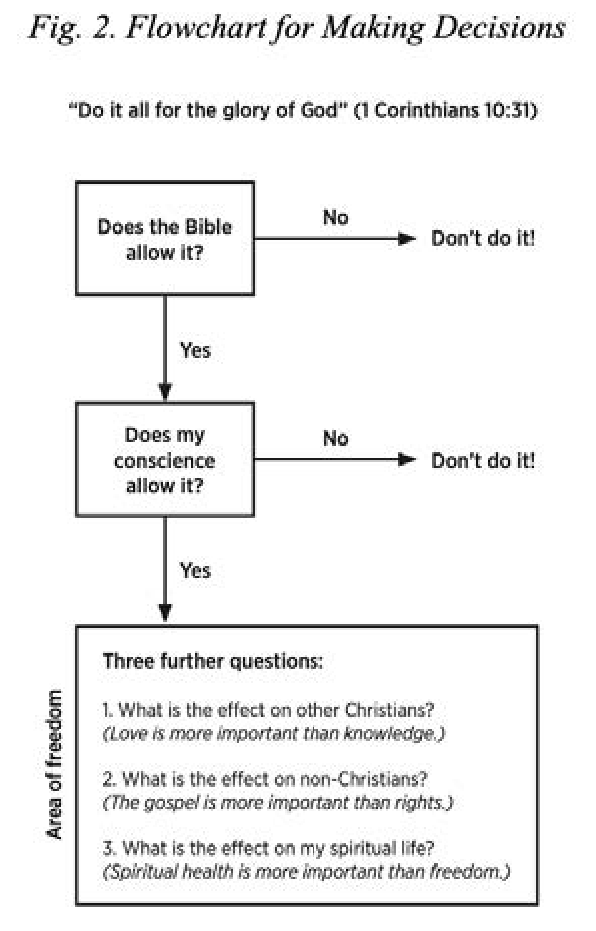
Fig. 2. Flowchart for Making Decisions
The initial question is “Does the Bible allow it?” If the Bible forbids a particular activity, such as having sex outside of marriage, then don’t do it. Hard no. Not debatable.
The next question is “Does my conscience allow it?” In other words, “Can I thank God for it?” If your answer is Yes, then we could add another question here in the flowchart: Do you need to calibrate your conscience to align with God’s Word? Your conscience is your consciousness or sense of what you believe is right and wrong.15 Your conscience can’t make a sinful activity (like getting drunk) permissible, but it can make a permissible activity (like drinking wine in moderation) sinful if your conscience condemns you for doing it.
The final three questions explore areas of freedom. They emphasize that you and your individual liberties are not the only factors to consider. A mark of maturity and godliness is that you choose what to do based not only on how it may affect you but on how it may affect others.
There are four diagnostic questions that can help you decide what to do:
- Holy Desire: What do you want to do?
- Open Door: What opportunities are open or closed?
- Wise Counsel: What do wise people who know you well and know the situation well
advise you to do? - Biblical Wisdom: What do you think you should do based on Biblesaturated wisdom?
After you have worked through those four questions and decided what to do, then what?
—
Discussion & Reflection:
- Are there decisions you’re currently facing that would benefit from these four diagnostic questions?
- Does the description of wisdom above align with how you’ve thought about it, or is this a new approach to wisdom for you? What are some areas in your life that require you to exercise biblical wisdom?
—
Part 3: Make a Decision and Press On
Don’t freeze up. Don’t overanalyze. Don’t anxiously fear that you might miss the center of God’s will. Don’t obsess that you might experience something unpleasant. Instead, as Kevin DeYoung exhorts, “Just do something.”16 Make a decision, and press on. Don’t “let go and let God.” Instead, as J. I. Packer puts it, “Trust God and get going.”17
When you make a decision, you may be tempted to be anxious, sulky, inflexible, overthink, and cowardly. Here’s what to do instead.
1. Don’t be anxious. Trust God.
Jesus commands you, “Do not be anxious about your life, what you will eat or what you will drink, nor about your body, what you will put on” (Matt. 6:25). God feeds the birds, and you are more valuable than they (6:26). Worrying won’t help you live longer (6:27), and it will actually make you less holy and less happy. Anxiety is counterproductive. God magnificently clothes the lilies, and he will also clothe you (6:28–30).
So instead of worrying about what you’ll eat or drink or wear (or what person you will marry or what school you will attend or what job you will work or what kids you will have or where you will live or when you will die), seek God’s kingdom and righteousness first, and God will take care of the rest (6:31–33). Don’t worry about the future because “each day has enough trouble of its own” (6:34b NIV). This is the heart of Faith over fear.
Proud people worry. Humble people do not. And the way you humble yourself is by casting all your anxieties on God: “Humble yourselves, therefore, under the mighty hand of God so that at the proper time he may exalt you, [by] casting all your anxieties on him, because he cares for you” (1 Pet. 5:6–7).
This act of surrender is a vital prayer for clarity in our lives.
The opposite of being anxious is trusting God. Do you trust him? Do you trust God even when he doesn’t tell you all the reasons for what he does? Do you trust God’s character based on how God has revealed Himself to you in Scripture? Choosing to trust in the Lord means believing in Jeremiah 29:11—that He has a future and a hope for you, even when the path is not yet visible. It means waiting on the Lord with a heart at peace, knowing that Gods timing is perfect. God’s words make you wise and provide the ultimate God’s direction.
This might be hard for you because you want to know the future. You don’t know the future, and that’s okay because God does. He has ordained everything. And he’s got you covered. He’s taking care of you, and he has given you exactly what you need to please him. “We know that for those who love God all things work together for good, for those who are called according to his purpose” (Rom. 8:28). “All things” includes all of your decisions — wise and unwise.
When you fret about the future, you are distrusting God and thus dishonoring God. You don’t need to know every detail about what’s coming; you simply need to rest in God’s plan. This is the essence of choosing Faith over fear. You need to trust and obey God. And that includes not worrying about tomorrow, but rather waiting on the Lord with a confident heart. Trusting God means believing that even when we don’t see the way, he is a Lamp unto my feet for the very next step.
As you navigate the unknown, let your heart be anchored in Jeremiah 29:11. You can be still and know that he is in control of Gods timing. Instead of seeking a map of the entire journey, practice walking by faith one day at a time, knowing that his grace is sufficient for every decision you face.
2. Don’t be sulky. Be holy and happy.
You can become so preoccupied with discerning what God’s will is for a particular decision (like whether to accept a job offer) that you minimize what Scripture explicitly says about God’s will. For example, two passages in the Bible explicitly say, “This is the will of God”:
– “This is the will of God, your sanctification [God’s will is for you to be holy (NLT)]: that you abstain from sexual immorality” (1 Thess. 4:3).
– “Rejoice always, pray without ceasing, give thanks in all circumstances; for this is the will of God in Christ Jesus for you” (1 Thess. 5:16–18).
God’s will is not for you to be sullen. It’s for you to be holy and happy. In C. S. Lewis’s The Voyage of the Dawn Treader, do you remember how bad-tempered Eustace is before Aslan de-dragons him? Don’t be sulky like Eustace. God’s will is precisely the opposite for you. He wants you to be holy and happy. You please God by obeying him,18 and you are happiest when you live according to God’s design — when you enjoy God and his gifts.19
3. Don’t be inflexible. Be willing to adjust your plans.
You’ve got to make decisions — some of which should be inflexible, like a moral decision not to commit adultery. But in many other areas, you have freedom to honor God by choosing this or that — whether to eat at Chipotle or Chick-fil-A, whether to read The Pilgrim’s Progress or The Lord of the Rings, whether to stay at home or to travel, whether to attend school full-time or to work full-time.
As you plan what to do, remember that you are not God:
Come now, you who say, “Today or tomorrow we will go into
such and such a town and spend a year there and trade and make a profit”— yet you do not know what tomorrow will bring. What is your life? For you are a mist that appears for a little time and then vanishes. Instead, you ought to say, “If the Lord wills, we will live and do this or that.” As it is, you boast in your arrogance. All such boasting is evil. (James 4:13–16)
Don’t be proud after you make a decision. If you made a wise decision, then God gave you that wisdom. And sometimes after you make a decision, you have to revise your plan in light of circumstances you didn’t foresee. Many of your decisions are alterable, so be willing to adjust them. Your plans will come
to pass only by God’s Will. Don’t be inflexible.
Learning to say “Thy will be done” in our planning is a core part of walking by faith. It requires us to have trust in the Lord even when our carefully laid plans are disrupted. This posture helps us maintain Faith over fear because we realize that our life is a mist, but God’s plan is eternal. When we hold our plans loosely, we are better prepared for Gods timing, knowing that he is the one who ultimately provides God’s direction.
4. Don’t overthink past decisions. Strain forward to what lies ahead.
Don’t spend your short life wondering, “But what if I had chosen differently?” Be like Paul:
“One thing I do: forgetting what lies behind and straining forward to what lies ahead, I press on
toward the goal for the prize of the upward call of God in Christ Jesus” (Phil. 3:13–14).
Of course, you should learn from your mistakes. That’s what wise people do. But you shouldn’t obsess over the past. Paul presses on toward the goal by not focusing on the past. This includes Paul’s past life before he became a Christian, his life as a Christian, and the good progress he has made as a Christian.
You may apply this principle responsibly to avoid overthinking past decisions. Instead of being preoccupied with what would have happened had you chosen differently, you should single-mindedly strain forward to what lies ahead. This is a practical way of trusting God with your history while walking by faith into your future. Make a decision, and press on.
When you stop looking back, you are free to focus on God’s plan for today. You can rest in the promise of Jeremiah 29 11, knowing that even your past missteps are covered by His grace. Rather than being stuck in “what ifs,” choose Faith over fear and move forward in the strength He provides.
5. Don’t be cowardly. Be courageous.
There may be an element of risk involved even when you make a God-honoring decision — like when Queen Esther resolved, “I will go to the king, though it is against the law, and if I perish, I perish” (Esther 4:16). You need courage to press on.20
If you are having a hard time picking which college to attend, you need courage to commit and then not fret about what you may be missing at another school. Choose wisely, and press on.
If you are a man considering whether to pursue a relationship with a particular woman in order to see if it would be fitting for you two to marry, you need courage because she might say “no.” Kevin DeYoung’s analysis and advice here is spot on:
When there is an overabundance of Christian singles who want
to be married, this is a problem. And it’s a problem I put squarely at the feet of young men whose immaturity, passivity, and indecision
are pushing their hormones to the limits of self-control, delaying the growing-up process, and forcing countless numbers of young women to spend lots of time and money pursuing a career (which is not necessarily wrong) when they would rather be getting married
and having children. Men, if you want to be married, find a godly gal, treat her right, talk to her parents, pop the question, tie the knot, and start making babies.21
I don’t mean to imply that only young men can sin and that young women can’t, and I recognize that there may be other mitigating factors — like feminism and cultural decay. My burden here is that some Christians have a subjective and lazy approach to marriage, and I think it’s wise to exhort men to courageously take the initiative and be responsible.
When you decide what to do, beware of a prosperity-gospel mindset. According to the prosperity gospel, God rewards our increased faith with increased health and/or wealth. But that perverts the gospel. The gospel is that Jesus lived, died, and rose again for sinners and that God will save you if you turn from your sins and trust Jesus. It’s not true that God always blesses his obedient people with health and wealth.
As you obey God, you may suffer. God doesn’t promise that your life will always be free from conflict, hardship, and trouble. To the contrary, the Bible says, “All who desire to live a godly life in Christ Jesus will be persecuted” (2 Tim. 3:12). In God’s good providence, it is normal for godly people to suffer — men like Job, Joseph, Daniel, Jeremiah, and Paul.
If you suffer, that does not necessarily signify that you made a bad decision. God does not promise that nothing bad will ever happen to you if you stay in the center of his will. But we can trust in the Lord that Christ will always be with us (Matt. 28:20) and that no person or thing can successfully be against us (Rom. 8:31–39). True Faith over fear means following God’s direction even when it leads through the valley of the shadow of death, knowing that God’s plan is for our ultimate good and His glory.
—
Discussion & Reflection:
- Which of these five items is most difficult for you? Why do you think that is? Is there a heart issue or wrong belief underlying that difficulty?
- If you’re reading this with a mentor, ask what major decisions he or she has made and how that process worked. What lessons did your mentor take away, what would be done differently now, etc.?
—
Conclusion: “I Was the Lion”
What would it be like to get glimpses into your life two, five, ten, twenty-five years from now? You might wish that God would interpret your past and reveal your future to you and explain how what’s happening right now fits in the big picture.
But that is not God’s normal way. You’re not supposed to make decisions by asking God to reveal your future. It will all make sense in due course. For now, your job is to trust God supremely and not yourself or anybody else. This is the essence of walking by faith, not by sight.
Instead of searching for a map of the next decade, we are called to be still and know that He is in control. When we stop obsessing over how to know Gods will for the distant future, we can focus on being faithful today. Trusting God means believing that Gods timing is perfect, even when the big picture remains a mystery to us. As we lean on Proverbs 3 5-6, we find that He doesn’t give us a crystal ball; He gives us His presence and His Word as a Lamp unto my feet for the very next step.
I love how C. S. Lewis portrays this truth in The Horse and His Boy when the lion Aslan talks to the boy Shasta. While Shasta thinks he is all alone, he complains, “I do think that I must be the most unfortunate boy that ever lived in the whole world. Everything goes right for everyone except me.” Lewis adds, “He felt so sorry for himself that the tears rolled down his cheeks.”22 Then Shasta suddenly realizes that someone was walking beside him in the pitch darkness. That someone is Aslan. When Shasta tells Aslan his sorrows, Aslan’s response should rebuke and encourage us of little faith:
[Shasta] told how he had never known his real father or mother and had been brought up sternly by the fisherman. And then he told the story of his escape and how they were chased by lions and forced to swim for their lives; and of all their dangers in Tashbaan, and about his night among the tombs, and how the beasts howled at him out
of the desert. And he told about the heat and thirst of their desert journey and how they were almost at their goal when another lion chased them and wounded Aravis. And also, how very long it was since he had had anything to eat.
“I do not call you unfortunate,” said the Large Voice.
“Don’t you think it was bad luck to meet so many lions?” said Shasta.
“There was only one lion,” said the Voice.
“What on earth do you mean? I’ve just told you there were at least two the first night, and—”
“There was only one, but he was swift of foot.”
“How do you know?”
“I was the lion.” And as Shasta gaped with open mouth and said nothing, the Voice continued. “I was the lion who forced you to join with Aravis. I was the cat who comforted you among the houses of the dead. I was the lion who drove the jackals from you while you slept. I was the lion who gave the Horses the new strength of fear for the last mile so that you should reach King Lune in time. And I was the lion you do not remember who pushed the boat in which you lay, a child near death, so that it came to shore where a man sat, wakeful at midnight, to receive you.”
“Then it was you who wounded Aravis?”
“It was I.”
“But what for?”
“Child,” said the Voice, “I am telling you your story, not hers. I tell no one any story but his own.”
“Who are you?” asked Shasta.
“Myself,” said the Voice, very deep and low so that the earth shook: and again “Myself,” loud and clear and gay: and then the third time “Myself,” whispered so softly you could hardly hear it, and yet it seemed to come from all round you as if the leaves rustled with it.
Shasta was no longer afraid that the Voice belonged to something that would eat him, nor that it was
the voice of a ghost. But a new and different sort of trembling came over him. Yet he felt glad too. …
After one glance at the Lion’s face, he slipped out of the saddle and fell at its feet. He couldn’t say anything, but then he didn’t want to say anything, and he knew he didn’t say anything.23
Direct encounters with God — like Aslan’s conversation with Shasta — are not normal. You don’t need
to seek them. God has already given you what you need to be faithful and fruitful. The above exchange between Shasta and Aslan should remind you that the all-knowing, all-powerful, all-good God is superintending all things for your good, and in this life, you won’t know all the ways and reasons God unfolds his plan for you. So don’t be anxious and sulky like Shasta. Trust God, and get going. Choose wisely, and press on.
Acknowledgments
Thanks to friends who graciously offered feedback on drafts of this little book, including John Beckman, Bryan Blazosky, Tom Dodds, Abigail Dodds, Betsy Howard, Trent Hunter, Scott Jamison, Jeremy Kimble, Cynthia McGlothlin, Charles Naselli, Jenni Naselli, Kara Naselli, Hud Peters, John Piper, Joe Rigney, Jenny Rigney, Adrien Segal, Katie Semple, Steve Stein, Eric True, and Joe Tyrpak.
End Notes
- Garry Friesen, with J. Robin Maxson, Decision Making and the Will of God: A Biblical Alternative to the Traditional View, 2nd ed. (Sisters, OR: Multnomah, 2004), 35. For a summary of the subjective view, see pp. 21–35. Friesen wrote his ThD dissertation on “God’s Will as It Relates to Decision Making” (Dallas Theological Seminary, 1978), and he has devoted scholarly attention to this issue for decades. What I am calling the subjective view, Friesen calls “the traditional view” since it was virtually the only view he heard people teach while he was growing up.
- Andrew Murray, God’s Will: Our Dwelling Place (Springdale, PA: Whitaker House, 1982), 76–77 (italics original).
- On the sufficiency of Scripture, see Stephen J. Wellum, Systematic Theology, Volume 1: From Canon to Concept (Brentwood, TN: B&H Academic, 2024), 338–49.
- See Andrew David Naselli and J. D. Crowley, Conscience: What It Is, How to Train It, and Loving Those Who Differ (Wheaton, IL: Crossway, 2016), 55–83.
- See Andrew David Naselli, Predestination: An Introduction, Short Studies in Systematic Theology (Wheaton, IL: Crossway, 2024), chap. 7 (pp. 111– 20). On God’s meticulous sovereignty and human responsibility, see chap. 6 (pp. 79–110).
- For advice on how this applies to getting married, see Douglas Wilson, Get the Girl: How to Be the Kind of Man the Kind of Woman You Want to Marry Would Want to Marry (Moscow, ID: Canon, 2022), 29–38.
- I later learned that her response was a bit misleading. She actually called it off because she had concerns about the guy’s character, but she didn’t want to communicate that to him. She wasn’t obligated to say that to the guy, but I understand why the guy was frustrated and perplexed. She hid behind a mystical veil of sanctified emotions instead of acknowledging a legitimate reason — she didn’t want to continue dating him because she didn’t think he was the type of man she wanted to vow to submit to and respect until death parts them. That is a lady’s prerogative. She has every right not to marry a guy if she thinks he is arrogant or incompetent or lazy or unattractive or annoying or wimpy or untrustworthy or whatever. She may well have been applying God’s moral will in a God-honoring way such that she concluded, “I don’t believe the Lord would have me marry you.”
- Garry Friesen, “Walking in Wisdom: The Wisdom View,” in How Then Should We Choose? Three Views on God’s Will and Decision Making, ed. Douglas S. Huffman (Grand Rapids: Kregel, 2009), 105. On Keswick theology, see Andrew David Naselli, No Quick Fix: Where Higher LifeTheology Came From, What It Is, and Why It’s Harmful (Bellingham, WA: Lexham, 2017).
- John MacArthur, Found: God’s Will; Find the Direction and Purpose God Wants for Your Life, 3rd ed. (Colorado Springs, CO: Cook, 2012).
- Augustine, Ten Homilies on the First Epistle of John, Homily 7 (on 1 John 4:4–12), §8.
- For how to discern if a man is called to pastoral ministry, see C. H. Spurgeon, “Lecture II: The Call to the Ministry,” in Lectures to My Students: A Selection from Addresses Delivered to the Students of the Pastors’ College, Metropolitan Tabernacle, Lectures to My Students 1 (London: Passmore and Alabaster, 1875), 35–65; James M. George, “The Call to Pastoral Ministry,” in Rediscovering Pastoral Ministry: Shaping Contemporary Ministry with Biblical Mandates, ed. John MacArthur (Dallas: Word, 1995), 102–105; Jason K. Allen, Discerning Your Call to Ministry: How to Know for Sure and What to Do about It (Chicago: Moody, 2016); Bobby Jamieson, The Path to Being a Pastor: A Guide for the Aspiring, 9Marks (Wheaton, IL: Crossway, 2021).
- New Oxford American Dictionary.
- For advice on how to interpret the Bible, see Andrew David Naselli, How to Understand and Apply the New Testament: Twelve Steps from Exegesis to Theology (Phillipsburg, NJ: P&R Publishing, 2017); D. A. Carson and Andrew David Naselli, Exegetical Fallacies, 3rd ed. (Grand Rapids: Baker Academic, forthcoming).
- Vaughan Roberts, Authentic Church: True Spirituality in a Culture of Counterfeits (Downers Grove, IL: InterVarsity Press, 2011), 133. Used with permission.
- See Naselli and Crowley, Conscience, 32–44.
- Kevin DeYoung, Just Do Something: A Liberating Approach to Finding God’s Will; or, How to Make a Decision without Dreams, Visions, Fleeces, Open Doors, Random Bible Verses, Casting Lots, Liver Shivers, Writing in the Sky, Etc. (Chicago: Moody, 2009).
- J. I. Packer, Keep in Step with the Spirit: Finding Fullness in Our Walk with God, 2nd ed. (Grand Rapids: Baker Books, 2005), 128. For a critique of “let go and let God” as a paradigm for Christian living, see Naselli, No Quick Fix.
- Cf. Wayne Grudem, “Pleasing God by Our Obedience: A Neglected New Testament Teaching,” in For the Fame of God’s Name: Essays in Honor of John Piper, ed. Sam Storms and Justin Taylor (Wheaton, IL: Crossway, 2010), 272–92.
- See John Piper, Desiring God: Meditations of a Christian Hedonist, 5th ed. (Wheaton: Crossway, 2025); Joe Rigney, The Things of Earth: Treasuring God by Enjoying His Gifts, 2nd ed. (Moscow, ID: Canon, 2024).
- Cf. John Piper, Risk Is Right: Better to Lose Your Life Than to Waste It (Wheaton, IL: Crossway, 2013); Joe Rigney, Courage: How the Gospel Creates Christian Fortitude, Union (Wheaton, IL: Crossway, 2023).
- DeYoung, Just Do Something, 108.
- C. S. Lewis, The Horse and His Boy, The Chronicles of Narnia (New York: HarperCollins, 1954), 161–62.
- Lewis, The Horse and His Boy, 164–66.
About the Author
ANDREW DAVID NASELLI (PhD, Bob Jones University; PhD, Trinity Evangelical Divinity School) is professor of systematic theology and New Testament at Bethlehem College and Seminary in Minneapolis and Lead Pastor of Christ the King Church in Stillwater, Minnesota. Andy and his wife, Jenni, have been married since 2004, and God has blessed them with four daughters.
#17 Sermon on the Mount — The Path of True Discipleship
Part I: The Gospel of Matthew as a Disciple-Making Book
The image of Jesus as a teacher, disciple-maker, and mentor is found throughout the Gospels, but nowhere so clearly as in Matthew. From beginning to end, the Gospel of Matthew speaks about discipleship, and the whole story is structured as a disciple-making book.
When John the Baptist comes preaching, his message is a call to repentance because of the coming of the Kingdom of Heaven (3:2). Jesus says the exact same thing as he begins his ministry (4:17). The call to repentance is not a message of condemnation, but of invitation. The call to repentance is not a message of heaped-up guilt but an urgent call to turn from one way of seeing and being in the world to God’s way of life. Repentance is discipleship language.
The famous climactic conclusion to Matthew 28 likewise emphasizes discipleship. In his great commission (Matt. 28:16–20), Jesus sends forth his disciples with his own authority to make disciples of people from every nation. This discipleship is life-on-life mentorship rooted in the Triune God (in the name of the Father, Son, and Spirit) and looks like baptizing and teaching people. Baptizing is an invitation for people to identify with Jesus and enter into the community of his other disciples. Teaching is an invitation to learn to inhabit the world in accordance with Jesus’ instructions on doctrine, morality, habits, and sensibilities that he himself models. This is mentorship, and there is nothing more central to Christianity than this.
But this emphasis on discipleship is not just at the beginning and the end of Matthew’s Gospel. Between the opening call to repentance and the closing commission to go and make disciples, the whole Gospel of Matthew is built on a disciple-making vision. Matthew communicates this by structuring the main part of his Gospel around five big teaching blocks (chapters 5–7, 10, 13, 18, 23–25). These blocks are collections of Jesus’ teachings for discipleship.
In the ancient world, many biographies were written about famous teachers and philosophers. The sayings of a teacher were often collected into memorizable compilations based on a theme, called “epitomes.” If someone wanted to learn a certain philosophy of life or religion, an epitome provided them a handy, accessible set of instructions to meditate upon and practice in real life. These epitomes were especially important because so few people in the ancient world had any access to education, and most people could not read or write beyond basic signs. Having a memorable block of teachings on a theme was crucial to the mentoring experience.
So Matthew, who is himself a disciple of Jesus and committed to obeying the Lord’s command to make disciples, wrote a masterful biography about Jesus the teacher with this purpose: to invite people to repentance and take Jesus’ yoke upon their lives so that they might find life. In short, Matthew is inviting us to be mentored into the way of discipleship in the Kingdom of Heaven. The stories of what Jesus did and the collections of his teachings were essential for this goal.
Matthew’s Gospel is organized like this, with the five teaching blocks highlighted:
I. Origins and Beginnings (1:1–4:22)
A. Introduction (1:1–4:16)
B. Bridge (4:17–22)
II. Revelation and Separation: In Word and Deed (4:23–9:38)
A. First Epitome (5:1–7:29)
B. First Narrative (8:1–9:38)
III. Revelation and Separation: As Master, So Disciples (10:1–12:50)
A. Second Epitome (10:1–11:1)
B. Second Narrative (11:2–12:50)
IV. Revelation and Separation: A New, Set-Apart People of God (13:1–17:27)
A. Third Epitome (13:1–53)
B. Third Narrative (13:54–17:27)
V. Revelation and Separation: Inside and Outside the New Community (18:1–20:34)
A. Fourth Epitome (18:1–19:1)
B. Fourth Narrative (19:2–20:34)
VI. Revelation and Separation: Judgment Now and in the Future (21:1–25:46)
A. Fifth Narrative (21:1–22:46)
B. Fifth Epitome (23:1–25:46)
VII. Endings and Beginnings (26:1–28:20)
A. Bridge (26:1–16)
B. Conclusion (26:17–28:20)
Thus, we can see that the whole Gospel is dedicated to disciple-making and these five epitomes give the highest concentration of mentoring material.
Focusing on the Famous: The Sermon on the Mount
Throughout the church’s history, the first of these epitomes — Matthew 5–7 — has been the most influential, most preached, most studied, most written about, and most famous portion of the entire Bible. Since at least the days of Augustine, these chapters have been given the title, “The Sermon on the Mount.”
Differences between denominations and theological traditions can be traced back to how differently they interpret these fundamental chapters. I often describe the Sermon on the Mount like a swimming pool test strip that shows chlorine levels, pH balance, and alkalinity. If we were to dip any theologian or denomination into the Sermon on the Mount, it would immediately tell us much about their theological understanding and commitments. This is because the Sermon touches on so many important truths, such as the relationship of the Old Testament to the teachings of Jesus, what it means to be righteous in God’s eyes, how to love your enemies, how to treat other people, and how to seek first the kingdom of God.
The Sermon on the Mount does not give us everything we want or need to know to be faithful disciples of Jesus. It’s only one of the five teaching blocks in Matthew; it’s part of other teachings in Matthew, and we have the whole rest of the Bible too! But the sermon is famous for a reason: It is expansive, profound, and foundational for the life of discipleship. These three chapters are an excellent place to start in learning to take Jesus’ yoke upon one’s life and to be mentored by him, the King of kings and the Wisdom of God incarnate.
Jesus concludes his most famous sermon with an image of two people who build the house on the rock of their lives in different ways (Matt. 7:24–27) — one who is foolish and one who is wise. The foolish person hears Jesus’ teachings but does nothing with them. The wise person hears and puts Jesus’ words into practice. The reason this is the final image in the sermon is that the whole message of Matthew 5–7 is an invitation to wisdom. Wisdom can be defined as practiced ways of inhabiting the world that accord with God’s Kingdom of Heaven and result in the true human flourishing we long for. This is the discipleship into which Jesus invites us. This is the yoke he is offering us if we are willing to be mentored by it.
Even as the whole Gospel of Matthew is intentionally structured, so too is the Sermon on the Mount. The sermon is not a random collection of sayings from Jesus, but a highly crafted and beautifully structured message.
Jesus’ sermon is organized like this:
A. Introduction: The Call to God’s People (5:3–16)
1. Nine Beatitudes for the New People of God (5:3–12)
2. The New Covenant Witness of the People of God (5:13–16)
B. Main Theme: The Greater Righteousness (GR) for God’s People (5:17–7:12)
1. GR in Relation in Obeying God’s Laws (5:17–48)
a. Proposition (5:17–20)
b. Six Exegeses/Examples (5:21–47)
c. Summary (5:48)
2. GR in in our Piety toward God (6:1–21)
a. Introduction: Pleasing the Father in Heaven, not Humans (6:1)
b. Three Examples (6:2–18)
** Central Excursus on Prayer (6:7–15)
c. Conclusion: Rewards in Heaven, not on Earth (6:19–21)
3. GR in our Relation to the World (6:19–7:12)
a. Introduction (6:19–21)
b. In Relation to the Goods of This World (6:22–34)
c. In Relation to the People of This World (7:1–6)
d. Conclusion (7:7–12)
C. Conclusion: An Invitation to Wisdom in Light of the Future (7:13–27)
1. Two Kinds of Paths (7:13–14)
2. Two Kinds of Prophets (7:15–23)
3. Two Kinds of Builders (7:24–27)
In what follows, we will walk through each section of Jesus’ sermon, seeking to understand the wisdom he is teaching. We will not be able to say everything there is to say about Jesus’ teachings here,1 but we will combine some sections and follow the general outline, asking the question, “What does it look like to be mentored by Jesus?”
—
Discussion & Reflection:
- What are some ways that you are tempted not inhabit the world according to the Kingdom of Heaven?
- In which areas in your life do you wish to see greater flourishing through the love your enemies command or other teachings of the Sermon on the Mount?
—
Part 2: Retooling Our Notions of Happiness (5:3–16)
As a pastor, one of the questions I regularly ask people is, “What message did you receive when you were growing up about how to find a good life?”
This is a very important question to ask ourselves because we all received some kind of message, and that message has continued to influence the course of our lives, for better or worse, whether we realize it or not. Everyone I’ve asked this question can come up with some answer. Many people immediately respond with a short saying a parent, uncle, or mentor repeated to them. Sayings like:
– “You’ll never work a day in your life if you love what you do.”
– “Work hard. Get good grades. Find a good spouse.”
– “Love God. Love others.”
– “Live with your eulogy in mind.”
– “Don’t worry about what anyone else thinks. Just be yourself.”
Or, if Star Wars played an important role, you might have heard:
– “Do or do not, there is no try” from Master Yoda.
We call these short, pithy sayings “aphorisms.” Aphorisms are words of wisdom to guide us through a myriad of unpredictable life situations. In the ancient world, there was a kind of aphorism that wisdom teachers used called a macarism, from the Greek word that means to be truly happy or to flourish (makarios). A macarism is a statement describing a way of living that is good and beautiful. A macarism is an invitation to adopt a certain mindset and set of habits so that we might find true human flourishing.
Macarisms were usually paired with their opposites, woes. Woes are not curses. There are warnings that certain ways of inhabiting the world will result in loss and grief. So too, macarisms are not blessings. They are invitations to the good life. When combined, macarisms and woes are often described as two paths of life that diverge and lead to very different experiences.
This combination of macarisms and woes is found throughout the Bible as the invitation to Godward wisdom, as the difference between the path of life and the path of destruction. For example, the whole book of Proverbs is full of such aphorisms, especially the first nine chapters, which are built on the idea of two ways. King Solomon paints a picture for his son of two paths to life; one leads to life, and the other to destruction. Likewise, Psalm 1, commonly referred to as a wisdom psalm, depicts two paths people’s lives can take — one under the influence of fools and the other where a person meditates on God’s instructions and lets this wisdom guide their life.
This is exactly what Jesus is saying in the opening part of the Sermon on the Mount. As the final and faithful Son of David, the King of God’s kingdom, and incarnation of wisdom itself, Jesus is offering to all people the way of inhabiting the world that promises true happiness, not only for this age but in the eternal New Creation as well. This is how Jesus introduces his sermon, with nine maxims about the truly good life.
For at least 1,500 years, these opening macarisms have been called the beatitudes. This description comes from the Latin word béatus, which means the same thing as makarios — “happy” or “flourishing.” Christians have always understood Matthew 5:3–12 as invitations to the truly flourishing life found through Jesus, the same Jesus who said elsewhere that he has come “that they might have life and have it abundantly” (John 10:10).
However, today, there is a lot of confusion about what the beatitudes are. Nearly every modern English Bible translates Jesus’ makarios statements as “Blessed.” “Blessed are the peacemakers… blessed are those who mourn,” etc. This is a very different idea. If we read Jesus’ the beatitudes as statements of blessing, then we must ask what this means. Is Jesus saying that God will bless the people who live in the ways he describes in 5:3–12? Are these new entrance requirements for getting into the Kingdom of Heaven? Or are these simply describing the kind of people who will be blessed by God when the kingdom comes? These questions misunderstand the nature of a macarism. In the beatitudes, Jesus invites us to adopt his true understanding of the world so that we might find true life. These are not entrance requirements or mere statements about the future. They offer a new vision for finding true life through following him.
What is shocking is not that Jesus paints us a picture of the truly flourishing life. What is shocking is the way he describes this life in God’s kingdom. Jesus’ macarisms are not at all what any of us would expect or naturally desire. When we read Jesus’ nine statements about where true life is to be found, with the exception of one, his statements are all unexpectedly negative!
– Flourishing [“blessed”] are the poor in spirit…
– Flourishing are those who mourn…
– Flourishing are the meek…
– Flourishing are those who hunger and thirst for righteousness…
– Flourishing are the merciful…
– Flourishing are the pure in heart… [the only potentially positive one]
– Flourishing are the peacemakers…
– Flourishing are those who are persecuted for righteousness’ sake…
– Flourishing are you when others revile you and persecute you and utter all kinds of evil against you
falsely on my account…
Notice these images — poverty, mourning, meekness, hunger and thirst, persecution. The notions of peacemaking and mercy may sound more positive, but these too are negative images of giving up our rights for the sake of reconciling relationships with others.
What is going on here? The key to understanding Jesus’ macarisms is to pay attention to what he says in the second half as well:
–… for theirs is the kingdom of heaven.
– … for they shall be comforted.
– … for they shall inherit the earth.
– … for they shall be satisfied.
– … for they shall receive mercy.
– … for they shall see God.
– … for they shall be called the sons of God.
– … for theirs is the kingdom of heaven.
Jesus is retooling our notions of the good life by inviting us to orient our lives around our relationship with God, who will provide all we long for and need. The reason he can say that these negative states — humility, mourning, loss of power, giving up the right to forgive others, embracing misrepresentation and persecution — are happiness is that, in those places, our hearts are redirected to God, and he meets us there. The key to the truly good life, Jesus is saying, is found in a reorientation of our lives toward God as we seek first the kingdom of God (see also Matt. 6:33)—including the fact that this will entail suffering, loss, and grief amid true happiness.
This is what the famous “salt and light” verses are about in Matthew 5:13–16. Jesus is calling his disciples to follow in his ways in the world, to be heralds of the new covenant message he is bringing. Because this will bring opposition and loss (see especially Matt. 10), his disciples will be tempted to shrink back from Jesus’ ways, to lose their saltiness, and to cover their light. But this is not the way of discipleship. Instead, Jesus says to “let your light shine before others, so that they may see your good works and give glory to your Father who is in heaven” (5:16).
So what is the mentoring message here?
We all desire to live a meaningful and happy life. Jesus and the Bible are not opposed to this. Indeed, Jesus begins his first Sermon on the Mount in the New Testament with this message. Our problem is not the desire for happiness, but our foolishness and blindness in seeking it in places other than God. As C.S. Lewis famously said,
It would seem that Our Lord finds our desires not too strong, but too weak. We are half-hearted creatures, fooling about with drink and sex and ambition when infinite joy is offered us, like an ignorant child who wants to go on making mud pies in a slum because he cannot imagine what is meant by the offer of a holiday at the sea. We are far too easily pleased. (“The Weight of Glory”)
Here at the beginning of the sermon, Jesus invites us to take on his yoke of mentoring, retooling our notions of the good life around God and his coming Kingdom of Heaven, following the ways of mercy, humility, enduring suffering, and longing that Jesus himself models.
—
Discussion & Reflection:
- How is this explanation of the beatitudes similar or different from how you’ve previously understood them?
- Why should we want to take on Jesus’ mentoring yoke — living in the wisdom of the Sermon on the Mount?
—
Part 3: What Does God Care About in Our Relationships with Others? (5:17–5:48)
One of the most perplexing and complicated questions for Christians is how to think about the Old Testament and its teachings in relation to the New Testament. Do the commands of the Old Testament still apply to Christians? Does God expect the same thing of his people in the New Testament as he does in the Old?
Different theologians and denominations have reached very different conclusions on these important questions, and two thousand years of reflection have not definitively resolved them. These are not merely academic questions. They affect how we think about God as well as what parts of the Old Testament, if any, continue to apply on a daily basis to God’s people in the new covenant.
These huge questions are at the heart of the main part of Jesus’ sermon (5:17–7:12). We can’t solve the dilemma completely from these verses alone; we need the whole New Testament to make sense of it. But this part of the sermon is the single most important section of Christianity’s answer to these issues.
Jesus directly addresses the issue of Torah (Mosaic instructions) as it relates to Christianity in Matthew 5:17: “Do not think that I have come to abolish the Law or the Prophets; I have not come to abolish them but to fulfill them.” In this profound statement, Jesus simultaneously affirms the goodness of what God did and commanded in Israel’s history and indicates that something new and different is coming through himself. Jesus affirms both continuity and discontinuity between the Old Testament/Judaism and Christianity. He is not abolishing, but he is fulfilling.
The many things Jesus says about doing God’s will in 5:17–7:12 unpack and explain what this continuity and discontinuity look like. The discontinuity is found in Jesus serving as the final arbiter and interpreter of God’s will. He exercises his authority to pronounce definitively how to interpret the Law and the Prophets (“you’ve heard it said but I say to you…”). At the end of the sermon, Jesus reiterates that it is his words that now stand as the final word: “Everyone who hears these words of mine and does them will be like a wise man who built his house on the rock” (7:24).
As we continue reading in Matthew, we see Jesus continue to claim divine authority, such as the ability to forgive sin (9:6), to exercise control over nature itself (14:13–33), and to proclaim that no one can know God except through him (11:25–27). This “all authority on heaven and on earth” that he possesses fully after his resurrection in Matthew 28:18–20 is transferred to his church, the ongoing group of his disciples throughout the world (18:18–20; 10:40; 21:21). All of this is discontinuity. There is a new era, a new covenant between God and humanity that is available for anyone who follows him in faith (26:28), whether Jew or Gentile, apart from the old Mosaic covenant (Rom. 3:21–26; Gal. 3:15–29; Heb. 9:15–28).
But there is also continuity between what God has said in the past and what Jesus is teaching now. God has not changed, and his will and his righteousness have not changed. Christians are part of a new covenant with Christ as the mediator, but the heart of what God wills for his people has not changed, because he never commands anything that does not accord with who he is. The Jewish-specific aspects of the Mosaic covenant have ended because their purpose has been fulfilled — to raise up the seed, Jesus, who would fulfill the promises to Abraham to bless all nations (Gal. 3:15–29). There is a new covenant to which everyone — Jew or Gentile — must belong to be God’s people. But the heart of God’s will for his creatures has not changed. This is what 5:17–7:12 is all about.
The statement that hangs over and guides all of Jesus’ teachings here is found in 5:20: “unless your righteousness exceeds that of the scribes and Pharisees, you will never enter the Kingdom of Heaven.” At first, this may sound like Jesus is saying that we have to do even more righteous things than the Old Testament saints, especially the very pious Pharisees. This is not a pleasant prospect. Nor is it Jesus’ point. Rather, his point is that we must have a righteousness that is not only external (behavior) but also internal (in the heart). The “righteousness that exceeds that of the scribes and Pharisees” is both external and internal. It is not a greater quantity of righteous things that we do behaviorally, but rather, it is behavior that is rooted in a heart that sees and loves God.
What Jesus is saying here is in complete continuity with everything God said in the Old Testament; God has always seen and cared about our hearts, not only our actions. To be holy is to be whole. Good deeds with a dead heart are not what God wants. We must be whole/consistent even as our heavenly Father is whole/consistent (5:48, which is what “perfect” means there). This is what Jesus is teaching throughout 5:17–7:12.
So what is the mentoring message here in 5:17–48?
Simply put, to be a mentored disciple of Jesus means we must look within our hearts, not just focus on our external good behavior. Jesus applies this whole-person “greater righteousness” idea to six ways we relate to other people. The following list provides examples. They are not a comprehensive set of instructions, but are meant to retrain our thinking about the importance of our hearts when we relate to each other.
– The first example concerns anger, resentment, and hatred toward other people (5:21–26). Jesus acknowledges that murder is wrong. But he presses into the heart issue under the ultimate act of murder — anger and resentment toward someone else. He challenges his disciples to look within and address the root issue.
– The second and third examples concern the powerful human experience of sexuality and its outworking in marriage (5:27–32). Adultery is wrong, Jesus affirms. But disciples cannot be content that they have not committed adultery when their hearts are full of lust (5:27–30). Disciples cannot treat the sacred bond of marriage from the place of a hardened heart and thus flippantly divorce (5:31–32; see further explanation in 19:1–10).
– In the fourth example, Jesus addresses being a whole person regarding follow-through with our words (5:33–37). If one makes an external commitment or promise, it should be matched by an internal will to fulfill it.
– In the fifth and sixth examples, Jesus presses the necessity of wholeness into the most difficult relationships — those who are wronging us and those who are our enemies (5:38–48). In both cases, Jesus calls his disciples to love your enemies. Even as God the Father is gracious to his children and his enemies, so too must Jesus’ disciples be toward our enemies.
—
Discussion & Reflection:
- Why does God not want only our actions to align with his Word?
- How has Matthew 5:17–48 challenged you regarding your relationships?
—
Part 4: What Does God Care About in Our Relationship with Him? (6:1–21)
In 5:17–20, Jesus clearly states that what he is teaching is not opposed to what God said in the past. He is bringing the New Covenant, which does redefine who the people of God are and how to have access to God — only through him. But the righteousness God requires has not changed. We must be transformed in our hearts, not just in our external behavior. Jesus now applies this to our spiritual practices done to honor God.
In 6:1, Jesus states clearly how the wholeness/greater righteousness principle applies to our spiritual practices. Disciples must be careful and attentive not only to their practices but also to their motives: “Be careful not to practice your righteousness in front of others to be seen by them.” Our heart-level motives matter, not just the things we do.
Jesus gives three real-time examples of both the good and the bad ways of working out our piety: our almsgiving, our praying, and our fasting. This is not a comprehensive list of spiritual practices, but rather models for working out what he is teaching. Each of these practices is good; Jesus is not critiquing them. But in each case, disciples must pay attention to their internal motivations.
In 6:2–4 Jesus addresses the good practice of giving money to those in need. Almsgiving differs from tithing and other forms of giving to support the Temple or a church. It is sacrificial giving to the specific needs of people. Almsgiving is part of the care for the poor that God commands throughout the Old Testament (Deut. 15:7–11; Ps. 41:1; Gal. 2:10; James 2:14–17). Nothing has changed here. But Jesus points out that it is possible to do this good work in an open and flashy way to gain honor and respect from others. True disciples will resist that motive and help those in need in ways that don’t pursue enhancing one’s status. This does not mean that all gifts must necessarily be in cash so that no one knows who gave the money. This does not mean that if we help someone move their furnishings, we have to show up in a ski mask, with our license plates removed, and our voices altered so no one knows we are the ones helping. But it does mean we must be vigilant with ourselves, paying attention to our motives and resisting self-aggrandizement.
In 6:5–6, Jesus addresses our prayer lives. Just as with giving to help those in need, it is possible to pray in a way that garners honor and awe from others. It is possible to become a very skilled professional preacher whose eloquence and public frequency become a source of self-promotion. Jesus’ disciples should resist this temptation but instead focus on praying to the Father in a sincere and personal way, not praying as a performance. As with almsgiving, this does not mean we can never pray publicly or corporately. The Old and New Testaments and the history of the church are full of good examples of praying with others. But it does mean we must be sensitive to the potential to pray with motives of gaining honor.
While he is on this topic, Jesus presses further into the issue of what our praying should look like by giving us what is called the Lord’s Prayer (6:9–13). Jesus’ disciples should not approach God like pagans do, babbling with many words to try to convince a distant God to hear them, as if prayer were a magical incantation (6:7). Rather, Christians know God as Father, even as Jesus does, and therefore we can pray in a different way. In the Lord’s Prayer, Jesus offers guidelines for the kind of praying that is not for show but is sincere and directed to God in a relationship.
In 6:18–19 Jesus gives his third example of what whole-person piety looks like, this time addressing fasting. Fasting — abstaining from food for a dedicated time to focus on our dependence on him — is something Jews and Christians have practiced for millennia. Jesus expects and commends this practice among his disciples. However, as with almsgiving and praying, it is all too easy to exercise the good practice of fasting in a way that seeks the honor of others. It is possible to fast in a way that draws attention to one’s piety. Instead, Jesus invites his disciples into a different way of fasting, focusing not on the external appearance but on the close connection to God as Father.
Jesus concludes this threefold discussion of paying attention to our hearts in acts of piety with a final exhortation: “Do not store up for yourselves treasures on earth,” where they can be destroyed, but instead “store up for yourselves treasures in heaven,” where they cannot be destroyed (6:19–20). This is another way of saying what he said back in 6:1, where he warned that, if you practice your piety with wrong motives, “you will have no reward from your Father in heaven.” In each example, Jesus uses the exact same language — the heart-motives make the difference between whether one receives a reward from the Father in heaven (6:4, 6, 18) or the temporary and fleeting “reward” of the praise of other people, which is really no reward at all (6:2, 5, 16).
So what is the mentoring message in 6:1–21?
Once again: To be a disciple of Jesus means we must look inside at our hearts, not just outside at our good behavior. Acts of piety — almsgiving, prayer, and fasting — are good because they shape our lives. But such external righteousness is insufficient if we do not examine our hearts and motives. The Pharisees model for us the potential of being a good religious person, but not truly having a relationship with God the Father.
Once we start hearing this message from Jesus, it is easy to fall into despair and demotivation, because an honest person knows that motives are never completely clear and pure. Even when we seek complete sincerity, our giving to others, our praying, our fasting, our teaching, our evangelizing, etc., are never free from mixture. Jesus’ point is not to paralyze us with morbid introspection that prevents us from doing good until we know that our hearts are totally pure. That will not happen until we are fully redeemed in the New Creation. Instead, Jesus is calling his disciples to live in awareness of their hearts. As we take his yoke of discipleship upon our lives, it will shape our motives, sensibilities, and affections. We will have seasons of growth and seasons of drought. We will make progress in one area of our hearts and stumble in others. But over time, we will see growth in wholeness as we learn from him.
—
Discussion & Reflection:
- What would it look like in your daily life for you to pray to God as your “Father in Heaven” using the Lord’s Prayer?
- In what ways are you tempted to make spiritual practices about gaining approval and honor from people, rather than honoring God in the Kingdom of Heaven?
- Do you struggle with obeying Jesus when you know your motivates aren’t 100% pure? Why should you still take the next step of faithfulness and seek first the kingdom of God?
—
Part 5: What Does God Care About in Our Relationship to the Things and People of the World? (6:19–7:12)
In ancient Greek writing, authors would often make clever plays on words, using the same words to convey two different ideas, much as we do in poetry and song lyrics today. In Matthew 6:19–21, Jesus does just this. The exhortation to treasure up treasures in heaven rather than on earth is the conclusion to what Jesus was saying about spiritual rewards in 6:1–18. At the same time, the exhortation to treasure up treasures in heaven rather than on earth also introduces 6:22–7:12.
In this third part of the main section of the Sermon on the Mount (6:19–7:12), Jesus continues the same message — being righteous is more than having godly external behavior; it must also come from a transformed heart. Righteousness that is only skin-deep is insufficient (5:20). Instead, to be a disciple is to be one who is pursuing wholeness — conformity to the Father’s will both inside and out (5:48).
In 6:19–7:12, Jesus applies the wholeness theme to the disciples’ relationships with the goods and people of the world, with money, and with relationships. What we treasure becomes what we love and who we are on the inside. This is what Jesus means by saying, “where your treasure is, there your heart will be also” (6:21). Jesus first shows how this heart-treasure principle works out in the disciple’s relationship to money. Using an image less familiar to modern readers, Jesus points out that money can turn our hearts toward greed and jealousy. The unhealthy or greedy eye makes the whole soul dark (6:22–24). He then describes the attempt to pursue both money and God as the impossible task of serving two masters, one of whom is opposed to the other. The result will be loyalty to one and disloyalty to the other; there is no way to truly love both God and wealth (6:24).
Pushing this idea further, Jesus addresses anxiety about money and all it can provide (6:25–34). Of course, life as a human is always full of worries and anxieties; it is very natural to have concerns about our future, our children and grandchildren, friends, church, country, and the world. Jesus is not condemning natural concerns, nor recommending a detached, non-emotional life. But he is pointing out that when we try to serve both God and money, the result is not the security and joy we expect. When we try to provide for ourselves while claiming to trust the Father, the result is not the safety and peace we think it will bring. Quite the opposite, this kind of dual-heartedness creates anxiety. Anxiety about money and all it can provide is the inevitable result of trying to live a split life between the present and an imagined future. This splitting of the soul is the opposite of being whole (5:48) and therefore will not bring flourishing, but more uncertainty.
The means to avoid this anxiety-creating attempt at loving God and money is two-fold. Jesus’ disciples must consciously remember the care and provision of their heavenly Father and reorient their heart-life commitments toward the coming Kingdom of Heaven.
To remember the heavenly Father’s care, we need look no further than creation itself. Birds do not have the ability to plant fields, and yet God provides for them (6:26). Flowers do not have the ability to sew clothes, and yet God provides for them (6:28–29). God’s children are worth infinitely more than fleeting birds and fading flowers. Therefore, we can be confident God will provide for us. We should consciously recall his fatherly care to calm our anxious hearts.
Ultimately, we must also consciously reorient our energy, calendar commitments, and bank accounts to kingdom priorities. Jesus invites his disciples to seek first the kingdom of God and his righteousness, promising that as they do so, God will provide all their daily needs (6:33).
In 7:1–6, Jesus continues teaching us that kingdom disciples are those who humbly examine their hearts and don’t judge others. Comparing ourselves to others and attempting to shore up our own identity by critiquing other people is not the way of life nor the righteousness that exceeds that of the scribes and Pharisees (5:20). To redirect us, Jesus gives a sober warning that sooner or later, the way we evaluate others will be justly turned on us (7:1). To drive home the point, Jesus gives the comical image of a person trying to remove a speck of dust from someone else’s eye while they have a huge plank sticking out of their own (7:1–5). This reminds us of Jesus’ parable about the servant who was forgiven much but then refused to forgive his fellow servant (Matt. 18:21–35). Jesus’ disciples are those who live with wisdom in their interactions with others (7:6) and whose lives are marked by mercy, compassion, and forgiveness (5:7, 9, 21–26, 43–48).
To conclude the main section of the sermon, Jesus speaks words of great comfort and encouragement to his disciples about the heavenly Father’s gracious care (7:7–11). God the Father is not like other gods of the ancient world — fickle, unreliable, ultimately unknowable. Rather, he is a father who joyfully, generously, and wholeheartedly gives good gifts to his children. We need only ask through the Lord’s Prayer.
All of Jesus’ teachings about whole-hearted living in relationship to the goods and people of the world (6:19–7:12) can be summed up with Jesus’ memorable saying, “In everything, do to others what you would have them do to you, for this the Golden Rule sums up the Law and the Prophets” (7:12). Jesus has not come to abolish the Law and the Prophets, but to fulfill them (5:17). He is bringing about a New Covenant and the redefinition of the people of God as all those who follow him. But God has always seen and cared about our inner person, our hearts. God wants us to live in the ways of his kingdom, but this righteousness must not be merely external, but internal as well. As we seek his kingdom, this kind of righteousness through a relationship with God as Father, we will begin to find the flourishing or blessedness that Jesus spoke of in the beatitudes (5:3–12).
So what is the mentoring message in 6:19–7:12?
The issue of money in our lives is always very personal. Money, wealth, and the things of the world are realities that everyone struggles with to some degree — and most people struggle with them to a large degree. As has been observed, the person who says they are unaffected by wealth is like the alcoholic who says he can take just one more drink. Money and all that it provides for us touch on heart-level issues of our security, identity, and worth.
Jesus does not shy away from addressing our relationship with money, and rightly so. His invitation to true human flourishing through becoming whole requires that we look inside and pay diligent attention to the ways we are tempted to lay up treasures on earth rather than in heaven, and to the ways we so often try to serve two masters at once — God and wealth. The result of this split life is not peace but anxiety. So the mentored disciple will be willing to let Jesus speak into his or her life at this core level of money and all the things it promises to provide us, consciously and continually reorienting our commitment to seek first the kingdom of God (6:33).
So too in our relationships with others. Heart-level honesty requires us to pay attention to all the ways we tend to judge and critique others. To be a mentored disciple is to be one who does the diligent work of resisting this critical posture toward others. Instead, we humbly turn to God as Father and ask him to do our plank removal.
The Father’s desire for his children is that they find freedom, peace, and flourishing in their relationship to the goods and people of the world. This will only happen as we open our hearts to this inner work to make us whole.
—
Discussion & Reflection:
- How has anxiety about money and all it offers manifested itself in your life? In what areas do you need to more fully seek first the kingdom of God more fully?
- Why is it easy to see the faults of others, but not our own? How can you invite accountability into your life so that you can see the various “specks” in your eye?
—
Part 6: Jesus’ Invitation to a Life of Wisdom and Flourishing (7:13–27)
As noted above, the Sermon on the Mount is structured in three parts — the invitation to true flourishing and shalom (5:3–16), the main theme of true righteousness, which means being consistent in our actions and hearts (5:17–7:12), and finally, a series of invitations to find true life (7:13–27). These parts are not disconnected. They can all be summed up under the umbrella idea of Wisdom. Wisdom is the Bible’s big category to describe God’s will for his people and the means by which we find shalom, peace, and flourishing. Wisdom is described as being with God in the beginning, inviting all people to find life through reorienting their lives to God’s ways (Prov. 8:1–36). And ultimately, wisdom becomes a person — Jesus Christ, the Son of God incarnate (1 Cor. 1:24; see also Matt. 11:25–30).
The whole Sermon on the Mount should be thought of as an invitation to wisdom, much like the book of Proverbs, Psalm 1, the Epistle of James, and many other parts of the Bible. If this is not clear to a hearer of the sermon so far, it will become exceedingly clear in Jesus’ conclusion.
Typically, wisdom is described in contrast with its opposite, foolishness. Our lives are depicted as a path with constant forks in the road. We can choose the path of foolishness that results in loss and grief and destruction. Or we can choose the path of wisdom that results in life, flourishing, and peace (see Psalm 1 again).
This “two-ways” kind of teaching and exhortation is what we find in Jesus’ three-part conclusion to his sermon:
Jesus’ Conclusion: Part One
In the first instance, he describes two gates and two paths, one of which is small and difficult and one of which is wide and easy (7:13–14). The natural inclination for any person is toward the easy and smooth way, but Jesus surprisingly says that this apparently superior way actually leads to destruction. By contrast, the rocky, uneven, pressed-tight way leads to life. What is this narrow and difficult way? It is the way of living that Jesus has just been commending throughout his message — seeking to be whole people rather than merely externally righteous. This is the more difficult way because it requires letting God do a revealing and transforming work not only on our behavior but on our attitudes, the posture of our souls toward God and others, the things we love and hate — in short, in our hearts. This is hard and painful. But this kind of soul work that makes us whole is the only way to find true life and peace.
Jesus’ Conclusion: Part Two
Jesus’ second “two-ways” example is longer and adds an element of nuance worth pondering (7:15–22). The big idea is that wise disciples will be discerning about what God values among his people. Our human tendency is to overvalue and honor people whose gifts and powers are flashy and outwardly impressive — described here as prophesying, driving out demons, performing many miracles (7:22). The Apostle Paul addresses the same issue by talking about the potential abuse of other outwardly dynamic gifts such as speaking in tongues, prophesying, healings, words of knowledge without being people of love (1 Cor. 12–14). Shockingly, Jesus shows that in many such cases, the apparently gifted don’t truly know God (7:23). They are false prophets (7:15). The difference between a true and false prophet, Jesus is saying, is not in the outward manifestation of flashy powers (we may recall that the magicians of Pharaoh’s court were able to mimic some of Moses’ divinely-given powers, Exod. 7:8–13). Rather, the true prophet is one whose insides match their outsides, whose behavior comes from a good heart. One could perform seeming miracles in the name of Christianity but inwardly be a wolf rather than a sheep, as they appear (7:15).
In 7:16–20 Jesus repeats a key idea: that you can tell a kind of tree by the kind of fruit it produces. A fig tree produces figs, not apples. A healthy tree produces whole fruit, not diseased fruit or fruitlessness. At first glance this seems to be the opposite of what Jesus is saying in this paragraph! He has just described someone who looks like a sheep and does apparently good things but is really a wolf. So how can we tell whether a tree is good or bad by its fruit if wolves can produce a sheepy kind of fruit? Here is where the important nuance comes in. The tree image reminds us that sometimes it takes time to discern what kind of tree someone is and whether that tree is truly healthy. When the plantain and banana plants are growing in the jungle you cannot tell the difference until their different kinds of fruit begin to bud and grow. Both living and dead trees often look the same in the winter. It is only in the spring when one tree begins to flower that one can tell the difference. So too with people in the world. Sooner or later the true fruit and true healthiness of a person will be revealed. This won’t come through more examples of external righteousness — acts of great piety, obedience to the Law, or even miraculous powers. Rather, true disciples can be discerned by looking at heart-level issues. The ways Jesus commends are first issues of the heart — love, mercy, compassion, humility, faithfulness, not being full of lust, greed, envy, hatred, and pride. Sooner or later these character traits, or lack thereof, will be revealed and will reveal what kind of tree someone truly is.
Jesus’ Conclusion: Part Three
The third and final “two-ways” invitation to wisdom is found in 7:24–27. The image Jesus uses to conclude his most famous sermon paints a picture of two different ways people might respond to his message. They can be described with clear and unmistakable terms: the foolish person and the wise one. Both of these people are described as building a house, which clearly represents their lives (see Prov. 8:1, where Wisdom is described as building her house). In light of the consistent wisdom theme throughout the Bible, the end state of these two different kinds of people is no surprise. The foolish person’s house is built on sand, and so washes away in a sudden storm flood. By contrast, the wise person’s house is built on rock and so, despite great winds and waves, it does not fall.
What does this mean? Jesus explains that the difference between the foolish person and the wise one is about a personal response to him. In both cases, the person hears Jesus’ teachings, even as we do now as we read these verses. But the difference between the fool and the wise one is in the response. The fool hears Jesus’ words and does nothing about them. The wise one hears Jesus’ words and takes them to heart by repenting, turning from one way of seeing and being in the world to the way of the kingdom. In his epistle, James reflects on Jesus’ words and describes the fool like a man who looks in a mirror and then goes away and immediately forgets what he looks like (James 1:23–24). This is self-deception (James 1:22). The wise one, on the other hand, hears Jesus’ words and does what he says. James describes this man as “the one who looks into the perfect law, the law of liberty, and perseveres, being no hearer who forgets but a doer who acts.” This person will “be blessed” or flourish (James 1:25). Note that the difference between the two houses can’t be discerned by focusing on the outward appearance. Both houses look great. The fundamental difference is in the hidden foundation, or lack thereof.
So what is the mentoring message in 7:13–27?
The main point of the sermon is an exhortation to be whole, to pursue a righteousness that is more than skin-deep. To drive this point home, Jesus gives us three memorable images: broad and narrow ways, true and false prophets, wise and foolish builders. In each case the issue is the same — the heart within is what matters, not just the outside appearance. The mentored disciple is one who hears Jesus’ invitation to live on the more difficult path, the way of heart-level transformation. It is easier to focus on external behavior because this seems more controllable and less invasive. But Jesus makes clear that this is not actually wisdom. This is the broad way that leads to destruction. This is the way of self-promotion by flashy skills and powers that shows one does not really know God. This is the way of the fool, raising walls and roof for a house that will disastrously fall when trials and difficulties and the final judgment comes. The mentored disciple hears these words of Jesus and turns away from the foolish path so that he or she might find a life worth living now and for eternity.
—
Discussion & Reflection:
- What postures of your heart need to be shaped by Jesus to be more in line with his wisdom?
- How do you grow in having a heart that desires God and his kingdom?
—
Conclusion
It is not difficult to see why Jesus’ Sermon on the Mount has remained central to Christian understanding and life. Jesus’ words are memorable, eye-opening, and challenging. They are at once profound and practical, theological and pastoral.
Try as we might to avoid their penetrating message, anyone who reads the Sermon sincerely will come away with a greater awareness of their brokenness and tendency to live just like the Pharisees — happy to focus on controlling behavior rather than looking at their hearts through repentance.
It is indeed difficult to take Jesus’ message to heart, despite his clear statement that we must have this whole-person righteousness or we will show ourselves not to be part of his coming Kingdom of Heaven, not on the path that leads to life, not the wise person whose house stands in the judgment. It is difficult because even the most godly and mature people, if they are honest, will still see plenty of moments of lust, coveting, greed, envy, resentment, anxiety, love for money, desire for the praise of others, and impure motives in their hearts. What do we do when we look inside and see that our hearts rarely, if ever, match our behavior? Does this mean no one will be saved?
The answer to this crucial question comes from taking the Gospel of Matthew as a whole. We are reminded that Jesus came into the world to save his people from their sins (1:21) by dying on our behalf and making a new covenant between God and humanity based on his atoning sacrifice (26:27–29). Jesus continually looks upon us with compassion (9:36). God is our Father and gladly gives to us. We must simply ask through the Lord’s Prayer (7:7–11). And we return to the powerful words from Jesus himself from 11:28, “Come to me, all you who are weary and burdened, and I will give you rest.”
Whenever we are learning any skill — driving a car, playing golf, learning a language, etc. — we stumble, misstep, and struggle. So too with learning to follow Jesus. Jesus calling the disciples was the start of a journey where the 12 Disciples names became synonymous with people who struggled but persevered. Every disciple in every place for the last 2000 years has stumbled, struggled, and often failed. This is what honest mentorship looks like. With the kindness and goodness of God in mind, we can confidently and imperfectly receive Jesus’ invitation to “take my yoke upon you and learn from, for I am gentle and humble in heart, and you will find rest for your souls” (11:29).
End Notes
- For a fuller explanation of the Sermon on the Mount, see Jonathan T. Pennington, The Sermon on the Mount and Human Flourishing: A Theological Commentary (Baker Academic, 2017).
About the Author
JONATHAN PENNINGTON (PhD, University of St. Andrews, Scotland) has been a professor of New Testament at Southern Seminary for nearly 20 years. He has also served in pastoral ministry for 30 years, currently as one of the teaching pastors at Sojourn East in Louisville, KY. He is the author of many books on the Gospels, how to interpret the Bible, and preaching. More information and many resources from Dr. Pennington can be found at www.jonathanpennington.com.
#16 The Bible: How to Read Scripture and the Apocrypha
Part 1: What Is the Bible?
The answer to this question is manifold, for the Bible has played a multifaceted role in shaping the world. In addition to being “the Word of God written” (WCF 1.2), the Bible is also a cultural artifact, a bulwark for civilization, a literary masterpiece, an object of historical inquiry, and sometimes a target for ridicule. Yet, for those who treat the Bible as a priceless treasure, and for churches that build themselves upon the fullness of its counsel, the Bible is more than a book for inspiration or religious devotion.
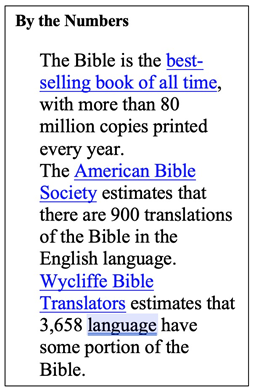
The Bible is, as Hebrews 1:1 begins, the very words of God, spoken to the fathers by the prophets “long ago, at many times and in many ways.” Indeed, God spoke to his people in ancient times, but writing hundreds of years after God spoke to Israel out of the fire (Deut. 4:12, 15, 33, 36), the author of Hebrews could say, “in these last days he has spoken to us by his Son.”
In this way, the Bible is not just a religious book deposited all at once. Nor is it a work of literature with no traction in history. Rather, the Bible is the progressive revelation of God, which perfectly interprets his acts of salvation and judgment in the world. As we look at the structure of the Bible, we see a cohesive narrative.
And more, the thirty-nine books of the Old Testament and New Testament divisions work together; the former played a unique role in preparing the way for the eternal Word to take on flesh and dwell among us (John 1:1–3, 14), and the twenty-seven books written after his ascension bore testimony to Christ’s life, death, resurrection, and exaltation. Understanding this connection is vital for any Bible reading plan
you might choose to follow. Even today, the Word of God continues to accomplish its purposes of redemption, even as the revelation of God’s Word came to a close at the end of John’s Apocalypse
(see Rev. 22:18–19).1
For this field guide, we will not delve into all the ways the Bible has shaped the world and has itself been shaped by the world.2 Instead, our time will be spent answering the theological question: What is the Bible, as the church has received it? To that question, I will offer three answers — one from the Protestant confessions, one from the Biblical canon, and one from the testimony of the Holy Spirit who inspired the Bible.
According to the Confessions
In 1517, a German monk with a mallet nailed the 95 Theses to the Wittenberg Castle Door.3 Martin Luther, a trained theologian and studious pastor, was concerned with the way the Roman Catholic Church had misled him and others to believe that righteousness was achieved through an endless maze of sacraments, instead of faith alone in the finished work of Christ alone — all by the grace of God. Indeed, by his study of Scripture, Luther had become convinced that the Roman Catholic Church had lost the Gospel and its message of justification by faith alone.4 Accordingly, he ignited the Protestant Reformation with his 95 Theses.
In the decades that followed, the Protestant Reformation recovered the Gospel and its source, the Bible. Unlike the Roman Catholic Church, which affirmed the Bible’s divine origin and authority but also put church tradition on the same level as the Bible, men like Luther, John Calvin, and Ulrich Zwingli began to teach that the Bible was the only source of inspired revelation. Whereas the Roman Catholic Church taught that God spoke through two sources, the Bible and the Church, the Reformers rightly affirmed Scripture as the only source of special revelation. As Luther famously stated,
Unless I am convinced by the testimony of the Scriptures or by evident reason — for I can believe neither pope nor councils alone, as it is clear that they have erred repeatedly and contradicted themselves — I consider myself conquered by the Scriptures adduced by me and my conscience is captive to the Word of God.5
Indeed, Luther’s advocacy for the Bible as God’s Word was echoed by all the Reformers. Today, the heirs of the Reformation continue to hold Scripture as God’s inspired and authoritative Word. The best place
to see that conviction is in the confessions that came from the Protestant Reformation, such as the Belgic Confession, the Thirty-Nine Articles, and the Westminster Confession of Faith, which all affirm Sola Scriptura. Yet, to offer my own tradition: The Second London Baptist Confession (1689).
In the opening paragraph of the first chapter, the ministers confessed their faith in God’s Word:
- The Holy Scriptures are the only sufficient, certain, and infallible standard of all saving knowledge, faith, and obedience… Therefore, the Holy Scriptures are absolutely necessary, because God’s former ways of revealing his will to his people have now ceased.
In this statement, they affirmed the sufficiency of Scripture, necessity, clarity, and authority. These four attributes articulate how Protestants view the Bible as “the word of God written” (WCF 1.2). Those who take the Word of God seriously treat it as divine truth in human words because they believe the testimony of Scripture itself.
According to the Canon
Protestants do not believe that church tradition is sufficient to develop beliefs about the Bible. Instead,
we believe Scripture bears witness to itself. For instance, 2 Timothy 3:16 says that all Scripture is “God-breathed” (theopneustos), asserting the inspiration of Scripture. Likewise, 2 Peter 1:19–21 identifies the Holy Spirit as the source for the prophets. Paul also notes in Romans 15:4 that what was written in former days was for our instruction and hope.
The Old Testament and New Testament are inextricably linked. The Law, the Prophets, and the Writings — the three parts of the Hebrew Bible — all point to Christ. Jesus identifies Himself as the subject of the Old Testament (John 5:39) and the one to whom all scriptures point (Luke 24:27, 44–49).
Jesus also anticipated the Holy Spirit coming to bear witness about Him (John 15:26; 16:13). This Spirit
of truth would remind the disciples of His words, ensuring that we can trust the Bible as God’s Word.
According to the Testimony of the Spirit
If the Bible is its own source of authority, is this not circular reasoning? While an argument for the Bible from the Bible is circular, it is not a fallacy. All claims to ultimate authority are broadly circular. If the Bible depended on an outside entity for its authority, that entity would become the authority over the Bible. This was the error of the Roman Catholic Church, which claimed authority to decide the canon and interpret it through tradition.
By contrast, the Reformers spoke of the Bible’s “self-attestation.” Because the Holy Spirit who prompted the inspiration of Scripture continues to impress its truth on souls today, we can have real confidence.
As we engage in daily Bible reading, the Spirit “drives away the misty darkness of errors” and instructs
us in truth.
By contrast, John Calvin and the Reformers spoke of the Bible’s “self-attestation.”6 The Bible is the Word of God because the Bible declares itself to be so, and its legitimacy is found in the way that its testimony is proven by all that it says about everything else. Equally, because the Holy Spirit who inspired the Bible continues to impress its truthfulness onto souls who hear it today, we can know that the Bible is God’s Word. In other words, because the origin of the Bible (an objective reality) and one’s confidence in the authenticity of the Bible (a subjective belief) both come from the same source (the Holy Spirit), we can have real confidence that the Bible is God’s Word. As the Reformer Heinrich Bullinger put it,
If, therefore, the word of God sounds in our ears, and there the Spirit of God shows forth his power in our hearts, and we in faith do truly receive the word of God, then the word of God has a mighty force and a wonderful effect in us. For it drives away the misty darkness of errors, it opens our eyes, it converts and enlightens our minds, and instructs us most fully and absolutely in truth and Godliness.7
Those willing to listen to the authors of Scripture will find a unified testimony of some forty men, writing in three different languages (Hebrew, Greek, and some Aramaic) over the course of fourteen hundred years. The likelihood that such a composition could be crafted cogently by human authors alone is impossible.
Still, the visible evidence of literary unity is powerful, but we remain dependent on the living God to reveal himself to us. And therefore, the testimony of the Spirit is ultimately what causes us to believe the Bible (John 16:13). This internal work of the Spirit is vital as we seek to understand how to pray for insight and illumination while we study.
In sum, then, God has spoken, and his words are found in the sixty-six books of the Bible. Or at least, those are the books that Protestants recognize in their Bible. Understanding this divine origin changes how to read Bible passages; we don’t just look for information, but for the voice of our Creator.
—
Discussion & Reflection:
- How would you answer the question “What is the Bible?” How would you put the above material in your own words?
- Was anything that you just read new or surprising to you? What challenged you?
- How does the truth that the Bible is God’s very Word affect the way you read it? Think specifically about your daily Bible reading—does this conviction change your posture or your expectations?
—
Part 2: Where Did the Bible Come From?
When we talk about the Bible, we are talking about the books of the Biblical canon. As R. N. Soulen has defined the term, a canon is “collection of books accepted as an authoritative rule of faith and practice.”8 In Hebrew, the word canon comes from the word qaneh, which can mean “reed” or “stalk.” In Greek, the word kanon often has the idea of being a rule or principle (see Gal. 6:16). Connecting both languages, Peter Wegner notes, “Certain reeds were also used as measuring sticks, and thus one of the derived meanings of the word [qaneh, kanon] became ‘rule.’”9
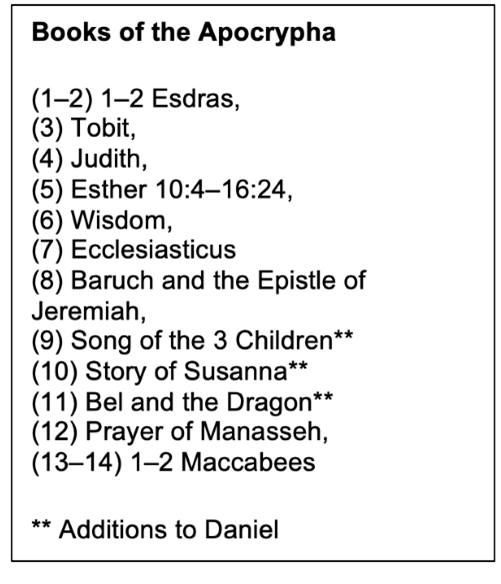
And so this explains the word’s background. But what about canonicity? How does a book “make the cut,” so to speak? That question is vital for understanding the Bible, the church, and who authorizes whom.
In answer to this set of questions, it is tempting to think that the church authorizes the Bible and decides what books should be in the canon. This is what the fourth session at the Council of Trent did in recognizing the books of the Apocrypha, and it is also what Dan Brown did in his fiction, suggesting that certain texts like the Gospel of Thomas were excluded by mere human politics. Even the language of the Apocrypha (the hidden things) hints at this kind of thinking, but actually, it is misguided.
As we noted above, the source of the Bible is God himself, and the Spirit is the one who moved the authors to write what they wrote. To measure twice before cutting once, the church did not authorize the books that would compose the canon; rather, the churches (led by the Spirit) recognized the books of the Bible as being inspired by God. In other words, the church did not create the Bible; the Bible, as the Word of God, created the church. This is a simple distinction, but one with massive implications for how to read Bible correctly.
What we think about the Biblical canon will largely determine how we approach Bible reading. Are the books of the Bible the work of God, recognized by men? Or is the canon the work of men? Put succinctly, individual assemblies in the first centuries had to decide which letters and Gospels were the result of the inspiration of Scripture. This is even seen within the text:
– 1 Corinthians 14:37: Paul insists that the spiritual must acknowledge his writings as a command of the Lord.
– 2 Peter 3:15–16: Peter recognizes Paul’s letters as Scripture.
– 1 John 4:6: John declares that those who know God listen to the apostolic testimony.
The New Testament teaches us that the Word of God was not something actively decided by the church, but something passively recognized. The words of the apostles were confirmed by works of the Holy Spirit (Heb. 2:4; 2 Cor. 12:12). Over three centuries, from the resurrection to the Easter Letter of Athanasius in 367 AD, the composition of the canon was a process of reception, not creation.
Because the Hebrew Bible canon was already a solid foundation in the days of Christ, the early church could focus on the New Testament testimony. In the rest of this section, I will offer three reasons for each testament as to why we can have confidence in the Old Testament and New Testament as we pursue a daily Bible reading plan.
Old Testament
The New Testament consistently testifies that the books of Moses (Torah), the words of the Prophets (Naviim), and the Psalms (Ketuviim) were the canonical books of the Old Testament.10 For this reason, “there is little to no [scholarly] dispute about the core of the Old Testament we see the New Testament use.”11 Nevertheless, let me offer three reasons why we should have confidence that these additional fourteen books of the Apocrypha are withheld from the canon.
1. First, by the time the books of the Apocrypha had been written, the Spirit of God had stopped speaking.
As noted by multiple sources, the Spirit of God no longer spoke after Malachi. For instance, the Babylonian Talmud declares, “After the latter prophets Haggai, Zechariah, and Malachi had died, the
Holy Spirit departed from Israel, but they still availed themselves of the voice from heaven” (Yomah 9b). Likewise, the historian Josephus notes in Against Apion, “From Artaxerxes to our own times a complete history has been written, but has not been deemed worthy of equal credit with the earlier records, because of the failure of the exact succession of the prophets’’ (1.41). Similarly, 1 Maccabees, one of the Apocryphal books, views its own time period as devoid of prophets (4:45–46). Thus, it is clear that the things written between Malachi and Matthew did not contain inspired Scripture.
2. Second, the early church made a clear distinction between canonical and non-canonical books.
From AD 382–404, Jerome translated the Bible into Latin. In time, his translation became known as the Latin Vulgate, a term signifying the common language of the people.12 In his translation work, he came across the “Septuagintal plus,” the extra books included in the Greek translation of the Old Testament.13 Sensing a need to translate from the original Hebrew and not rely solely on the Greek translation, he quickly discerned that not all of the books found in the Septuagint were of equal value. Thus, he limited the canonical books to the thirty-nine found in today’s Protestant Bibles.14 In turn, he accepted the apocryphal books as having a place for historical instruction, but not for determining doctrine.15
The canonical books alone possessed such authority.
In the centuries that followed until the Reformation, Jerome’s distinction between canonical and non-canonical books was largely lost. As his Latin translation became the people’s book, Apocryphal books were often included.16 Accordingly, the medium formed the message, and the Apocrypha became part
of the accepted canon. This inclusion would sponsor erroneous doctrines in the Roman Catholic Church, doctrines like praying for the dead (2 Macc. 12:44–45) and salvation by almsgiving (Tobit 4:11; 12:9).
We can see why the early church made a clear distinction between canonical and noncanonical books.
3. Third, the Reformation recovered the Hebrew Bible.
When Reformers like Martin Luther began championing Sola Scriptura (“Scripture alone”), the question of canon returned. And among Protestants, the Apocrypha was returned to its proper place — a selection of books useful for their history, but not for authoritative doctrine. This is evident in the way that Luther, Tyndale, Coverdale, and other Protestant Bible translators followed the distinction of Jerome, and relegated the Apocryphal books to appendices in their respective Bible translations.17
By contrast, the Council of Trent (1545–63) recognized these books as authoritative for doctrine and condemned anyone who would question their place. Additionally, the first Vatican Council (1869–70) reinforced the point and argued that these books were “inspired by the Holy Spirit and then entrusted
to the church.”18 This divide still stands between Protestants and Roman Catholics. Yet, for reasons stated above, it is best to follow Jerome’s distinction that the books of the Apocrypha are neither necessary nor appropriate for establishing doctrine. Rather, they are merely helpful for providing historical background to the story of God’s work among the people of Israel.19
New Testament
If the New Testament confirms the books of the Old Testament, what confirms the books of the New?
At first blush, this question seems to be more challenging. But just as Jesus and the early church could recognize that the Scriptures came from the Holy Spirit (2 Pet. 1:19–21; cf. 2 Tim. 3:16) over against those books that did not come from the Spirit, so too the early church could recognize Gospels and Epistles that came from the apostles and those that did not.
1. First, the origins of the canon are evident in the New Testament itself.
For instance, in 1 Timothy 5:18, Paul cites from Moses and Luke, referring to both of them as Scripture: “For the Scripture says, ‘You shall not muzzle an ox when it treads out the grain,’ [Deut. 25:4] and, ‘The laborer deserves his wages’ [Luke 10:7].” Similarly, Peter associates Paul’s letters with Scripture (2 Pet. 3:15–16).
And this reference comes right after Peter states, “that you should remember the predictions of the holy prophets and the commandment of the Lord and Savior through your apostles” (2 Pet. 3:2). In other words, Peter understands the apostles to be carrying the very words of Christ, and he associates the apostles with the holy prophets of the Hebrew Bible.
In sum, then, the Bible itself bears witness to the apostolic writings as God’s Word. This internal evidence is a cornerstone of the inspiration of Scripture and provides a firm foundation for any daily Bible reading plan. By seeing how the apostles viewed each other’s work, we gain clarity on the unity of the Old Testament and New Testament.
2. Second, as with the Apocrypha, the other books written in the centuries after Christ do not measure up.
As Köstenberger, Bock, and Chatraw note, the Letter of Ptolemy, the Letter of Barnabas, and the Gospels
of Thomas, Philip, Mary, and Nicodemus all demonstrate themselves to be “leagues apart” from inspired Scripture.20 For instance, citing the most famous extra-Biblical Gospel, they write of the Gospel of Thomas:
This book is not a Gospel in the pattern of the four Gospels of Scripture. It has no storyline, no narrative, no account of Jesus’s birth, death, or resurrection. It contains 114 sayings allegedly attributed to Jesus, and though some sound like what you might hear in Matthew, Mark, Luke, or John, many are strange and bizarre. Broad consensus places its writing in the early to late second century, but it never factored into canonical discussions. In fact, Cyril of Jerusalem specifically warned against reading it in the churches, and Origen characterized it as an apocryphal Gospel. The following statement [from Michael Kruger] sums it up: “If Thomas does represent authentic, original Christianity, then it has left very little historical evidence of that fact.”21
3. Third, the early church quickly reached a consensus on the canon.
Indeed, due to multiple factors, the early church reached a consensus on the canon over many generations. While Christian books like the Letter of Barnabas and The Shepherd of Hermas were appreciated, and occasionally read in some churches, they were not confused with Scripture. Like with the Apocrypha, Jerome noted that these “ecclesiastical” writings were good “for the edification of the people but not for establishing the authority of ecclesiastical dogmas.”22
Throughout the first few centuries after Christ, a growing list of recognized books emerged. Indeed, as listed here, the church not only cited the apostles in their sermons, letters, and books, but they would occasionally list the books as well (e.g., the Muratorian Canon).23 And thus, “the books of the New Testament were recognized (not selected) as cream that had risen to the top, used by churches because they were seen to have unique and special value.”24 To cite Jerome once more,
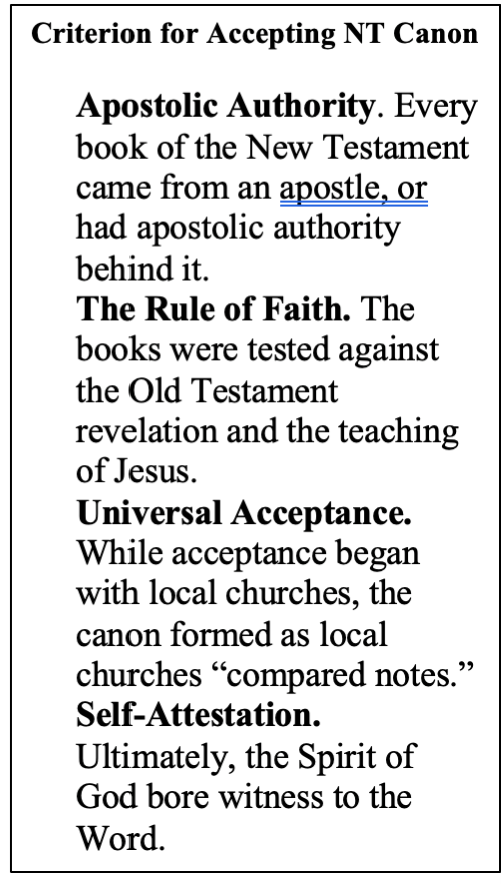
Matthew, Mark, Luke, and John are the Lord’s team of four, the true cherubim (which means ‘abundance of knowledge’), endowed with eyes throughout their whole body; they glitter like
sparks, they flash to and fro like lightning, their legs are straight and directed upward, their backs are winged, to fly in all directions. They are interlocked and hold on to one another; they roll along like wheels within wheels; they go to whatever point the breath of the Holy Spirit guides them.
The apostle Paul writes to seven churches (for the eighth such letter, that to the Hebrews, is placed outside the number by most); he instructs Timothy and Titus; he intercedes with Philemon for his runaway slave. Regarding Paul, I prefer to remain silent rather than write only a few things.
The Acts of the Apostles seem to relate a bare history and to describe the childhood of the infant church; but if we know that their writer was Luke the physician, ‘whose praise is in the Gospel, ’ we shall observe likewise that all their words are medicine for the sick soul. The apostles James, Peter, John, and Jude produced seven epistles, both mystical and concise, both short and long — that is, short in words but long in thought so that there are few who are not deeply impressed by reading them.
The Apocalypse of John has as many mysteries as it has words. I have said too little in comparison with what the book deserves; all praise of it is inadequate, for in every one of its words manifold meanings lie hidden.25 In this list, Jerome gives us the twenty-seven books of the New Testament, but he also hints at their respective glories. And thus, it moves us to consider why the canon matters.
Why the Canon Matters
We have labored to answer the question, “Where did the Bible come from?” for a very basic reason: namely, how one understands the Bible’s formation, source, and contents determines how one reads — or doesn’t read! — the Bible’s message. Bible readers who are serious about knowing God cannot have confidence to believe what Scripture says or conviction to do what it commands unless they know that the Bible is the inspired and authoritative Word of God and not the fabrication of religious men.
On this point, the Biblical canon matters immensely. It serves as the boundary that protects the sufficiency of Scripture, ensuring that we neither add to nor take away from God’s complete revelation. Without a defined canon, a daily Bible reading habit would lack the firm foundation of knowing exactly which words are God’s words.
As we finish this section, let’s expand on the importance of the canon with three implications. These points will clarify how to read Bible texts with the assurance that you are handling the genuine inspiration of Scripture, rather than late additions like the Apocrypha or the Gospel of Thomas, which do not bear the marks of apostolic authority.
Understanding the canon is not just for scholars; it is essential for every believer’s Bible reading plan.
It provides the historical and theological “coordinates” needed to navigate the Old Testament and New Testament faithfully.
1. First, the formation of the canon undergirds the unity of God’s Word.
Amazingly, Scripture was written by about 40 human authors over roughly 1,400 years. But behind all of them is the one divine author who breathed out every word (2 Tim. 3:16; 2 Pet. 1:19–21). Indeed, the unity of Scripture is not found in a single deposit of information or a text devoid of literary tension. Rather,
the unity of the Bible comes from the fact that it “has God for its author, salvation for its end, and truth, without any mixture of error, for its matter” (BFM 2000). That is to say, over time, God inspired a series
of interconnected books that came to form a unified yet variegated revelation.
The formation of the canon, therefore, serves to undergird the unity of God’s Word, such that readers of the Book can know they are reading a drama of redemption. As God revealed himself to Moses, then to the prophets on the way to Christ, and then through the ministry of the apostles, there are tensions, events, and instructions that may appear contradictory. In one place, God says don’t eat anything unclean (Lev. 11); in another, he says the direct opposite (Acts 10). Bacon is back on the menu! If this appears disjointed or contradictory, that is only because one hasn’t yet learned how this part of the storyline unfolds.
In truth, the Bible is unified by a story rather than a set of timeless abstractions. And thus, understanding how the canon was formed through the ages of redemption reinforces confidence in the unity of Scripture. This is vital for any Chronological Bible reading plan, as it helps the reader see the progress of God’s plan. At the same time, it trains us in how to read Bible passages by resolving legitimate tensions through the lens of progressive revelation—a point we will consider below. This organic unity is what makes daily Bible reading so rewarding; we aren’t just reading fragments, but a singular, divine narrative.
2. Second, the source of the canon undergirds the authority of God’s Word.
If the canon was composed over time, as God spoke to the fathers through the prophets at many time and in many ways (Heb. 1:1), and if the canon was closed because the full and final revelation of God has come in Jesus Christ (Heb. 1:2; cf. Rev. 22:18–19), then we must acknowledge that this book is unlike any other. Indeed, the debate over the canon matters because what Scripture says, God says. This was the point that B. B. Warfield made in a famous essay entitled, “‘It Says:’ ‘Scripture Says:’ ‘God Says,’”26, and it can be found throughout the New Testament, where Jesus and his apostles appeal to Scripture as the authoritative Word of God.
For this reason, it matters that we know what is in the Bible and what is not. For, as we will see, when we follow the Reformation principle of letting Scripture interpret Scripture (i.e., the analogy of Scripture), we must define and explain Scripture by other passages that are actually inspired by God. Biblical theology, “the discipline of letting Scripture interpret Scripture and reading the whole Bible according to its own literary structures and unfolding covenants,” depends on having a Bible with fixed boundaries.27 To deny the canon, therefore, or to place canonical and non-canonical books on the same level leads to faulty interpretations and theological conclusions. Something I have labeled “the butterfly effect of Biblical theology.”
3. Third, the arrangement of the canon reveals the message of God’s Word.
If God is the source of the canon and the formation of its contents was under his divine providence, then we should not ignore the arrangement of God’s Word. In other words, just as Paul can make a theological argument for justification by grace alone by simply recognizing the way that the law of Moses was added 430 years later to the covenant made with Abraham (Gal. 3:17), so we should recognize that the literary and historical arrangement of the Biblical canon has interpretive significance. In other words, instead of seeing the Bible as a collection of books accidentally arranged, we should see how the whole canon reveals a message.
This is true in books like the Psalms and the Twelve, otherwise known as the minor prophets, but it is
true with the whole Bible too. As Old Testament scholar Stephen Dempster has observed, “Different arrangements generate different meanings.” And thus, “on a larger scale, the interpretive implications of the different arrangements of the Hebrew Tanakh and the Christian Old Testament have been noted.”28 Dempster’s observation is critical for reading the Bible, even as it introduces a wrinkle that exceeds the bounds of this field guide.
Dempster, along with others, has noted the way in which the Hebrew was arranged differently from the standard English Bible. The former has twenty-two books, the latter thirty-nine. To date, no publishers have offered an English Bible arranged like the Hebrew Bible. Nevertheless, awareness of this difference
is worthwhile. For not only does the Hebrew arrangement predate the English order, but this literary arrangement tells a theological story and provides a “hermeneutical lens through which its contents can be viewed.”29
Finally, it should be noted that this difference in canonical arrangements should not undermine our confidence in Scripture, but it should remind us of how Scripture came together. When we compare one passage with another, one part of the Bible with another, arrangement does matter. And this will be most evident as we come to Part 4 (How should we read the Bible?). Before going there, we have one more question to answer: What is (not) in the Bible?
—
Discussion & Reflection:
- How did this section strengthen your faith in God’s Word?
- How would you respond to a friend who thinks the books of the Apocrypha carry equal authority
as the sixty-six canonical books?
—
Part 3: What Is (Not) in the Bible?
I will not attempt to answer this question in the positive here, for to answer “What is in the Bible?” would require a full engagement with all sixty-six books. Indeed, there is a need for such engagement, and there are many helpful resources on this point, including Study Bibles,30 Bible surveys,31 and, most profitably, Biblical theologies. The reason I believe Biblical theologies are most helpful is that they do more than survey the text; they provide a lens through which we can read Scripture and understand its overarching message. Of all the good books on the subject, I would begin with these three.
– Graeme Goldsworthy, According to Plan: The Unfolding Revelation of God in the Bible (2002)
– Jim Hamilton, God’s Glory in Salvation through Judgment: A Biblical Theology (2010)
– Peter Gentry and Stephen Wellum, God’s Kingdom through God’s Covenants: A Concise Biblical Theology (2015)
While a positive Biblical theology will help anyone know what is in the Bible and how it fits together,
it is equally important to know what is not in the Bible. That is to say, if we come to the Bible with wrong expectations, we are susceptible to misreading Scripture or giving up reading Scripture entirely because it does not match our preconceived ideas.
However, if we can clear away some false expectations of Scripture, it will prepare us to read the Bible well. Understanding the boundaries of the Biblical canon ensures that we don’t accidentally treat human traditions or cultural myths as having the same weight as the inspiration of Scripture.
Misconceptions often arise when readers expect the Bible to be a modern science textbook, a simple “rule book” for every specific life decision, or a collection of disconnected moral fables. By identifying what is absent—such as the Apocrypha in the Protestant tradition or modern cultural additives — we protect the sufficiency of Scripture. This clarity is vital to a healthy daily Bible reading habit, as it allows the text to speak for itself without being muffled by our own assumptions.
Recognizing these boundaries helps us focus on the core message: the Old Testament and New Testament unity that points to the person and work of Jesus Christ.
And to help us avoid misreading the Bible, let me offer five considerations from Kevin Vanhoozer.
In his illuminating book, Pictures at a Theological Exhibition: Scenes of the Church’s Worship, Witness, and Wisdom, Vanhoozer reminds us that the Bible is a communication from God, the Father, Son, and Holy Spirit, to the people made in his image. In other words, it is not merely a religious text or handbook for spiritual living. Rather, citing J. I. Packer, he summarizes the Bible in one sentence: “God the Father preaching God the Son in the power of God the Holy Ghost.” And with this positive statement in place,
he provides five things the Bible is not.32
Building on the idea of clearing away false expectations, here are five essential truths about what the Bible is—and what it is not:
- Scripture is not a word from outer space or a time capsule from the past, but a living and active Word of God for the church today. It is not a relic to be admired from a distance, but a present-tense address from the Creator to His people.
- The Bible is both like and unlike every other book: it is both a human, contextualized discourse
and a holy discourse ultimately authored by God and intended to be read in canonical context. It possesses a dual authorship—human and divine—that requires us to respect its history while submitting to its authority. - The Bible is not a dictionary of holy words but a written discourse: something someone says to someone about something in some way for some purpose. We shouldn’t treat it like a reference manual for isolated “magic words,” but as a series of intentional communications.
- God does a variety of things with the human discourse that makes up Scripture, but above all, he prepares the way for Jesus Christ, the climax of a long, covenantal story. From the first pages of the Hebrew Bible to the final vision of Revelation, the narrative arc is intentionally directed toward the Savior.
- God uses the Bible both to present Christ and to form Christ in us. The goal of our daily Bible reading is not merely the accumulation of facts, but transformation into the image of the Son.
These principles shift our focus from a “what can I get out of this” mentality to a “what is God saying to me” posture. When we understand how to read Bible genres as parts of this grand covenantal story, the Old Testament and New Testament become a unified voice shaping our faith today.
Indeed, getting the Bible right does not secure good interpretation or practice, but getting the Bible wrong will lead to errors large and small. So we should aim to rightly understand what Scripture is and what it is intended to do — namely, to lead us to Christ and make us like him. This means we must read the Bible with faith, hope, and love. Or to draw out the logical implications, we read the Bible with hope that the God who spoke in his Word will produce in us faith that leads to love.
Truly, no other book in the world can do that. And if we treat the Bible like any other book, we will misread it. Knowledge may increase, but faith, hope, and love will not. At the same time, if we do not
give attention to the grammatical and historical nature of the Bible as a book, we are liable to misread its contents as well. Accordingly, we need to read the Bible wisely, but such wisdom depends on knowing what the Bible is and what it is not.
To return to Packer’s definition of Scripture, the Bible is the Father’s Word to us, inspired by the Spirit,
to bring us to the Son, so that by God’s Word in human words we might know him and be conformed into his image. In this way, the Bible is a book given to illicit praise to the triune God (doxology) and to cultivate faith, hope, and love in God’s people (discipleship). And with these two orientations in place,
we are now ready to consider how to read the Bible.
—
Discussion & Reflection:
- Are you ever tempted to think wrongly about what the Bible is? Do any of the five items listed above describe things you think or have thought before?
- Do you read the Bible “with hope that the God who spoke in his Word will produce in us faith that leads to love”? How might that change the way you engage with Scripture?
—
Part 4: How Should We Read the Bible?
As with the first three parts, the question at hand — how to read Bible? — requires more than can be offered here. Nevertheless, I will offer three practical steps for reading the Bible as God’s Word, keeping in mind the inspiration of Scripture.
– Discover the grammatical and historical context of the passage.
– Discern where the passage is found in the covenantal history of the Bible, tracing the story from the Old Testament and New Testament.
– Delight in the way that this passage brings you to a fuller knowledge of Jesus Christ, making it the heart of your daily Bible reading and any Bible reading plan.
These three “steps” can be described as the textual, covenantal, and Christological horizons of any given passage.33 In order, each serves as a stepping stone towards uncovering the meaning of a text, its placement in redemptive history, and its relationship to God revealed in Christ. Together, they provide a consistent approach to reading any part of the Bible, for those who are willing to “study” the works revealed in God’s Word (Ps. 111:2).
Such a consistent approach is helpful because understanding the Bible on its own terms takes work. Because every Bible reader brings his or her own preconceived notions to Scripture, any proper method for reading will help us see what is in the Bible and avoid imposing our own ideas and interests on it.
To do that, I have found this threefold approach to be remarkably helpful.34 So, we will look at each.
Yet, before taking the first step, let me offer a word of encouragement to those just beginning to read the Bible. Whether you are starting a new Bible reading plan or simply making daily Bible reading a part of your life, understanding how to read Bible texts will help you see the divine inspiration of Scripture on every page.
Preparing to Read the Bible: Cultivating a Heart for God’s Word
While reading the Bible well takes discipline and skill, it begins with something far more basic — simply reading the Bible. Just as running precedes running well, and playing the piano at home precedes playing the piano for others, so too reading the Bible well begins with the simple act of reading.
Therefore, I would encourage anyone who is just beginning to read Bible to trust God, ask for his help, and read with faith. God promises to reveal himself to anyone who seeks him with a true heart (Prov. 8:17; Jer. 29:13). If you read Scripture, you will learn that we cannot seek God without his help (Rom. 3:10–19), but you will also discover that God delights to show himself to those who approach him with faith (Matt. 7:7–11; John 6:37). God is not stingy toward those who seek in faith.
Knowing that, those who read the Bible should pray and ask God to make Himself known to them. The Spirit is the one who gives life and light, and because reading the Bible is a spiritual endeavor, new readers should ask for his divine aid. And then, with faith that he hears and answers such a prayer, they should read, read, and read some more. Just as physical growth takes repeated meals and bodily motion before size and strength are registered in a body, so spiritual growth and Biblical understanding take time too.
Thus, the most important thing for reading the Bible is cultivating a heart for God’s Word. And there is no better place to do that than Psalm 119. If reading the Bible is new for you, take one stanza (eight verses) of Psalm 119, read it, believe it, pray it, and then begin reading the Bible.
Additionally, having a consistent time, place, and Bible reading plan or schedule will make reading more enjoyable.35 Over the years, I have learned that daily Bible reading is not simply a habit to develop; it is a heavenly meal to enjoy. Just as we eat food for physical strength and pleasure, so Scripture should be enjoyed the same way. As Psalm 19:10–11 puts it, “More to be desired are they than gold, even much fine gold; sweeter also than honey and drippings of the honeycomb. Moreover, by them is your servant warned; in keeping them there is great reward.”
With this promise in mind, let me encourage you to taste and see how good the inspiration of Scripture is. As you read, I offer these next three steps to help you make the most of reading the Bible well.
The Textual Horizon: Discovering the Meaning of the Text
All good Bible reading begins with the text. And a key text for observing Biblical interpretation in action is Nehemiah 8. Describing the action of the priests, who were commissioned to teach people of Israel (Lev. 10:11), Nehemiah 8:8 reads, “They read from the book, from the Law of God, clearly, and they gave the sense, so that the people understood the reading.” In the historical context, the people needed re-education in God’s ways when they returned from exile. Even before the exile, attention to the Law had been lost (cf. 2 Chron. 34:8–21), and now delivered from captivity, the sons of Israel were not much better off. Hebrew had been lost in the exile; Aramaic was the new lingua franca, and so Nehemiah had the Law read, and the priests “gave the sense” of its meaning.
Like Ezra himself (Ezra 7:10), these Levitical leaders helped the people understand and apply the Law of God. As the Law commanded them to do (Lev 10:11), they were explaining what the Law meant. And thus we have a true example of Biblical exposition, where the text is explained line by line. In particular, the meaning of a passage is found in the prose, the poetry, and the propositions found in sentences, stanzas, and strophes. In short, how to read Bible literature effectively begins by paying attention to the literary and historical context of a given passage.
This focus on the original intent is a vital part of the inspiration of Scripture. When you engage in daily Bible reading, you are not just looking for a personal “feeling,” but for the “sense” that God originally communicated through the human authors. Whether you are following a specific Bible reading plan or studying a single book, understanding this context helps you rightly handle the Bible and its message.
And importantly, this way of reading is not just produced outside the Bible; it is actually found within it. Deuteronomy and Hebrews both demonstrate Biblical exposition, which is another way of describing reading the Bible with precision and application. For instance, Deuteronomy 6–25 expounds the Ten Commandments (Exodus 20; Deuteronomy 5), and Hebrews is a sermon that expounds and relates multiple passages from the Old Testament.36
On this basis, we can learn from Scripture how to read Bible narratives and teachings. And when we
read the Bible, we should begin at the textual horizon, where we pay careful attention to the author’s intentions, the historical context of the audience, and the aim of the book, written from the author to the audience. In this way, we should first pay attention to what the author says (the textual horizon) and then when he says it (the covenantal horizon).
The Covenantal Horizon: Discerning the Storyline of God’s Covenant History
Zooming out from the textual horizon, we come to the covenantal horizon, or what others have called
the epochal horizon.37 This horizon recognizes that the Bible is not merely a catalog of timeless truths. Rather, it is a progressively revealed testimony about God’s redemption in history. It is intentionally written along the lines of a multi-faceted promise fulfilled in Christ. As Acts 13:32–33 says, “And we
bring you the good news that what God promised to the fathers, this he has fulfilled to us, their
children, by raising Jesus.”
In recent centuries, this progressive revelation has been variously described as a series of dispensations
or covenants. And while various traditions have understood the Biblical covenants differently, the Bible is unmistakably a covenantal document, comprised of two testaments (Latin for “covenant”), and centered on the new covenant of Jesus Christ.
Therefore, it fits the Biblical storyline to understand it as a series of covenants. In fact, from an overview of the Bible, we can lay out redemptive history along six covenants, all leading to the new covenant of Christ.
– Covenant with Adam
– Covenant with Noah
– Covenant with Abraham
– Covenant with Israel (mediated by Moses)
– Covenant with Levi (i.e., the priestly covenant)
– Covenant with David
– The New Covenant (mediated by Jesus Christ)
These covenants are listed in chronological order and can be shown to possess organic unity and theological development over time. For matters of reading the Bible, it is necessary to ask, “When is this text taking place, and what covenants are in force?”
This question requires the reader to grow in his or her understanding of the covenants, their structure, stipulations, and promises of blessings and curses. In this way, the covenants function as Scripture’s tectonic plates. And knowing their contents provides a growing awareness of the Bible’s message and how it leads to Jesus Christ. This perspective is vital for a fruitful daily Bible reading that respects the inspiration of Scripture.
The Christological Horizon: Delighting in God through the Person and Work of Christ
In Scripture, there is from the beginning a forward-looking orientation that leads the reader to look for Christ. That is to say, beginning with Genesis 3:15 when God promises salvation through the seed of the woman, all Scripture is written in italics — meaning, it slants forward towards the Son who is to come. As Jesus taught his disciples, all Scripture points to him (John 5:39), and so to interpret any portion of the Bible rightly, we must see how it naturally relates to Christ. This is what Jesus did on the Emmaus Road (Luke 24:27), and in the Upper Room (Luke 24:44–49), and what all his apostles continued to do and teach.
To see this method of reading the Old Testament and New Testament Christologically, one can look at the sermons in Acts. For instance, on the Day of Pentecost, Peter explains how the outpouring of the Spirit fulfills Joel 2 (Acts 2:16–21), the resurrection of Christ (Psalm 16; Acts 2:25–28), and the ascension of Christ (Psalm 110; Acts 2:34–35). Likewise, when Peter preaches on Solomon’s Portico in Acts 3, he identifies Jesus as the prophet like Moses prophesied in Deuteronomy 18:15–22 (see Acts 3:22–26). More comprehensively, when Paul is put under house arrest in Rome, Acts 28:23 records how the imprisoned apostle expounded the Scripture, “testifying to the kingdom of God and trying to convince them about Jesus both from the Law of Moses and from the Prophets.” Long story short, the sermons in Acts give many illustrations of how the apostles read the Old Testament Christologically.
Admittedly, this Christ-centered approach to interpretation can be misapplied or mischaracterized. But rightly understood, it shows how sixty-six different books find their unity in the Gospel of Jesus Christ.
The Bible is unified because it comes from the same God, and even more, it points to the same God-man, Jesus Christ. And because it is a human book with gracious promises to all humanity, all Scripture points to the long-awaited messiah who is the mediator between God and man.
To relate the three horizons, then, every text has a place in the covenantal framework of the Bible that leads us to Christ. Hence, every text is organically related to the covenantal backbone of Scripture, and every text finds its telos in Christ through the progress of Biblical covenants. And unless we bring these three horizons together, we fall short of understanding how to read Bible passages. At the same time, the order of the horizons matters too. Christ is not transported back in time to Israel, nor should we simply make superficial connections between the red color of the thread in Rahab’s window (Josh 2:18). Instead, we should understand the whole episode with Rahab (Joshua 2) in light of the Passover (Exodus 12), and then from the Passover, we can move to Christ.
This Christ-at-the-end (Christotelic) presupposition is based on the exegetical conviction that all Scripture, all covenants, all typology lead to Jesus. And, accordingly, it has massive interpretive implications. It says that no interpretation is complete until it comes to Christ. Any application that comes to us from the
Old Testament, which avoids the person and work of Christ, is fundamentally unsound. Equally, all New Testament applications find their source of strength in Christ, the covenant he mediates, and the Spirit
he sends. Therefore, all true interpretations of the Bible must be drawn from the text and related to the covenants, so that they bring us to see and savor Jesus Christ.
This is how we should read the Bible — over, and over, and over again!
Fear and Fear Not, but Take Up and Read
As we finish this field guide, I can imagine that the earnest follower of Christ or the individual considering the claims of Christ may feel inadequate for the task of reading the Bible. And, in a counterintuitive way, I want to affirm such feelings. Approaching God on Mount Sinai was daunting. And though we have a mediator available to us today in the person of Jesus Christ, it remains a gracious and fearful thing to approach God in his Word (Heb. 12:18–29). In this way, we should approach the Word of God with reverence and awe.
At the same time, with Christ living to intercede for those whom he is calling to himself, we should not fear. God deals mercifully with sinners who trust him and seek him in his Word. Thus, reading the Bible is not a fearful activity. So long as we come humbly before God, it is filled with grace, hope, life, and peace.
In truth, no one is, in and of himself, sufficient to read the Bible. All true Bible reading depends on the triune God communicating Himself to us and on us praying for grace to read God’s Word rightly.
In a world filled with endless distractions and competing voices, even the chance to engage in daily Bible reading is difficult. And thus, when we endeavor to pick up the Bible to read, we should do so with confidence that God can speak through the cacophony, and with prayer, asking God to help us. To that end, I offer this final word about Bible reading from Thomas Cranmer (1489–1556).
In a sermon on the place of reading Scripture, he emphasized the importance of repeated reading and the need to read Scripture humbly. As we read the Bible, let these words encourage us to understand it with patient humility and obedience, so that our profit from it results in praise to the living God who still speaks through it.
If we read once, twice, or thrice, and understand not, let us not cease so, but still continue reading, praying, asking of others, and so by still knocking, at the last the door shall be opened, as Saint Augustine says. Although many things in the Scripture are spoken in obscure mysteries, yet there is no thing spoken under dark mysteries in one place, but the selfsame thing in other places is spoken more familiarly and plainly to the capacity of both the learned and the unlearned. And those things in the Scripture that be plain to understand and necessary for salvation, every man’s duty is to learn them, to print them in memory, and effectually to exercise them; and as for the obscure mysteries, to be contented to be ignorant in them until time as it shall please God to open those things unto him. . . . And if you are afraid to fall into error by reading Holy Scripture, I shall show you how you may read it without danger of error. Read it humbly with a meek and a lowly heart, to think you may glorify God, and not yourself, with the knowledge of it; and read it not without daily praying to God, that he would direct your reading to good effect; and take upon you to expound it no further then you can plainly understand it. . . . Presumption and arrogance [are] the mother of all error: and humility needs to fear no error. For humility will only search to know the truth; it will search and will confer one place with another: and where it cannot find the sense, it will pray, it will inquire of others[s] that know, and will not presumptuously and rashly define anything which it knows not. Therefore, the humble man may search for any truth boldly in the Scripture without any danger of error.38, 39
—
Discussion & Reflection:
- Did any of this section help you know how to read Bible more faithfully?
- Which of the three horizons was most helpful to you?
- What’s your plan for how to regularly engage in daily Bible reading?
—
Endnotes
- Sometimes this view of God’s revelation ceasing at the end of the apostolic age is called cessationism. For a helpful discussion of this position, see Thomas R. Schreiner, Spiritual Gifts: What They Are and Why They Matter (Nashville: B&H, 2018), 155–69.
- For those interested in considering the Bible’s place in America, as well as its impact on the citizens of this nation, Mark Noll’s book, America’s Book: The Rise and Decline of a Bible Civilization, 1794–1911 (New York: Oxford University Press, 2022), is well worth the effort to read.
- Stephen J. Nichols, The Reformation: How a Monk and a Mallet Changed the World (Wheaton, IL: Crossways, 2007).
- Admittedly, his own theology had not crystallized in 1517. But by 1520, he had come to a place of understanding and affirming the five solas of the Reformation: Salvation is by grace alone, by faith alone, in Christ alone, according to Scripture alone, all for the glory of God alone. Hence, sola gratia, sola fide, solus Christus, sola Scriptura, and soli Deo Gloria.
- LW 32:112. Cited in Matthew Barrett, ed., Reformation Theology: A Systematic Survey (Wheaton IL: Crossway, 2017), ##.
- John Calvin, Institutes of the Christian Religion, ed. John T. McNeill, trans. Ford Lewis Battles (Louisville: Westminster John Knox, 1960), 1.7.5.
- Quoted in Barrett, Reformation Theology, 172.
- Richard N. Soulen, Handbook of Biblical Criticism, 2nd Ed. (Louisville, KY: Westminster John Knox, 2011), 37.
- Paul Wegner, The Journey from Texts to Translations: The Origin and Development of the Bible (Grand Rapids: Baker Academic, 2004), 101.
- The Torah, Naviim, and Ketuviim, make up the Tanakh, or the Hebrew Bible.
- Andreas Köstenberger, Darrell Bock, and Josh Chatraw, Truth Matters: Confident Faith in a Confusing World (Nashville: B&H Academic, 2014), 45.
- Today, the word “vulgar” is associated with crude or offensive speech, but in Latin the word vulgaris had to do with common, or of the masses. Hence, the Vulgate was a Bible written in common speech.
- F. F. Bruce, The Canon of Scripture (Downers Grove, IL: InterVarsity, 1988), 87–93.
- More exactly, he numbered twenty-two books of the Hebrew Bible, taking the Minor Prophets as one book, and other English books (e.g., 1–2 Chronicles and Ezra–Nehemiah) as one book also. We will revisit this way of numbering below.
- To be most precise, Jerome actually saw two kinds of books standing outside of Scripture — those that possessed an edifying effect for the church and others that were to be wholly avoided (Bruce, The Canon of Scripture, 90). Thus, he writes in the preface to his commentary on Proverbs, Ecclesiastes, and Song of Songs: “As the church indeed reads Judith, Tobit, and the books of Maccabees, but does not receive them among the canonical books, so let it read these two volumes for the edification of the people but not for establishing the authority ecclesiastical dogmas [i.e., church doctrine]” (Cited in Bruce, The Canon of Scripture, 91–92).
- Bruce, The Canon of Scripture, 98–100.
- Bruce, The Canon of Scripture, 101–04.
- Bruce, The Canon of Scripture, 105.
- Interestingly, Bruce points out that many Roman Catholic scholars do recognize the “deuterocanonical” nature of the Apocrypha (Bruce, The Canon of Scripture, 105). Nevertheless, Rome’s understanding of Scripture and tradition puts the Apocrypha on the same level as Scripture for deciding doctrine.
- Bruce, The Canon of Scripture, 51–54.
- Köstenberger, et al., Truth Matters, 52–53.
- Cited by Bruce, The Canon of Scripture, 228
- The Muratorian Canon (ca. AD 190) listed twenty-one books from the New Testament. Bruce, The Canon of Scripture, 158–69.
- Bruce, The Canon of Scripture, 50.
- Jerome, Epistle 53.9. Cited in Bruce, The Canon of Scripture, 225.
- B. B. Warfield, “‘It Says:’ ‘Scripture Says:’ ‘God Says,’” in The Inspiration and Authority of the Bible, and (Phillipsburg, NJ: P&R, 1948), 299–348.
- Biblical theology can be defined as “the discipline of letting Scripture interpret Scripture and reading the whole Bible according to its own literary structures and unfolding covenants.” https://christoverall. com/article/concise/the-butterfly-effect-how-Biblical-theology-makessystematic-theology-more-or-less-Biblical/
- Stephen Dempster, Dominion and Dynasty: A Theology of the Hebrew Bible (Downers Grove, IL: InterVarsity, 2003), 35.
- Following Roger Beckwith, The Old Testament Canon of the New Testament (Grand Rapids, MI: Eerdmans, 1984), Dempster, Dominion and Dynasty, 35, writes, “The oldest order was clearly that of the Hebrew canon, and there is strong evidence that this was the Bible of Jesus Christ.”
- My study Bible of choice would be the ESV Study Bible.
- Bible surveys provide information about the author, audience, and aim of every book in the Bible. Two excellent Bible surveys are Tremper Longman III and Raymond Dillard, An Introduction to the Old Testament (Grand Rapids: Zondervan Academic, 2006), and D. A. Carson and Douglas J. Moo,
An Introduction to the New Testament (Grand Rapids: Zondervan Academic, 2005). - Kevin J. Vanhoozer, Pictures at a Theological Exhibition: Scenes of the Church’s Worship, Witness, and Wisdom (Downers Grove, IL: IVP Academic, 2016), 79–80.
- These “three horizons” have alternatively been labeled textual, epochal, and canonical.
- David Schrock, The Three Most Important Words I Learned in Seminary: “Textual, Epochal, Canonical” 9Marks, https://www.9marks.org/article/ the-three-most-important-words-i-learned-in-seminary-textual-epochalcanonical/.
- For a selection of good Bible reading plans, see the multiple reading plans offered by the ESV Bible Translation. Additionally, I have found Scripture Union’s E-100 (Essential 100 Challenge) reading plan to be the best place to introduce someone to the whole Bible. In 100 selections from the Bible, it leads the reader through the whole canon of Scripture.
- Scott Redd, “Deuteronomy,” in A Biblical-Theological Introduction to the Old Testament, ed. Miles Van Pelt (Wheaton, IL: Crossway, 2016), 141; Dennis Johnson, Him We Proclaim: Preaching Christ from All the Scriptures (Phillipsburg, NJ: P&R, 2007), 167–97.
- I prefer covenantal as it focuses on the Bible’s own terms, covenants instead of epochs.
- Cited in Barrett, Reformation Theology, 184.
About the Author
DAVID SCHROCK is pastor for preaching and theology at Occoquan Bible Church in Woodbridge, Virginia. David is a two-time graduate of The Southern Baptist Theological Seminary. He is a founding faculty member of theology at Indianapolis Theology Seminary. He is also the editor-in-chief of Christ Over All and author of multiple books, including The Royal Priesthood and Glory of God. He blogs at DavidSchrock.com.
#10 Work as Worship: Biblical Teachings on Labor and Purpose
Part I: A Theology of Work (Why It Matters)
The First Worker
To understand our work, we must look at the very beginning of the Bible.
We often skip past the first few verses of Genesis to get to the story of Adam and Eve. But if we slow down, we see something remarkable in the very first sentence:
“In the beginning, God created the heavens and the earth” (Genesis 1:1).
The first thing the Bible tells us about God is that He is a worker.
He is not sleeping. He is not playing. He is working. He is creating. He is building. This is one of the most foundational biblical perspectives on work, showing us that productivity, craftsmanship, and creativity come from God Himself. It is also one of the clearest examples of labor in the Bible, demonstrating that work is woven into the fabric of creation from the very beginning.
In the creation account, we see God taking chaos and turning it into order. He separates light from darkness. He gathers the waters. He plants a garden. He forms animals.
God gets His hands dirty, so to speak. He is an architect, a gardener, a zoologist, and an artist.
And at the end of each day of work, He steps back. He looks at what He has made. And He says, “It is good.”
God finds satisfaction in His work. He enjoys the fruit of His labor. This is a blueprint for a biblical work ethic, showing us that meaningful labor is not simply about efficiency or profit-it is about reflecting the God who labors with purpose and delight.
This is the foundation of a Christian view of work. Work is not beneath God. Therefore, work is not beneath us. When we labor, we reflect His image. Whether we work with spreadsheets, tools, textbooks, or care for children and gardens, we reflect His creative nature.
That is why Scripture gives us Bible verses about work, such as Colossians 3:23 (“Whatever you do, work heartily, as for the Lord and not for men”), reminding us that every task can be sacred when done for God. There are even motivational Bible verses for work, like Proverbs 16:3 (“Commit to the Lord whatever you do, and He will establish your plans”), encouraging us to see daily tasks as a place of faithfulness and trust.
When we begin to see our jobs and responsibilities through this lens, we understand work according to the Bible as far more than a way to earn a paycheck. Our labor becomes worship. Every task-big or small-can be work as worship, especially when we offer it to God with diligence, gratitude, and integrity (see 1 Corinthians 10:31).
This also protects us from separating our faith from our vocation. The Bible and work are not two unrelated subjects. Scripture shapes how we show up in the office, how we use time, how we respond to mistakes, and how we treat coworkers. Understanding this allows us to pursue healthier rhythms, including work-life balance in the Bible, modeled by God Himself in Genesis, where He worked six days and rested on the seventh.
Ultimately, the more we study Bible verses about working hard, such as Proverbs 13:4 or 2 Thessalonians 3:10, the more we see that excellence, honesty, and perseverance are not merely corporate ideals-they are spiritual disciplines. Our daily labor becomes a sacred opportunity to glorify God, serve others, and live out our calling in the world He created.
The Creation Mandate
After God creates the world, he creates human beings. And immediately, he gives them a job description.
“Be fruitful and multiply and fill the earth and subdue it, and have dominion over the fish of the sea and over the birds of the heavens and over every living thing that moves on the earth” (Genesis 1:28).
Theologians call this the “Creation Mandate” or the “Cultural Mandate.”
It is God’s command to the human race to take the raw materials of the world and make something of them.
He put Adam in the Garden of Eden “to work it and keep it” (Genesis 2:15).
Please notice when this happens. This is Genesis 2. This is before sin enters the world.
This is a crucial point for us to understand. Many Christians believe that work is a punishment for sin. We think, “If Adam hadn’t eaten that fruit, I wouldn’t have to go to the office today. I would just be sitting on a cloud playing a harp.”
That is false.
Work was part of paradise. God designed humans to work. He designed us to be productive.
God made us in his image. Since God is a worker, we are workers. When we build, organize, clean, fix, or create, we are reflecting the character of God. This is where the idea of work as worship becomes deeply meaningful-our labor is not merely economic, but spiritual. A biblical view of productivity is central to understanding Christian work ethics.
Imagine a child watching his father fix a car. The child picks up a plastic wrench and mimics his father. He wants to be like his dad.
That is what we do when we work. We are mimicking our Father.
Whether you are writing code, painting a wall, or negotiating a contract, you are bringing order out of chaos. You are exercising dominion over a small part of God’s creation. When seen through a Christian work ethics framework, even ordinary labor reflects the dignity of God’s design and becomes an act of worship.
This gives our work profound dignity.
It means your work matters, not just because it pays the rent, but because it is part of what it means to be human. You were built for this, and work as worship helps us see that choosing excellence, integrity, and service in our vocation glorifies God.
The Brokenness of Work
If work is so good, why does it feel so bad?
Why do we struggle with burnout? Why do we have bad bosses? Why is the work often boring, repetitive, or frustrating?
To answer that, we have to turn the page to Genesis 3.
Adam and Eve rebelled against God. They sought to be their own gods. Sin entered the world, and it broke everything.
It broke our relationship with God. It broke our relationship with each other. And it broke our relationship with work.
Listen to the curse God pronounces in Genesis 3:17–19:
“Cursed is the ground because of you; in pain you shall eat of it all the days of your life; thorns and thistles it shall bring forth for you… By the sweat of your face you shall eat bread.”
Notice carefully: God did not curse work. He cursed the ground.
He made the environment of our work hostile.
Before the fall, Adam worked the garden and it yielded fruit joyfully. It was a partnership.
After the fall, the ground fights back. Adam plants wheat, but weeds grow instead. He works hard, but the crop fails. There is friction. There is frustration.
This is the theology of “thorns and thistles.”
Every job has thorns.
For the farmer, it is literal weeds and drought.
For the software engineer, the “thorns” are bugs in the code and system crashes.
For the teacher, the “thorns” are unruly students and endless paperwork.
For the mother, the “thorns” are the laundry that gets dirty again five minutes after it is washed.
We feel this frustration deep in our bones. We work hard, but things don’t always work out. Projects fail. Companies go bankrupt. Our bodies get tired and ache.
This explains the “Monday Morning Blues.” We are trying to do good work in a fallen world that resists us.
We are also broken on the inside. Because of sin, we tend to twist work into something it was never meant to be.
We make work an idol. We look to our careers to give us meaning and worth. We think, “If I get that promotion, then I will be somebody.” This leads to overwork and anxiety.
Or, we go to the other extreme. We become lazy. We resent work. We do as little as possible. We act like the slothful servant.
So, we have a problem. We are created to work, but work is broken. The ground is cursed, and our hearts are idolatrous.
This is why the idea of work as worship becomes so essential. We need a redeemed vision of work that lifts our eyes beyond earthly frustration and toward God’s glory.
And even more, we must see the hope Scripture offers. When we study Jesus and work, we discover that Jesus spent most of His earthly life as a carpenter, not a preacher. His example teaches us that ordinary labor can honor God, restoring our dignity in the workplace and helping us rediscover work as worship in a fallen world.
Is there any hope?
The Redemption of Work
The gospel is the good news that Jesus Christ has come to redeem all things.
He redeems our souls from hell. He redeems our bodies from death. And he begins the work of redeeming our labor.
Think about Jesus for a moment. He spent thirty-three years on earth. For three of those years, he was a preacher and a miracle worker.
But for the years before that, he was a carpenter (Mark 6:3).
The Son of God spent decades cutting wood, carrying timber, and likely building furniture or structures. He had calluses on his hands. He knew what it was like to sweat. He knew what it was like to have a customer who wanted a table by Friday.
By working with his hands, Jesus sanctified human labor. He showed us that ordinary work is holy and can be understood as work as worship, not just economic survival.
But he did more than just set an example. He died for our sins and rose again to make us new creations.
When we are united to Christ by faith, our work takes on a new purpose.
The Apostle Paul gives us the new marching orders for Christian work in Colossians 3:23–24:
“Whatever you do, work heartily, as for the Lord and not for men, knowing that from the Lord you will receive the inheritance as your reward. You are serving the Lord Christ.”
This changes everything and reshapes how we see work as worship.
Paul was writing to bondservants-people who had no freedom and often worked in terrible conditions. Their tasks were menial. No one thanked them.
Yet Paul tells them: You are serving the Lord Christ.
This means your boss is not your ultimate boss. Your manager is not your ultimate supervisor.
Jesus Christ is your boss.
When you file a report, you are filing it for Jesus. When you change a tire, you are changing it for Jesus. When you clean a bathroom, you are cleaning it for Jesus. This is the essence of work as worship-ordinary tasks offered to the Lord.
This lifts the burden of our work.
If we are working for men, we are crushed when they criticize us. We are prideful when they praise us. We are constantly riding a rollercoaster of emotions based on their approval.
But if we are working for Christ, we are steady. We want to do excellent work because he deserves our best. But we don’t need the applause of the world to feel valuable. We already have the love of God.
A New Motivation
Reformed theology teaches us that we are saved by grace alone, through faith alone, not by our works.
You cannot work your way into heaven. No amount of success at the office will impress God or pay for your sins.
But because we are saved by grace, we work out of gratitude.
We don’t work to get saved; we work because we are saved.
We work to love our neighbor. And when our labor becomes an act of service rather than self-promotion, it naturally becomes work as worship, expressing gratitude toward God.
Martin Luther, the great Reformer, spoke often about this. He said that God does not need our good works, but our neighbor does.
God does not need shoes. But your neighbor needs shoes. So, the cobbler serves God by making good shoes for his neighbor.
God does not need food. But your neighbor needs food. So, the farmer serves God by growing good crops.
This is the dignity of your job. It is a way to love your neighbor.
When you do your job well, you are loving the people who benefit from your work.
If you are a barista, you love your neighbor by making a warm, excellent cup of coffee that helps them start their day.
If you are an accountant, you love your neighbor by helping them organize their finances and keeping them out of legal trouble.
If you are a janitor, you love your neighbor by giving them a clean, healthy space to live or work.
This is not “secular” work. This is kingdom work. It is the work of caring for God’s world and God’s people. When viewed through a redeemed lens, every righteous task becomes work as worship, carrying eternal significance.
Living in the Tension
We must be honest. We still live in a fallen world. The ground is still cursed.
Even with a right theology, work will still be hard. You will still get tired. You will still have days where you want to quit.
But now, we have a bigger perspective.
We know that our labor is not in vain (1 Corinthians 15:58). We know that God sees what we do in secret.
We also have a promise. The Bible ends with a picture of a new city-the New Jerusalem.
In that new city, the curse is gone. There are no more thorns and thistles. But there is still activity. His servants will serve him (Revelation 22:3).
We are heading toward a world where work will be pure joy. We will create and build and serve without fatigue and without frustration.
Until then, we labor in hope. We ask God to give us strength, and we approach our daily responsibilities with the mindset of work as worship, offering every task as a way to glorify him.
We stop dividing our lives into “Sunday” and “Monday.” We bring our faith into the factory and the office.
We are God’s instruments, bringing a little bit of order and beauty into a broken world, pointing people toward the ultimate rest we have in Jesus.
Part II: The Idols of the Office (Heart Check)
John Calvin, a key figure of the Reformation, famously said that the human heart is a “perpetual idol factory.”
He meant that we are constantly taking good things-like family, money, or work-and turning them into ultimate things. We try to make them do what only God can do. We look to them to give us safety, meaning, and happiness.
We often think of idolatry as bowing down to a golden statue. But in the modern world, our idols are usually much more subtle. And one of the most common places we build altars is in the workplace.
The office, the job site, or the shop floor is not spiritually neutral ground. It is a place of worship.
Every day you go to work, you are worshipping something. You are either worshipping God by offering your work to him, or you are worshipping something else-success, money, approval, or comfort. Viewing our labor as work as worship keeps our hearts aligned with the Lord rather than with our own ambitions.
When we worship work, we ruin it. A job makes a wonderful servant but a terrible master. If you look to your career to save you, it will eventually crush you.
We need to do a heart check. We need to look under the hood of our motivations and see what is really driving us.
Identity vs. Calling
When you meet someone new at a party, what is the first question you ask?
Usually, it is: “What do you do?”
In our culture, we are defined by our jobs. We are doctors, plumbers, teachers, or accountants. We tend to think, “I am what I do.”
This is a dangerous place for a Christian to be. It ties our identity to our performance.
If your identity is built on your career, you will live on an emotional rollercoaster. When business is good, when you get the promotion, when the project succeeds, you feel soaring pride. You feel like you matter. You feel “righteous.”
But when you make a mistake, when the deal falls through, or when you get laid off, you are devastated. You don’t just feel like you failed at a task; you feel like you are a failure. Your very self-worth is destroyed.
This happens because we are looking to our work to justify us. We are trying to prove to the world, to our parents, or to ourselves that we are valuable.
This is a form of works-righteousness. It is the opposite of the gospel.
The gospel tells us that our identity is not found in what we do, but in what Christ has done for us.
The apostle Paul writes in Colossians 3:3, “For you have died, and your life is hidden with Christ in God.”
If you are a Christian, your real life is not your LinkedIn profile. Your real life is hidden with Christ.
This gives us a massive amount of freedom.
If your identity is secure in Christ, you can handle failure at work. It might hurt, and it might cost you money, but it cannot touch who you really are. You are a beloved child of God, and a bad day at the office cannot change that.
If your identity is secure in Christ, you can also handle success. You won’t let it go to your head. You realize that your talents are gifts from God, and you give him the glory.
We need to move from viewing work as our identity to viewing it as our calling.
An identity is something you achieve; a calling is something you receive. When you see work as a calling, you are not trying to create a name for yourself. You are simply trying to be faithful to the one who called you, approaching your responsibilities with gratitude and treating them as work as worship, not as a way to prove your worth.
The Two Ditches
As we try to walk the path of faithful work, there are two ditches on either side of the road. We tend to fall into one or the other.
The First Ditch: Overwork
This is the ditch of idolatry. This is the person who cannot stop working. They check emails at dinner. They work weekends. They neglect their family, their health, and their church because they are obsessed with their job.
Often, this looks like dedication. The world applauds this. But God looks at the heart.
Why are we overworking? Often, it is driven by greed or fear.
We might be greedy for more money or more status. We want to build our own little kingdom. We want to be like the builders of the Tower of Babel, who said, “Let us make a name for ourselves” (Genesis 11:4).
Or, we might be driven by fear. We are terrified of not having enough. We don’t trust God to provide, so we think we have to do it all ourselves. We work as if God doesn’t exist.
Psalm 127:2 gives a stern warning to the overworker: “It is in vain that you rise up early and go late to rest, eating the bread of anxious toil; for he gives to his beloved sleep.”
Work is a gift, but it becomes exhausting when we make it ultimate. The book of Ecclesiastes offers a sobering reminder about toil, rest, and satisfaction. Ecclesiastes on work teaches us that endless striving apart from God is “vanity and a chasing after the wind” (Ecclesiastes 2:22–23). Without the Lord, labor becomes exhausting instead of life-giving.
If you cannot rest, it is a sign that you do not trust God. You think the world will stop spinning if you stop working. But God is sovereign. He can take care of things while you sleep.
The Second Ditch: Laziness
This is the ditch of sloth. This is the person who does the bare minimum to get by. They cut corners. They kill time. They grumble about every task.
The book of Proverbs is full of warnings about the “sluggard.”
“The sluggard says, ‘There is a lion in the road! There is a lion in the streets!’” (Proverbs 26:13). The lazy person is full of excuses.
Laziness is not just a personality flaw; it is a spiritual issue. It is a failure to love.
Remember, work is how we love our neighbor. If you are lazy, you are not loving your neighbor.
If a mechanic is lazy and doesn’t tighten the bolts properly, he puts the driver in danger. If a teacher is lazy and doesn’t prepare a lesson, the students suffer.
Laziness is also a form of theft. If you are being paid to work eight hours and you only work four, you are stealing from your employer.
We must avoid both ditches.
The Christian Way: Diligence
The Christian way is the middle path of diligence. We work hard, not because we are anxious or greedy, but because we are grateful. We strive for excellence, but we know when to stop. We are engaged, but we are not enslaved.
Here again, ecclesiastes on work helps us. Ecclesiastes 3:13 reminds us that to “eat, drink and find satisfaction in all their toil-this is the gift of God.” Work becomes meaningful when it is received as a gift, done unto the Lord, and held with open hands instead of clenched fists.
Working for the Applause
There is a third idol that often hides in our hearts at work: the idol of man-pleasing.
Who are you working for?
It is very natural to work for the applause of people. We want our boss to like us. We want our coworkers to respect us. We want our clients to be impressed.
There is nothing wrong with having a good reputation. “A good name is to be chosen rather than great riches” (Proverbs 22:1).
But the desire for approval can easily become a trap.
Scripture calls this “eye-service.” Paul warns against this in Colossians 3:22: “Obey in everything those who are your earthly masters, not by way of eye-service, as people-pleasers, but with sincerity of heart, fearing the Lord.”
Eye-service means working hard only when the boss is watching. When the supervisor walks into the room, you suddenly look busy. When they leave, you slack off.
This reveals that you fear man more than you fear God.
The “fear of man” is a crippling trap. If you live for the approval of others, you will be a slave to their opinions. You will be afraid to make hard decisions. You will compromise your integrity to fit in. You will be crushed by criticism.
You will become a chameleon, changing your colors depending on who is in the room.
But if you fear the Lord, you are free from the fear of man.
You know that God is always watching. He sees the work you do in private. He sees the extra effort you put in when no one else notices.
And more importantly, you know that you already have his approval in Christ.
If you are a Christian, you do not work to get God to love you. You work because he already loves you. You have the only applause that matters.
This gives you a deep, stable confidence.
You can respect your boss without worshipping them. You can serve them well, even if they are ungrateful. You can handle unfair treatment with grace, because you know that your ultimate reward comes from your Heavenly Father.
Diagnosis
How do you know if you have idols in your office?
Look at your emotions. Idols always demand a sacrifice. They usually sacrifice your peace and your joy.
Are you constantly anxious about work? Do you become angry or defensive when someone critiques your work? Do you look down on people who have “lesser” jobs than you? Do you envy people who have “better” jobs than you? Do you find it impossible to take a Sabbath rest?
These are smoke signals. They tell you that there is a fire in your heart. They tell you that you are looking to work to give you something that only Jesus can give.
The solution is not just to “try harder” to be balanced. The solution is to repent.
We need to confess that we have loved our careers more than our Creator. We need to confess that we have trusted our paycheck more than our Provider.
And then, we need to look to Christ.
Jesus is the only one who finished the work. On the cross, he said, “It is finished” (John 19:30).
The work of salvation is done. You don’t have to earn your place in the universe. It has been given to you as a gift.
When this truth sinks into your heart, the idols begin to crumble. You can go back to work on Monday with a light heart. You are free to just do the job, love your neighbor, and go home, knowing that you belong to God.
Part III: The Myth of “Secular” Work
Pastors vs. Plumbers
There is a hierarchy in the Christian mind that is hard to break.
We tend to think of Christians in a pyramid. At the top are the missionaries who move to the jungle. Just below them are the pastors and the worship leaders. Then, maybe, come the employees of Christian non-profits.
And then, at the bottom, is everyone else. The accountants, the truck drivers, the waitresses, the dentists.
We think the people at the top are doing the “real” work of God. They are in “full-time ministry.” The rest of us are just paying the bills to support them.
We assume that if you really loved Jesus, you would go to seminary. If you really wanted to serve God, you would quit your job and work at a church.
I want to tell you clearly: This is a lie.
It is a lie that has crippled the church for centuries. It suggests that there are two categories of life: the “sacred” (prayer, evangelism, church) and the “secular” (business, art, politics, manual labor).
The Protestant Reformation fought hard to destroy this wall.
Before the Reformation, the church taught that the only way to live a truly holy life was to become a monk or a nun. You had to withdraw from the world to get close to God.
Martin Luther, the German Reformer, looked at the Bible and said, “No.”
He taught the “priesthood of all believers.” He argued that a dairy maid milking a cow can glorify God just as much as a preacher in a pulpit.
Why? Because the work of the dairy maid is God’s work. God wants the cow to be milked. God wants the people to be fed. When she does her job, she is God’s hands, feeding his creation.
Luther wrote, “The works of monks and priests, however holy and arduous they be, do not differ one whit in the sight of God from the works of the rustic laborer in the field or the woman going about her household tasks.”
Do not miss this. In the sight of God, the sermon and the spreadsheet are not spiritually different. They are different functions, yes. But one is not “holier” than the other.
Both can be done in faith. Both can be done for the glory of God. Both can be done as acts of love.
If you are a plumber, you are not a second-class Christian. You are a servant of Christ who brings fresh water and sanitation to people. You prevent disease. You bring order to chaos.
That is kingdom work.
The Sacredness of the Ordinary
We struggle with this because we tend to be Gnostics at heart.
Gnosticism was an ancient heresy that taught that the physical world was bad and the spiritual world was good. Gnostics believed that God didn’t care about bodies, food, or buildings-He only cared about souls.
We fall into this trap today. We think God only cares about “spiritual” things like Bible study and prayer. We think He is indifferent to how we build bridges or how we bake bread. But a biblical perspective on work corrects this misunderstanding by showing us that God created both the spiritual and physical realms and delights in both.
But look at the Bible.
God created a physical world. He called it “very good.” He gave detailed instructions to Moses on how to build a tabernacle-involving gold, wood, fabric, and oil. He cared about the craftsmanship (Exodus 31).
Jesus Christ took on a physical body. He ate fish. He walked on dirt roads. He touched lepers. He was resurrected in a physical body.
God loves the material world. He made it. Therefore, working with material things is a spiritual act. When a carpenter builds a table, he is working with the wood God created. When a scientist studies a cell, she is examining the work of God’s hands.
A biblical perspective on work helps us understand that the ordinary is sacred. There is no such thing as “secular” work for the Christian. Everything we do is done in the presence of God.
Brother Lawrence, a 17th-century monk who worked in a kitchen, famously practiced “the presence of God” amidst the noise of pots and pans. He said, “The time of business does not with me differ from the time of prayer; and in the noise and clatter of my kitchen… I possess God in as great tranquility as if I were upon my knees at the blessed sacrament.”
You can have communion with God while you are coding. You can worship while you are welding. A biblical perspective on work teaches us to stop waiting for the “spiritual” moments and realize that the ordinary moments are where we live our faith.
The Concept of Vocation
If all work matters, how do we know what we should do?
This brings us to the doctrine of Vocation.
The word “vocation” comes from the Latin word vocare, which means “to call.”
For a long time, people thought a “calling” was a mystical experience where God told you to become a priest.
But the Reformers retrieved the biblical truth that every legitimate job is a calling.
God calls people to be farmers. He calls people to be magistrates. He calls people to be mothers and fathers.
How do you know your calling? It is usually not a voice from heaven. It is the intersection of three things:
- Your Talent: What are you good at? God has given you specific gifts. If you are terrible at math, you are probably not called to be an accountant. If you faint at the sight of blood, you are not called to be a surgeon.
- Your Desire: What do you enjoy? God often gives us a holy enjoyment in our work. Some people love the challenge of sales. Others love the quiet focus of research.
- The World’s Need: What does your neighbor need? This is the most important factor. A calling is not just about self-fulfillment; it is about service.
If you have a job right now, you can assume that-for this season-this is your calling.
God is sovereign. He is the one who orchestrates the details of our lives. You are not at your desk by accident. You are not on that construction site by luck.
God has placed you there.
He has placed you there to be salt and light. He has placed you there to restrain evil and promote good.
Think about the story of Joseph in the Old Testament. He was sold into slavery. He worked in Potiphar’s house. He worked in a prison. Eventually, he worked in the palace of Pharaoh.
Joseph could have complained. He could have said, “This isn’t spiritual work. I’m just managing grain storage.”
But he did his work faithfully. And because he did, God used him to save thousands of people from starvation.
Your work has a purpose in God’s providence.
You may not see it. You may feel like a small cog in a big machine. But God uses the faithful work of his people to sustain the world.
When you deliver a package, you are helping commerce flow. When you legislate a just law, you are protecting the weak. When you paint a beautiful picture, you are refreshing the soul.
But What About Evangelism?
I can hear the objection: “But isn’t saving souls the most important thing? Shouldn’t I just use my job as a platform to preach to my coworkers?”
Evangelism is crucial. We are commanded to share the gospel. We should pray for open doors to speak of Christ to our colleagues.
But we must be careful here.
If we view our work only as a platform for evangelism, we devalue the work itself.
Imagine a Christian surgeon. Before the surgery, he prays with the patient. That is good. But then, during the surgery, he is sloppy. He doesn’t pay attention. He makes a mistake.
Is God glorified by that? No.
God is glorified when the surgeon cuts straight and heals the body.
If you are a Christian pilot, the best way to glorify God is to land the plane safely. If you preach the gospel over the intercom but crash the plane, you have not served your neighbor well.
We glorify God by doing the work well.
Our competence is often what gives us the platform to speak. Our excellence never saves anyone, but it removes unnecessary obstacles to hearing the gospel. When people see that you are diligent, honest, and skilled, they will respect you. They will wonder why you are different.
Peter tells us to “keep your conduct among the Gentiles honorable” so that they may see our good deeds and glorify God (1 Peter 2:12).
Your work is the primary way you show the world what God is like.
If you are lazy, you tell the world that God is not worth serving. If you are dishonest, you tell the world that God is a liar.
But if you are excellent, kind, and trustworthy, you adorn the gospel. You make the truth about Jesus look beautiful.
So, do not despise your “secular” job. Do not wish you were somewhere else.
Stand tall in your vocation. Whether you are sweeping floors or running a corporation, you are standing on holy ground. You are a priest in God’s world, offering up your labor as a sacrifice of praise.
Part IV: How to Work Like a Christian (Practical Skills)
Excellence as Witness
We have established that work is good, that it matters to God, and that it is a way to love our neighbor.
Now we need to get practical. What does this actually look like on a Tuesday afternoon?
The first and most important way a Christian acts at work is by pursuing Excellence.
There is a strange idea in some Christian circles that because we care about the “next world,” we don’t have to care too much about this one. We might think, “Well, the world is passing away, so it doesn’t really matter if this report is perfect,” or “Jesus is coming back, so who cares if the paint job is a little messy?”
This is terrible theology.
If we serve a God of excellence-a God who designed the wings of a butterfly and the orbit of the planets with precision-then our work should reflect that excellence.
Excellence is a form of witness.
Imagine you have a coworker named Dave. Dave has a “Jesus Saves” bumper sticker on his car. He plays worship music at his desk. He invites everyone to the Easter service.
But Dave is terrible at his job. He is always late. He misses deadlines. His work is sloppy. He blames others for his mistakes.
What does Dave teach the office about Jesus?
He teaches them that Christians are lazy. He teaches them that God doesn’t care about quality. His incompetence becomes a stumbling block for the gospel. When he tries to share his faith, people roll their eyes.
Now imagine a coworker named Sarah. She doesn’t have a bumper sticker. She is quiet about her faith at first.
But Sarah is the most reliable person on the team. When she says she will do something, she does it. Her work is thorough. She anticipates problems. She is helpful.
When Sarah eventually speaks about Jesus, people listen. They respect her. Her competence has built a platform for her testimony.
Proverbs 22:29 says, “Do you see a man skillful in his work? He will stand before kings; he will not stand before obscure men.”
Skill matters. Competence matters.
This doesn’t mean you have to be the CEO. It doesn’t mean you have to be the smartest person in the room. It simply means you do your specific job to the best of your ability.
If you are a janitor, be the best janitor in the building. Make those floors shine. If you are a student, write that essay with care. Check your grammar. If you are a coder, write clean code.
We do this not to show off, but to serve. Bad work burdens our neighbor. Good work blesses our neighbor.
As Christians, we should be the employees that bosses fight to keep. We should be the contractors that homeowners recommend to their friends. Our reputation for excellence should be so strong that it makes people curious about the God we serve.
Integrity in the Gray Areas
The workplace is full of gray areas. It is full of opportunities to cut corners, fudge numbers, or twist the truth.
This is where Christian character is tested.
We believe in a God of truth. Jesus called himself “the Truth” (John 14:6). Therefore, a Christian must be a person of absolute integrity.
This is easy to say, but hard to do when money or reputation is on the line.
When you make a mistake that will cost the company money, do you admit it? Or do you try to cover it up? When you are selling a product, do you disclose its flaws? Or do you spin the facts to get the commission? When you fill out your expense report, are you honest? Or do you pad the numbers because “everyone else does it”?
Integrity means doing the right thing when no one is watching.
But for the Christian, Someone is always watching.
We live Coram Deo-before the face of God. We know that God sees the secret emails. He sees the hidden accounts.
This conviction helps us resist temptation. We know that a clean conscience is worth more than a bonus check.
One specific area of integrity we often overlook is Time Theft.
If your employer pays you for eight hours of work, and you spend two hours scrolling through social media, shopping online, or chatting with friends, you are stealing. You are taking money for work you did not do.
We often justify this. “My boss doesn’t pay me enough,” we say. Or, “I get my work done quickly, so it doesn’t matter.”
But the Bible calls us to be faithful in little things (Luke 16:10).
Christians should be known as people who give a full day’s work for a full day’s pay. We should be known as people who tell the truth, even when it hurts us.
This kind of radical honesty is rare. In a world of spin and deception, integrity stands out like a light in the darkness.
The Difficult Boss and the Annoying Coworker
Work would be great if it weren’t for the people.
We can handle the spreadsheets and the tools. It is the micromanaging boss, the gossiping coworker, or the rude client that makes us want to quit.
How do we handle difficult relationships at work?
We must start with our theology of sin. Reformed theology teaches that human beings are “totally depraved.” This doesn’t mean everyone is as bad as they could be, but it means every part of us is tainted by sin.
Therefore, we should not be surprised when people at work are selfish, angry, or incompetent. We are working with sinners. And we are sinners, too.
So, how do we respond?
1. We respond with Submission.
This is a hard word. But the Bible is clear.
Peter writes, “Servants, be subject to your masters with all respect, not only to the good and gentle but also to the unjust” (1 Peter 2:18).
Peter was writing to slaves who had no rights. Yet he told them to submit-even to the unjust ones.
This applies to us today. If you have a difficult boss, you are called to respect their position, even if you don’t respect their character. You don’t roll your eyes. You don’t badmouth them in the breakroom. You do what they ask (as long as it is not sinful).
We do this because we trust God’s sovereignty. God placed that boss over you for a reason. Maybe he is using them to teach you patience. Maybe he is using them to humble you.
2. We respond with Grace.
The workplace is often a place of judgment. If someone makes a mistake, they are hammered. If someone is weak, they are pushed aside.
Christians bring grace into the office.
We are the people who forgive. When a coworker snaps at us, we don’t snap back. We assume they might be having a hard day.
We are the people who refuse to gossip. When the team gathers to complain about Susan, we walk away, or we say something kind about her.
We are the peacemakers. Romans 12:18 says, “If possible, so far as it depends on you, live peaceably with all.”
This doesn’t mean we are doormats. It doesn’t mean we tolerate abuse or illegal behavior. There are times to speak up, to go to HR, or to quit.
But our general posture is one of kindness. We treat the janitor with the same respect as the CEO. We look people in the eye. We listen.
3. We respond with Prayer.
Do you pray for your coworkers?
It is easy to complain about them. It is much harder to pray for them.
But Jesus told us to “pray for those who persecute you” (Matthew 5:44).
If you have a boss who is making your life miserable, pray for him. Pray for his family. Pray for his salvation. It is very hard to hate someone you are praying for.
We must view the “annoying coworker” not as an obstacle to our work, but as the object of our work.
Maybe God put you in that office not just to write code, but to show the love of Christ to the guy in the next cubicle who is going through a divorce. Maybe the work is just the setting for the real ministry of relationship.
Being a Non-Anxious Presence
Finally, one of the best skills a Christian can bring to work is a non-anxious presence.
Workplaces are fueled by anxiety. People are terrified of missing targets. They are stressed about layoffs. They are frantic about deadlines.
In the middle of this storm, the Christian should be a rock.
Why? Because our hope is not in the quarterly earnings report. Our hope is in the Lord.
We know that God is in control. We know that he holds the future.
When everyone else is panicking, we can be calm. We can think clearly. We can remind people that the sky is not falling.
This peace is supernatural. It comes from the Holy Spirit. And it is incredibly attractive.
People will come to you and ask, “How do you stay so calm?”
And that gives you the open door to tell them about the Prince of Peace.
Part V: Rest and the End of Work
The Command to Stop
We have talked a lot about working hard. We have talked about diligence, excellence, and sticking with it. But if we only talk about work, we are missing half the picture. God did not just create work. He also created rest.
In Genesis 1, God works for six days. He forms the mountains. He fills the oceans. He creates man and woman. It is a flurry of activity.
And then, in Genesis 2:2, the Bible says: “And on the seventh day God finished His work that He had done, and He rested on the seventh day from all His work that He had done.” This rhythm of rest is foundational to a biblical perspective on work, reminding us that labor and rest are both gifts from God rather than competing priorities.
This is shocking. God is omnipotent. He has unlimited power. He does not get tired. He does not have sore muscles. He does not need a nap.
So why did He rest?
He rested to set a pattern for us. He built a rhythm into the fabric of the universe: work and rest. Six days of labor, one day of stopping. Later, when God gave the Ten Commandments to Moses, He made this rhythm a law.
“Remember the Sabbath day, to keep it holy. Six days you shall labor, and do all your work, but the seventh day is a Sabbath to the Lord your God” (Exodus 20:8-10). This command reflects the heart of a biblical perspective on work- that our vocation is meaningful, but it is never ultimate. Only God is ultimate.
We often treat the Fourth Commandment as a suggestion: “I’m too busy to rest. I have too much to do.” But refusing to rest is not a badge of honor. It is disobedience.
Refusing to rest is actually a form of pride. It is acting like we are God. Only God can keep the world running without stopping. When we refuse to stop, we are saying, “I am indispensable. If I stop working, everything will fall apart.”
The Sabbath is a weekly reality check. It reminds us that we are creatures, not the Creator. We are finite. We have limits. A biblical perspective on work helps us see that rest is not weakness – it is worship and humility.
When we stop working for one day a week, we declare our trust in God. We are saying, “Lord, I have done what I can do. Now I trust You to take care of the rest.”
In the Reformed tradition, we view the Lord’s Day (Sunday) as a “market day for the soul.” It is the day we stop our ordinary labors to focus on worship, fellowship, and mercy. It is a day to reset our hearts.
If you never stop working, your soul will shrivel. You will become dry and brittle. You will lose your joy. You need to stop. You need to put down the phone. You need to close the laptop. You need to rest in the finished work of Christ and enjoy the physical rest He gives His beloved.
Boundaries
If we are going to rest well, we need boundaries.
In the modern world, work has no boundaries. It follows us home in our pockets. The smartphone means the office is always open. Your boss can email you at 10:00 PM. A client can text you on Saturday morning.
If you do not set boundaries, work will eat your entire life.
This destroys your ability to love your neighbor-specifically, the neighbors who live inside your house.
If you are physically present at the dinner table but mentally checking emails, you are not loving your family. You are ignoring them.
If you are too exhausted from work to serve at your church or help a friend move, your work has become an idol. It has taken the energy that belongs to God and his people.
We need to learn the holy art of saying “No.”
We need to say “No” to the phone after a certain hour. We need to say “No” to working on the Lord’s Day. We need to say “No” to the promotion if it means sacrificing our family’s spiritual health.
This requires faith. We worry that if we draw boundaries, we will fall behind. We worry we will get fired.
But remember who provides for you. It is not your company. It is God.
Psalm 23 says, “The Lord is my shepherd; I shall not want.”
If the Lord is your shepherd, he will make sure you have what you need. You don’t have to hustle 24/7 to survive. You can work hard, go home, and sleep in peace.
Setting boundaries also makes you a better worker.
Study after study shows that people who never rest actually produce less. They make more mistakes. They are less creative. They burn out.
God knows how he built us. He built us to need sleep. He built us to need play. He built us to need worship.
When we respect God’s design, we flourish.
The Eternal City
Finally, we need to talk about where this is all going.
What is the future of work?
Some Christians think that heaven is going to be an eternal church service. They imagine we will float on clouds, wearing white robes, singing hymns forever and ever.
If that’s your view of heaven, work seems temporary and meaningless. You might think, “I’m just enduring this job until I get to the real life where I don’t have to do anything.”
But the Bible gives us a different picture.
The Bible ends not in the clouds, but in a city-the New Jerusalem coming down to the New Earth (Revelation 21).
Cities are places of culture, architecture, and activity.
In the New Earth, the curse will be gone. There will be no more thorns and thistles. There will be no more frustration, no more sweat, no more exhaustion.
But there will be service.
Revelation 22:3 says, “His servants will worship him.” That word for “worship” is often translated as “serve.”
We will serve God. We will reign with him.
Think about what Adam was supposed to do. He was supposed to explore the world, develop it, and fill it with God’s glory. He was stopped by sin.
In the New Earth, the Second Adam (Jesus) restores us to our original purpose.
Scripture teaches that we will serve and reign with Christ-what that looks like, we do not fully know. But it won’t feel like a job. It will feel like joy.
Imagine creating art without ever running out of inspiration. Imagine building structures that never decay. Imagine exploring the universe without ever getting tired. Imagine working in perfect harmony with others, without jealousy or politics.
This changes how we view our work now.
Our work today is a “first fruit.” It is a practice run.
When you build something good today, you are echoing the future. When you bring order to chaos today, you are acting out a small parable of the New Creation.
Your work is not just about paying the bills until you die. It is about practicing for eternity. It is about developing the talents God gave you so that you can use them for his glory forever.
This gives us hope.
The project you can’t quite finish? In the New Earth, it will be finished. The justice you fight for but can’t quite achieve? In the New Earth, justice will roll down like waters. The beauty you try to create but falls short? In the New Earth, everything will be beautiful.
We work today in the hope of that coming Kingdom.
Conclusion
We have covered a lot of ground.
We started with the alarm clock and the dread of Monday morning. We looked at God as the First Worker. We admitted that work is broken by sin, but we also saw that it is redeemed by Christ.
We looked at the idols of our hearts-the desire to make a name for ourselves or the temptation to be lazy.
We smashed the myth that “secular” work doesn’t matter, and we saw that every legitimate job is a calling from God.
And we looked at how to actually do the work-with excellence, integrity, and grace-before finally resting in God’s design.
So, where do we go from here?
Tomorrow morning, the alarm will ring again.
You will have to get up. You will have to commute. You will have to deal with that difficult boss or that confusing spreadsheet.
But you go into it differently now.
You go into it armed with a theology of work.
You know that you are not just a cog in a machine. You are a child of God, placed in that specific spot to bring glory to your Father.
As you head back into your daily routine, remember that ordinary labor becomes a work of worship when it is done for the Lord and not merely for human approval. What feels small or unnoticed can be a holy offering when your tasks are done with faith, love, and sincerity.
The Apostle Paul gives us a final word of encouragement in 1 Corinthians 15:58. After writing a long chapter about the resurrection and the future hope of the believer, he lands the plane with this practical command:
“Therefore, my beloved brothers, be steadfast, immovable, always abounding in the work of the Lord, knowing that in the Lord your labor is not in vain.”
Your labor is not in vain.
It is not wasted time. It is not meaningless.
Every email answered with kindness, every floor mopped with excellence, every diaper changed with love-it all matters. God sees it. He counts it as service to him.
This is why everyday work is not separate from ministry. Your workplace can become a quiet work as ministry when you love your neighbor through the quality of your service, the integrity of your conduct, and the compassion you show to those around you.
So, go to work.
Go to work knowing that you are justified by grace, not by your performance. Go to work knowing that Jesus is your true Boss. Go to work knowing that you are loving your neighbor.
Let me pray for you as you head back to the task.
Father, I pray for the person reading this guide. I thank You that You have given them work to do. I pray that You would help them see their job through Your eyes.
Lord, when the work is hard and the thorns are sharp, give them endurance. Remind them that they are serving the Lord Christ.
When they are tempted to make an idol out of their career, remind them that their life is hidden with Christ in God. Give them the courage to rest.
And when they feel like their work is small and unnoticed, remind them that nothing done for You is ever in vain.
Bless the work of their hands, Lord. May they work with such excellence and grace that the world looks on and gives glory to You.
In Jesus’ name, Amen.
About the Author
THE CHRISTIAN LINGUA TEAM is the world’s largest Christian translation agency offering translation and overdub services for video, audio, and media projects worldwide.
#9 Grace in the Bible: Growing in God’s Favor and Mercy
Part 1: The God of All Grace
The Scriptures use the word grace in many different, wonderful ways. For instance, grace in the Bible is used in terms of salvation, but it’s also involved in sustaining a believer in sanctification and suffering. Careful students of Scripture will notice that its meaning depends on distinct theological contexts. The breadth and depth of the word “grace” is an invitation by God to eagerly pursue a comprehensive understanding of all of grace.
Yet, regardless of its context or use, grace in the Bible always functions as the undeserved favor of God—His initiative toward sinners who could never earn His kindness. Like a kaleidoscope, every which way you turn it, there’s beauty, complexity, and nuance. Paul describes this abundant generosity as “the immeasurable riches of his grace in kindness toward us in Christ Jesus” (Eph. 2:7). This chapter will 1) define grace, 2) establish that grace is an intrinsic aspect of God’s character, and 3) underscore the generosity of grace offered to undeserving sinners. Let’s begin our study by defining the grace of God.
Defining Grace
While all the attributes of God are worthy and beautiful, special consideration is made throughout the Scriptures to attach adjectives to grace. It’s as though the authors took out a thesaurus and looked for every word they could find to extol the virtues of grace. This is exactly why grace in the Bible is portrayed as limitless, powerful, and overflowing with God’s favor toward His people.
Consider Paul’s celebration of God’s grace: “to the praise of his glorious grace, with which he blessed us in the Beloved. In him we have redemption through his blood, the forgiveness of our trespasses, according to the riches of his grace, which he lavished upon us in all wisdom and insight” (Eph. 1:6–8). Praiseworthy, glorious, rich, and lavish — these are extraordinary terms to describe the features and properties of grace.
The language grasps at the extreme nature of this wonderful, amazing grace. And then consider that the recipients of this grace are creatures most unpraiseworthy — far from glorious, poverty-stricken, and destitute sinners. In contrast to its recipients, grace in the Bible is set on beneficiaries who are the most unworthy. Therefore, unfathomable generosity is an essential component to its definition, as it reveals God’s favor poured out on those who deserve none.
Matthew Henry offers this: “Grace is the free, undeserved goodness and favor of God to mankind.” Jerry Bridges defines it this way: “Grace is God’s free unmerited favor shown to guilty sinners who deserve only judgment. It is the love of God shown to the unlovely. It is God reaching downward to people who are in rebellion against Him.”
Definition:
Grace is God’s unwarranted and staggering generosity that saves rebellious sinners through the gift of salvation, then grows them in holiness for His glory.
Grace, defined biblically, includes four essential features:
– unending and extravagant generosity
– unmerited favor
– the gift of salvation
– the power that drives spiritual growth
God’s Grace on Display
The book of Exodus is clearly filled with episodes marked by God’s mercy and the grace in the Bible. Israel’s cycle of faithlessness and failure was met time after time with abundant generosity. Perhaps no one saw it quite as clearly as their leader, Moses. Exodus 33 recounts a turning point in Israel’s dramatic march toward the long-awaited Promised Land. Grab your Bibles and read Exodus 33:7–34:9 to follow this dramatic story.
True to Israel’s pattern of foolishness, they had faltered, and Moses desperately needed the assurance that God Himself would accompany them in the final leg of the wearisome journey. Moses was depleted of strength, barren of courage, and broken in spirit (33:12). He needed a visual aid to assist his confidence and assurance that God’s presence would go with them. He demanded that God visibly escort them before he would take one more step (33:16). This audacious request — “show me your glory” — if granted, would assure them of God’s character and covenant partnership in the mission ahead (33:18).
In an act of incredible kindness and saving grace, God granted this extraordinary appeal. God took great care to position Moses in the cleft of the rock, with his eyes shielded so that Moses would only be exposed to the back portions of God’s glory (33:23). In a grace-saturated moment, God provides Moses with unmitigated evidence of His presence, all the while protecting Moses from an experience that would have otherwise killed him (33:20).
Israel had experiential knowledge of God’s well-deserved wrath and justice, and what it is like to stand in opposition to a holy God (Ex. 19:16; 32:10, 35; 33:5). The construction of the golden calf (which had just occurred) was fair evidence that He would not tolerate being marginalized or replaced, which makes this act of kindness even more astonishing. Moses makes this desperate petition of God, and God responds with an act so generous, manifesting His compassion, patience, lovingkindness, constancy, forgiveness, and steadfastness. This is grace in the Bible! Moses puts pen to paper in praise to describe God’s “unfailing love,” “splendor,” and “favor” (Ps. 90).
And this manifestation was not limited to a single occasion for Moses because grace is deeply embedded in the character of God. Moving from the Old Testament to the New Testament, we read of God being the source and fullness of “grace upon grace” (John 1:16). Paul describes saving grace as it functions to bring sinners to life in Ephesians: But God, being rich in mercy, because of the great love with which he loved us, even when we were dead in our trespasses, made us alive together with Christ—by grace you have been saved—and raised us up with him and seated us with him in the heavenly places in Christ Jesus, so that in the coming ages he might show the immeasurable riches of his grace in kindness toward us in Christ Jesus. For by grace you have been saved through faith. And this is not your own doing; it is the gift of God, not a result of works, so that no one may boast. (Eph. 2:4–9)
The key feature in our salvation is God’s grace, and Paul is properly redundant in this passage to celebrate that fact.
One passage after another affirms that grace is central to God’s character:
– He is a king whose throne is called “grace” (Heb. 4:16).
– He is a kind and gracious benefactor, making his grace “abound” for his people (2 Cor. 9:8).
– He is the God of all grace (1 Pet. 5:10), in stark contrast to earthly kings who flaunt their position with cold, unbending power.
– He loves to display “to be gracious to you, and therefore he exalts himself to show mercy to you” (Isa. 30:18).
– He is a king who will not “turn his face from you” because he is “gracious and merciful” (2 Chron. 30:9).
– Our own “Moses moment” came when God revealed his glory in the person of his Son, a fully embodied display of grace and truth (Titus 2:11). Jesus’ life is all the visual aid we need through which we begin to receive “grace upon grace” (John 1:16). And in an ultimate act of benevolence, God superintended the death of his very own son for rebels and insurrectionists (Rom. 3:24–25). Truly, he is the God of all grace.
Undeserving Sinners
The beauty of grace in the Bible is that it glistens against the backdrop of total darkness. In the case of the Israelites, a long history of stubborn, egregious disobedience made God’s kind response to Moses all the more stunning and magnificent. In our own case, our total depravity and rebellion accentuates not only the need for and depth of grace, but also the brilliance of grace being offered to us.
I could tell you exactly where I was standing when I saw the beautiful diamond I would present to my wife, Julie. I had worked hard to custom design a stone that represented my commitment to and passion for her. My friend, a diamond broker, procured the gem and eagerly brought it to me for inspection. We stepped outside on that sunlit day.
With great expectation I watched him pull out a cloth of black velvet and lay the stone upon it. The stone refracted every color of the rainbow. It glistened and sparkled, and I was delighted. The diamond was all that I had hoped for — a fitting gift for my bride to be. But its beauty was highlighted against the backdrop of blackness. Grace is the gleaming diamond that sparkles brightest against the backdrop of the sinfulness of man.
To understand the magnificence of God’s grace, we must first roll out the black backdrop of our sin. This biblical view is imperative if we are to appreciate grace, and more importantly, to fully enjoy it with humility and gratitude. Without an accurate assessment of our dire position, grace would be relegated to a mere accessory in our otherwise comfortable lives. And because we don’t grasp our unworthiness, apathy marks the hearts of many professing Christians.
We use the label “sinner” to imply the need for forgiveness, for salvation (Rom. 3:23). However, the Bible uses far more insulting language to describe our condition: “enemies of God” (James 4:4), “alienated and hostile in mind” (Col. 1:21), “hostile toward God” (Rom. 8:7), and “stubborn children” (Isa. 30:1). Jonathan Edwards accurately said, “You contribute nothing to your salvation except the sin that makes it necessary.”
God’s mercy and how grace is described in the Bible are central themes in understanding God’s relationship with us. Grace is not only the undeserved favor God extends toward us, but it also serves as the foundation of our salvation and transformation. The Bible describes grace as a gift that is unearned, given freely, and boundlessly generous, which makes God’s mercy all the more profound. It’s this mercy that allows us to experience grace, even though we are undeserving.
Man’s complete lack of merit is what exalts and magnifies the generosity of God. Our miserable condition underscores his extravagant response and enlarges our gratitude for his amazing grace. Phillips Brooks reminds us that we are all undeserving recipients of extravagant grace: “One who has been touched by grace will no longer look on those who stray as ‘evil;’ or ‘those poor people who need our help.’ Nor must we search for signs of ‘loveworthiness.’ Grace teaches us that God loves because of who God is, not because of who we are.”
Grace is God’s unwarranted and staggering generosity that saves rebellious sinners through the gift of salvation and then grow(s) them in grace for his glory. Christian hearts should be moved by God’s abounding generosity toward his faithless creation. And to think that this grace flows from within God’s character to our needy lives is simply astounding.
—
Discussion & Reflection:
- What is “grace” in your own words? What makes grace challenging to live out?
- Consider a moment when, like Moses, you needed the assurance of God’s presence in your circumstances and in grace, God spoke to you through his Word.
- Psalm 103 states that it is good in thankfulness to “remember all of his benefits” and to declare those moments as testimony of his grace to others. Share this list of blessings with your mentor.
—
Part 1: The Grace that Saves
Though grace is one of the bedrock attributes of God, sinners don’t encounter grace personally until salvation. Yes, there is common grace that all people enjoy. But the grace that will usher us into eternal relationship with Himself is reserved for those whom He has chosen and justified (Rom. 8:30). We are awakened to see, enjoy, and benefit from the abundance of grace when it is breathed into us through saving faith.
Grace: Death to Life and Eternal Riches
Great stories often involve a rags-to-riches arc, with a dramatic turn of fortunes. It is God’s grace though, that authors the most dramatic transformative story ever told. This is better than rags to riches; it is the grace that brings the dead to life.
The second chapter of Ephesians explains every salvation story as the supernatural move from being “dead in our trespasses and sins” to having “life in Christ.” As sinners, without hope or life, we are lifted from the wicked, devious dominion of the devil to the heights of heavenly glory and seated with Christ in the heavenlies (Eph. 2:1, 2, 6). The author and agent of this transformation is “the immeasurable riches of His grace in kindness toward us in Christ Jesus” (Eph. 2:7). We are saved by grace through faith, and that grace and faith are gifts from God (Eph. 2:8). Our works and failed attempts at righteousness contribute nothing but deeper indebtedness and greater condemnation (Eph. 2:9). But grace is the conduit through which saving faith travels and delivers salvation to undeserving sinners (Eph. 2:8–9). All souls languish in need of God’s grace by virtue of their total spiritual bankruptcy. We have nothing to offer Him to commend ourselves. We need the generosity of His grace to overwhelm our incapacity and deliver us to salvation.
In the early days of the burgeoning church, the Jerusalem council pronounced plainly: “but we believe that we are saved through the grace of the Lord Jesus” (Acts 15:11). Salvation is delivered to sinners as an expression of God’s unfathomable compassion and grace in the person, life, death, and resurrection of Jesus Christ.
That is precisely what Paul states in Romans 5:20, that grace abounds, overwhelming any and all sin, for the repentant sinner. Through His grace, God is able to save to the uttermost (Heb. 7:25). Spurgeon paints a picture of grace and its many saving gifts:
Observe adoringly the fountainhead of our salvation, which is the grace of God. By grace are you saved. Because God is gracious, therefore sinful men are forgiven, converted, purified, and saved. It is not because of anything in them, or that ever can be in them, that they are saved, but because of the boundless love, goodness, pity, compassion, mercy, and grace of God.
Grace Is a Gift
For Christmas in 1978, I was given a Millennium Falcon — perhaps the greatest present I had ever received. I remember flying that YT-Correlian light freighter throughout our apartment imagining the impossibility of navigating the Kessel Run in under twelve parsecs. The radar, the ramp, the cockpit, Han and Chewie — all the feels of one of the greatest Christmas gifts ever. But in some ways, I may have deserved that gift. I was an obedient and loved son who expected that I would not receive coal in my stocking, and I had dreamed of the likely possibility of receiving something spectacular.
And that is what makes the grace in the Bible so exquisite. Grace leaves no room for any expectation based on who I am or what I have done. A shockingly generous gift, completely unexpected, and utterly undeserved — we didn’t even have a desire for the gift as I did that Christmas for what I received. All of salvation, including the desire for it, is part of the gift of grace (Rom. 3:10–12). Paul accentuates the freedom of God’s mercy when he says that we are “justified by his grace as a gift” (Rom. 3:24; 4:4). Salvation includes the “free gift of righteousness” (Rom. 5:17). Not only does justification save us from the rightful wrath of God, but it includes the gift of the righteousness of Christ (2 Cor. 5:21). And in addition to the righteousness of Christ, we are also now heirs of eternal life, “so that being justified by his grace we might become heirs according to the hope of eternal life” (Titus 3:7). The expansiveness of this gift of grace is incomprehensible.
Since we are trained to contribute some merit, pedigree, or self-righteousness, Paul is quick to highlight that grace is not associated with the works of the law: “if it is of grace, it is no longer on the basis of works, otherwise grace would no longer be grace” (Rom. 11:6). God’s mercy makes salvation inaccessible outside of His gift of grace so that no one can boast except in Him (1 Cor. 1:30–31). God protects His grace from any assumption of assistance from the sinner. The gift of salvation is not a choice for this reason. Derek Thomas stridently states, “If you believe that salvation is all your choosing, have the courage and conviction to stand before God and tell Him you would like to pause from thanking Him, and thank yourself.”
And the Gift Goes On
Incomprehensibly, many Christians assume that the grace in the Bible that brought them to salvation has done its work and is no longer practically useful. They are content to have had the “death to life” transformation, but now must find a way to white knuckle the rest of life. But that is a gross underestimation of the trajectory of grace in the life of a believer. To be fair, much of what is written in Christian literature places heavy emphasis on salvific grace and focuses less on growth grace.
But God’s favor saves and keeps. The Christian both obtains access to God by grace (gift grace) and is given perpetual power by standing in it (growth grace). Grace facilitates the flourishing that Scripture describes as “abundant life” (e.g. John 10:10). This is what the Apostle Paul has in mind when he links gift faith to growth faith, “for if, because of one man’s trespass, death reigned through that one man, much more will those receive the abundance of grace and the free gift of righteousness reign in life through the one man Jesus Christ” (Rom. 5:17). Paul artfully differentiates between the kindness of God to save (“free gift of righteousness”) from the abundance of growth grace (to “reign in life”).
The Bible on grace doesn’t normally use terms to separate gift grace from growth grace since it is viewed as one cohesive deposit of God’s generosity — grace to save and grace to sanctify. Gift grace and growth grace begin and sustain the Christian’s life to glory. Paul envisions a life of grace reigning in abundance (Rom. 5:17; 6:14–19). He even chides the reader for attempting growth outside of the grace given through the work of the Holy Spirit: “Are you so foolish? Having begun in the Spirit are you now being perfected in the flesh?” (Gal. 3:3).
What a kindness of God to extend the warranty of salvation to the end of the believer’s life as they navigate the complexities of living worthy of the gospel in a fallen world. Understanding this growth grace is essential to living a life to the glory of God.
—
Discussion & Reflection:
- Think about and write out the depths of your bankruptcy and unworthiness. Consider Mark 7:20–23; Romans 1:29–32; Ephesians 2:1–3 and 4:17–19. Before Christ, how were the words in these verses representative of your heart? How does an estimation of our unworthiness drive our passion for what he has provided for us?
- Consider the many grace gifts of salvation that are given by God. Read Romans 3–8 and Ephesians 1–3 to discover these amazing gifts of saving grace, and spend some time making a list of all that God graciously gives in salvation.
—
Part 3: The Growth of Grace
Obviously, not all gifts are the same. They vary in size and shape, which is what gives mysterious delight to Christmas morning. The same is true of our experience of grace as Christians; it too varies in shape and size.
Which raises two questions:
- Do all Christians have access to the same amount of God’s grace?
- Do all Christians experience the same portion of grace from God?
Scripture answers this with a clear “yes” to the first question; and the answer to the second is “no.” Let me explain. One of the significant distinctives between gift grace and growth grace is the manner in which they are received. Gift grace, or electing grace, is delivered to the sinner who is chosen by God (Eph. 1:4–5); growth grace (in its depth and breadth) is chosen or pursued by the believer (1 Pet. 4:10). And to the extent a believer desires, pursues, and practices the means of grace, he will be filled, and filled to overflow.
Not all Christians access the same portion of grace in the Bible. Consider the idea that Christians can augment their experience of God’s grace. Think about that. You are able to grow and enhance your experience of God’s grace, not just a deeper understanding, but a grander experience, a greater quantity (James 4:6) and higher quality (2 Cor. 9:8) of his magnificent generosity.
In fact, Peter plainly commands us to grow in the grace in the Bible and knowledge of the Lord Jesus Christ (2 Pet. 3:18). Christians are called to nurture and develop their experience and enjoyment of God’s grace. Having defined the greatness of saving grace, this chapter explains the concept of growth grace and how we cultivate it.
The Privilege of Growing in God’s Grace
The believer should view saving grace as the first of many grace gifts. Saving grace is the gate through which Christians pass to then walk daily the path of grace. Without understanding this fuller view of a life of grace, a believer will limit his experience of God’s limitless generosity. Gift grace serves one moment (the moment of conversion) and one purpose
(to justify us before God). However, the grace of God is wonderfully expansive — a gift intended to reach into every part and moment of the believer’s life.
Several verses highlight this truth that Christians can cultivate the amount of grace that they experience in life. Peter concludes his second epistle with a benediction to “grow in the grace in the Bible and knowledge of our Lord and Savior Jesus Christ” (2 Pet. 3:18). Our lives are intended to be filled with the abundance of grace that has been lavished upon us (Rom. 5:17; Eph. 1:8). Through our various needs and limitations, “God is able to make all grace abound to you” (2 Cor. 9:8).
So, let’s consider these two aspects of grace: gift grace and growth grace.
Gift Grace and Growth Grace
One of the great misunderstandings about grace is that it is a static gift. The truth is that grace is an extraordinary, dynamic force. It is made available as much as the believer is desiring to utilize it.
Let’s consider different functions of gift grace and growth grace.
| Gift Grace | Growth Grace |
| Grace saves | Grace cultivates |
| Grace pardons | Grace serves |
| Grace transforms | Grace produces |
Gift grace is a one-size-fits-all saving act of God’s sovereign generosity. Christians enjoy the same quantity and quality of grace in the gift of salvation. Grounded in the merit of Christ and the unassailable fortress of justification by faith alone, the Christ follower is saved into a life of grace (Rom. 3:24). As mentioned earlier, the gift of salvation involves a multitude of graces (e.g., forgiveness, adoption, redemption, cleansing, Holy Spirit, spiritual gifts, etc.). Gift grace is an extravagant and glorious expression of God’s generosity to undeserving sinners and measured out equally to all who receive it. All the merit is Christ’s; all the glory is God’s (2 Cor. 5:21).
However, what we are learning in this field guide is that growth grace includes the privilege of everyday, every-hour provision of bounty for every need in life (2 Cor. 9:8–15). What is a grace? Growth grace is the grace that sustains and keeps, allowing the believer to be established and to yield fruit to the glory of God. Growth grace is grace that works, runs, and empowers righteous living and holy effort.
The implications of both graces are vast and wonderful. God graciously saves the sinner, subduing his rebellion through the reign of Christ’s righteousness. Then, as if that generosity (undeserved forgiveness and a promise of heaven) wasn’t enough, God places the converted soul under the rule of grace (Rom. 5:17). That rule of grace leads the Christian down the path of sanctification.
Define grace in the Bible: Progressive sanctification teaches that Christians grow in their faith and faithfulness as they mature in Christ (Col. 1:28; Eph. 4:14–16). In many ways, this growth is the growth of grace. Grace is a catalytic force moving, growing, and motivating the Christian to honor and serve God (Titus 2:11–14).
The grace of God is a dynamic power that saves in order that it might reign in the Christian’s life. The salvation of God’s gift grace (Rom. 5:20) leads to the establishment of growth grace (Rom. 5:21). Grace overwhelms sin to justify (Rom. 5:1) and to sanctify (Rom. 6:15–18).
The Christian is privileged to function under the power, authority, and sanctifying influence of grace. Law no longer has dominion (Rom. 6:14). The talons of the law no longer have a hold on the Christian. Now we are empowered with freedom to serve God and others (Gal. 5:13). The Westminster catechism puts it well when it says, “Sanctification is the work of God’s free grace, whereby we are renewed in the whole man after the image of God, and are enabled more and more to die unto sin, and live unto righteousness.”
Having established the distinctions between saving grace and growth grace, we want to highlight the beautiful dynamic that saving grace chooses us and we choose growing grace. To choose growing grace requires a cooperative effort between the resources of the Holy Spirit and a willingness to exert ourselves in using them (1 Cor. 15:10). God’s grace has a developable quality, where the believer can mature and enjoy more of His grace. Stewarding that grace is the next challenge — let’s discover practical ways to grow in grace.
—
Discussion & Reflection:
- What are some ways that we might neglect the experience of God’s grace in our lives?
- How do Christians receive God’s saving grace?
—
Part 4: Ten Ways to Grow in Grace
The beauty of biblical grace has been illuminated. Against the backdrop of our sin and alongside the growing believer, grace has saved and led. But many Christians have an inadequate view of God’s grace in terms of sanctification and fruit-bearing. Consequently, those believers have a limited experience with the grace of God. Christians are designed to receive God’s grace, respond to God’s grace, and see its effectiveness increase in daily life.
God commands you, believer, to grow in grace. These ten pursuits offer the Christian the joy of maximizing his experience of grace. Let’s strive to grow in grace through these ten encouragements.
1. Steward God’s grace
Christians need to realize that God has given them grace to steward for the purpose of utility and benefit. It seems that Peter was especially aware of the privilege of growth grace. In his first epistle he commands believers, “as each has received a gift, use it to serve one another, as good stewards of God’s varied grace” (1 Pet. 4:10). “Varied grace” in this passage doesn’t refer to quantity but rather the differing gifts that Jesus Christ sovereignly dispenses (Eph. 4:7). The remarkable concept here is the call for Christians to “steward” or “manage” God’s grace. Growth grace includes our action and development as we seek to “fan into flame” the gift of God that has been received (2 Tim. 1:6).
Stewards of grace have been given a treasure to oversee, with careful deliberation, for the purpose of encouraging and blessing others. This is not a suggestion or addition to our busy life — it is our life. God has genuinely overwhelmed every believer with a vast array of talents, skills, and resources. One specific area where believers are called to steward God’s grace is with spiritual gifts which are designed for each believer.
“Charis” is the New Testament word for grace. God’s grace gifts (charismata) include the spiritual gifts. Ephesians 4:7 states, “grace was given to each one of us according to the measure of Christ’s gift.”
Consider your complete gift mix. Every Christian has five sources of gifts:
- Natural gifts from birth (innate aptitudes)
- Experiences and learning in life (where you lived, language studied)
- Developed life-skills (playing an instrument, achievement in service)
- Professional skills developed (training and accomplishments)
- Spiritual gifts (teaching, encouragement, giving, leadership, etc.)
Consider the many gifts you have been given (and every believer without exception is the recipient of spiritual gifts) and look with earnestness for ways and places where those gifts can bless and serve others to the glory of God (Rom. 12:6–8). Christian, you are called to effectively manage the fullness of God’s mercy and grace. God has overwhelmed every believer with an array of gifts. Enjoy the fullness of God’s gifts by stewarding them.
2. Bask in the vastness of God’s grace
Christians must consider the limitless nature of God’s mercy and grace — the immense wonder and awesome reach of His generosity. As stewards of God’s mercy and grace, Christians should bask in the impossible task of attempting to quantify it.
Paul says it this way: “In the coming age he might show the immeasurable riches of his grace in kindness toward us in Christ Jesus. For by grace you have been saved…it is a gift from God” (Eph. 2:7–8). When you consider His creation, the massive oceans, galaxies of space, the complexities of billions of molecules and atoms in a single creature, can you imagine the expanse of His grace that has no limitations or boundaries?
Earlier in the same book, Paul speaks again of the limitless grace available to the Christian, “to the praise of his glorious grace, with which he has blessed us in the Beloved…according to the riches of his grace, which he lavished upon us” (Eph. 1:6–8). The word “lavish” means “beautifully unrestrained, limitless, and extravagant.”
Spurgeon highlights the expansive glory of God’s mercy and grace: “What an abyss is the grace of God! Who can measure its breadth? Who can fathom its depth? Like all the rest of His attributes, it is infinite.” All grace is available to the humble, hungry Christian (2 Cor. 9:8).
3. Stand in grace
Grace is the Christian’s foundation. It is the beginning of the journey and the power for our ongoing spiritual life, accomplished through the Holy Spirit (Rom. 3:24; John 1:16). Peter ends his first epistle with a rousing encouragement that “the God of all grace will himself restore, confirm, strengthen, and establish you. To him be the dominion forever and ever. Amen.” (1 Pet. 5:10, 11). Immediately, he exhorts Sylvanus to stand in the true grace of God (5:12). God is establishing us in grace, and we are to deliberately choose to stand in the grace that God has provided. Here is the beautiful synergy of sanctification (Phil. 2:12, 13; Jude 21).
To stand requires establishing and maintaining a fixed position. The Christian’s life should be rooted and grounded in God’s unfailing love and grace. Christians enjoy the privilege of continuing in His grace (Acts 13:43).
What does it mean to stand in grace?
- Recognize that God authored our salvation by His grace
- Depend on His grace for provision and power
- Pursue the avenues of God’s grace
- Avoid the corruption of the world
Pursue the streams of God’s grace, including spiritual disciplines, God’s Word, the fruit of the Spirit, and investment in the local church. Avoid the defilement of the world, including lusts, fleshly desires, and worldly entertainment, etc. (2 Tim. 2:22).
The Christian’s life should be rooted and grounded in God’s unfailing love, which means we acknowledge God and continually praise Him as we move from grace to grace (John 1:16). Our experiences are repeatedly understood, whether in suffering or success, as grace on display.
Exercise: Identify the spiritual disciplines that you need to improve to be better established in God’s grace. Talk with your mentor about how to build more deeply-rooted biblical habits.
4. Humble yourself for more grace
Gift grace comes when a penitent sinner acknowledges his pride and self-sufficiency before a holy God (Mark 1:15). That posture of humility is also necessary for the Christian desiring to live a life worthy of the gospel (Eph. 4:1–2). Humility is the conduit through which grace flows freely in the life of a believer (1 Pet. 5:6). There can be no competition in the heart of a believer for the throne that belongs to the king. If the Lord chooses to exalt us, it is up to Him to choose when and how; any other priority is idolatry. Our sin nature will continually desire to advance our status and success, and a believer is watchful for those instincts and eager to return displaced glory to its rightful owner. Pride is a grace killer, but “the Lord lifts up those who are bowed down” (Ps. 146:8). It isn’t just a sinful bent that must be checked; pride must be routinely and aggressively eradicated from the life of a believer who wishes to grow in grace (1 Pet. 5:5).
God gives greater grace to the humble Christian. Consider James 4:6: “But he gives more grace. Therefore, it says, ‘God opposes the proud but gives grace to the humble.’” What a remarkable assertion: more grace! How is it that a believer has access to a greater amount of God’s grace? The answer is through the humble acknowledgment of our needs and limitations. The nearness of God and His great grace is for those who distance themselves from sin in repentance (James 4:8, 9). The lowly posture of contrition and mourning attracts God’s attention, just as Isaiah says, “But this is the one to whom I will look: he who is humble and contrite in spirit and trembles at my word” (Is. 66:2).
Isaiah further accentuates God’s particular care for the humble believer: For thus says the One who is high and lifted up, who inhabits eternity, whose name is Holy; “I dwell in the high and holy place, and also with him who is of a contrite and lowly spirit, to revive the spirit of the lowly and to revive the heart of the contrite.” (Isa. 57:15).
What remarkable grace to be received and pursued: the intimate presence and revival of God’s Spirit. Grace in scripture consistently teaches that the grace of God comes to those who are dependent and lowly (Matt. 5:8). God’s attention is drawn not to the flash and arrogance of our earthly posturing, but to a humble and lowly heart that is honest with failures and shortcomings and eager to repent. Like the crushed and contrite tax collector, crying out in desperation for mercy, so Jesus Christ commends those who humble themselves (Luke 18:13–14).
Peter also argues, “All of you, clothe yourselves with humility toward one another, for God opposes the proud and gives grace to the humble” (1 Pet. 5:5). So while gift grace is a one-size-fits-all dispensing, growth grace varies based on the believer’s intentional choice to humble himself.
With striking repetition, the Scriptures command the believer to humble himself (e.g. James 4:10). Jesus Christ says, “For everyone who exalts himself will be humbled, and he who humbles himself will be exalted.” (Luke 14:11) These scriptural calls repeatedly command believers to humble “themselves.” (1 Pet. 5:5–6). This is called reflexive action, or an action that the Christian is required to do to himself. We have a carnal bent towards being self-referential, self-indulging, and self-aggrandizing (Prov. 16:18). And because the enemy is subtle, we may even be unaware of that predisposition within ourselves. Our rebellion began with a seed of pride and it’s difficult not to trace every other sin and find pride at its root (Obad. 3).
It is the clear testimony of Scripture that when the Christ-follower adopts a posture of lowliness and humility, God’s attention is captivated and grace has room to move freely in his life. Phillip Brooks beautifully describes, “Grace, like water, flows to the lowest part.” Oh, that we would crave humility and make room for grace to fill us.
5. Learn the lessons of grace-filled obedience
For so many people, grace is a synonym for license, being nice, or even compromise. However, grace, biblically understood, promotes righteousness and hates sin. It pursues obedience and honor. Grace promotes godliness and a hatred of worldliness. So, instead of grace giving room to flirt with the world, grace teaches us to renounce lusts.
Paul’s words inform us about the powerful, sanctifying influence of God’s grace: For the grace of God has appeared, bringing salvation for all people, training us to renounce ungodliness and worldly passions and to live self-controlled, upright and godly lives in this present age, waiting for our blessed hope, the appearing of the glory of our great God and Savior Jesus Christ, who gave himself for us to redeem us from all lawlessness and to purify for himself a people for his own possession who are zealous for good works (Titus 2:11–14).
Grace trains the Christian to:
- renounce ungodliness
- reject worldliness
- be self-controlled
- pursue righteousness and godliness
- love good works
This is the power of growth grace.
It is remarkable that the primary implication of living by grace (Rom. 5:17; 6:14) is that Christians should submit themselves to obedient lives. In fact, when grace rules in our lives, we will present every part of our lives as slaves of righteousness (Rom. 6:18). That dedication will promote sanctification and lead to eternal life.
Perhaps in our weaker moments we’ve requested grace from others to overlook a fault, but this is a misapplication of its function. Rather than understanding grace as merely a “pass” for wrongdoing or even a license to continue in sin, it is the jet fuel that drives us to holiness. John Piper has said keenly, “Grace is power, not just pardon.” Far beyond the assumption that grace gives ground for compromise, grace instead cultivates a hunger for holiness and obedience.
Exercise: Talk with your mentor about areas of life that call for greater attention and higher levels of righteousness and obedience. Where is God wanting you to experience more of his purifying grace?
6. Find your strength in God’s grace
In a culture obsessed with the pursuit of identity, the grace-filled believer knows exactly who and whose he is. Today’s psychologized society is averse to anything that would underscore a sense of infirmity, weakness, or guilt. Our culture tells us to run from those things. Safety is the priority of our self-protecting, individualistic culture. Conversely, the believer celebrates his lowly estate, understands that “his power is made perfect in weakness,” and finds himself in the reality of his sin, shame, shortcomings, and suffering covered by a gracious Savior (2 Cor. 12:9–12). The believer is strengthened by grace as it provides all that we lack in wisdom, patience, endurance, and hope (2 Tim. 2:1).
Grace is well-timed help for the believer (2 Cor. 9:8). Faithful witnesses to this are found in the lives of men and women like Elisabeth Elliot, John Paton, Ridley and Latimer, and Amy Carmichael. So many saints drank deeply from the well of grace to sustain them in their suffering and allow them even to rejoice in the pain. First Peter serves as a dynamic manual for the Christian facing trials. Each chapter includes a passage to instruct its readers how to navigate storms, not just for survival but for sanctification. If we believe that all circumstances flow from the loving hand and providence of God, we can be assured that we will have help to be steadfast, strength to endure, and comfort for rest.
Apart from grace, our suffering will seem pointless, our trust may falter, and our hope will extinguish. Grace holds all the truths of Christ in place in our hearts, in our minds, and in our memories as we recall his unfailing faithfulness. Christian, remember that it is the God of all grace who serves you in the middle of the trial (1 Pet. 5:10).
Samuel Rutherford, a Scottish Reformer who knew trials well, says succinctly, “Grace grows best in winter.” Don’t despise your difficulties. Our weaknesses are the open hands in which God places his surpassing grace. Recognize that your weaknesses are empty vessels for him to fill to the overflow (2 Cor 9:8).
The author of Hebrews highlights the grace that is available from the throne of grace: “Let us then with confidence draw near to the throne of grace, that we may receive mercy and find grace to help in time of need” (Heb. 4:16).
Perhaps no greater promise encourages the beleaguered soul as 2 Corinthians 9:8: “God is able to make all grace abound to you, so that having all sufficiency in all things at all times, you may abound in every work.” What extraordinary scope and breadth of grace that is available to you. The key is your willingness to acknowledge your need and humbly seek his help in prayer. D. L. Moody meaningfully summarizes the posture of the Christian who receives the fullness of God’s growth grace, “A man does not get grace till he comes down to the ground, till he sees he needs grace. When a man stoops to the dust and acknowledges that he needs mercy, then it is that the Lord will give him grace.”
As we reflect on bible verses about god’s grace, we are reminded of how abundant and freely given His grace is, available to all who humbly seek it.
7. Eagerly Speak the Word of Grace
The gospel is the word of grace. In Paul’s final sermon to the Ephesian elders, he told them, “I do not account my life of any value nor as precious to myself, if only I may finish my course and the ministry that I received from the Lord Jesus, to testify to the gospel of the grace of God” (Acts 20:24). The gospel of the grace of God is a message of his generosity to undeserving mankind. We should be similarly eager to live and preach the gospel of grace. Later, Paul simply refers to the gospel as, “the word of his grace” (Acts 20:32). In Galatians, “the grace of Christ” is used synonymously with “the gospel of Christ” (Gal. 1:6–7). Furthermore, Paul commands to speak only words that provide grace for need of the moment (Eph. 4:29).
8. Work by God’s Grace
What Paul says in 1 Corinthians 15 can be life-changing for our understanding of the power and value of grace. Paul writes, “But by the grace of God I am what I am, and his grace toward me was not in vain. On the contrary, I worked harder than any of them, though it was not I, but the grace of God that is with me” (1 Cor. 15:10). He humbly acknowledges that grace is the reason anything good and redemptive has occurred in his life. And he acknowledges that grace invigorated within him this drive to work. In fact, he said that grace caused him to work “harder than any of them.” Grace motivated Paul to work robustly for the Lord.
For too many Christians, spiritual work is drudgery, something to be aggressively avoided. The gift of saving grace ought to lead to a life devoted to work and service (Eph. 2:10). For Paul, caring for others was the apex of his life (2 Cor. 12:15). He devoted all his energies and efforts to gospel progress so that he could participate further and more meaningfully in the gospel of grace (1 Cor. 9:23). Grace appears from God to “purify for himself a people for his own possession, zealous for good works” (Titus 2:14). The good works flow out of a dependence on God’s supplying grace.
It is the power of the Spirit that energizes obedience (Col. 1:29). The Christian’s obedient work is not a self-willed performance to pay God back for salvation. Christian work is an adventure of ever-deepening dependence and indebtedness to his grace so that his fruit can be produced in us (John 15:7–8).
Grace encourages work. Follow the impulse of his grace and exert yourself — not for the purpose of earning God’s love — but in response to it, work for his purposes and enjoy the thrill of functioning by his power (John 15:5). And in this ongoing dependence, believers are continually growing in grace, not as a means of earning God’s favor but as a natural result of walking in the power he supplies.
9. Treat Others by the Principle of Grace, Not of Merit
Christ’s instructions regarding loving our enemies scandalized the religious elite. Luke 6:27–36 brings together Jesus’ teaching regarding how to treat those who seem undeserving. He begins with the jarring “love your enemies” command and completes his lesson with “he is kind to the ungrateful and the evil. Be merciful even as your Father is merciful” (Luke 6:35–36).
The Christian’s capacity to love undeserving people is derived from a life filled with grace. The word for “grace” occurs three times in this passage of Christ’s teachings but is translated in an unusual way. Christ asks his followers about the “benefit” (6:32–33) of loving those who love you, and “if you lend to those from whom you expect to receive, what credit is it to you?” (6:34)? We have had our lives changed by mercy and grace; we should share that grace with others, even those who might seem unworthy in our eyes.
In other words, when you love those who might not reciprocate, you evidence that your life has been overwhelmed by grace and that you have generosity to give to others without repayment. This reflects the biblical definition of mercy, where God shows kindness and forgiveness to those who do not deserve it. When Christians function out of the deep well of grace received, God is honored, and reward is prepared (Luke 6:35–36).
Exercise: Consider three people in your life who should receive more grace from you. It is likely that you are treating them according to what you think they merit. Rethink your treatment of these candidates of grace.
10. Submit to the reign of God’s grace
What a merciful sovereign who sits on a “throne of grace” (Heb. 4:16)! God’s nature and impulses cause him to rule with grace so that believers are privileged and welcomed to live all our days under the dominion of grace.
Paul calls us to realize the enormous privilege it is to live under this reign: “For if, because of one man’s trespass, death reigned through that one man, much more will those who receive the abundance of grace and the free gift of righteousness reign in life through the one man Jesus Christ” (Rom. 5:17).
Because God’s grace in Christ by his Spirit has neutralized the power and effect of sin, a believer is free to pursue a life with a purposeful commission. Living under the rule of grace allows the Christian, who outside of Christ is hostage to self, to serve righteousness with devotion and vigor. (Rom. 5:21; 6:6). And so finally, “Sin will no longer have dominion over you, since you are not under the law but under grace” (Rom. 6:14).
Holiness now becomes the chief pursuit, objective, and reward. Obedience fueled by grace rejects the burden of the law and enjoys the freedom bought by Christ. God’s grace ushers in the ability to pursue our original design and purpose. It is the glorious echo of Eden!
—
Discussion & Reflection:
- If you are in a season of significant trial, read 1 Peter and list the truths concerning suffering
in every chapter and how those truths should impact your suffering. - Who in your life needs the gospel of grace to be expressed to them in word and in deed?
Talk with your mentor about a plan to extend the saving message of his grace. - What good works should you pursue by God’s grace? Where should you offer more of your
time and energy? - What areas of your life may still be held hostage to the law rather than freed by grace (areas where you’re living to earn God’s favor, rather than live in response to it)? How should you present your
life more faithfully to God as an instrument of righteousness?
—
Conclusion
God seeks to pour out the fullness of his grace abundantly on every Christian’s life. Grace is God’s unwarranted and staggering generosity to sinners, it saves rebels through a gift and then grows them in holiness for God’s glory. While it is astonishing that God would commission his grace to save us, it is imperative that the Christian realize the completeness of grace ordained to fill his days. The expansive goodness of gift grace and the greatness of growth grace are both freely offered by God in Christ.
The meaning of mercy in the Bible is beautifully intertwined with God’s grace. Mercy represents God’s compassion and kindness to the undeserving, providing forgiveness and the chance for redemption. This mercy is evident in the way God extends grace to sinners, not because of what they have done, but simply out of his unmerited favor.
Martyn Lloyd-Jones summarizes the glory of grace with these words:
It is grace at the beginning, and grace at the end. So that when you and I come to lie upon our deathbeds, the one thing that should comfort and help and strengthen us there is the thing that helped us in the beginning. Not what we have been, not what we have done, but the grace of God in Jesus Christ our Lord. The Christian life starts with grace, it must continue with grace, it ends with grace. Grace wondrous grace. By the grace of God I am what I am. Yet not I, but the grace of God which was with me.
May our hearts respond to his glorious, surpassing grace with the sentiments of Paul,
“Thanks be to God for his inexpressible gift” (2 Cor. 9:15)! And so God’s written word of grace concludes with this benediction:“The grace of the Lord Jesus be with you all. Amen” (Rev. 22:21).
About the Author
KURT GEBHARDS is the happy husband to Julie and delighted father of Reilly, Shea (and Noah), McKinley, Camdyn, Macy, and Dax. It is a joy to pastor the faithful saints at The Grove Bible Chapel in Valrico, Florida and to write on themes to encourage God’s people to love and serve him fully. Oh, and I do have special
enjoyment of Puritan books, WW2 history, and all things New York baseball Mets!
#6 Living with Purpose: Using Time and Technology to the Glory of God
Part 1: Live by a Compass
You shall love the Lord your God with all your heart, and with all your soul and with all your mind.
Matthew 22:37
I prefer to live by a compass and not a clock. Knowing your true north sets you on a healthy course for Living with purpose as a highly intentional person and leader. Most are driven by the tyranny of the clock and not their own predetermined priorities. Those people can never find enough time in the day! They are continually exasperated and frustrated at the end of a long day. I don’t find time in a day for what I value, I make the time. I rue the day where I freestyle my way through the hours, days, or week. I don’t want to be like a ship without a rudder — being haphazard is not a virtue.
You have to make wise choices in this life, especially when it comes to time. So what are your priorities? What do you value? The best place to start is to identify your various roles and responsibilities. Structure your life and days around those various roles: a Christian, professional, executive, author, craftsman, pastor, church leader, mother, wife, husband, father, author, brother, sister, whatever they may be. Identify and write down your specific roles and responsibilities. No two people are the same, so there is no wrong answer. Next, allocate your time to those roles.
I will say this again later, but most people are living for people who will not even show up at their funeral. No professional ever says on their deathbed, “I wish I spent more time at the office.” And I’ll bet you have never seen a hearse pulling a moving truck full of toys and trinkets from this life. I will go one step further, if you are going to cheat, cheat the office and not your home. Again, live for those who will actually show up at your funeral. Most of the people we are trying to impress won’t even attend (they might send some daisies). At the risk of being harsh (for the record, I am harder on myself than on you), if you succeed at work and fail at home, guess what? You failed. Family is always more important than career. After your personal relationship with Jesus, family is your priority.
Biblical planning involves intentionally organizing your time and priorities around what truly matters — relationships, responsibilities, and faith. It’s not about being busy, but about being purposeful in all you do. In this world, we are bombarded with distractions, including the constant pull of Christian social media that often pulls our attention away from what truly matters. Be mindful of your time online. Use it for edification and connection, but do not let it replace the real, in-person relationships that God calls us to nurture. Living with purpose means recognizing the importance of balance, especially in how we spend our time and energy in this modern age.
Now that we have set aside the clock and identified our priorities, let’s jump in with both feet and start by doing some time management work.
Know Thyself
Do you know why you are here? I am not asking, “do you know why we are here?” That is clearly determined by Scripture as you live out a Christian worldview. The Westminster Shorter Catechism (1647) asks the question, “What is the chief end of man?” The answer is succinct and helpful: “Man’s chief end is to glorify God and to enjoy Him forever.” That is crucial for us to grasp, but not what I am driving at. My question for you is more specific, why are you here?
In the 1981 film Chariots of Fire, Olympic runner Eric Liddell remarked when interviewed, “when I run, I feel his pleasure.” It may not be running for you, so what is it that you do that gives you confidence to say, “when I do X, I feel the Lord’s pleasure.” This is where Living with purpose becomes deeply practical — knowing the unique calling that aligns your gifts with God’s pleasure. I would encourage you to write yourself clear with a single sentence. This could take you a number of weeks and even months because it is such a significant sentence to craft. It should not be broad or lack specificity. Run it by some friends and family, take your time to dial it in. This single sentence will be a manifesto and serve you all the days of your life. Furthermore, it will serve as a necessary guardrail as you make both small and major decisions in this life. Exercises like this anchor Biblical planning, helping you build your life with intentionality rather than impulse. I have encouraged countless people in this simple exercise and I promise it will yield much fruit on the decision making tree. Here is mine: “To be a disruptive leader and inspiring teacher of gospel organizations that change the world.” Every single word matters in this simple sentence. Now you give it a try.
Let me also push you to “reverse engineer your life.” Michael Hyatt, in his book Living Forward, introduced me to this concept. In this exercise, you fast forward your life and think through your death. What do you want on your tombstone? This is not suggesting you become morbid, but you should think through your epitaph. There are some funny epitaphs that have appeared on grave stones over the centuries:
– ”I told you I was sick.” Mark Jones
– “Second fastest draw in New Austin.” Byron Vicker
– “He loved bacon.” Jim Hawkins
– “Sorry, hanged by mistake.” George Johnson
So let me ask you, how do you want to be remembered? What does a well-lived life look like to you? Getting a mental picture and then writing it down will help. Next, with the end in mind, work backwards to today. Are you on track to meet your goals (more on this later)? How are you doing with your plan? Are you on the right path? Living with purpose is not accidental; it requires alignment with Biblical leadership principles, clarity of calling, and the courage to evaluate your life honestly. How do you want to be remembered? Socrates said, “An unexamined life is not worth living.” I think it helps a ton to reverse engineer your life to ensure you are intentional with your whole life, not just with this year — especially in an age where social media and Christianity often collide, and public noise can easily drown out your true God-given direction.
As a teenager, Jonathan Edwards was deadly serious about following Jesus. He crafted seventy resolutions for himself so that he would live a God-centered life. Many were about the proper use of time. For example, number five was a resolution “never to lose one moment of time, but to improve it in the most profitable way I possibly can.” Number six: “To live with all my might, while I do live.” Number seven: “Never to do anything, which I should be afraid to do if it were the last day of my life.” I told you he was serious! His resolutions are potent stuff. Maybe you should look them up and do likewise. His approach captures the heart of Living with purpose, refusing to waste the days God gives.
Make a Plan
Having no plan is actually a passive plan. It has been aptly said, “aim at nothing and you will be sure to hit it every time.” The Scriptures command us to plan (Prov. 16:1–4). However, we make our plans in pencil with the awareness that God knows us best and is committed to making us more like Jesus (Phil. 1:6). So God is the eraser attached to our #2 pencil of planning. We plan, but we do not do it apart from God’s sovereign will, nor should we do it presumptuously. Presumptuous planning assumes we know the future, when the truth is that it rests solely in the providential hand of God (James 4:13–17). Biblical planning submits plans to the lordship of Christ. So resist making predictions, make your plans in pencil, and don’t boast about what you plan to do in the future. These are the biblical guardrails for planning.
With that as our basis, you need a plan. I find a 3–5 year plan is both manageable and doable. Anything beyond five years becomes a crystal ball and hard to predict. You should think deeply as you plan and write it down. There is the “masterplan” and then there is a daily plan. The format or the tool is for you to choose. Do what works for you, but make it accessible and attainable. So much of our plan comes down to sheer discipline, good rhythms of life, and clarity of direction. Here are a few things I have adopted along the way that might help you get started:
– FIRST, go deeper, not wider. I have this gnawing regret that I have been far too transactional and not as transformational in my work and relationships. Sure, I can be known for getting things done and making things happen, but there is more to life than being good at execution. Those who leave a legacy are those who prioritized deep relationships.
– Second, nothing should replace or supplant your personal time with God. Daily time in the Scriptures and prayer (and deploying all other personal spiritual disciplines) is essential to be effective. To maximize our stewardship of time, you must set aside time with God. That is the most important relationship you have. Do not neglect what is supposed to be central to your Christian life. It was the Apostle Paul’s singular fear that he would be “led away from a sincere and pure devotion to Christ” (2 Cor. 11:3). The spiritual disciplines of reading and prayer are life-giving and life-altering. Spending time with Jesus is not elective. This is where work and worship intertwine, shaping the whole of your daily rhythms.
– THIRD, build your life plan around your various roles. A husband, a dad, a professional, an athlete, an author, a mom, an executive, a fireman, etc. You get the point. Your roles should determine your values and priorities.
– FOURTH, create margin in your schedule. Every minute of every day cannot be accounted for. If they are, you will not be a healthy leader. We all need rest — even God rested on the seventh day. Plus, you do not want people to perceive you as too busy (as if that is a virtue) and not approach you for wisdom. I order my day so that I have margin for others and divine interruptions.
– FIFTH, slow the digital noise in your life. I am equally tempted to waste time on my iPhone, iPad, or computer. More on this later, but the devil distracts us with our devices. When you are present, be present and not lost online.
– Sixth, do your pain first. I’m now talking about the daily rhythms of life and work, but you have to get into a good rhythm. I strive to do the hardest things first on any given day. I despise thinking about having a hard conversation all day and it turns over and over in my stomach until I get it done. That anxiety is not good for the body or soul. Philippians 4:6 states that we are not to be anxious about anything. This one discipline of doing the hard things first has been a huge success in slaying my unhelpful and distracting stressors. Practicing this consistently becomes part of Biblical time management — stewarding each day with faithfulness rather than fear.
– One final thing. There is a two-letter word you have to deploy to have an effective plan. That word is “no.” You just can’t say “yes” to everything as much as you want. You will end up doing a lot of okay things and the occasional good things. But are you doing the best things? Are you working on your plan? Are you living for relationships that really matter to you? I want you to live a life of no regrets, and if you are going to attain this you need to be attentive to your plan and keep Living with purpose at the center.
If you don’t attack life, life will attack you. As a general rule, I try to play offense and not defense when it comes to my life plan. I spend up to one hour a day reviewing the plan, one day a month resetting my priorities, and one weekend a year to get away and think deeply about the direction of my life. Let me give you a spiritual shove as you seek to reverse-engineer your life and live on mission by having a well-thought-out plan. As J.C. Ryle put it, “tomorrow is the devil’s day, today is God’s.” Make your plan today, take dominion over your life, and you will not regret the time and effort it will take. This is at the heart of Living with purpose, being intentional with every moment and decision.
Avoid Toxic People
Relationships make up a huge part of our lives. An important piece of Time stewardship is knowing how to steward our relationships. Some important biblical relational wisdom includes:
You can’t please everyone (1 Thess. 2:4).
We can’t take everything too personally (Prov. 4:23).
Envy is the art of counting someone else’s blessings instead
of your own (Prov. 14:30).
The fear of man is a snare (Prov. 29:25).
There have been seasons in my life when I intentionally stepped back from a relationship. Why? Because life’s too short to spend time with toxic people. Did you know that an abundance of friends is cautioned in Scripture? Proverbs 18:24 says that, “A man or woman of many companions may come to ruin, but there is a friend who sticks closer than a brother.” We boast about how many “friends” we have on our social media channels, but are they true friends? Consider yourself fortunate if you have five lifelong and loyal friends — not fair-weather friends, but foul-weather friends. Friends that run into the mess of your life when everyone runs out. Friends that will run the rapids with you and not pull out at the first sign of difficulty.
We become who we spend time with. This is why Solomon said, “Make no friendship with a man given to anger, nor go with a wrathful man” (Prov. 22:24). I’ve told my boys to choose their friends carefully because bad company corrupts good morals (1 Cor 15:33). You just cannot and should not spend copious amounts of time with people who will bring you down. Its impact on you will be detrimental. You have to decide to put aside these types of toxic relationships for the purpose of good stewardship of your time and for your own spiritual health. True friends sharpen us rather than make us dull (Prov. 27:17). You don’t have to directly tell someone you are moving away from them, just intentionally and slowly stop moving toward them. Absence from toxic people will open up your calendar and improve your life in amazing ways.
Time management in the Bible teaches us to wisely use our time, honoring God with both the people we spend time with and how we spend it. Avoiding distractions and focusing on relationships that matter is a key part of Biblical planning.
Use Technology Wisely
Our time is being eaten up by our technology. There is a tidal wave of content pouring into our lives and homes. Did you know that there are over 100 billion emails sent each day? That’s more than ten times the global population. Texting is off the charts — this year the number of text messages will exceed six trillion. Information overload is a real thing. According to Stephen Davey, “If you happen to read the New York Times newspaper for one week, you will be exposed to more information than the average person, living in the 1800s, came across in their entire lifetime.” Did you know that 88% of all teenagers own a cell phone? What is more staggering is that 48% of preteens own cell phones. Even worse, children are spending five hours on a variety of electronic devices every day!
If we’re not careful, we’ll drown in this tidal wave of information. High impact people know how to use their technology with intentionality. We all have the same twenty-four hours in a day to steward, so we have to be astute and recognize what is distracting us from our primary roles and goals. Living with purpose means recognizing what truly matters and resisting the distractions that threaten to derail us. Like me, you might also struggle because it’s so hard to say “no.” I confess there are too many cool things to learn, watch, and listen to. So much of it is good, but our roles and priorities can help us discern between what things are good and things that are best. Deciding between what is good and best is a serious discipline. It takes daily evaluation and thoughtfulness. It’s also an art to navigate the wave of information at our fingertips.
When it comes to discipline and practices around the usage of our technology, here are a few things I have learned (albeit imperfectly) over the years:
– We have to put structured limits on our screen time. And that goes for everyone in your home, not just the kids. For example, Andy Crouch, in his book The Tech-Wise Family, states “that our phones go to bed before we do and they wake up later than we do.” He also recommends that you not look at your phone until the morning hour reaches doubledigits on the clock. I love my Garmin Fenix7. It prompts me to turn off technology and my consumption of entertainment one hour before my predetermined scheduled bedtime. This nudge is so helpful and is a constant reminder to bring my technology usage under dominion. Making time for God means setting boundaries that allow us to focus on Him, even in our technological age. Getting into a daily rhythm with your technology goes a long way in controlling it rather than it controlling you.
– My general daily schedule is pretty simple: mornings are for God, afternoons are for people and work, and evenings for my family. That means I have to stubbornly resist the temptation to wake up, roll over in bed and check my email. One of my pet peeves is when people check their phone every time it dings, vibrates, or lights up. Do you really think you’re that important? Occasionally I am waiting for a text, call, or email but I let the person know in advance that it is coming: “Pardon my interruption in a few minutes, but this is an emergency.” All other digital noise is silenced. Furthermore, it’s not a pattern of mine to look at my phone during meetings. Turn your phone over and ignore it. Be present, not constantly looking down at your phone or doing a Google search. People’s time is valuable so honor them with your undivided attention. Other times we should be present are at the dinner table (4 out of 10 parents say electronic devices are a significant disruption to family meals), driving and dropping your kids off at school, at a movie, sporting events, a play, etc. You get the drift.
– When it comes to teenagers, if you let them experience technology, please make sure all the technology goes to a central location at bedtime, never behind closed doors, always in view, always total access by mom or dad, no unknown passwords, and don’t allow the use of private mode (this ensures there is no history to your search activity) to search the internet. Trouble is on the horizon if you’re sloppy or lenient with your technology expectations as parents. I don’t care if every kid in school is doing it, it doesn’t make it right. One shocking statistic is that 62% of teenagers say they received a nude image on their phones and 40% say they had sent one (The Porn Phenomenon by the Barna Group). I strongly recommend you start strict with your parameters — it’s easier to loosen your expectations than to tighten them.
– Email can be a virtue or a vice. Email was designed by the military to be terse and to the point. It’s better to send-short form emails that are to the point than long and verbose. I never use email for hard conversations because you cannot read someone’s body language and it’s easy to misread an email. I also never send a nasty email or snarky email. Furthermore, they can easily be passed on and become a permanent record.
– Speaking of email, clean out your inbox. Your inbox is not designed to be a task list. I am regularly coming in contact with people who have 100,000+ emails (most are spam). That is mind-boggling and distracting to your stewardship of time.
– One final thing, I never use the bcc option (blind carbon copy), because that is including people in the conversation without other parties knowing. The Scriptures teach that if you have a problem with someone then you go to them (Matt. 18). You don’t hide behind anonymity. The Lord would never lead you to criticize or confront without stating who you are talking to. Even in snail mail, if the letter is not signed, it goes in the waste bin. Be up front, open, and honest or don’t send the email.
Regarding your social media, similar principles apply. Don’t be snarky and mean online. Don’t be inappropriate. Don’t be over-the-top. Our social media channels are permanent records. As a matter of fact, the first place I go when I am doing a job interview is to the social media feeds of the one I’m interviewing. What are they talking about? What is their worldview? What are they photographing? Don’t be sloppy with your social media. Better yet, use it to honor and glorify God. Borrow the wisdom of James and be slow to speak. God has given us two ears and one mouth to remind us about censoring our speech online. Also, don’t be deceived by the social media use of others. Most people post only that which is awesome and positive. Sometimes I fall under low-grade self-condemnation, thinking my kids or days are not as awesome as everyone else’s. Nobody is posting the bad news, pictures of being overweight, and how they failed big time. Social media can be a distortion field or a bit of rose-colored glasses. Follower beware!
Living with purpose also includes being intentional with how we use our social media. If we take it seriously, we can use it as a platform to share the good news and build up others.
Part 2: Attack Life or Life Will Attack You
The soul of the sluggard craves and gets nothing, but the soul of the diligent is made fat.
Proverbs 13:4
You probably picked up on the fact that I resist leaving things to chance. We are to be intentional with all of our lives, not just our time and technology. If you choose to float through this one life, you will inevitably waste it. I think this is one of Satan’s primary strategies to distort and neutralize us. He supports, “push it off until tomorrow.” We don’t realize that complacency wreaks havoc in the undisciplined life.
The Apostle Paul told his young lieutenant Timothy to “Keep a close watch on yourself and on the teaching” (1 Tim. 4:16). This is a rare occasion in Scripture where we are told to pay attention to ourselves. Most of Scripture encourages us not to pay attention to ourselves, but to die to ourselves. Time stewardship and Christian priorities are areas where we must watch ourselves closely. Satan rejoices when we are sloppy with our time. Solomon gives us a strong warning against this kind of sloppiness:
“How long will you lie there, O sluggard?
When will you arise from your sleep?
A little sleep, a little slumber,
a little folding of the hands to rest,
and poverty will come upon you like a robber,
and want like an armed man.”
(Prov. 6:9–11)
Diligence is the biblical expectation. You attack life or life will attack you. How does one attack life and make sure it is not unintentional but instead effective? A few ideas:
First, always do your pain first. I mentioned this above, but state it again here because of how important it is. I have encouraged a thousand people with this simple principle. When you make your daily list of things to get done on a 3×5 card, sticky note, Notes app, or in a Google Doc, you then have to prioritize your day. I always do the hardest things first. That could be a hard conversation, a broken toilet, digging a large hole for a new tree, or cleaning out your garage. Whatever the task, do your hardest one first. If not, you will spend mental energy all day thinking about doing it, processing how to do it, and then punt it to tomorrow because you “ran out of time.” If you knock it out first thing it will feel momentous, even if it proved not that big a deal.
Just this week, I changed out a flush valve on one of our toilets. That thing was intimidating because the last time I attempted such a feat I ended up having to call a plumber and replace the whole toilet. It looked like a bomb went off in our bathroom. The whole DIY movement scares those of us who had a mechanical bypass. However, sometimes I muster up enough courage, like last week, and tackle the problem. It ran nonstop for more than ten days as I put off this daunting challenge. It was like the scene in the movie Castaway when Tom Hanks finally made fire and was running around the fire pit screaming “I made fire!” Instead, I strutted around the house saying, “I fixed the toilet!” I share this to my own hurt, but it’s what we do with painful and stubborn problems. We let them intimidate us and get ourselves worked up and our stomach tied in knots for no reason. Start your day with the painful things and then as you tire throughout the course of a day, the day will get easier and procrastination will dissolve in your life.
Another discipline to help you attack life is to set aside sufficient time to do what Cal Newport calls “deep work.” Everyone needs to set aside blocks of time to think deeply about their goals, productivity, life, and future. Living with purpose means carving out time for these moments of deep reflection. Undistracted time is where you can work on your life and not just live it. Newport contends that this kind of focus is like a mental muscle: through deliberate time and training, you can strengthen your focus and expand your mental capacity. It is the discipline of rising above the noise and looking at your life from a different vantage point. For me, that discipline is invaluable. These times require intense concentration and are for the express purpose of self-examination. I have practiced this for years and could not recommend a more helpful tool to add to your stewarding toolbox. These times are designed for you to check in and be brutally honest with how you are doing. All of us can get stuck in the trees and we end up missing the forest. During these moments I am asking myself three key questions:
“What do I need to stop doing?”
“What do I need to start doing?”
“What do I need to continue doing?”
I have found these diagnostic questions helpful in trying to be honest about where I am at that moment. I wish we all could have accountability partners who would ask us the hard questions, but these three will do the trick for now.
One final thought on this principle. I have been living the adventurous Christian life for thirty-eight years, and if I have one encouragement to share with you, it would be to continue to grow in grace. Christian leadership principles include leading with humility and a desire to continually grow. You have the Holy Spirit in you. You are not stuck. You do not need to continue to walk in the flesh. You can, by the power of the Holy Spirit, make the necessary changes in your life and rhythms. Too many people look into the proverbial mirror and walk away hopeless. You have one life to live, so live it to its fullest. Jesus said, “I came that they may have life and have it abundantly” (John 10:10). You are not stuck. If you feel stuck, work your way out by confessing your procrastination and changing your ways. I love that the Apostle Paul, at the end of his life, was still growing and hungry. He told the Philippian church that his desire was “that I may know him and the power of his resurrection, and may share his sufferings, becoming like him in his death, 11 that by any means possible I may attain the resurrection from the dead” (Phil. 3:10–11). You can turn around today.
Play Offense Not Defense
It really doesn’t matter how long you live, it matters how you live. It’s what you do with your time that counts. William James was right, “the great use of life is to spend it for something that will outlast it.” You need to make a choice because time can be wasted but it cannot be stored; it has no shelf life. If you want to leave a powerful legacy, you have to determine how you will live. Living with purpose requires us to play offense, not defense.
Jesus was immensely busy. The first chapter of Mark’s Gospel captures a day in the life of Christ. He walked miles, called his disciples, healed many, missed a meal, wrestled with a demon spirit, combatted the religious elite, visited the synagogue to teach, and then at night the whole city came out and he healed people and cast out demons. Then we read how he began his next day: “rising very early in the morning, while it was still dark, he departed and went out to a desolate place, and there he prayed” (Mark 1:35).
Jesus knew the power of prayer, so he didn’t find time to pray. He made time to pray. He got up while everyone else was sleeping and got the job done. How much more do we need to engage in prayer and submit our calendars to the Lord in prayer? Martin Luther, when faced with a daunting schedule, quipped, “I have so much to do today that I shall spend the first three hours in prayer.” Beware of the man who does not pray, but attempts to march in his own strength. Prayerlessness is playing defense, not offense.
Bake in Some Margin
While I’m writing this section, a young man called me to get some advice (it’s good to have multiple mentors you can call in a moment’s notice) and the first words out of his mouth were, “I’m sorry to bother you, I know you’re really busy.” Actually, I’m not that busy. Not because I don’t have many things on my plate, but because I order my day and am intentional with my time. That includes making sure I have enough margin built into my life and schedule. I am a strong believer (though an imperfect practitioner) in the rest and war rhythm found in the Scriptures. There are times we go to war and times we need rest. There is a time for everything (Ecc. 3:1–11). You need to discern the times and not get them backwards. David got himself in deep sin because he should have gone out to war, but instead, he stayed back in Jerusalem to rest (2 Sam. 11:1–18). Samuel says that it was the season for kings to go out to war, and David is relaxing in the palace. He was in the wrong place at the wrong time.
As you resist the tyranny of the urgent and define your priorities, you will also be able to place some margin in your schedule. Everything, including rest, is on my calendar. I can then tell people who inquire about a time slot that I already have an appointment. Everything, including margin, is on the calendar.
Another benefit of allowing for margin in your schedule is that it keeps you open to divine interruptions. Hebrews 13:2 says that there are times when we are showing hospitality to “angels unawares.” What if God wants you to share the gospel with a stranger, neighbor, or coworker? Are you really going to say you don’t have time? The Apostle Paul asked for prayer “that God may open to us a door for the word, to declare the mystery of Christ” (Col. 4:3). He concludes that section with the exhortation to “walk in wisdom toward outsiders, making the best use of the time” (Col. 4:5).
I never like my days so tight that I might miss a divine interruption. Remember, play offense, not defense. You are not to put yourself in the position where your schedule dictates your day and priorities. Christian life purpose means ordering our days according to God’s will, ensuring that we are ready to respond to the opportunities He gives. We order our days by what we value. You have to say “no” to some good things in order to say “yes” to the right things. Daily ask yourself the question, “Should I be doing this right now?” The Apostle Paul said on one occasion, “Every athlete exercises self-control in all things. They do it to receive a perishable wreath, but we an imperishable. So I do not run aimlessly” (1 Cor. 9:25–26). We are to run as the winners run. Focused, lean, and unrelenting.
Part 3: Get Stuff Done
“Whatever your hand finds to do, do it with all your might.”
Ecclesiastes 9:10
I resonate with Peter’s challenge, “to gird up our minds for action.” That’s what our lives call for: action. Proverbs says, “Whoever works his land will have plenty of bread, but he who follows worthless pursuits lacks sense” (Prov. 12:11). I tell my boys regularly to make a plan, prioritize your day, and get stuff done! You’ve likely heard the saying that there’s only one way to eat an elephant _ one bite at a time. There are no tricks, just discipline. “Rise and grind” is a common mantra in our home. But included in that is the calling to work smart, not just hard. Use your mind for the glory of God. It’s a reminder not to waste valuable time but instead be productive — like the ants, remember?
There is an expectation for all of us to be faithful. Paul says that “it is required of stewards that they be found faithful” (1 Cor. 4:2). Some have only the virtue of faithfulness in view and only fulfill one half of the equation. You see, there is also the expectation to be fruitful. We’re also told in the Scriptures to bear much fruit. Faithful and fruitful are two sides of the same coin. And two mandates for all Christians who believe Jesus could come back any day. We live in light of his promise and soon return.
This is why Christian goal setting is a significant practice for good stewardship of time. Both long-term, short-term, and daily goals should be on our radar. By long-term, I mean three-to-five years. After five years, you put them on the lifetime bucket list and chip away at them as you have time. Again, I do think it is good to think big (I do this regularly) and to think far off in the distance, but it’s challenging to have itemized and attainable goals for those thoughts. You want your goals to stretch you but never break you.
Short-term goals are six months to one year out. You can wrap your mind around these. They are realistic, measurable, achievable, and specific. You want gospel and life goals that stretch you, they make you think outside the box and take you places you would never go if left to yourself. Living with purpose means setting goals that help you grow in your relationship with God, and intentionally prioritizing time for both work and worship. Plan your work, then work your plan. Write your goals down. Itemize them. Easy and simple access to these goals is important. Share them with your mentor or accountability partners.
Tracking your goals is critical for productivity. We are all plagued with forgetfulness, it’s part of the depravity impact. But goals will give us valuable focus: “The soul of the sluggard craves and gets nothing, while the soul of the diligent is richly supplied” (Prov. 13:4). If you fail at planning, you’re planning to fail from the outset. I need to know what I must get done each day, week, and month. I thoroughly enjoy reviewing my progress at the end of each day, then I repeat the practice and make a new list to be ready to go the next day.
One tip I would suggest is to prioritize each day what you must get done versus what you wish to get done. I use the Franklin Covey method of placing an A1 or A2 in the column of my list. “A1” items are a must, and “A2” items are a strong desire. This way, I can prioritize my day. It might sound like a lot but it really is simple and rewarding. There are days that I complete and think, “this was my day and I got stuff done.” And then there are other days when my list proved impossible. That’s okay and will happen to all of us. Don’t get discouraged. Productive people keep moving forward. If you get knocked off your horse, saddle up and get back on. Never forget, keep the first things first.
Lastly, try not to make a list for Sundays. This is a day set aside for worship and rest — doing stuff that you don’t normally do on the other six days. Christians and social media can also benefit from setting boundaries, ensuring that time spent online doesn’t interfere with worship and rest. Make time for God, whether it’s through rest, worship, or being present with others.
Choose Healthy Habits
We have covered a lot of territory together. I have sought to be immensely practical in our ten concepts and principles. Now it’s time for you to choose wisely. Discipline in your stewardship of time and technology should not scar you. As a matter of fact, it will most likely bring a strong measure of freedom. Living with purpose is about making intentional choices that align with God’s priorities, rather than letting life happen to you.
Don’t feel overwhelmed, but instead choose to deal with each one of these ten over the next thirty days. Don’t throw your hands up, get your pencil out and a pad of paper and start listing your priorities. Build a Google Doc as your master list so you can frequent it, share it, and amend it. Talk to other highly productive people you admire and learn from their life experience and life hacks. That is exactly what mentoring is, so don’t overthink it. It is simply going to someone who has more wisdom and life skills and who is perhaps further down the trail of productivity than you and then asking them for help. As a matter of fact, you should have as many mentors as you have roles and dimensions in your life. There is great wisdom in a multitude of counselors throughout your life. Humility admits where you need help and then pursues a solution. So seek out productive people and spend time with them.
One last thing, there is no wrong way in how you build or structure your plan. You are free to do it how you wish. The only wrong thing is not having a plan. What the Bible says about time management is that we are to be wise stewards of the time God gives us, making the most of every opportunity (Eph. 5:16). This can be challenging in today’s world, but with intentionality and prayer, we can manage our time effectively.
As you set out to steward your time and technology faithfully and fruitfully, I want to leave you with one of my favorite quotes. This inspiring and sobering word comes from Oswald Chambers:
The man of leadership caliber will work while others waste time, study while others sleep, pray while others play. There will be no place for loose or slothful habits in word or thought, deed or dress. He will observe a soldierly discipline in diet and deportment, so that he might wage a good warfare. He will without reluctance undertake the unpleasant task that others avoid or the hidden duty that others evade because it evokes no applause or wins no appreciation. A Spirit-filled leader will not shrink from facing up to difficult situations or persons, or from grasping the nettle when that is necessary. He will kindly and courageously administer rebuke when that is called for; or he will exercise necessary discipline when the interests of the Lord’s work demand it. He will not procrastinate in writing the difficult letter. His letter bin will not conceal evidence of his failure to grapple with urgent problems.
This is Christian time management: working diligently in the areas that matter most, using time wisely for God’s kingdom, and being faithful in the small and large tasks. Onward.
Onward.
About the Author
DAN DUMAS is CEO & Founder of Red Buffalo – a serious gospel consulting group which helps organizations to think outside the box, get unstuck, think big, go big, access deep networks and realigned
to their mission. Dan serves as a fractional- executive with a number of nonprofits, like Planted Ministries, a church planting organization in Latin America and beyond. Dan previously served as Special Advisor for Foster Care and Adoption for the State of Kentucky. Dan most recently pastored Christ Church in Bardstown, Kentucky. He is passionate about all things leadership, adoption, expository preaching and ministry, biblical manhood and being an idea-generating organizational leader.
#4 Your Life in the Body of Christ
Part 1: The Body Principle
The Apostle Paul tells us plainly that the secret is your life in the church! I call it the “body principle.” The principle is as follows: Christ ordained that our highest spiritual growth will happen through our participation in his body, the church. There is no “lone ranger” Christianity. There are no isolated spiritual giants. There are no spiritually mature hermits living in caves. Red Wood trees are found growing together, making up a great Sequoia forest. So it is with giant Christians. Giant Christians grow in community with other giants. This is the essence of christian community, where believers help one another grow into the fullness of Christ.
Christ established that his discipleship hub would be the church. He constructs his spiritual giants — together — through the life of the church. Paul says in Ephesians 4:13–14 that Christ will build up the body of Christ:
until we all attain to the unity of the faith and of the knowledge of the Son of God, to mature manhood, to the measure of the stature of the fullness of Christ, so that we may no longer be children, tossed to and fro by the waves and carried about by every wind of doctrine, by human cunning, by craftiness in deceitful schemes.
Notice in these verses Paul’s emphasis on “maturity.” He describes the Christian life as a progression in which we grow from spiritual babes in Christ into “mature manhood.” The original word for mature is teleios and it means to reach a state of being “perfected” or “fully grown.” It is the idea of growing into completeness as fully grown Christian disciples. Paul uses the same word in 1 Corinthians 14:20 when he says, “Brothers, do not be children in your thinking. Be infants in evil, but in your thinking be mature.”
Also notice in Ephesians 4:13 how this process takes place. It is “until we all attain to the unity of the faith and the knowledge of the Son of God, to mature manhood…” The entire “body” engages in this process of Christian growth together, until “we all attain” maturity. It is God’s design that spiritual maturity comes through life in the church — through worship, teaching, fellowship, and prayer in the church. Or to state it negatively, you will never reach your full growth that God designs for your life outside of the church.
The Quantico of the Christian Life
In order to flesh out this principle more fully, let me take up the subject of training a new Marine officer — something in which I have first-hand experience. In order to train a new Marine officer, the Marine Corps does not send YouTube links so you can learn to march in your driveway. Nor do they send you a pull-up bar so you can practice your pull-ups. Nor will they send a sergeant instructor to your house in order to personally train you. Why? Because it is not an individual exercise.
To become a Marine officer, you must step on a plane and fly to Reagan or Dulles airport, from where you will eventually be transported south to a humid little training depot on the Potomac River called Quantico. It is there you are immersed in a more than one-hundred-year-old Marine tradition of officer training named Marine Corps Officer Candidate School (OCS). Once there, your head will be shaved. You will wake up every morning at four o’clock to strenuous physical training led by a British Royal Marine. And that is just the beginning of your day! Hours of Marine education classes, drill on the parade deck, leadership exercises, and martial arts training follow. This rigor continues for weeks in what seems like an unremitting dream.
Perhaps the most famous thing about Quantico is a swamp-like creek nearby called “the Quigley.” The water is murky with mud. Often snakes can be seen fleeing from Marines into its shallows. Therefore, in what seemed like Marine irony, thought up by some sadistic sergeant instructor of a bygone age, someone decided that many of the training events should end by swimming, running, or carrying logs through the Quigley!
No one could accomplish the rigors of Marine OCS alone. All of these exercises were completed with the other future Marine officers in my platoon and company. We trained together. We lifted one another up. We looked out for one another. One prior enlisted Marine, who was making the jump to officer, taught me how to make my rack (bed) and clean my rifle to pass inspection. The sight of your buddy fifty yards ahead motivates you to run and swim through the Quigley. As you do your pullups, the future Marine officer in front of you is counting your pullups and encouraging you ahead. We drilled together. We ate together. We went on long marches together. We went on liberty together. Everything was done together — a picture that beautifully mirrors how the christian community grows and thrives. And when we finally graduated from Marine OCS, we marched across the parade deck together. We had together been forged into Marine officers. So it is with our spiritual growth. Christ designed the church to be a spiritual Quantico — the place where spiritual giants are forged together through faithful church ministry and shared discipleship.
The metaphor Paul uses so often in the New Testament is not dissimilar to this one (see Rom. 12; 1 Cor. 12; Eph. 4). As seen earlier, Paul loved to describe the church as a body. Of course this is the metaphor the Lord Jesus taught Paul on the Damascus Road, when he asked him, “Saul why are you persecuting me?” (Acts 9:4). The idea troubled Paul. When had he persecuted the Lord Jesus? Jesus equated his followers with himself, as part of his body of christ, and so to persecute his body was to persecute Christ.
It is this spiritual reality that compels us to grow in grace in a local “body” or “assembly.” Every Christian should strive to train in Christlikeness in a local body, where they will be spurred on to spiritual maturity.
Understanding the Body Principle
To understand this body principle more fully, we must go to the place in Scripture where it is clearly outlined: Ephesians chapter four. In the first sixteen verses of this chapter, the Apostle Paul gives us a robust description of how the church functions in our sanctification. We’ve already seen several verses from this section, but here is the section in its entirety:
I therefore, a prisoner for the Lord, urge you to walk in a manner worthy of the calling to which you have been called, with all humility and gentleness, with patience, bearing with one another in love, eager to maintain the unity of the Spirit in the bond of peace. There is one body and one Spirit—just as you were called to the one hope that belongs to your call—one Lord, one faith, one baptism, one God and Father of all, who is over all and through all and in all. But grace was given to each one of us according to the measure of Christ’s gift. Therefore it says, “When he ascended on high he led a host of captives, and he gave gifts to men.” (In saying, “He ascended,” what does it mean but that he had also descended into the lower regions, the earth? He who descended is the one who also ascended far above all the heavens, that he might fill all things.) And he gave the apostles the prophets, the evangelists, the shepherds and teachers, to equip the saints for the work of ministry, for building up the body of christ, until we all attain to the unity of the faith and of the knowledge of the Son of God, to mature manhood…
Step 1: The Right Motivation
Paul begins instructing us with the most basic thing: our attitude. To train properly in the body of christ, you need the right motivation. Paul defines this motivation in Ephesians 4:1, “I therefore, a prisoner for the Lord, urge you to walk in a manner worthy of the calling to which you have been called…”
Of course Paul has just finished explaining that salvation is entirely by grace through faith (Eph. 2:8–9). But having received this call to grace unto salvation, we are now to “walk in a manner worthy of this calling.” Walking refers to the overall pattern of our lives. For example, Paul says in Ephesians 5:2, “Walk in love, as Christ loved us and gave himself up for us.” He says in Ephesians 5:15, “Look carefully then how you walk, not as unwise but as wise.”
We are to “walk worthy” out of a desire to give honor to God for what he has done in bringing salvation to our souls. We are to walk worthy from a heart of gratitude for all he has done for us. Holy conduct is never the result of trying to earn God’s favor, but of having already received God’s favor. Those who have been rescued by grace desire to walk in grace, participating in prayer in the church, joining together in worship in church, and embracing meaningful church membership. The sweet reality of salvation spurs us on to godly living in Christ’s body. That is our motivation. And it is the only motivation.
One question we should ask ourselves at this point is this: If God’s grace and salvation does not motivate us to holy living, then do we actually understand grace? For Paul, the answer is an emphatic “no!” He writes eloquently in the sixth chapter of Romans that no redeemed sinner willfully continues to live a life of habitual sin. “May it never be!” he says (Rom. 6:2). So if we lack the desire to obey Christ, we must return to the very truth of the gospel and surrender to him in faith. That is the only place to begin.
Step 2: The Right Character (Christlikeness)
After understanding our motivation, we must begin to function in the body of christ with the right character qualities. In other words, we must engage the church with the right virtues. Just as weight lifters enter the gym with a mindset focused on explosiveness, toughness, and endurance, and just as runners enter the race with a mindset focused on speed, pace, and perseverance, so the Christian should enter the church focused on the correct virtues — all of which are shaped through prayer in the church and shared life in the community of believers.
Those virtues can be summed up in the word “Christlikeness.” Paul breaks down this Christlikeness into five virtues. He writes, “with all humility and gentleness, with patience, bearing with one another in love, eager to maintain the unity of the Spirit in the bond of peace.”
The virtues are as follows: humility, gentleness, patience, forbearance, and an eagerness to maintain spiritual unity (Eph. 4:2–3). The first two virtues deal with the mindset we must have in regards to ourselves (humility, gentleness). The third and fourth virtues deal with our mindset toward others (patience, forbearance). And the fifth virtue is really a summarizing statement about the general mindset toward the church (maintaining “the unity of the Spirit in the bond of peace”).
The Five Christlike Virtues
| Type of Virtue | Virtues in the Church (Christlikeness) | |
| Mindset toward Ourselves | Humility (Eph. 4:2) | Gentleness (Eph. 4:2) |
| Mindset toward Others | Patience (Eph. 4:2) | Forbearance (Eph. 4:2) |
| Mindset toward the Church | Eager to Maintain the Unity of the Spirit (Eph. 4:3) | |
Here are general definitions of the virtues:
Humility – to take the low place; to know who you really are before God; to put others ahead of yourself. Paul uses the same word in Philippians 2:3, “Do nothing from selfish ambition or conceit, but in humility count others more significant than yourselves.” These virtues are essential for a healthy christian community, where believers put the needs of others above their own.
Gentleness – acting in meekness; restraining one’s power; not displaying a domineering spirit but a spirit of kindness. If you have ever had a professor who thought they were a big shot, then they probably treated people in a prideful, domineering way. Gentleness is the exact opposite. It is closely related to humility in that it is a posture of meekness and humility. Ephesians 4:32 could be used as a definition for gentleness: “Be kind to one another, tenderhearted, forgiving one another, as God in Christ forgave you.” This virtue is indispensable in the church community, where believers learn to interact with grace rather than dominance.
Patience – the state of maintaining tranquility under duress. When others do not measure up to our expectations, we must exercise patience. I think of trying to pack our family car for a long trip. Every parent knows the challenges of trying to prepare children for an excursion and the inevitable “duress” that results. But “patience” is the fruit the Holy Spirit produces in our lives (Gal. 5:22). By God’s grace, we can and should remain “tranquil” even when we face difficulties in others.
Bearing with one another in love – similar to patience above, this virtue deals with long-suffering. In a sense it means that we accept someone despite their deficiencies. What enables us to do this? Love! The love of Christ compels us to “bear with one another.” Paul says in 1 Corinthians 13:7, “[7] Love bears all things, believes all things, hopes all things, endures all things.” One important thing to remember in regard to this is that our Lord bears much from each of us. Each of us deserves to be an outcast. But Christ, in his love and grace accepts us. He bears with us despite our disobedience. So as Christ bears much with us, so we must bear with other believers — a reality shown most clearly when we gather for prayer in the church, carrying one another’s burdens.
Eager to Maintain the Unity of the Spirit – this is a summarizing virtue that encompasses our life in the church. We are to be vigilant about keeping the unity of the body of christ that the Holy Spirit has created. The Christian is never told in the New Testament to create unity. Rather, the Christian is told to maintain the unity the Holy Spirit has already created. This is a very important distinction to note, because we live in an evangelical world that emphasizes ecumenism, racial reconciliation, and other types of unifying strategies that all fail to understand the biblical principle of spiritual unity. We never create unity. Indeed, we cannot. Rather, the Holy Spirit creates unity, and then we are called to preserve it.
The phrase the Apostle Paul uses to describe this unity is “in the bond of peace.” The word he uses for “bond” is the same word used to describe tendons or sinews in the human body (sundesmos). He uses the same word in Colossians 3:14, “And above all these put on love, which binds everything together in perfect harmony.” What Paul is saying is that the Holy Spirit has already bound us together in peace and love with other Christians. This bond transcends nationalities, languages, and cultures. It is a spiritual bond. One of the devil’s primary objects is to destroy this bond, which he often does in local congregations. So Paul’s instruction is that we be vigilant in maintaining this spiritual unity and not give the devil a foothold.
Step 3: The Right Unity
In order for each church to function properly, it must be built on the right unity. As if to satisfy our curiosity, Paul then describes its essence. He says,
“There is one body and one Spirit—just as you were called to the one hope that belongs to your call—one Lord, one faith, one baptism, one God and Father of all, who is over all and through all and in all” (Eph. 4:4–6).
You will notice that Paul lists seven “spiritual unifiers.” The thoughtful Bible student will remember that seven is a number of perfection. It is a divine number. In other words, the unity Paul is describing is a perfect unity. In the original Greek text, Paul does not even use the phrase “There is” at the beginning of verse four. He merely states, “One body, one Spirit…” and so forth. He lists simple declaratives in describing this unity all qualified with the word “one.”
It becomes clear in looking at this perfect unity, that Christ has made us completely “one” in him. One other interesting aspect to note is that the unity is described in aspects of each person of the Godhead. The first three unifiers are brought about by the Holy Spirit (one body, one Spirit, and one hope that belongs to our call). The second three unifiers are brought about by the Son (one Lord, one faith, and one baptism). Finally, the seventh unifier is brought about by the Father (one Father of all, “who is over all and through all and in all”).
The Seven Spiritual Unifiers
| Member of the Trinity | Spiritual Unifiers in Ephesians 4:4–6 | ||
| God the Holy Spirit | 1) One body | 2) One Spirit | 3) One hope that belongs to our call |
| God the Son | 4) One Lord | 5) One faith | 6) One baptism |
| God the Father | 7) One God and Father who is over all and in all | ||
When Martyn Lloyd-Jones preached through Ephesians 4, he did a separate message on each one of these seven unifiers. We do not have that much time to spend on each one of them, but a thorough study on each one is very rich. Here is a shorter summary:
1) One body – The church is united together in Christ into one spiritual body. This is the heartbeat of christian community, where believers understand that God has knit them together into one living organism. Paul says in Romans 12:5, “so we, though many, are one body in Christ, and individually members of one another.” He also says in Colossians 3:15, “And let the peace of Christ rule in your hearts, to which indeed you were called in one body.” This is the picture of the church. Christ has knit us together into one living organism in the power of the Spirit — the body of christ. Paul outlines in 1 Corinthians that we are different members or parts of the body (1 Cor. 12:14), describing this organic unity of the parts in a staggering way:
As it is, there are many parts, yet one body. The eye cannot say to the hand, “I have no need of you,” nor again the head to the feet, “I have no need of you.” On the contrary, the parts of the body that seem to be weaker are indispensable, and on those parts of the body that we think less honorable we bestow the greater honor, and our unpresentable parts are treated with greater modesty, which our more presentable parts do not require. But God has so composed the body, giving greater honor to the part that lacked it, that there may be no division in the body, but that the members may have the same care for one another. If one member suffers, all suffer together; if one member is honored, all rejoice together.
This is the essence of unity in the church — many members, one body, bound together by Christ.
2) One Spirit – Furthermore, every Christian is indwelt by the same Holy Spirit. This means that every Christian has the same spiritual experience of the “new birth” (John 3:5–8). Every Christian has the same interaction with the “divine nature” (2 Pet. 1:4). Every Christian is spiritually cleansed in the soul (Ezek. 36:25). Every Christian produces the same type of spiritual fruit (Gal. 5:22). Paul says in 1 Corinthians 12:13, “We are all made to drink of one Spirit.” He says earlier in Ephesians, “that we are sealed with the promised Holy Spirit” (Eph. 1:13).
The Christian spiritual life, then, is largely similar for every Christian. Obviously, we all have our unique trials and experiences, but these are all mediated through the same Holy Spirit. Growing up, I would watch the Anne of Green Gables films with my mother. In the films Anne would often refer to her closest friends as “kindred spirits.” The idea being that their friendship was knit together because of their common “spirit” or interests. In Christianity this is even more the case — we have the same Holy Spirit indwelling each of us.
3) One hope that belongs to your call – Every Christian, because of the Holy Spirit’s call in their lives, has their heart set on heaven. Paul says in Ephesians 1:18, “Having the eyes of your heart enlightened, that you may know what is the hope to which he has called you, which are the riches of the glorious inheritance in the saints.” This is the hope of the Christian. For this reason every Christian is a cloud gazer, looking to the skies awaiting our Lord’s return. Christ and his eternal kingdom, and not the things of the world, are our ultimate hope (2 Cor. 4:16–18).
4) One Lord – Christians all worship the one Lord and Savior. There was a debate in the evangelical world when I was a young man about whether it is necessary for every Christian to surrender to Jesus as Lord in order to be saved. Some argued that this added a “work” to saving faith. The truth, though, is that the message of the gospel demands a faith that is a surrendering faith, a faith that confesses the Lordship of Jesus Christ. Paul says in Romans 10:13, “For ‘everyone who calls on the name of the Lord will be saved.’” When we trust Christ, we do not “make him Lord.” He is Lord, and we simply confess our trust in him.
Therefore, all true Christians confess the Lordship of Jesus Christ. Paul says it is a universal principle that, “if we live, we live to the Lord, and if we die, we die to the Lord. So then whether we live or whether we die we are the Lord’s” (Rom. 14:8). Practically speaking, this means that Christ owns the life of every Christian. We are “slaves of God” (Rom. 6:22). Therefore, we must ask what the Lord’s will is in every situation and seek to pursue it (Rom. 12:2).
5) One faith – Moreover, in Christ Jesus, we are united in a common faith. What Paul means by “one faith” is that we believe the same basic truths. Sometimes these truths are called “first order doctrines.” I heard John MacArthur recently call these doctrines the “drivetrain” of the Christian faith. That’s a great metaphor. They are the pivotal doctrines that make the Christian life run. This is why “faith” is sometimes referred to as an objective reality that is outside ourselves. For example, Paul said that he preached “the faith” (Gal. 1:23) and that he labored for “the obedience of faith” (Rom. 1:5). Jude says that there is a “faith once for all delivered to the saints” (Jude 3).
The early creeds of the church — such as the Apostles Creed and Nicene Creed — were written to delineate what these must-believe truths are. This shared confession is a core expression of the body of christ, shaping our unity as we gather in church fellowship around these essential doctrines. Generally speaking, the doctrines that must be believed are as follows:
– The doctrine of the Trinity. God is one God in three persons. The three persons, God the Father, God the Son, and God the Holy Spirit are God (Matt. 28:20).
– The doctrine of creation. God is the creative agent behind all that exists. He created everything, including mankind, in the beginning (Gen. 1:1; John 1:1).
– The doctrine of sin and judgment. The first man, Adam, broke God’s law and brought sin upon all mankind (Rom. 5:12). Therefore every person who has ever lived is a sinner (Rom. 3:23). Because of our sin before God, we deserve God’s judgment and wrath, which God will bring on the last day (Rom. 6:23; Acts 10:42).
– The doctrine of Scripture. God has revealed himself through his Word, and he has spoken perfectly through men to do it (2 Pet. 1:21; 2 Tim. 3:16). Therefore the Bible is inerrant and infallible in the original manuscripts.
– The doctrine of Christ. The eternal Son of God took on our humanity and lived a sinless life in order to be our representative (John 1:1–18; Phil. 2:5–11).
– The doctrine of redemption. On the cross, Jesus Christ did not become a sinner, but he took on our sin penalty. In his humanity, he took upon himself the eternal wrath of God for our sins (2 Cor. 5:21; Rom. 3:25).
– The doctrine of resurrection. Jesus Christ rose again from the dead three days after his death. He is the “firstfruit” of all those who believe in him, who will follow in his resurrection (see 1 Cor. 15).
– The doctrine of the second coming and eternal state. The Lord Jesus is returning to judge the living and the dead, to make all things new, and to establish his eternal kingdom (1 Thess. 4:13–18; Rev. 21, 22).
6) One baptism – Baptism is a symbol that represents the spiritual reality of our union with Christ. We are united to him in his death, burial, and resurrection. Baptism pictures this reality. When we go under the water, it represents our death and crucifixion with Christ (Gal. 2:20). When we come up out of the water, it represents our new life in him (2 Cor. 5:17). For this reason, Jesus commanded that all Christian disciples receive this outward symbol, which represents the reality of our spiritual baptism into him (Matt. 28:19, 20; Rom. 6:4). All Christians receive this same baptism into Christ, which is the initiating sign of the Christian faith.
7) One God and Father who is over all, through all, and in all – Finally, the unity ends with the knowledge of God the Father. There is no higher spiritual experience than knowing God (John 17:3). Christian spirituality ends here with doxology. This is what drives us to worship and gather together (Heb. 10:25). We are enraptured with the beauty of God. We are gripped by his transcendent holiness. We find that knowing God is the sweetest existence that man can find on this earth.
As you can see, the unity that God has created in the church is a marvelous unity. It is a unity that demands our participation in the body of Christ, grounding us in a christian community that reflects God’s design.
Step 4: The Right Gifts
For our participation in the body of Christ, the Lord has imparted a wonderful thing to us: spiritual gifts. As part of his glorious enthronement in heaven, he showered spiritual gifts to us in his church. Paul says:
But grace was given to each one of us according to the measure of Christ’s gift. Therefore it says, “When he ascended on high he led a host of captives, and he gave gifts to men. (In saying, “He ascended,” what does it mean but that he had also descended into the lower regions, the earth? He who descended is the one who also ascended far above the heavens, that he might fill all things.)
The picture painted in these verses is of a king coming triumphantly back to his kingdom after a great victory, who then showers his subjects with the great spoils of war. Christ “descended” to the earth in the incarnation, only to “ascend” back into heaven at the end of his ministry as the established messianic king. In so doing he showers “grace,” which literally means “a gift” to his people. This grace is not saving grace, but rather “spiritual gifts.” The gifts impart spiritual competencies that each of us is to use towards the edification of the whole body. Paul says, “All these are empowered by one and the same Spirit, who apportions to each one individually” (1 Cor. 12:12).
Moreover, like a snowflake, every Christian is unique in the spiritual gift or gifts that are received; no two Christians are exactly the same in their spiritual gifting (1 Cor. 12:4). Often, multiple spiritual gifts are given to every believer, and they are given in various degrees. Even those with the gift of teaching, for example, are gifted in different ways: some for teaching children, others for teaching college students, and others for teaching seminary students. God essentially crafts each one of us in unique ways with various gifts and proportions of gifts in order to serve. This diversity strengthens the church organization as each member contributes in distinct ways.
I believe that with the closing of the canon of Scripture, the higher gifts of miracles, tongues, and prophecies have ceased (1 Cor. 13:8–10). But the other gifts are still operative in the church today. These would include:
– The gift of service (Rom. 12:7)
– The gift of teaching (Rom. 12:7)
– The gift of exhortation/preaching (Rom. 12:8)
– The gift of generosity/giving (Rom. 12:8)
– The gift of leadership (Rom. 12:8)
– The gift of mercy (Rom. 12:8)
– The gift of wisdom (1 Cor. 12:8)
– The gift of faith (1 Cor. 12:9)
– The gift of discernment (1 Cor. 12:10)
This list is not exhaustive. Nor is any gift list in the New Testament completely exhaustive. There are a variety of gifts, all being given through the same Holy Spirit. The important principle is that you know your spiritual gift(s), and that you then start using them in the body.
Step 5: The Right Leaders
With everyone receiving different spiritual gifts, you would think the church would be very chaotic. I know it might sound silly, but if everyone is a unique snowflake, then it would seem the church would be a blizzard! What is in place to help put the body into order? To help there be order and organization in the body, Paul says that Christ also gives leaders to the church. The leaders, through their proclamation of the Word of God, bring order and spiritual dynamism to the body. Paul says in Ephesians 4:11–12, “And he gave the apostles, the prophets, the evangelists, the shepherds and teachers, to equip the saints for the work of ministry, for building up the body of Christ.”
As the church grows, these leaders also help cultivate christian unity, ensuring believers remain anchored in doctrine, love, and shared purpose — something strengthened through regular prayer in the church, which keeps the body sensitive to the Spirit and united in mission.
Paul lists four offices (some argue for five) that God gives to the church. They are the apostles, the prophets, the evangelists, and the pastor-teachers. Let me briefly define each role:
Apostles – To qualify as an apostle, one must have witnessed the ministry of the Lord Jesus and then have been personally commissioned by him (Acts 1:21–26). The Apostle Paul considered himself the “least among the apostles,” since he had been a distant bystander to the Lord’s ministry, and he was the last to be commissioned of the apostles (1 Cor. 15:9). The apostles were the ones who determined how the church was to function under the name and guidance of Christ (John 14:27). It was to the apostles that our Lord gave the “keys of the kingdom” to establish his New Testament church (Matt. 16:19). Since our Lord has ascended into heaven, no apostles have been commissioned other than Paul. Therefore, when the Apostle John finally died on the island of Patmos, the office of apostle ceased to exist. There are no modern day apostles. Yet we stand on the traditions that they established, given to us through the Word of God.
Prophets – A prophet is someone who spoke the Word of God through the empowerment of the Holy Spirit (2 Pet. 1:21). Before the New Testament canon was complete and circulated, there was a dire need for people in every church to receive revelation from God. Therefore, in the early church, God raised up prophets to fill the void. Four of the daughters of Philip were said to prophesy (Acts 21:9). Agabus, the prophet, came and prophesied to Paul that he would be arrested in Jerusalem (Acts 21:10–14). Paul recounts that many prophets would give prophecy in the early churches (1 Cor. 14:3). We could consider Mark, Luke, Jude, James, and the writer of Hebrews prophets as well, since they contributed to the New Testament canon, yet were not considered apostles. When the New Testament canon was closed (Rev. 22:18–19), the office of prophet ceased to function in the church. Paul clearly states, “As for prophecies, they will pass away…” (1 Cor. 13:8).
Evangelists – Evangelists were those with a larger-scope ministry. As their name suggests, their responsibility was to herald the gospel, win the lost to Christ, and labor in the establishment of churches. We talk about “church planters” today, but technically a “church planter” would fall under the category of what the New Testament refers to as an “evangelist.” Early evangelists included Timothy, Titus, Tychicus, Tertius, Lucius, Jason, Sosipater, and many others. These men were involved in an itinerant evangelistic ministry in order to win souls and build up the churches. Paul specifically tells Timothy to “do the work of an evangelist” (2 Tim. 4:5). Modern day examples would include George Whitefield, D. L. Moody, or Billy Graham. These men were certainly called to preach the gospel, but they were called to preach it on a large scale and build up and revive churches.
Pastor-Teachers – The pastor-teachers are those men who are called to full-time shepherding/teaching ministry in the local church. It is my estimation that all pastor-teachers are elders, but not all elders are gifted as pastor-teachers (see elder requirements in 1 Tim. 3 and Titus 1). A pastor-teacher is the preacher who is called by God to enter into the full-time teaching ministry of the church. The way the pastor-teacher is recognized is by their preaching and teaching gifts. Remember, it is Christ who gives them to the church. These men are faithful to teach “the whole counsel of God” in the local body of Christ and faithful to provide leadership to elders as the first among equals (Acts 20:27). There might be men gifted as “pastor-teachers” who serve underneath the primary pastor-teacher of each church. Oftentimes the Lord is training and preparing these men to eventually be sent out to shepherd and teach as the pastor-teacher of a different congregation.
The New Testament Word-Centered Offices
| Office | Time | Location | Function |
| Apostle | Discontinued | Global church | For the proclamation of the gospel and the establishment of churches |
| Prophet | Discontinued | Local church (primarily) | For the building up of the local church |
| Evangelist | Continued | Global church | For the proclamation of the gospel and the establishment of churches |
| Pastor-Teacher | Continued | Local church | For the building up of the local church |
Step 6: The Right Ministry
With the right leaders in place operating according to their calling, those within the church can serve properly with their respective giftings and ministries. Paul says the leaders “equip the saints for the work of ministry” (Eph. 4:12). The word for ministry is diakonia, the root of which gives us the word deacon. Paul’s point is that everyone is to serve in the ministry of the church. And the ministry is a “construction project,” the “building up” of the body of Christ (Eph. 4:12). Often in modern thinking, ministry is for the pastors and the evangelists. But that is not what Paul says! The pastor-teachers and the evangelists are for the equipping of the saints for their ministries.
I once heard John MacArthur say that Moody Monthly ran an article on Grace Church in the 1970s. The title of the article was “The Church with Eight Hundred Ministers.” The thesis of the article was that nearly every adult member of the church served in an official capacity in the life of the church. Spiritual dynamism gripped the church. The body functioned properly. What followed was incredible growth — not just numerically, but most importantly, in terms of spiritual maturity! When everyone serves, using their spiritual gifts in the life of the body, the body becomes strong.
Step 7: The Right Maturity
Now we have come full circle to where we began. When the body of Christ is functioning in this way, and we are functioning in the body, we grow exponentially spiritually. We take flight. We arrive at that “mature manhood” (Eph. 4:13). We arrive at the “measure of the stature of the fullness of Christ” (Eph. 4:13). At this point a spiritual dynamic work has taken place in you that can only take place within the body of Christ. What does this maturity look like?
First, discernment. Discernment is not just knowing truth from error, but truth from half-truths. Paul describes what one outcome of our maturity should be in Ephesians 4:14: “that we may no longer be children, tossed to and fro by the waves and carried about by every wind of doctrine, by human cunning, by craftiness in deceitful schemes.”
Mature Christians stand through the false teachings and “deceitful schemes” that Satan loves to peddle in the church. They withstand theological liberalism, social justice movements, woke ideologies, evangelical feminism, and a whole host of perilous teachings that Satan uses to deceive and tear down the church.
Second, being a disciple-maker. Rather than just being taught, maturity means you are able to teach others. You impart sound doctrine and biblical wisdom to less mature Christians. Paul places one important qualifier on this teaching: it is to be done in love. We have all known people who discuss doctrine as a coffee-house debater and not a churchman. They talk about the truth in order to win arguments and not to build up others. Contrary to this mindset, Paul says we must have both truth and love as we make disciples. He says: “Rather, speaking the truth in love, we are to grow up in every way into him who is the head, into Christ” (Eph. 4:15).
This quality of being a disciple-maker is critical to our own growth. We cannot claim to be mature until we can speak the truth in love to others.
Third, long-term service. We are to be disciplined to serve in the body over a long period of time. Paul says: “the whole body, joined and held together by every joint with which it is equipped, when each part is working properly, makes the body grow so that it builds itself up in love” (Eph. 4:16). This deep commitment mirrors the unifying reality represented in one baptism, reminding us that our shared identity in Christ fuels lifelong faithfulness.
The key quality here is to be a “part” that is “working properly.” We must be content to fulfill our role — whatever the Lord has given us to do. And we should strive to fulfill this role for a long time. My grandfather taught a televised Sunday School class at his church for more than forty years. He was faithful, week in and week out, to prepare his lesson and show up to teach the class. He even followed up with those members of the class who were not able to be present each week. After he was diagnosed with leukemia, just months before he died, he continued teaching. It was not until he was placed in hospice care and died about a week later did he stop. He literally taught until he physically was unable to do so. That is the picture of spiritual maturity. I told our congregation one time, “You serve as hard as you can, for as long as you can, until God says you’re canned!” When we are carrying out these three disciplines, we know that we have arrived at spiritual maturity.
The Three Marks of Spiritual Maturity
| Quality | Definition |
| Discernment | The mature disciple is able to distinguish truth from half-truths. |
| Disciple-maker | The mature disciple begins teaching others in love and making other disciples of Jesus Christ. |
| Disciplined to serve | The mature disciple uses their spiritual gifts in the life of the church until the Lord closes the door to know longer use their spiritual gift. |
Part 2: Discipleship In The Body
Now that the most important aspect of life in the church is clearly understood, we can now begin to look more specifically at what discipleship in the church should look like. The most basic principle of discipleship is that we are disciples of Christ. Therefore, discipleship is the process of spiritual growth that makes us more like Christ. And the way it happens is by seeing Christ. Paul says in 2 Corinthians 3:18:
And we all with unveiled face, beholding the glory for the Lord, are being transformed into the same image from one degree of glory to another. For this comes from the Lord who is the Spirit.
This truth is absolutely vital. Otherwise we will be duped by so much of the gutter spirituality offered to us in America. Discipleship means becoming like Christ, doing what he did, thinking like he thought. The word disciple (mathetes) literally means a learner. A disciple learns from his master. Therefore, discipleship happens as we encounter Christ, depend upon him for strength, and begin to be formed into his christlike character. As we have seen, this can only truly happen within his body, the church. But how does it happen? What are the practices?
When you study the life of Christ and then the teaching of the apostles, there are five practices that we should take part in within our local church that form and shape us as disciples. They are:
- the teaching of the Scriptures;
- prayer;
- fellowship;
- worship; and
- disciple-making.
If you need an acrostic to help remember it, remember the phrase: Saved People Follow the Worthy Man (Scripture, Prayer, Fellowship, Worship, Making Disciples).
The Scriptures
Teaching the Word of God is paramount because that is where Christ is primarily seen. As we saw earlier, we are to “speak the truth in love” (Eph. 4:15). Perhaps the key verse highlighting the importance of teaching Scripture in the life of the church is found in Colossians. Paul exclaims:
Him we proclaim, warning everyone and teaching everyone with all wisdom, that we may present everyone mature in Christ. For this I toil, struggling with all his energy that he powerfully works within me. (Col. 1:28–29)
As Christ and his truth is faithfully proclaimed, people see the truth of the gospel on display. They see their own sin and unbelief. They see their need of Christ. They are built up in the hope of his coming kingdom. In a word, they are transformed and grow toward Christian maturity. Paul said that he worked with all the spiritual juice the Holy Spirit would give him towards this end. Proclaiming Christ, warning brothers and sisters, and “teaching with all wisdom,” so that everyone would become mature in Christ. Paul knew that the life transformation occurred as people saw Christ in the Word of God. This is why he was so insistent in the pastoral epistles to focus on the proclamation of the Word of God. For example notice these imperatives:
“Command and teach these things.” (1 Tim. 4:11)
– “Until I come, devote yourself to the public reading of Scripture, to exhortation, to teaching.” (1 Tim. 4:13)
– “Keep a close watch on yourself and on the teaching. Persist in this, for by so doing you will save both yourself and your hearers.” (1 Tim. 4:16)
– “Command these things as well, so that they may be without reproach.” (1 Tim. 5:7)
– “Let the elders who rule well be considered worthy of double honor, especially those who labor in preaching and teaching.” (1 Tim. 5:17)
– “Follow the pattern of the sound words that you have heard from me, in the faith and love that are in Christ Jesus. By the Holy Spirit who dwells within us, guard the good deposit entrusted to you.” (2 Tim. 1:14)
– “What you have heard from me in the presence of many witnesses entrust to faithful men, who will be able to teach others also.” (2 Tim. 2:2)
– “Do your best to present yourself to God as one approved, a worker who has no need to be ashamed, rightly handling the word of truth.” (2 Tim. 2:15)
– “All Scripture is breathed out by God and profitable for teaching, for reproof, for correction, and for training in righteousness, that the man of God may be complete, equipped for every good work.” (2 Tim. 3:16–17)
– “I charge you in the presence of God and of Christ Jesus, who is to judge the living and the dead, and by his appearing and his kingdom: preach the word; be ready in season and out of season; reprove, rebuke, and exhort, with complete patience and teaching.” (2 Tim. 4:1–2)
– “He [the elder] must hold firm to the trustworthy word as taught, so that he may be able to give instruction in sound doctrine and also to rebuke those who contradict it.” (Titus 1:9)
– “But as for you, teach what accords with sound doctrine.” (Titus 2:1)
– “Show yourself in all respects to be a model of good works, and in your teaching show integrity, dignity, and sound speech that cannot be condemned, so that an opponent may be put to shame, having nothing evil to say about us.” (Titus 2:7–8)
Clearly, the imperative is for pastors to unleash the Word of God in their congregations. Pastors are called to wade into the deep waters of the Word, to take their congregations to places where they have never been before — to the gate of Heaven itself. The Word of God should flow forth in every activity of the church. Every meeting, gathering, class, and occasion should ring forth with the Holy Scriptures. So it becomes not just the pastor-teachers, but everyone speaking the Word of God to one another. Only when this happens will the church ministry begin to make actual Christlike disciples.
Prayer
Fueling all this is the corporate life of prayer. It is not an accident that in Acts 6, the apostles said, “We will not wait tables, but rather will devote ourselves to prayer and the ministry of the word” (Acts 6:4). Prayer must always accompany the ministry of the Word. It is the jet fuel of the church’s ministry.
When a small revival happened at Martyn Lloyd-Jones’s church in Aberavon, Wales, Lloyd-Jones attributed the revival to the church’s prayer meetings. The meetings were held, introduced by the pastor, but then open to every church member who desired to pray. The prayers were focused on the advance of the kingdom and the Word of God. They pleaded for conversions and for the Word of God to bear fruit in their lives. The fruit of this is that God the Holy Spirit—who unites us as one body one spirit—began to move in the prayer meetings. Then the regular services were felt to contain even more power. Similarly, the 1857 New York revival began when some businessmen in New York simply began praying and fervently asking God to move in America. In answer to their prayers, God unleashed one of the mightiest revivals that has ever occurred on American soil.
Prayer expresses humility before God. It is an admission that we are not good enough on our own to pull off the ministry. We need the supernatural power of the Holy Spirit in order to accomplish anything in the ministry (1 Cor. 3:6). It is also communion with God. When a church spends an inordinate amount of time in prayer, it demonstrates that they are indeed a God-centered church.
Fellowship
Anthony was a man who lived in Egypt during the period of the early church who desired a deeper communion with God. He felt like the world played far too much of an influence in his life. So in order to practice what he thought was a higher form of Christianity, he renounced his belongings and his regular Christian experience to go live the life of a spiritual hermit in the desert. He lived on only bread and water and almost entirely in seclusion from other people. He became the leader of what later came to be called the desert fathers. When you contrast this with the life of Christ and the exhortations that we saw Paul give earlier to the Ephesians, we see clearly that it is out of step with biblical instruction. For this reason it was right for John Wycliffe, Jan Hus, and then Martin Luther and the Reformers to renounce monasticism. The Christian life must be lived in the “fellowship” (koinonia) of the body.
Paul told the Romans, “For I long to see you, that I may impart to you some spiritual gift to strengthen you—that is, that we may be mutually encouraged by each other’s faith, both yours and mine” (Rom. 1:11–12). Paul knew that even he, the great apostle, needed the encouragement of these believers. It is then that Christ’s body begins ministering to us, providing nourishment.
One other element that we must say about fellowship is that, for it to be a biblical fellowship, it must be based on truth. There is a reason why in Acts 2:42 Luke records, “And they devoted themselves to the apostles’ teaching and the fellowship…” It is the doctrine which creates the true fellowship. The fellowship is not just people who share the same interests, rather it is people united in the truth, from various different backgrounds, who then mutually encourage one another.
This commitment to truth also shapes every expression of church ministry, ensuring that fellowship is rooted in Scripture rather than personal preference.
Worship
Jesus told the woman at the well that, “The hour is coming, and is now here, when the true worshipers will worship the Father in spirit and truth, for the Father is seeking such people to worship him. God is spirit, and those who worship him must worship in spirit and truth” (John 4:23, 24).
The word Jesus uses for “worship” is proskuneo. It literally means to fall on your face, an expression that points to a bowing of the heart before God. Jesus is saying we are to revere God as we worship him. This is to be done in spirit, meaning from our hearts. It is not to be merely external but to flow from the depths of our being. Jesus said, “Love the LORD with all your heart, soul, mind, and strength” (Mark 12:30). This worship is also to be done in the truth. We are to worship God as he really is, not who we want him to be.
Furthermore, the worship must be centered on the Word of God. There are five elements listed in the New Testament that are to make up Word-centered worship. They are:
- Reading the Word of God (1 Tim. 4:13)
- Praying the Word of God (Acts 2:42)
- Singing the Word of God (Eph. 5:19)
- Preaching the Word of God (2 Tim. 4:2)
- *Seeing the Word of God (the ordinances of baptism and the Lord’s Supper) (1 Cor. 11:17–34)
For the reason of spiritual accountability and true fellowship in the Word of God, the ordinances should only be practiced in the life of the church. They should not be taken in small groups or by para-church ministries, for none of these constitute the church.
Making Disciples
I once heard pastor Tommy Nelson say, “We are to be stallions, not mules!” If you have been around a farm long enough, the analogy will quickly set in. Mules work hard, but they never reproduce. Stallions, on the other hand, produce offspring! This is God’s design for each of us in the body (Matt. 28:18-20). Dawson Trotman, the founder of The Navigators, used to ask people, “Who are your spiritual children? Have you replicated yourself?” It’s a fantastic and often convicting question. Yet it is the imperative the Lord gives each of us. It is the imperative Paul gave to Timothy:
and what you have heard from me in the presence of many witnesses entrust to faithful men, who will be able to teach others also. (2 Tim. 2:2)
We are to entrust what we have learned about following Christ to another generation of disciples. We are to replicate ourselves. We are to be stallions, not mules. This desire to win people to Christ and then to “teach them to observe all that Christ commanded” should set a fire in our hearts. Paul expressed it this way: “I have become all things to all people that I might save some” (1 Cor. 9:22). William Chalmers Burns followed Robert Murray M’Cheyne as pastor of Kilsyth in Scotland. God used Burns to lead a revival in Scotland in 1839. Yet he yearned to make more disciples. He said:
“I am ready to burn out for God. I am ready to endure any hardship, if by any means I might save some. The longing of my heart is to make known my glorious Redeemer to those who have never heard.”
He eventually made his way to China to serve as a missionary. And he became the spiritual father of Hudson Taylor, the man who pioneered the missionary enterprise in China. Like Burns, our hearts must burn to make disciples through evangelism and teaching the Word of God.
Small Group Discipleship
We should be engaged in the Scriptures, prayer, fellowship, worship, and making disciples within the life of our entire church. But sometimes it is helpful to dial these elements (Scriptures, prayer, fellowship, worship, and disciple making) down into a smaller group while maintaining the practices in the larger church. It is helpful for churches to facilitate different types of discipleship programs for believers in various stages of growth and maturity. This should be done as part of the life of the church, with people in your local church. Discipleship groups that are not based in the local church lose the “body principle” we outlined earlier. Without the dynamism of the body and the corporate aspect of discipleship outlined above, a smaller discipleship group will always exist in the shadows. It can never plunge you into the depths because it is outside the body.
For this reason, I only disciple men who are engaged in my local church body and actively involved in the church’s corporate life. This is also where healthy church ministry most clearly shapes how discipleship functions, yet one-on-one or small group discipleship yields great results within the life of the church. The key is to set a time limit (three weeks, three months, one year, etc.) and then outline how those in the discipleship group will be trained. What Scriptures will be studied and how will those in the group be trained to be disciple-makers? This type of teaching and training becomes an invaluable part of every church’s disciple-making process. We must always be asking how we can press people further in their spiritual maturity, and often a discipleship group is an excellent way to do this. I must also add that this culture creates organic discipleship. Organic discipleship takes place when people start using these principles on auto-pilot. They evangelize and teach others and form Bible studies and go to the prisons without a formalized discipleship program. In other words, they do not need the church to officially organize it. Rather, they are self-starters within the church. By focusing on corporate discipleship and then engaging in small-group discipleship, disciple-making becomes the DNA of the church’s culture.
Appendix: What Type of Church?
One of the great questions I often receive as a pastor is, “How do I find a biblical church?” It is true that in order to be involved in the life of the church in the way we have outlined, you must be careful to join the right church. I would rather drive an hour and twenty minutes to get to a good, strong church than languish for years in a weak, dying, or dead church. You should desire to find a church with similar convictions to this field guide. For our church, Capital Community Church in Raleigh, North Carolina, I outlined twelve pillars that define who we are. I humbly put them before you as examples of important qualities to think about as you seek a biblical church in which to invest your life and participate in faithful church ministry. Here they are:
- God-centered – Our desire and central focus is to see God honored and glorified in our church, in our families, and in the life of each believer. We want to live “Coram Deo” — before the face of God.
- Plurality of Elders – God’s design for the church’s governance is that each local church should be led and shepherded by a plurality of godly men who serve in the office of elder.
- Sound Doctrine – Sound doctrine serves as the center of gravity of Christ’s true church. It begins with the gospel, but it also includes teaching the full counsel of God.
- Biblical Worship – We desire to worship God “in spirit and in truth,” as prescribed in his Word.
- Spirit-Filled Fellowship – Our Spirit-filled fellowship is the shared spiritual experience of the regenerating work of the Holy Spirit and then believing the same gospel. We seek to preserve this unity of the Spirit in the bond of peace.
- Expository Preaching – We are committed to the sequential and expository method of teaching the Bible in which we understand the doctrinal truths about God, ourselves, and our redemption in Christ and apply them to our daily lives.
- Necessity of Holiness – Christ calls every believer in his church to live a life of personal holiness out of a heart of gratitude to God for salvation. If Christ’s church is to be holy, that must be reflected in the lives of its members.
- God-designed Families – Strong, biblical families are the foundation of both the church and culture. So we equip Christian husbands, wives, and children to honor the Lord in establishing strong Christian families.
- Intercessory Prayer – We are absolutely dependent on the Spirit of God in intercessory prayer for the advance of all the kingdom work of the church.
- Evangelistic and Missional Zeal – Every believer should be zealous and actively involved in the advance of the gospel in our communities and among the nations.
- Discipleship Training – Every Christian disciple should know certain doctrines and be equipped to do certain things in ministry. Our desire is to train and “present everyone mature in Christ.”
- The Semper Reformanda Principle – This phrase, meaning “always reforming,” is definitional of our church. It means we must always be seeking to be more conformed to the Word of God as a church. We must always be pressing forward in the advance of the kingdom of God and not rest on our past ministry successes.
Grant Castleberry is the senior pastor of Capital Community Church in Raleigh, North Carolina. He is also the president of Unashamed Truth Ministries (unashamedtruth.org), a ministry which serves to introduce people to God-centered Christianity.
About the Author
GRANT CASTLEBERRY is the senior pastor of Capital Community Church in Raleigh, North Carolina. He is also the president of Unashamed Truth Ministries (unashamedtruth.org), a ministry which serves to introduce people to God-centered Christianity.